



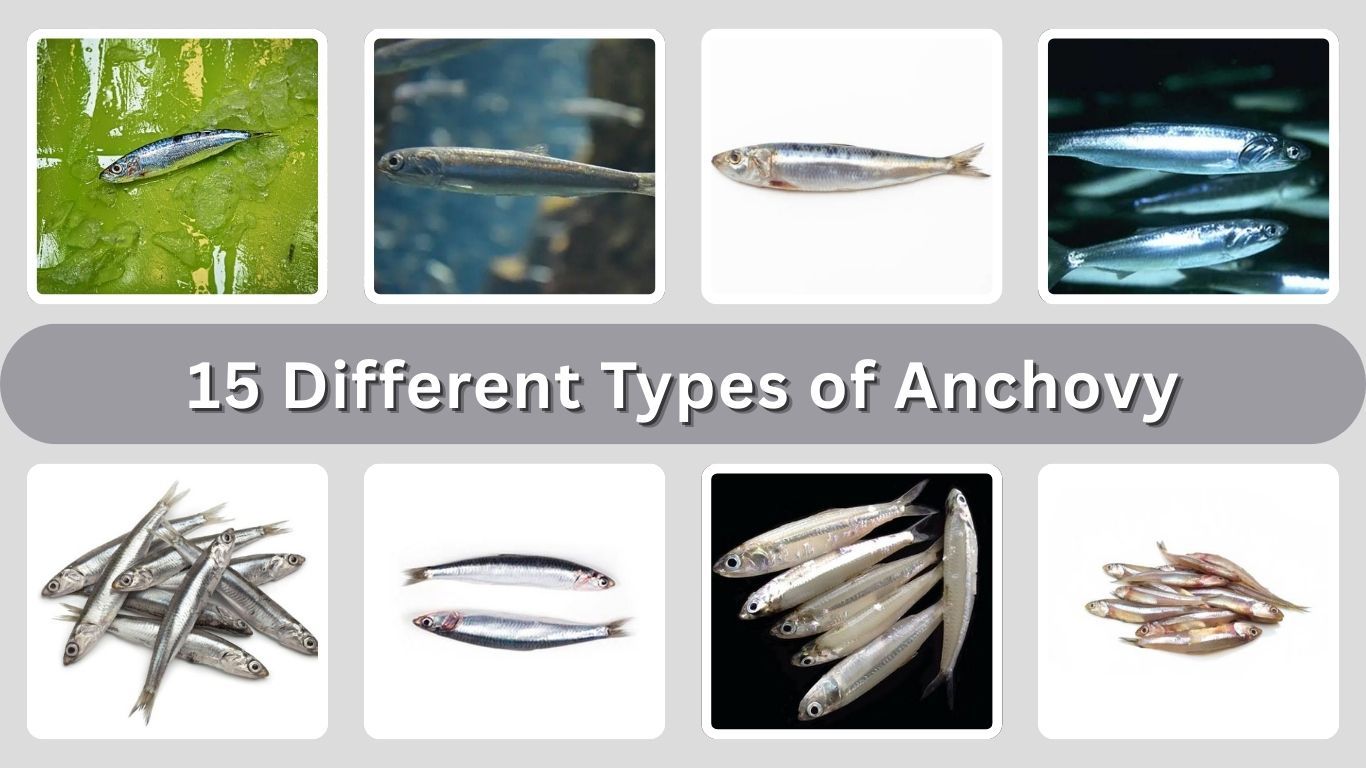
Anchovies are small, silvery schooling fish that play a massive role in both marine ecosystems and global fisheries. Found in oceans around the world, they form huge shoals in coastal waters and feed mainly on plankton. Despite their tiny size, anchovies support countless larger predators, including fish, seabirds, and marine mammals. They are also widely harvested for human food, bait, and fishmeal, making them one of the most economically and ecologically important fish groups on Earth.
1. European Anchovy (Engraulis encrasicolus)

The European anchovy is one of the most well-known anchovy species in the world and is widely harvested for food. It is especially famous in Mediterranean cuisine, where it is used fresh, salted, or canned. This small schooling fish plays an important ecological role by linking plankton to larger marine predators.
Identification
- Slender, elongated body with a bluish-green back and silvery sides
- Average length of 12–15 cm (5–6 inches)
- Large mouth extending behind the eyes
- Single dorsal fin positioned mid-body
- Forked tail with translucent fins
Habitat and Distribution
The European anchovy is mainly found in the Mediterranean Sea, Black Sea, and the eastern Atlantic Ocean. It prefers coastal waters and estuaries, often forming huge schools near the surface, especially during warmer months.
Diet and Feeding Behavior
This species feeds mostly on plankton, including tiny crustaceans and fish larvae. It swims with its mouth open to filter food from the water, making it an important plankton consumer in marine ecosystems.
Behavior and Lifecycle
European anchovies are highly social fish that live in large, dense schools for protection. They spawn in warm seasons, releasing eggs into open water. The larvae drift with currents before developing into juvenile fish.
Importance to Humans
European anchovies support major commercial fisheries in Europe and North Africa. They are commonly preserved as salted fillets, anchovy paste, or canned products and are valued for their strong flavor and high omega-3 content.
2. Peruvian Anchoveta (Engraulis ringens)
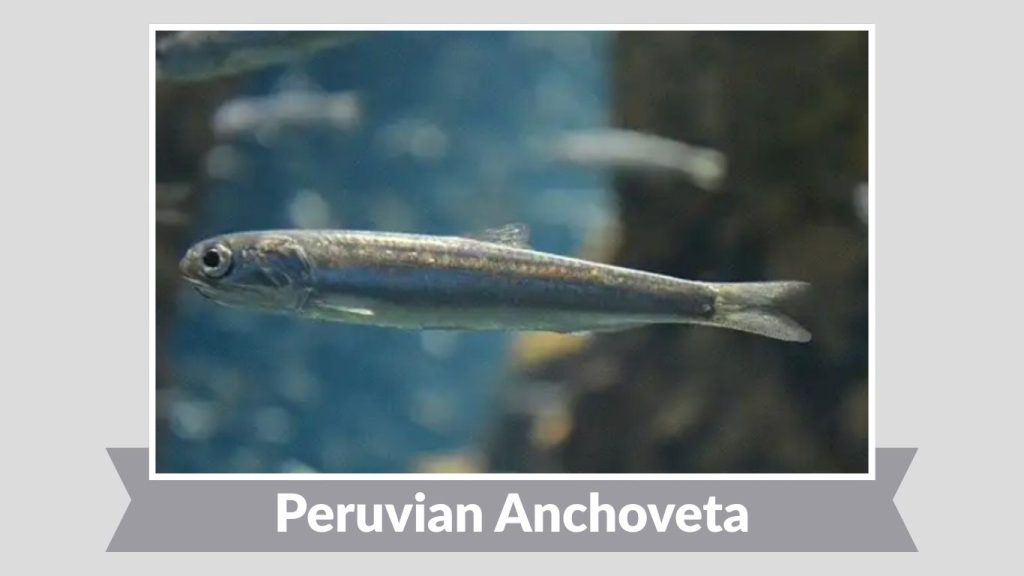
The Peruvian anchoveta is the most heavily harvested anchovy species in the world and forms the backbone of South America’s fishing industry. It is best known for its massive populations along the Pacific coast and its critical role in global fishmeal and fish oil production.
Identification
- Small, slim-bodied fish with a steel-blue back and silver belly
- Average length of 10–15 cm (4–6 inches)
- Large mouth reaching behind the eye
- Single dorsal fin and deeply forked tail
- Soft, delicate scales that shed easily
Habitat and Distribution
Peruvian anchoveta are found mainly along the Pacific coasts of Peru and Chile. They thrive in cold, nutrient-rich upwelling waters and usually stay close to the shoreline, forming enormous surface schools.
Diet and Feeding Behavior
They feed primarily on phytoplankton and zooplankton, filtering microscopic organisms from the water. Their feeding activity helps transfer ocean nutrients up the food chain to larger fish, seabirds, and marine mammals.
Behavior and Lifecycle
This species is highly migratory and schooling. Spawning can occur multiple times a year when conditions are favorable. Eggs and larvae drift with currents, allowing populations to expand quickly during productive ocean cycles.
Importance to Humans
The Peruvian anchoveta supports the largest single-species fishery on Earth. It is mainly processed into fishmeal and fish oil, though fresh and canned anchoveta are also consumed locally in coastal regions.
3. Japanese Anchovy (Engraulis japonicus)
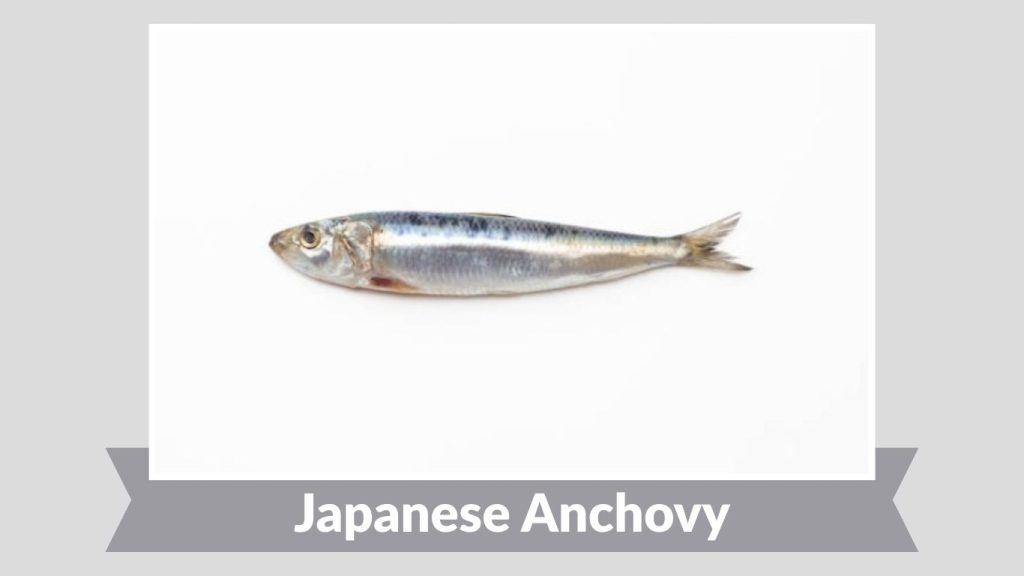
The Japanese anchovy is a common and economically important anchovy species in East Asia. It is widely used in Japanese, Korean, and Chinese cuisine, both fresh and dried, and also plays a major ecological role as a primary food source for many larger marine animals.
Identification
- Slender, streamlined body with a bluish-green back and bright silver sides
- Average length of 10–12 cmWq cm
- Large mouth extending behind the eyes
- One dorsal fin near the middle of the body
- Forked tail and transparent fins
Habitat and Distribution
Japanese anchovies are found throughout the northwestern Pacific Ocean, including waters around Japan, Korea, China, and Taiwan. They inhabit coastal seas, bays, and estuaries, often gathering in large surface schools.
Diet and Feeding Behavior
They feed mainly on plankton such as copepods and fish larvae. Using filter-feeding behavior, they swim through plankton-rich waters with open mouths to capture tiny drifting organisms.
Behavior and Lifecycle
This species is highly schooling and migratory, moving seasonally in response to temperature and food availability. Spawning usually occurs in warmer months, with eggs released into open water where larvae develop quickly.
Importance to Humans
Japanese anchovy is a staple in East Asian fisheries. It is used to make dried anchovies, anchovy powder, fermented fish sauces, and is also sold fresh or canned for human consumption.
4. Californian Anchovy (Engraulis mordax)
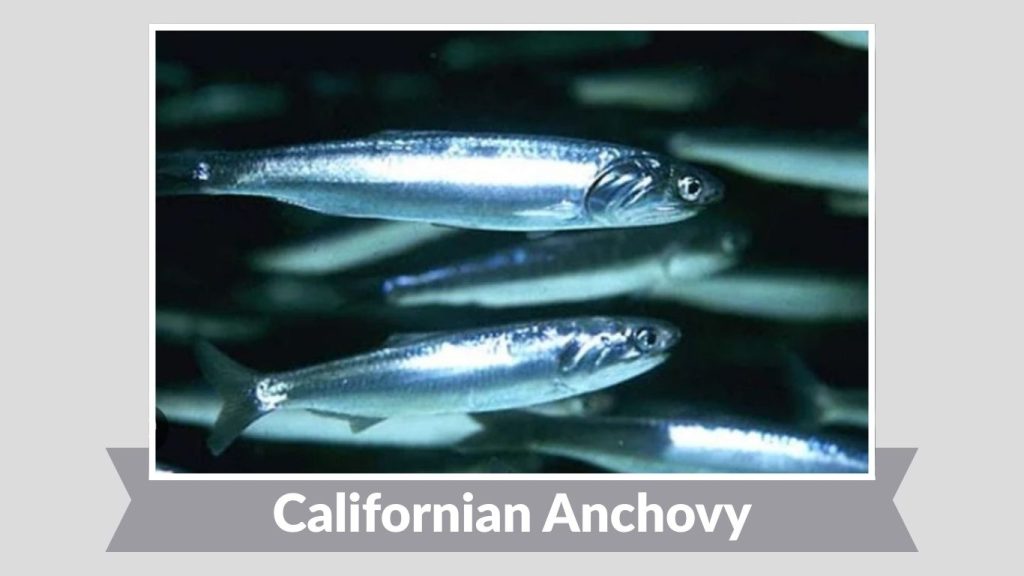
The Californian anchovy is a common small schooling fish along the west coast of North America. It plays a vital ecological role as a key food source for seabirds, marine mammals, and larger fish, and it also supports important regional fisheries.
Identification
- Slender, laterally compressed body with a blue-green back and silvery sides
- Average length of 12–20 cm (5–8 inches)
- Very large mouth extending well behind the eyes
- Single dorsal fin positioned mid-body
- Deeply forked tail with translucent fins
Habitat and Distribution
Californian anchovies are found in the eastern Pacific Ocean from British Columbia to Baja California. They inhabit coastal waters, bays, and estuaries, often forming dense surface schools.
Diet and Feeding Behavior
They feed primarily on zooplankton, fish eggs, and microscopic organisms. This species uses both filter feeding and snapping at individual prey, depending on food availability.
Behavior and Lifecycle
Californian anchovies form massive schools that move in response to water temperature and plankton blooms. Spawning occurs offshore, and the eggs and larvae drift with currents before juveniles move closer to shore.
Importance to Humans
They are commercially harvested for bait, animal feed, and human consumption. In some regions, Californian anchovies are canned or used in sauces and fish-based products.
5. Australian Anchovy (Engraulis australis)
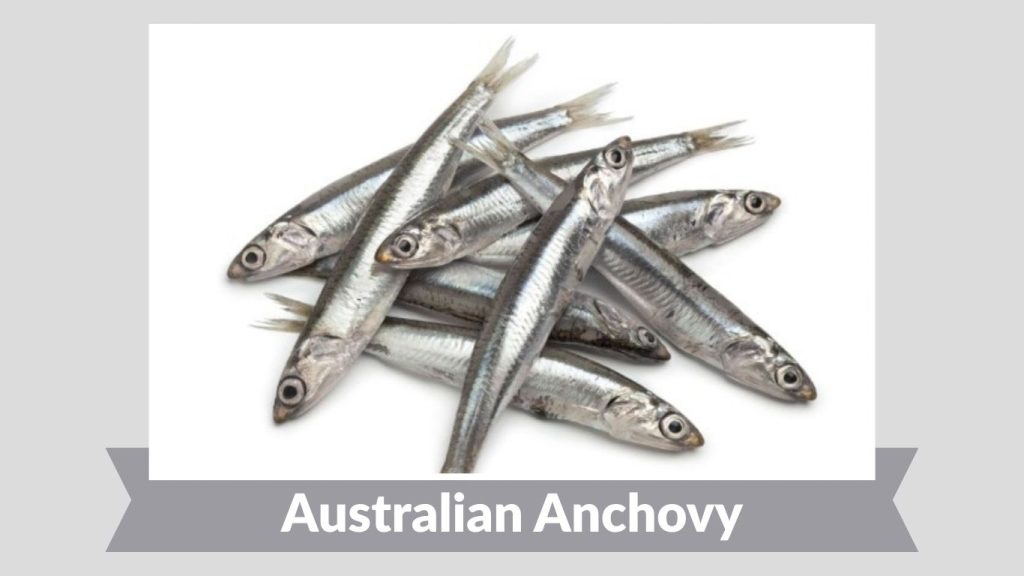
The Australian anchovy is a small, silvery schooling fish native to the coastal waters of Australia and New Zealand. It is an important link in marine food webs, transferring energy from plankton to larger predatory fish, seabirds, and marine mammals.
Identification
- Slender, elongated body with bluish-green back and bright silver sides
- Average length of 9–12 cm (3.5–5 inches)
- Large mouth reaching past the eyes
- Single dorsal fin near the center of the body
- Forked tail and delicate, easily shed scales
Habitat and Distribution
This species occurs along southern Australia, Tasmania, and around New Zealand. It is commonly found in coastal waters, bays, and near continental shelves, often forming large surface schools.
Diet and Feeding Behavior
Australian anchovies feed mainly on plankton, including copepods and microscopic algae. They are filter feeders and are often seen near the surface in plankton-rich waters.
Behavior and Lifecycle
They are highly social fish, forming dense schools that move seasonally. Spawning usually takes place in warmer months, with eggs and larvae drifting freely before settling into juvenile habitats.
Importance to Humans
Australian anchovies are harvested for bait, fishmeal, and local consumption. They are also important for sustaining commercial species that rely on them as a primary food source.
6. Argentine Anchovy (Engraulis anchoita)

The Argentine anchovy is one of the most abundant anchovy species in the southwestern Atlantic Ocean. It forms massive schools and plays a crucial role in marine ecosystems, serving as a primary food source for many fish, seabirds, and marine mammals.
Identification
- Slender, elongated body with a dark bluish back and silvery flanks
- Average length of 12–17 cm (5–7 inches)
- Large mouth extending behind the eyes
- Single dorsal fin located mid-body
- Forked tail and thin, delicate scales
Habitat and Distribution
This species is mainly found along the Atlantic coasts of Argentina, Uruguay, and southern Brazil. It inhabits coastal and shelf waters, often gathering near the surface in huge schools.
Diet and Feeding Behavior
Argentine anchovies feed on phytoplankton and zooplankton, especially copepods and tiny crustaceans. Their feeding activity helps regulate plankton populations and supports higher trophic levels.
Behavior and Lifecycle
They are highly migratory and form dense schools for protection. Spawning occurs in open water, where eggs and larvae drift before developing into juveniles that later join adult schools.
Importance to Humans
Argentine anchovy supports major regional fisheries and is mainly used for fishmeal, fish oil, and bait. It is also processed for human consumption in some South American markets.
7. Cape Anchovy (Engraulis capensis)
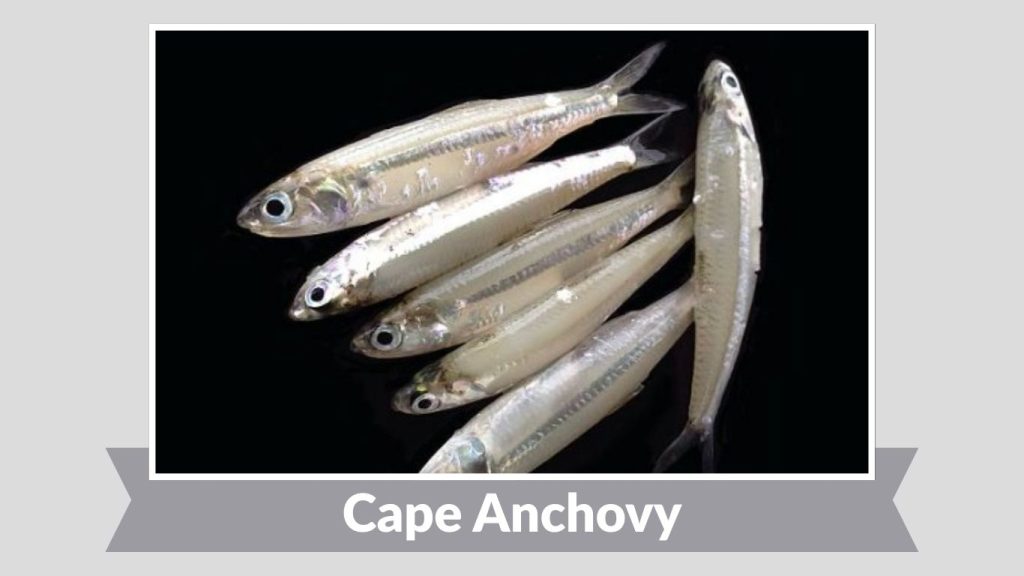
The Cape anchovy is a small but extremely important pelagic fish found off the coast of southern Africa. It supports one of the region’s largest commercial fisheries and is a key food source for seabirds, seals, and predatory fish.
Identification
- Slender, silvery body with a bluish-green back
- Average length of 10–13 cm (4–5 inches)
- Large mouth extending beyond the eyes
- Single dorsal fin positioned mid-body
- Forked tail and translucent fins
Habitat and Distribution
Cape anchovies are mainly found along the Atlantic coast of southern Africa, especially around Namibia and South Africa. They thrive in cold, nutrient-rich upwelling waters and often school near the surface.
Diet and Feeding Behavior
They feed on phytoplankton and zooplankton, filtering microscopic organisms from the water. Their feeding supports the transfer of ocean productivity to higher predators.
Behavior and Lifecycle
This species forms enormous, tightly packed schools. Spawning occurs in offshore waters, and eggs and larvae drift with currents before juveniles move into coastal zones.
Importance to Humans
Cape anchovy is heavily harvested for fishmeal, fish oil, and bait. It is also consumed fresh, dried, or canned in parts of southern Africa.
8. Indian Anchovy (Stolephorus indicus)
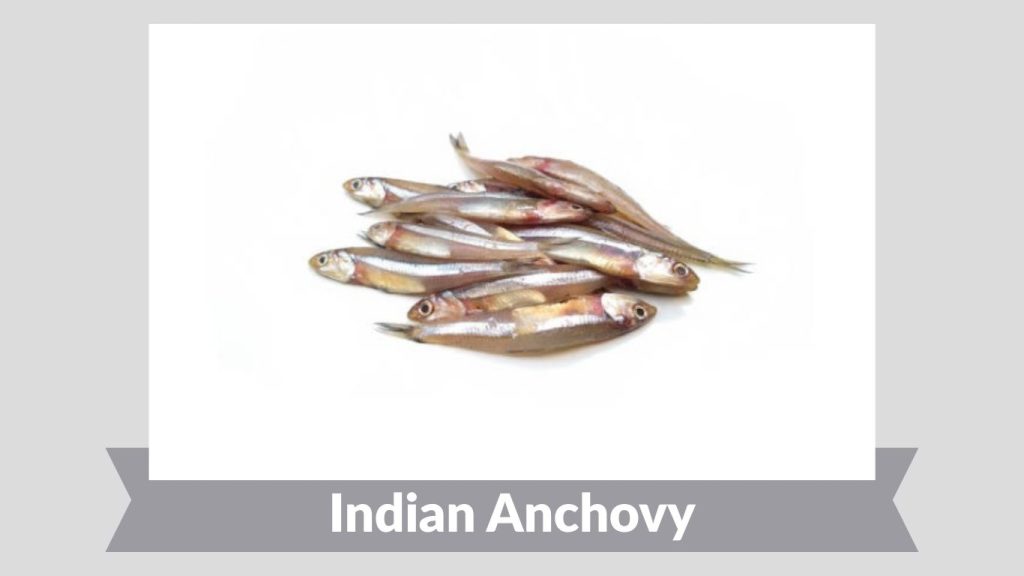
The Indian anchovy is a small coastal anchovy species widely distributed in the Indian Ocean region. It is commonly caught in artisanal and commercial fisheries and is an important food fish in South and Southeast Asia.
Identification
- Slender, laterally compressed body with silvery sides and a light bluish back
- Average length of 8–12 cm (3–5 inches)
- Pointed snout with a large mouth
- Single dorsal fin located mid-body
- Forked tail with transparent fins
Habitat and Distribution
Indian anchovies are found in the Indian Ocean, including the coasts of India, Sri Lanka, Bangladesh, and Southeast Asia. They inhabit coastal waters, estuaries, and bays, often forming dense schools near the surface.
Diet and Feeding Behavior
They mainly feed on plankton such as copepods, diatoms, and fish larvae. This filter-feeding habit makes them an important part of coastal food webs.
Behavior and Lifecycle
Indian anchovies are schooling fish that reproduce in open water. Spawning often peaks during warmer seasons, and larvae drift before settling into nearshore nursery areas.
Importance to Humans
This species is widely consumed fresh, dried, or salted and is an important protein source in many coastal communities.
9. Thai Anchovy (Stolephorus commersonnii)
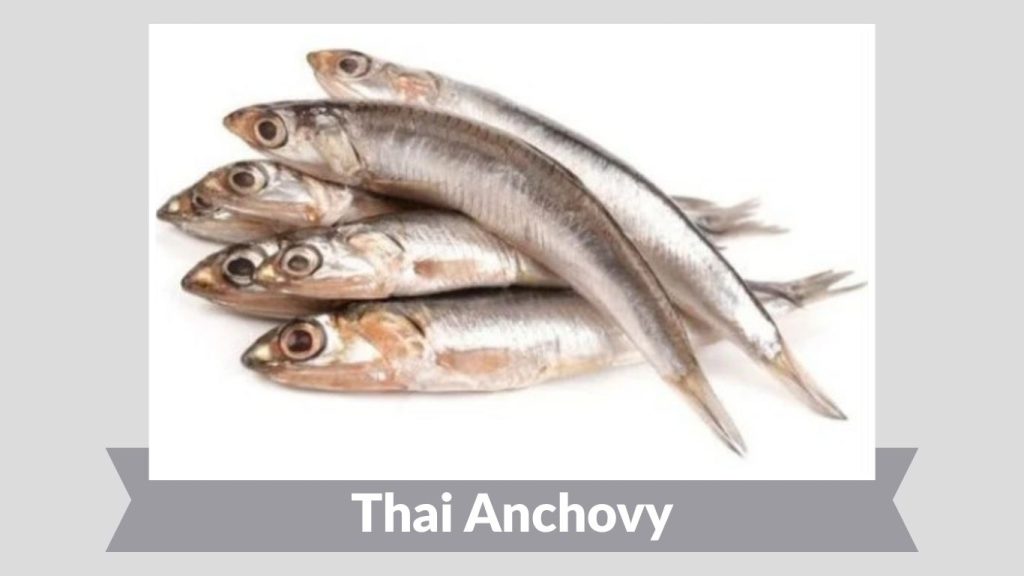
The Thai anchovy is a small tropical anchovy species widely distributed in Southeast Asian waters. It is especially valued in Thailand and neighboring countries, where it is commonly used dried, fermented, or as a flavoring ingredient in traditional dishes.
Identification
- Very slender, silvery body with a faint bluish-green back
- Average length of 6–10 cm (2.5–4 inches)
- Large mouth reaching to or beyond the eye
- Single dorsal fin set near the middle of the body
- Forked tail and nearly transparent fins
Habitat and Distribution
Thai anchovies occur throughout the Indo-Pacific region, including the Gulf of Thailand, Andaman Sea, South China Sea, and coastal waters of Indonesia and Malaysia. They prefer warm coastal waters, estuaries, and shallow bays.
Diet and Feeding Behavior
They feed on microscopic plankton such as copepods, larvae, and algae. Their constant feeding helps convert plankton into biomass for larger marine predators.
Behavior and Lifecycle
This species forms fast-moving schools near the surface. Spawning occurs in warm seasons, with eggs and larvae drifting freely before juveniles join adult schools.
Importance to Humans
Thai anchovy is widely harvested for dried anchovies, fish sauce, shrimp paste blends, and local seafood markets across Southeast Asia.
10. Australian Tropical Anchovy (Stolephorus delicatulus)
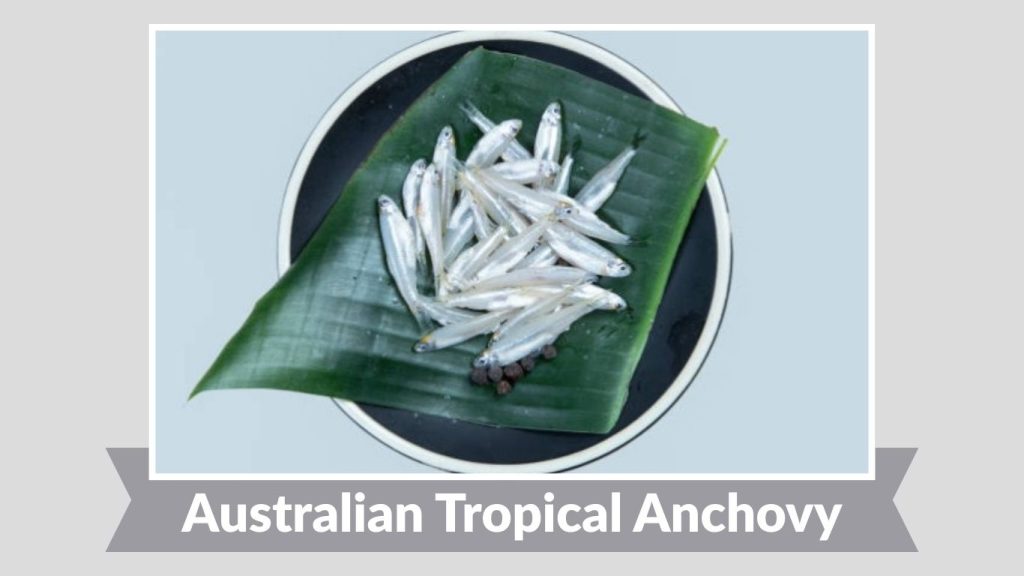
The Australian tropical anchovy is a small, delicate anchovy species found in warm coastal waters. It is an important forage fish, providing a major food source for reef fish, seabirds, and nearshore predators.
Identification
- Very slim, translucent body with silvery sides
- Average length of 5–9 cm (2–3.5 inches)
- Large mouth and pointed snout
- Single dorsal fin located slightly behind mid-body
- Deeply forked tail and fragile scales
Habitat and Distribution
This species is distributed across northern Australia and the tropical Indo-Pacific region. It inhabits shallow coastal waters, lagoons, and estuaries, often forming small to medium-sized schools near the surface.
Diet and Feeding Behavior
Australian tropical anchovies feed mainly on tiny plankton, including copepods and phytoplankton. They use filter-feeding behavior to capture food from the water column.
Behavior and Lifecycle
They are active schooling fish that reproduce in open water. Eggs and larvae drift with currents, allowing the species to spread across wide tropical areas.
Importance to Humans
Although not as commercially dominant as some anchovy species, they are used locally for bait and small-scale food fisheries.
11. Hardenberg’s Anchovy (Stolephorus waitei)
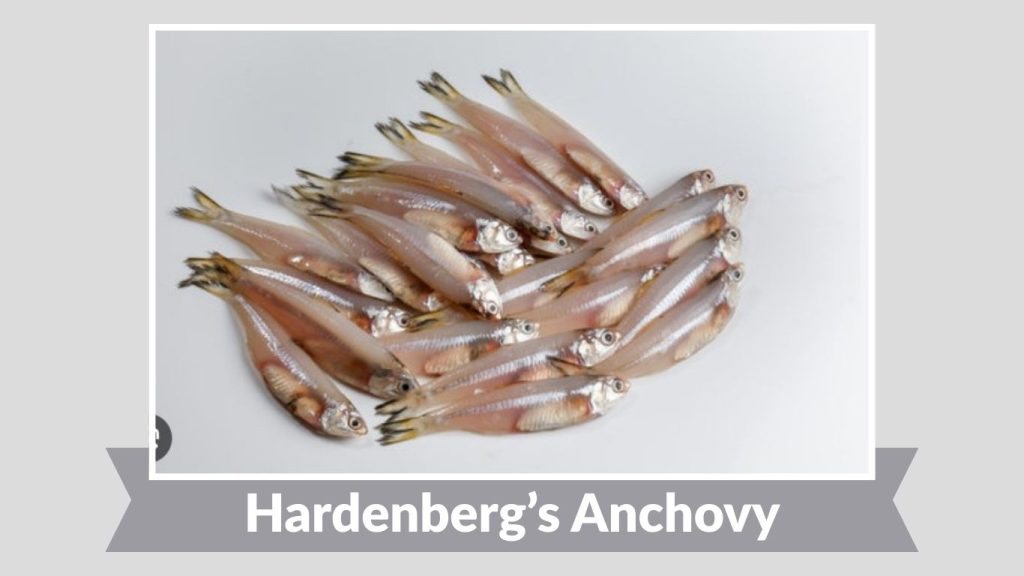
Hardenberg’s anchovy is a small coastal anchovy species found mainly in warm Indo-Pacific waters. It is less known commercially but plays an important ecological role as a forage fish, supporting many larger predators in coastal and reef-associated ecosystems.
Identification
- Slender, soft-bodied fish with bright silvery sides and a pale blue back
- Average length of 6–9 cm (2.5–3.5 inches)
- Relatively large mouth extending to the rear of the eye
- Single dorsal fin placed mid-body
- Forked tail and almost transparent fins
Habitat and Distribution
This species occurs in parts of the western Pacific and eastern Indian Ocean, especially around Indonesia, northern Australia, and nearby island regions. It prefers shallow coastal waters, lagoons, and estuaries.
Diet and Feeding Behavior
Hardenberg’s anchovy feeds on fine plankton, including tiny crustaceans and algae. It captures food by filter-feeding while swimming continuously through plankton-rich water.
Behavior and Lifecycle
They form loose to dense schools and remain active near the surface. Spawning takes place in open water, with eggs and larvae drifting before juveniles move into sheltered coastal zones.
Importance to Humans
This anchovy is mainly used as bait and in small local fisheries. It is also important indirectly because it supports many commercially valuable predator species.
12. Shorthead Anchovy (Encrasicholina heteroloba)
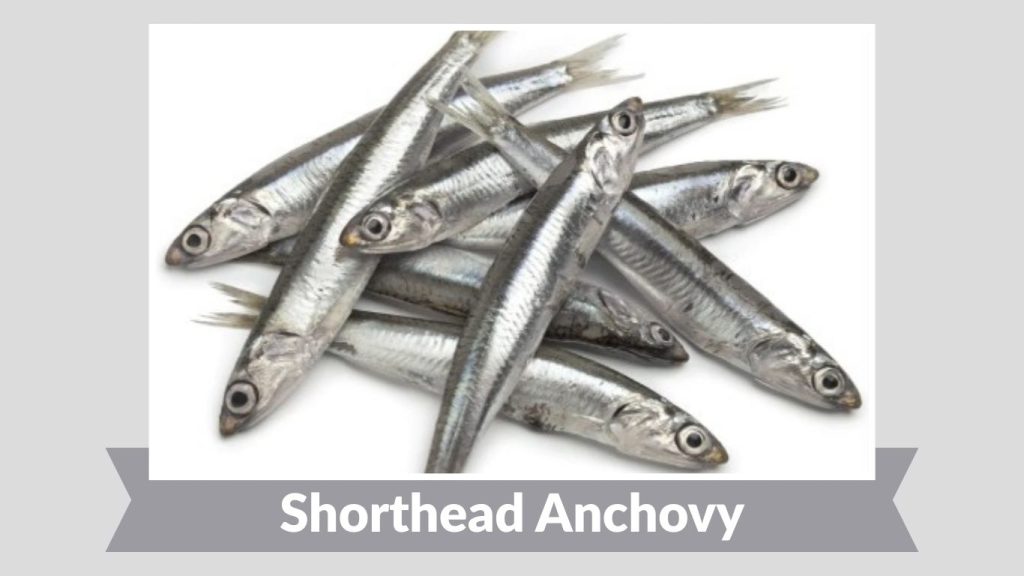
The shorthead anchovy is a small, fast-swimming anchovy species common in tropical and subtropical oceans. It is an important forage fish that supports reef fish, tuna, seabirds, and other marine predators.
Identification
- Slender body with a short, blunt head and silvery sides
- Average length of 6–10 cm (2.5–4 inches)
- Large mouth with the upper jaw extending behind the eye
- Single dorsal fin near the center of the body
- Forked tail and nearly transparent fins
Habitat and Distribution
Shorthead anchovies are found throughout the Indo-Pacific region, including the Red Sea, Indian Ocean, and western Pacific. They inhabit coastal waters, lagoons, and offshore surface waters, often schooling near reefs and open coasts.
Diet and Feeding Behavior
They feed mainly on zooplankton such as copepods, larvae, and tiny crustaceans. Their constant plankton grazing makes them a key link between microscopic life and larger predators.
Behavior and Lifecycle
This species forms large, mobile schools and often migrates short distances in response to food availability. Spawning occurs in open water, with eggs and larvae drifting with ocean currents.
Importance to Humans
Shorthead anchovies are harvested for bait, fishmeal, and local consumption. In some regions, they are dried or used in traditional fish-based seasonings.
13. Buccaneer Anchovy (Encrasicholina punctifer)
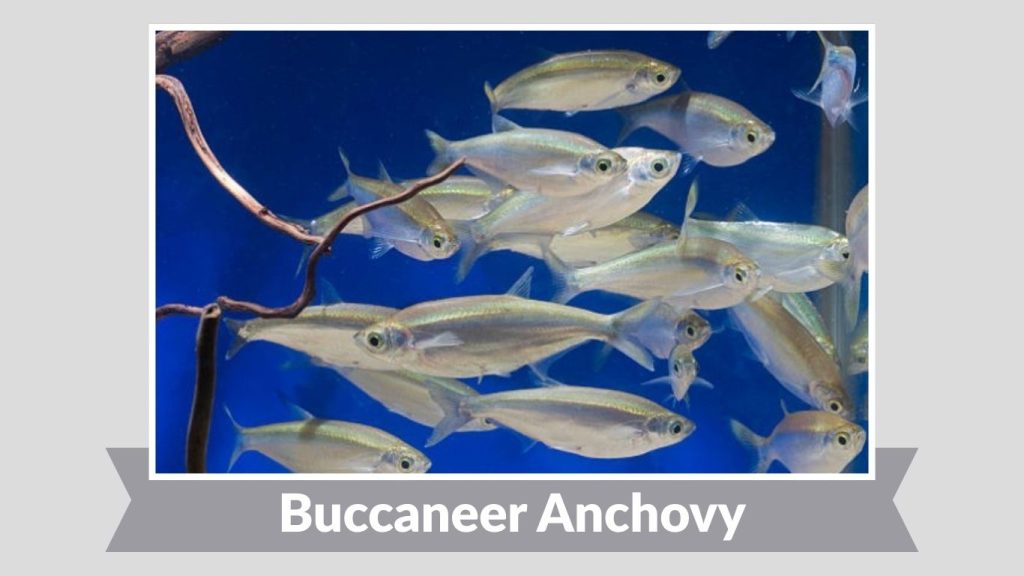
The buccaneer anchovy is a small tropical anchovy species widely distributed in warm ocean waters. It is an important forage fish, forming large schools that support many commercially valuable predators such as tuna, mackerel, and seabirds.
Identification
- Slender, elongated body with silvery sides and a faint bluish back
- Average length of 7–11 cm (3–4.5 inches)
- Large mouth extending past the eye
- Single dorsal fin located mid-body
- Forked tail and delicate, translucent fins
Habitat and Distribution
This species occurs across the Indo-Pacific region, including the Red Sea, Indian Ocean, and western Pacific. It inhabits coastal waters, lagoons, and open nearshore seas, often schooling close to the surface.
Diet and Feeding Behavior
Buccaneer anchovies feed mainly on zooplankton such as copepods, larvae, and small crustaceans. They filter tiny organisms from the water while swimming in coordinated schools.
Behavior and Lifecycle
They are highly schooling fish and often migrate short distances following plankton blooms. Spawning takes place in open water, with eggs and larvae drifting freely.
Importance to Humans
This species is used primarily as bait and in small-scale fisheries. It also plays a major ecological role by supporting larger commercial fish populations.
14. Broadband Anchovy (Encrasicholina devisi)
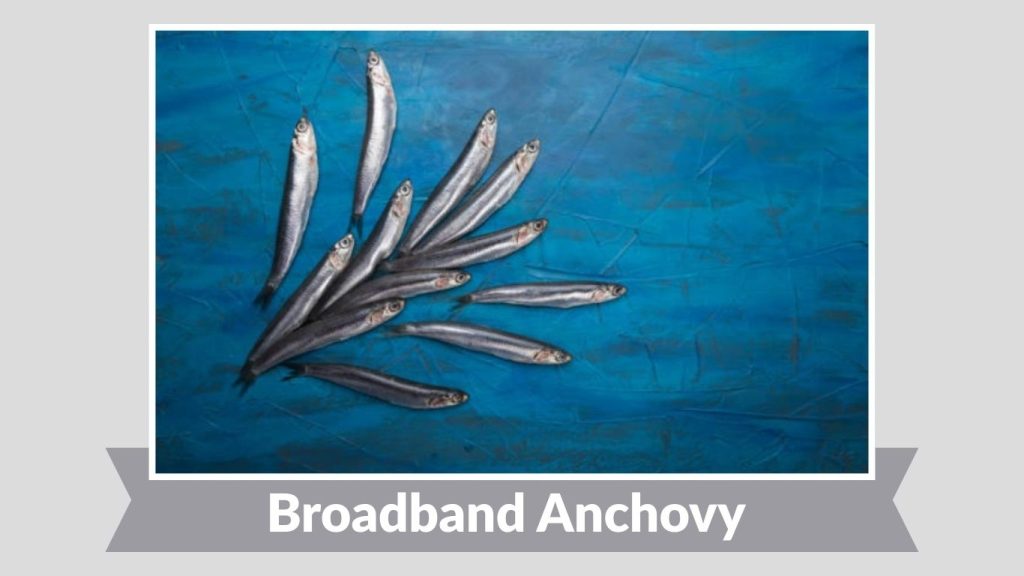
The broadband anchovy is a small tropical anchovy species known for its wide silvery stripe along the side of its body. It is a common forage fish in coastal ecosystems and is an important food source for larger fish, seabirds, and marine predators.
Identification
- Slender body with a distinct broad silver band along the sides
- Average length of 6–9 cm (2.5–3.5 inches)
- Large mouth extending beyond the eye
- Single dorsal fin positioned near the middle of the body
- Forked tail and almost transparent fins
Habitat and Distribution
Broadband anchovies are found throughout the Indo-Pacific region, including coastal waters of Southeast Asia, northern Australia, and Pacific islands. They prefer warm, shallow seas, lagoons, and reef-associated coastal zones.
Diet and Feeding Behavior
They mainly feed on zooplankton, fish larvae, and microscopic crustaceans. Their filter-feeding behavior allows them to efficiently harvest plankton from surface waters.
Behavior and Lifecycle
This species forms active surface schools that move constantly in search of plankton. Spawning occurs in open water, and the eggs and larvae drift with currents before juveniles settle into coastal habitats.
Importance to Humans
Broadband anchovies are used locally as bait and for small-scale food fisheries. They are also ecologically important because they support many commercially valuable predator species.
15. Bigeye Anchovy (Stolephorus insularis)
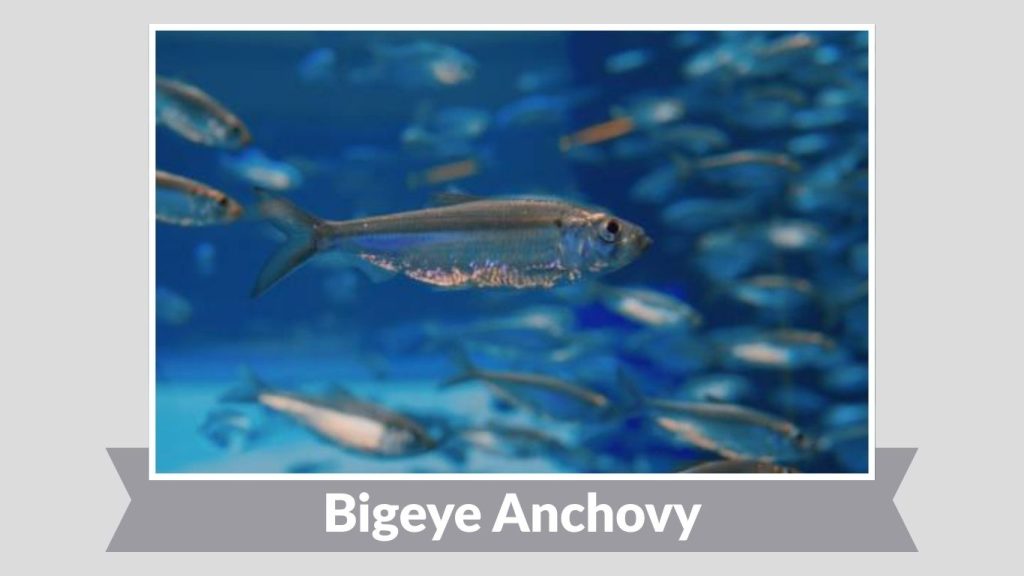
The bigeye anchovy is a small, delicate anchovy species recognized for its relatively large eyes. It is a common coastal forage fish in tropical regions and plays an essential role in sustaining reef and nearshore food webs.
Identification
- Slender, translucent body with bright silvery sides
- Noticeably large eyes compared to head size
- Average length of 5–8 cm (2–3 inches)
- Large mouth extending to the rear of the eye
- Single dorsal fin mid-body and a forked tail
Habitat and Distribution
Bigeye anchovies are found across the tropical Indo-Pacific, including coastal waters of Southeast Asia, northern Australia, and Pacific islands. They inhabit shallow coastal seas, lagoons, and reef edges, often forming dense surface schools.
Diet and Feeding Behavior
They feed primarily on microscopic plankton such as copepods, larvae, and phytoplankton. Their constant filter-feeding supports energy transfer from plankton to higher predators.
Behavior and Lifecycle
This species is highly schooling and often active near the surface at night. Spawning occurs in open water, with eggs and larvae drifting freely before juveniles recruit into coastal populations.
Importance to Humans
Bigeye anchovies are mainly used as bait and in small local fisheries. In some regions, they are dried or fermented for traditional foods.
FAQs
What are anchovies mainly used for?
Anchovies are widely used as food, bait, and in the production of fishmeal and fish oil. In many countries, they are eaten fresh, dried, salted, or canned and are valued for their strong flavor and high omega-3 content. They are also essential for feeding farmed fish and livestock.
Are all anchovy species small in size?
Yes, almost all anchovy species are small fish. Most grow between 5 and 20 centimeters long. Their small size allows them to form huge schools, which helps protect them from predators and makes them highly efficient at feeding on plankton.
Where are anchovies commonly found?
Anchovies are found in oceans around the world, especially in coastal and upwelling regions. They are common in the Mediterranean Sea, Atlantic Ocean, Pacific Ocean, and Indian Ocean, usually living near the surface in nutrient-rich waters.
What do anchovies eat in the wild?
Anchovies mainly eat plankton, including tiny crustaceans, algae, and fish larvae. They are filter feeders, swimming with open mouths to trap microscopic food particles, which makes them a vital link between plankton and larger marine animals.
Why are anchovies important to marine ecosystems?
Anchovies play a key ecological role because they transfer energy from plankton to larger predators such as tuna, seabirds, dolphins, and seals. Without anchovies and similar forage fish, many marine food webs would collapse or become unstable.