




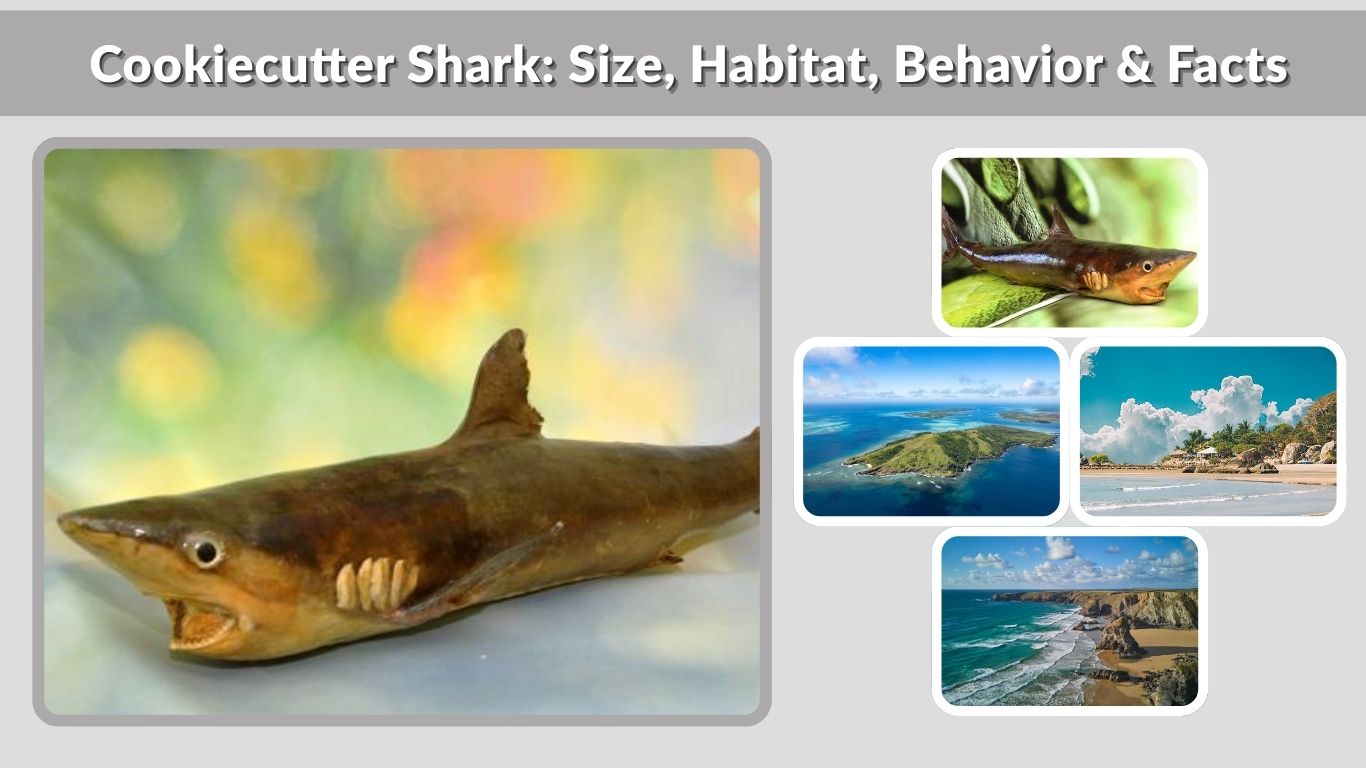
The cookiecutter shark is one of the ocean’s strangest and most fascinating predators. Small in size but highly specialized, this deep-sea shark is famous for leaving perfectly round bite marks on much larger animals. Known scientifically as Isistius brasiliensis, it uses a unique suction-and-twist feeding method that sets it apart from other shark species. Despite its intimidating feeding style, it rarely encounters humans. Living mostly in deep tropical waters, the cookiecutter shark remains a mysterious yet important part of the marine ecosystem.
What Is a Cookiecutter Shark?
The cookiecutter shark is a small deep-sea shark species belonging to the family Dalatiidae, which includes several species of kitefin sharks. Its scientific name, Isistius brasiliensis, reflects its classification and early discovery near Brazil. Although it may not look particularly threatening at first glance, this shark has evolved one of the most unusual feeding strategies in the animal kingdom.
Unlike large predatory sharks that chase and overpower prey, the cookiecutter shark feeds by removing small, circular plugs of flesh from much larger animals. This parasitic-style feeding allows it to survive without needing to kill its prey. Because of this strategy, it occupies a unique niche in ocean ecosystems.
Why Is It Called the “Cookiecutter” Shark?
The name “cookiecutter” comes from the distinctive wounds it leaves behind. After attaching itself to a larger animal, the shark twists its body to carve out a neat, round chunk of flesh. The resulting injury looks remarkably similar to a circular cookie cut from dough with a metal cutter.
These circular bite marks have been found on whales, dolphins, seals, large fish such as tuna, and even other shark species. In some cases, similar marks have appeared on submarines and undersea cables, highlighting the shark’s powerful bite.
Is the Cookiecutter Shark Dangerous?
Despite its dramatic feeding behavior, the cookiecutter shark is not considered a major threat to humans. Encounters are extremely rare because the species spends most of its time in deep offshore waters. A few minor incidents involving night swimmers or divers have been recorded, but these are uncommon and typically non-fatal.
For most people, the cookiecutter shark is more of a biological curiosity than a danger. Its small size and deep-water habitat greatly reduce the likelihood of human interaction.
Cookiecutter Shark Size and Physical Characteristics
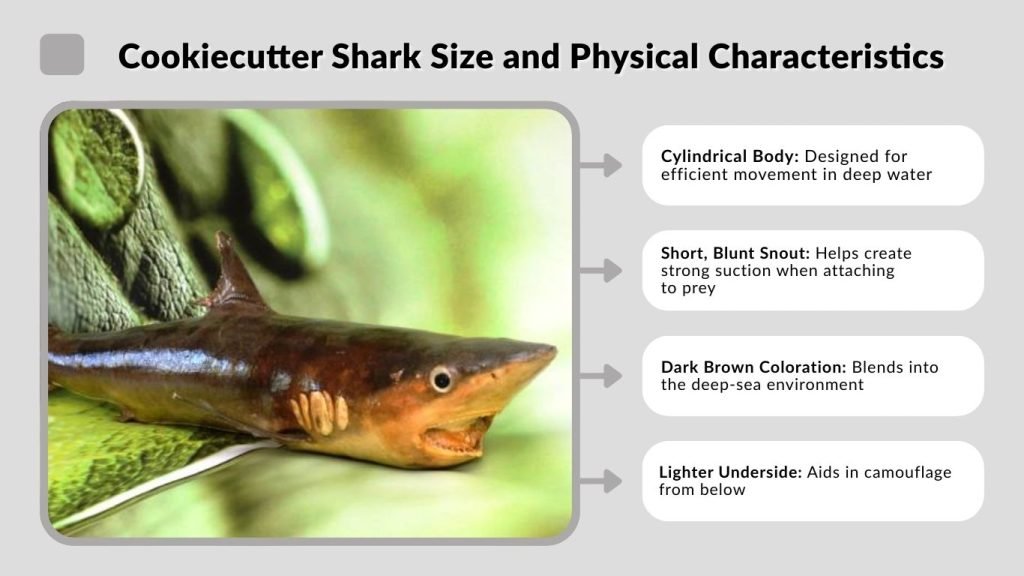
The cookiecutter shark may be small compared to most shark species, but its body is highly specialized for survival in the deep sea. Built for stealth rather than speed, this compact predator combines a cylindrical shape, glowing underside, and uniquely structured teeth to execute its famous circular bite. Every physical feature — from its size to its coloration — supports its parasitic feeding strategy and deep-water lifestyle.
Quick Overview of Size
- Average Length: 14–22 inches (35–56 cm)
- Maximum Length: Around 22 inches (56 cm)
- Weight: Approximately 1–3 pounds (0.5–1.4 kg)
- Females: Typically slightly larger than males
- Body Type: Small, stout, cigar-shaped
Despite its modest size, the cookiecutter shark is powerful for its length and capable of biting animals many times larger than itself.
Key Physical Characteristics
- Cylindrical Body: Designed for efficient movement in deep water
- Short, Blunt Snout: Helps create strong suction when attaching to prey
- Dark Brown Coloration: Blends into the deep-sea environment
- Lighter Underside: Aids in camouflage from below
- Dark Throat Band: May act as a lure to attract larger predators
Unique Adaptations
- Bioluminescent Photophores: Light-producing organs along the belly
- Large Triangular Lower Teeth: Form a sharp cutting blade
- Small Upper Teeth: Assist in gripping prey
- Strong Suction Lips: Create a seal before twisting bite
- Replaceable Tooth Row: Lower teeth can detach as a unit for quick replacement
Though small in appearance, the cookiecutter shark’s physical design makes it one of the most specialized and efficient feeders in the ocean.
Habitat and Distribution
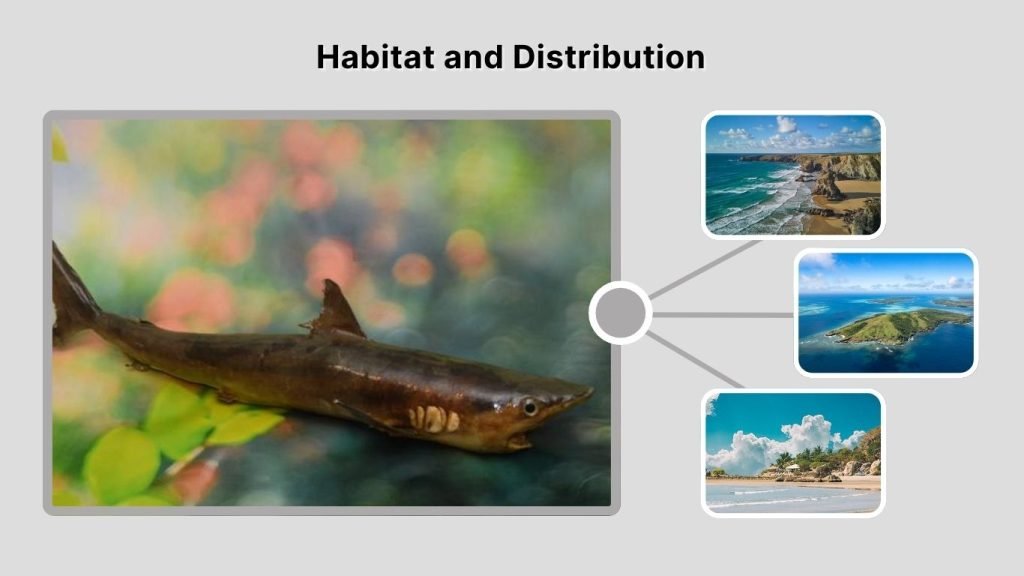
Cookiecutter sharks are found in tropical and subtropical oceans around the world. They inhabit parts of the Atlantic, Pacific, and Indian Oceans. Because they prefer deep offshore waters, they are rarely seen near coastlines.
Their habitat range includes open ocean environments where larger marine animals frequently travel. This positioning increases their chances of encountering suitable hosts for feeding.
Preferred Ocean Depths
During the day, cookiecutter sharks typically remain at great depths, sometimes descending as far as 3,500 meters (about 11,500 feet). At these depths, sunlight is minimal or nonexistent.
At night, however, they migrate upward toward the surface in a daily vertical movement. This migration allows them to access feeding opportunities while reducing exposure to predators during daylight hours.
Migration Patterns and Daily Movement
The cookiecutter shark performs what scientists call diel vertical migration, a daily movement between deep and shallow waters. During daylight hours, it stays in the dark depths of the ocean to avoid predators. As night falls, it rises closer to the surface, where many large marine animals travel or feed.
This vertical migration increases its chances of encountering whales, dolphins, large fish, and other potential hosts. By moving under the cover of darkness, the shark reduces its own risk while maximizing feeding opportunities. This behavior is common among many deep-sea species, but in the cookiecutter shark, it plays a crucial role in its survival strategy.
Feeding Behavior: How the Cookiecutter Shark Bites
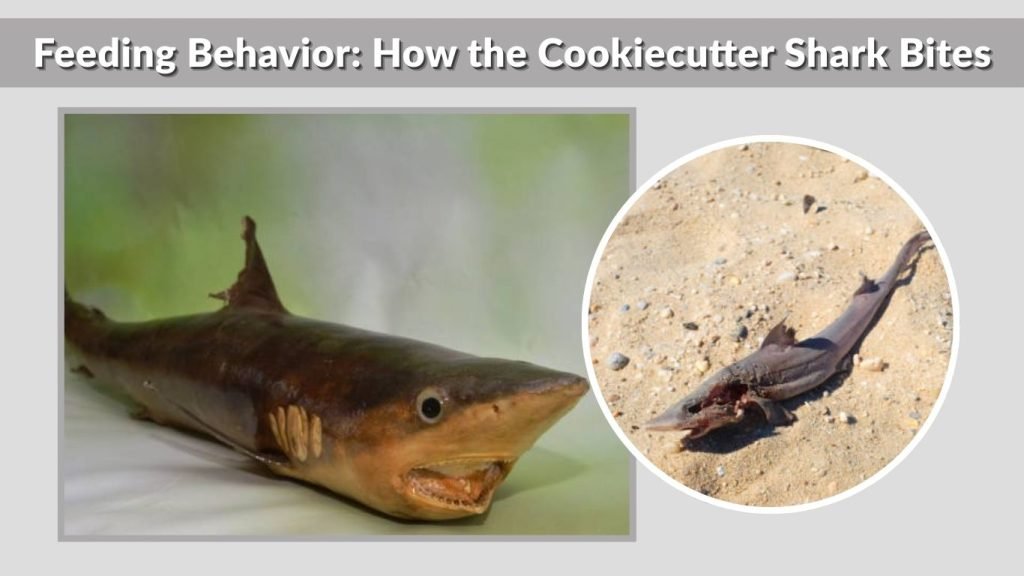
The feeding method of the cookiecutter shark is one of the most unusual in the animal kingdom. Rather than hunting and consuming entire prey animals, it removes small plugs of flesh from larger creatures. This makes it more of a parasitic feeder than a traditional predator.
To begin an attack, the shark approaches its target stealthily. Using its bioluminescent underside, it may disguise itself against the faint surface light, while the darker throat band acts as a lure. When a larger animal comes close enough, the shark attaches itself firmly using suction created by its lips.
It then performs a rapid twisting motion. The large, serrated lower teeth slice into the flesh, cutting out a clean, circular chunk. Within seconds, the shark detaches and swims away, leaving behind a round wound.
The Famous Round Bite Marks
Cookiecutter shark bites are easy to identify because of their near-perfect circular shape. These wounds can measure about two inches (5 centimeters) across and are often found on:
- Whales
- Dolphins
- Seals
- Large tuna
- Other shark species
Marine biologists have used these marks to track cookiecutter shark distribution and feeding patterns. In some cases, animals carry multiple scars from repeated encounters.
How It Attacks Larger Animals
What makes the cookiecutter shark remarkable is its willingness to target animals much larger than itself. A shark less than two feet long can successfully bite creatures that weigh several tons.
It does not attempt to overpower its host. Instead, it relies on speed, precision, and a quick escape. The feeding process is brief, minimizing the chance of retaliation. This strategy allows the shark to gain nutrition without engaging in prolonged conflict.
Unusual Targets
In addition to marine animals, cookiecutter sharks have been known to bite non-living objects. Bite marks have been discovered on:
- Submarines
- Underwater research equipment
- Undersea communication cables
These incidents likely occur because the shark mistakes moving or illuminated objects for potential prey. Their strong jaws and cutting teeth are powerful enough to damage synthetic materials.
Cookiecutter Shark Attacks on Humans
Attacks on humans are extremely rare. Because cookiecutter sharks inhabit deep offshore waters and are mostly active at night, encounters with people are uncommon.
There have been a few documented cases involving open-ocean swimmers and divers, particularly during nighttime activities. In these instances, the injuries were small, circular wounds similar to those found on marine animals. While painful, such bites are not typically life-threatening.
Should Divers Be Concerned?
For most divers and swimmers, the risk is minimal. Staying in groups, avoiding nighttime open-ocean swims, and using proper lighting equipment can further reduce the already low chance of an encounter.
Overall, the cookiecutter shark is not considered aggressive toward humans and does not actively seek them out as prey.
Life Cycle and Reproduction
Like many shark species, the cookiecutter shark is believed to be ovoviviparous. This means that eggs develop inside the mother’s body, and the young are born live after hatching internally.
Because the species lives in deep waters, much of its reproductive behavior remains poorly studied. Scientists believe that females give birth to relatively small litters, though exact numbers are uncertain.
Growth and Lifespan
Juvenile cookiecutter sharks are miniature versions of adults, already equipped with the specialized teeth and glowing photophores needed for survival. This early development allows them to begin feeding independently at a young age.
Precise lifespan data is limited, but like many small shark species, they are thought to have moderate life expectancies. Continued deep-sea research may provide clearer answers in the future.
Ecological Role in the Ocean Ecosystem
Although their feeding style may seem harmful, cookiecutter sharks play an important role in marine ecosystems. By feeding on large animals without killing them, they contribute to a complex web of predator-prey interactions.
Their bites may weaken injured or sick individuals, indirectly influencing natural selection. Additionally, they serve as prey for larger predators, including bigger sharks and possibly marine mammals.
Natural Predators
Despite their clever adaptations, cookiecutter sharks are not at the top of the food chain. They may be hunted by:
- Larger shark species
- Tuna and other large fish
- Marine mammals
Their deep-water habitat and vertical migration help reduce predation risk.
Interesting Facts About the Cookiecutter Shark
- It is one of the smallest shark species in the ocean.
- It can glow thanks to bioluminescent photophores.
- It leaves nearly perfect circular wounds on its prey.
- It migrates vertically every day between deep and shallow waters.
- It has been known to bite submarines and underwater cables.
These traits make it one of the most unique sharks ever discovered.
Cookiecutter Shark vs. Other Small Sharks
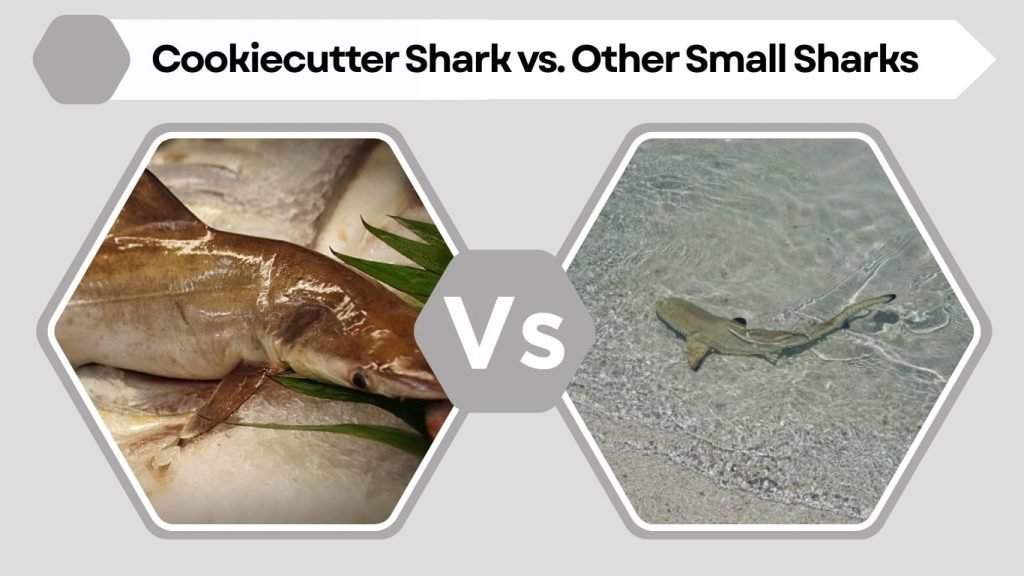
Compared to the dwarf lantern shark, another tiny deep-sea species, the cookiecutter shark is larger and far more aggressive in its feeding strategy. While both species can produce light, only the cookiecutter shark uses a suction-and-twist method to remove chunks of flesh.
It is sometimes compared to parasitic lampreys, which also attach to larger animals. However, lampreys rasp flesh using circular rows of teeth, whereas the cookiecutter shark slices out a clean plug with a powerful rotating bite.
This distinct feeding mechanism sets it apart from nearly all other shark species.
Conclusion
The cookiecutter shark may be small, but it is one of the ocean’s most extraordinary predators. With its glowing body, razor-sharp lower teeth, and signature circular bite marks, it has evolved a feeding strategy unlike any other shark. Living mostly in the deep sea, it remains mysterious and rarely seen by humans. Despite its unusual behavior, it plays an important role in marine ecosystems and continues to fascinate scientists studying life in the ocean’s depths.