


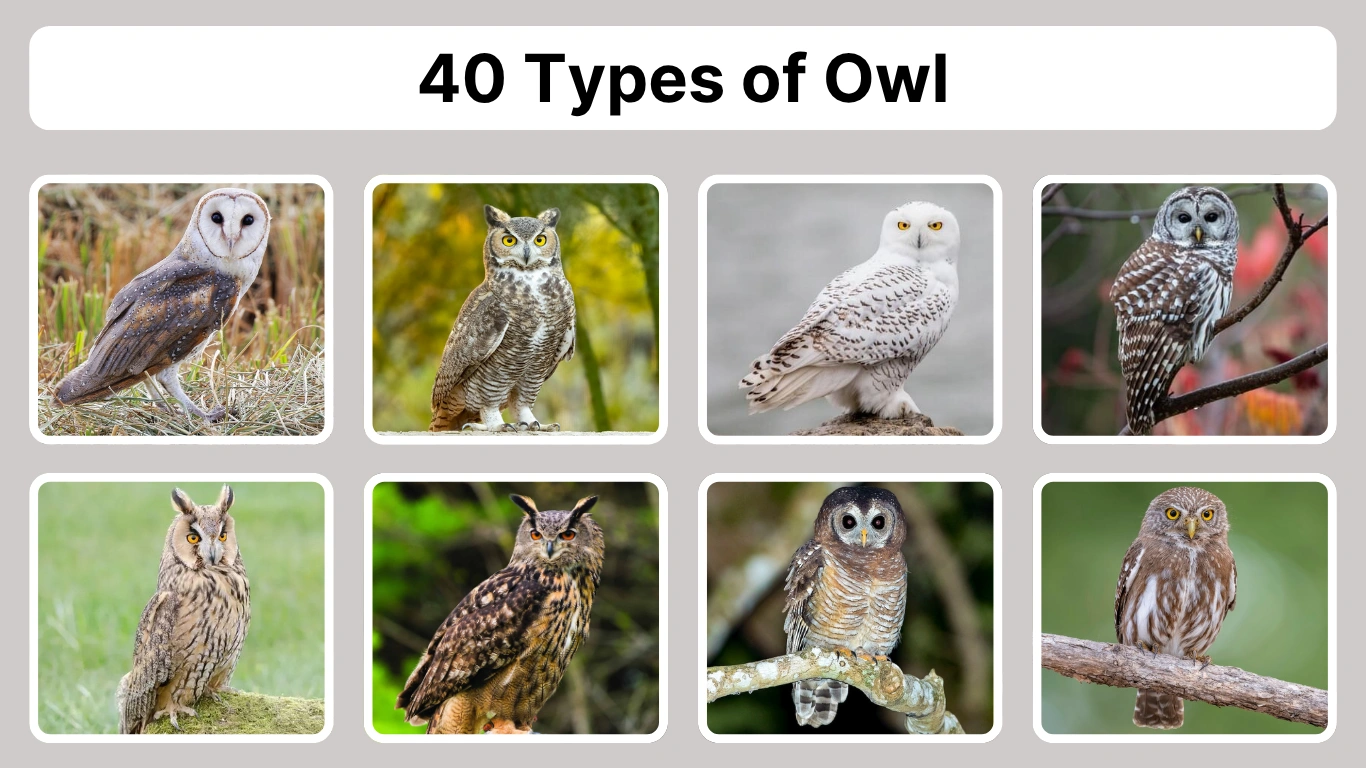
Owls are among the most fascinating and diverse bird species in the world. With over 250 known species, these nocturnal raptors inhabit nearly every continent and thrive in a wide range of environments—from deep forests and arid deserts to open grasslands and high mountain ranges. In this guide, we’ll explore 40 remarkable types of owls from around the globe, diving into their physical traits, behaviors, preferred habitats, and what makes each one unique.
Whether you’re a bird enthusiast, a nature lover, or simply curious about these mysterious night hunters, this detailed overview will help you identify and appreciate the incredible variety and beauty of owls across the planet.
1. Barn Owl
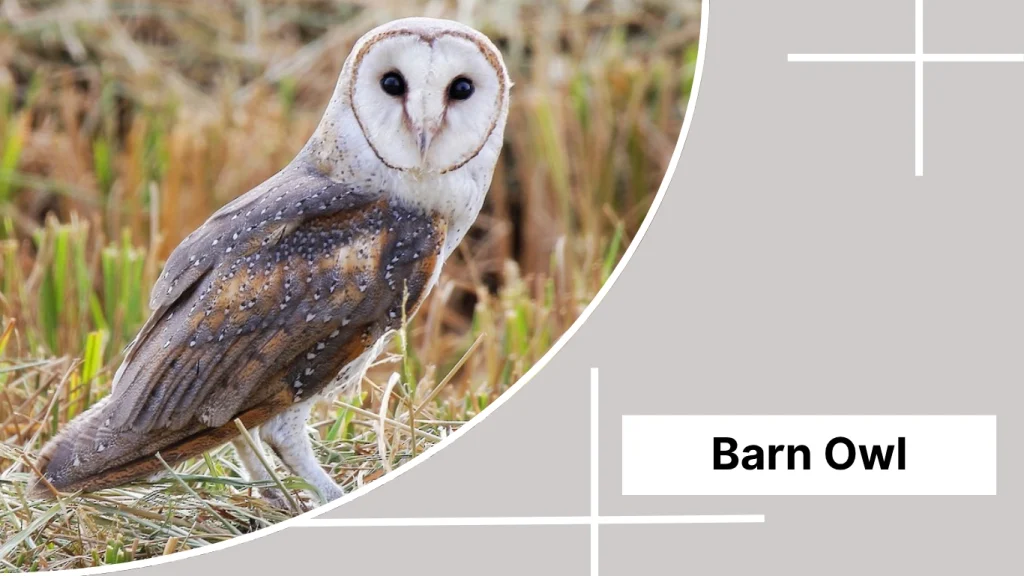
The Barn Owl (Tyto alba) is one of the most widely distributed species of owl in the world. Known for its ghostly appearance and silent flight, this owl is often associated with folklore. It prefers open habitats like farmlands, grasslands, and woodlands, and is especially recognized by its heart-shaped face and pale plumage.
Identification
- Heart-shaped, white facial disc
- Dark eyes set in a pale face
- Upperparts golden-buff with fine speckles
- Underparts pale to white
- Long legs and relatively short tail
- Length: 13–15 inches (33–39 cm)
- Wingspan: 31–37 inches (80–95 cm)
Habitat
Barn Owls are found in open country environments such as agricultural fields, marshes, and deserts. They often nest in barns, tree cavities, or nest boxes.
Diet
Primarily feeds on small mammals like voles, mice, and shrews. They hunt mostly at night using their acute hearing.
Behavior
Barn Owls are solitary and nocturnal. They fly silently due to their specialized feathers and are known for their eerie screech, rather than the traditional hoot.
Reproduction
Barn Owls may breed multiple times a year depending on food availability. They lay 4–7 eggs on average, with chicks hatching asynchronously.
2. Great Horned Owl
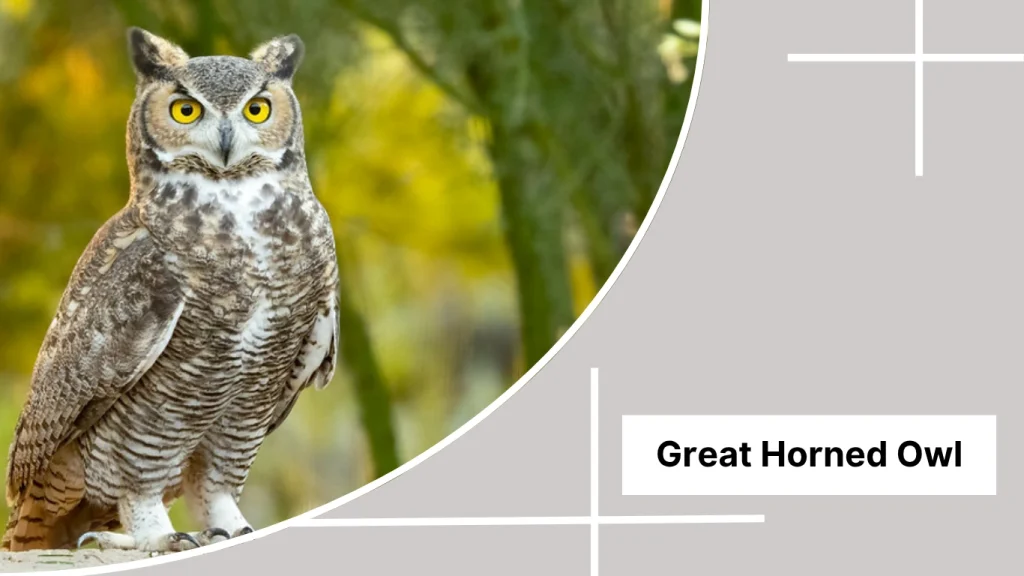
The Great Horned Owl (Bubo virginianus) is a powerful, adaptable predator known for its prominent feathered tufts or “horns” and deep hooting call. Found across the Americas, it thrives in forests, deserts, wetlands, and even suburban areas. This owl is often referred to as the “tiger of the sky” due to its strength and fierce hunting skills.
Identification
- Prominent feather tufts (“horns”) on head
- Large, stocky body with broad wings
- Yellow eyes and a white patch on the throat
- Mottled gray-brown plumage with darker barring
- Length: 18–25 inches (46–63 cm)
- Wingspan: 40–57 inches (101–145 cm)
Habitat
Great Horned Owls inhabit a wide range of habitats, including deciduous and coniferous forests, swamps, deserts, and even city parks. They nest in tree cavities, abandoned nests of other birds, and cliffs.
Diet
They are generalist predators and feed on a variety of prey including rabbits, rodents, skunks, birds, snakes, and even other owls.
Behavior
Mostly nocturnal, they are highly territorial and aggressive when defending nesting sites. Their deep, resonant hoots are often heard at dusk and dawn.
Reproduction
Usually lays 2–4 eggs in late winter. The female incubates the eggs while the male brings food. Chicks fledge in about 6–7 weeks.
3. Snowy Owl
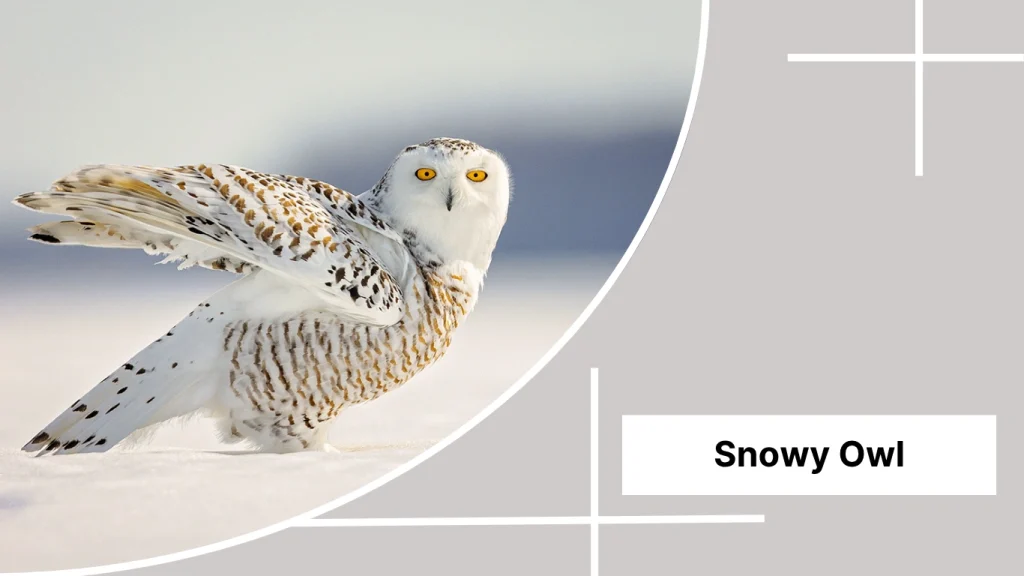
The Snowy Owl (Bubo scandiacus) is one of the most striking and iconic owls, instantly recognizable by its bright white plumage and piercing yellow eyes. Native to the Arctic tundra, it occasionally migrates south in large numbers during irruption years.
Identification
- Predominantly white body, with varying black or brown markings
- Males are whiter; females have more dark barring
- Round head with no ear tufts
- Yellow eyes and black bill
- Large, heavy-bodied owl
- Length: 20–28 inches (51–71 cm)
- Wingspan: 49–59 inches (125–150 cm)
Habitat
Prefers open Arctic tundra for breeding. In winter, it may be found in coastal dunes, prairies, and even airport fields or farmlands.
Diet
Feeds mostly on lemmings and voles in the Arctic. During winter migration, it hunts small mammals and birds.
Behavior
Diurnal and crepuscular—active during the day and twilight. Perches on the ground or low mounds to survey territory.
Reproduction
Nests on the ground in a shallow scrape. Lays 3–11 eggs depending on food availability. Both parents care for the young.
4. Barred Owl
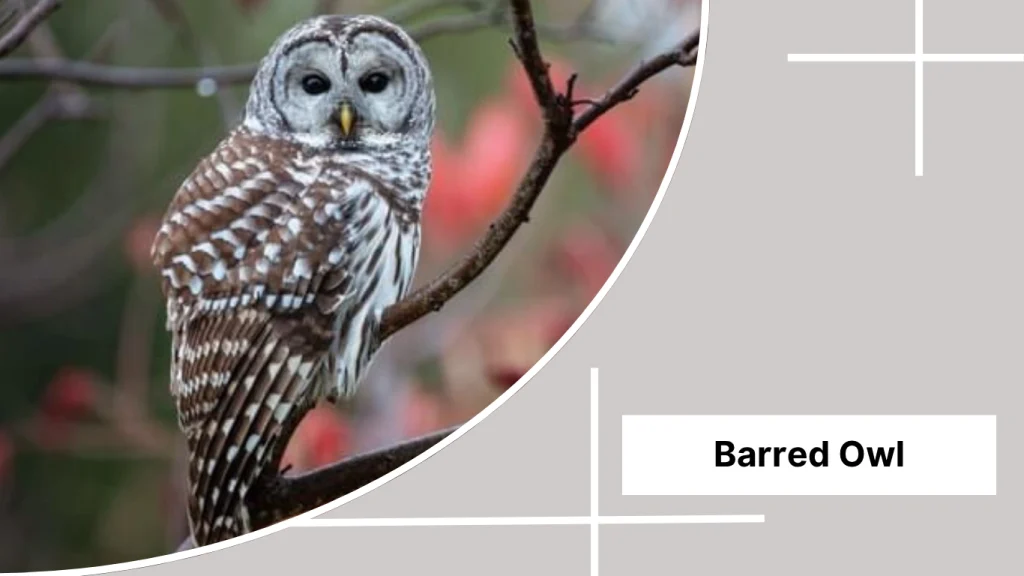
The Barred Owl (Strix varia), also known as the “hoot owl” for its distinctive call, is a large woodland species with soulful dark eyes. It’s common in eastern North America and is known for its haunting “Who cooks for you? Who cooks for you all?” call.
Identification
- Large, round head with no ear tufts
- Brown eyes (uncommon among owls)
- Horizontal bars on chest and vertical streaks on belly
- Overall mottled brown and white plumage
- Yellow beak and facial disc
- Length: 16–25 inches (40–63 cm)
- Wingspan: 38–49 inches (96–125 cm)
Habitat
Lives in mature forests, especially near water bodies like swamps, streams, and wooded wetlands. It nests in natural tree cavities or old hawk nests.
Diet
Feeds mainly on small mammals, birds, amphibians, and reptiles. Occasionally catches fish and invertebrates.
Behavior
Barred Owls are primarily nocturnal but may hunt during the day, especially in overcast weather. They are sedentary and form strong territory bonds.
Reproduction
Breeding season begins in late winter. Typically lays 2–4 eggs. The female incubates while the male provides food. Owlets leave the nest about 4–6 weeks after hatching.
5. Eastern Screech Owl
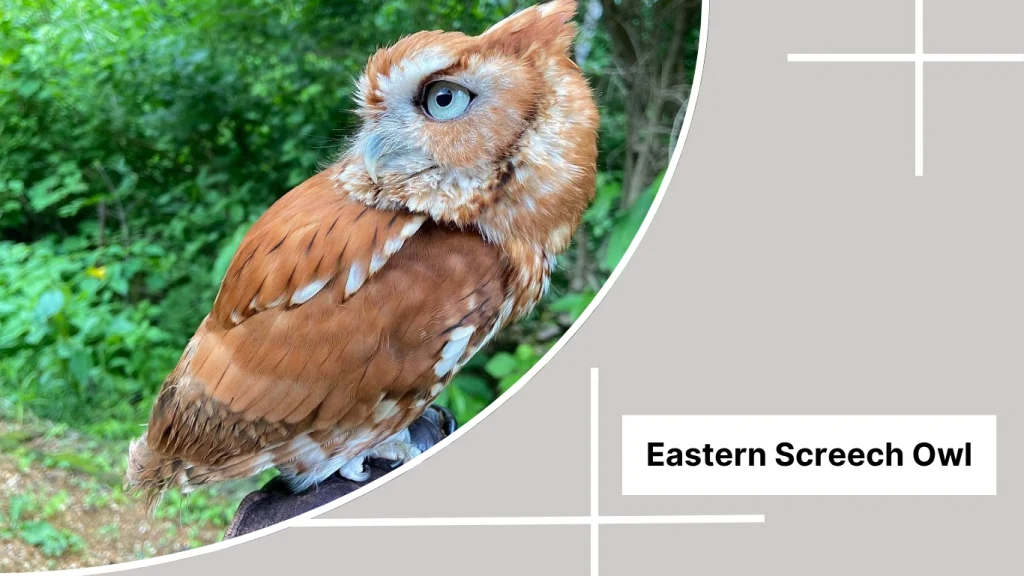
The Eastern Screech Owl (Megascops asio) is a small yet fearless forest owl known for its excellent camouflage and trilling nighttime calls. Despite its name, it doesn’t actually screech but emits soft whinnies and tremolo calls.
Identification
- Small, stocky owl with ear tufts
- Comes in two color morphs: gray and reddish-brown (rufous)
- Yellow eyes and streaked breast
- Cryptic plumage blends with tree bark
- Length: 6–10 inches (16–25 cm)
- Wingspan: 18–24 inches (46–61 cm)
Habitat
Commonly found in wooded areas, including suburban neighborhoods, orchards, and city parks. Nests in tree cavities and nest boxes.
Diet
Eats a wide variety of prey: insects, small mammals, birds, lizards, frogs, and even crayfish.
Behavior
Nocturnal and secretive. Often remains motionless during the day, relying on camouflage. Highly adaptable to human presence.
Reproduction
Breeding starts in late winter to early spring. Typically lays 2–6 eggs. Both parents care for the young, and fledging occurs after about 4 weeks.
6. Western Screech Owl
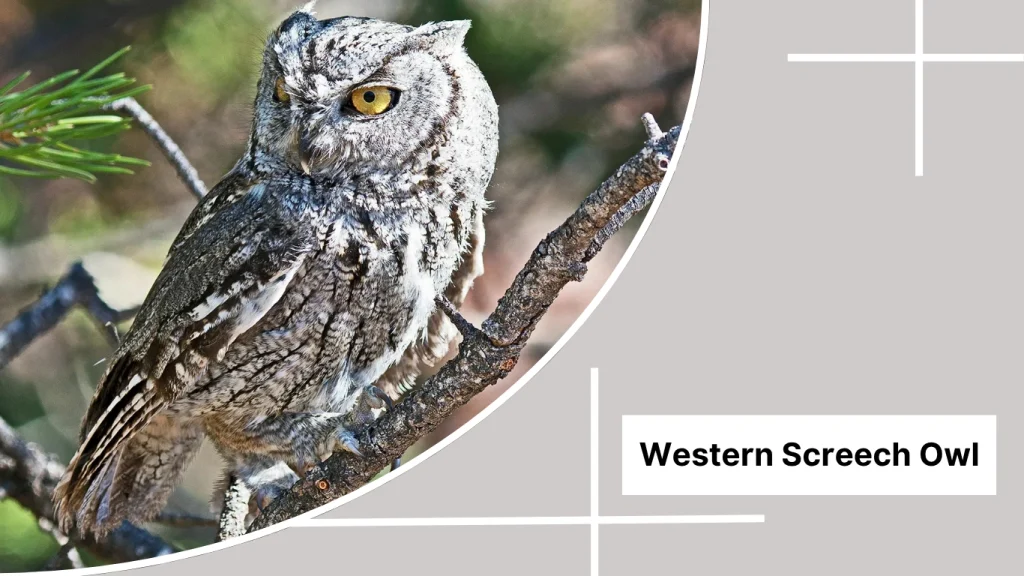
The Western Screech Owl (Megascops kennicottii) is the western counterpart of the Eastern Screech Owl, sharing a similar size and behavior. Though rarely seen, it’s commonly heard—its series of soft, accelerating whistles echo through forests, deserts, and backyards of the western United States.
Identification
- Small owl with short ear tufts
- Plumage ranges from gray to brown with streaked and spotted pattern
- Yellow eyes and a rounded facial disc
- Often confused with Eastern Screech Owl but has a distinct voice
- Length: 7–10 inches (18–25 cm)
- Wingspan: 20–24 inches (51–61 cm)
Habitat
Found in forests, deserts, canyons, and suburban areas across western North America. Nests in tree cavities, cliff crevices, and nest boxes.
Diet
Feeds on insects, spiders, small mammals, birds, amphibians, and reptiles. Known to catch prey larger than itself.
Behavior
Nocturnal and elusive, but tolerates urban environments well. Often perches quietly during the day, blending into tree bark.
Reproduction
Lays 2–5 eggs per clutch. Both parents participate in feeding the chicks. Young leave the nest about a month after hatching.
7. Northern Saw-whet Owl
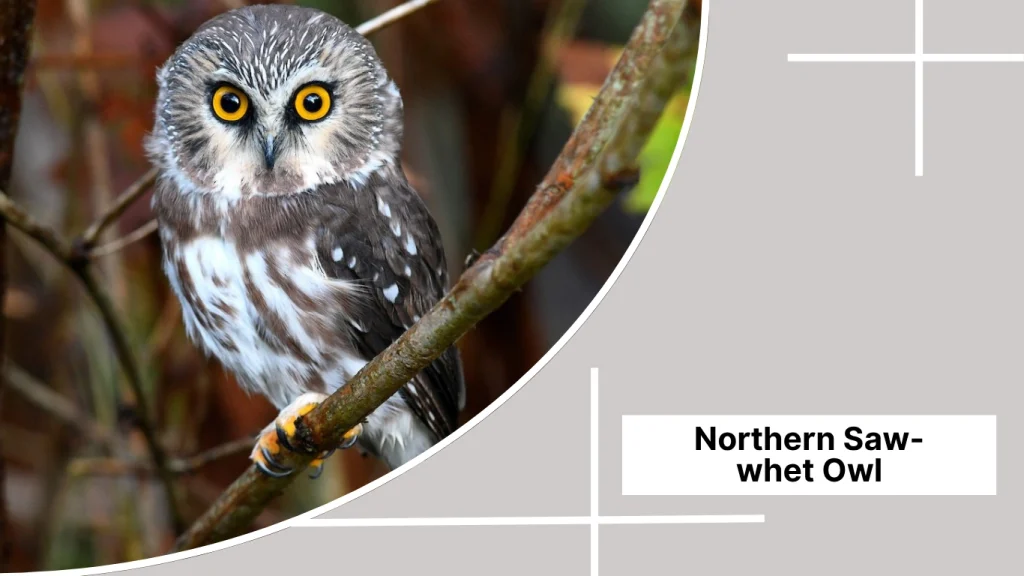
The Northern Saw-whet Owl (Aegolius acadicus) is a tiny, secretive owl with a large round head and big yellow eyes. It’s named for one of its calls, which sounds like the whetting of a saw. Despite its size, it is a fierce hunter.
Identification
- Very small owl with no ear tufts
- Big, round head and facial disc with white “Y” pattern
- Brown body with white streaks on chest and belly
- Yellow eyes and short tail
- Length: 7–8 inches (18–20 cm)
- Wingspan: 16–18 inches (41–46 cm)
Habitat
Prefers dense coniferous or mixed forests across North America. Roosts in thick cover during the day and nests in tree cavities or nest boxes.
Diet
Primarily feeds on mice and voles. Also eats small birds and insects.
Behavior
Nocturnal and hard to spot. Often silent except during breeding season, when males call repeatedly for hours. Migrates at night during fall and spring.
Reproduction
Breeding begins in spring. Typically lays 4–7 eggs. The female incubates while the male hunts. Fledging occurs at around 4–5 weeks.
8. Long-eared Owl

The Long-eared Owl (Asio otus) is a medium-sized owl known for its long, slender ear tufts that point straight up. It has a slim body, cryptic plumage, and a haunting call, making it an expert at hiding in dense woodlands during the day.
Identification
- Tall, upright ear tufts (often held erect)
- Orange to yellow facial disc with black outline
- Streaked brown and buff body
- Bright yellow eyes
- Slender, upright posture when roosting
- Length: 13–16 inches (33–40 cm)
- Wingspan: 35–39 inches (90–100 cm)
Habitat
Prefers dense forests for roosting and open grasslands or shrublands for hunting. Commonly roosts communally in winter in conifers or thickets.
Diet
Feeds mostly on small mammals, especially voles and mice. Occasionally takes small birds, reptiles, and insects.
Behavior
Nocturnal and extremely elusive. Roosts silently during the day and becomes active after dusk. Migrates seasonally in some parts of its range.
Reproduction
Nests in old stick nests made by hawks or crows. Lays 4–6 eggs, incubated by the female. Chicks fledge in about 3–4 weeks.
9. Short-eared Owl
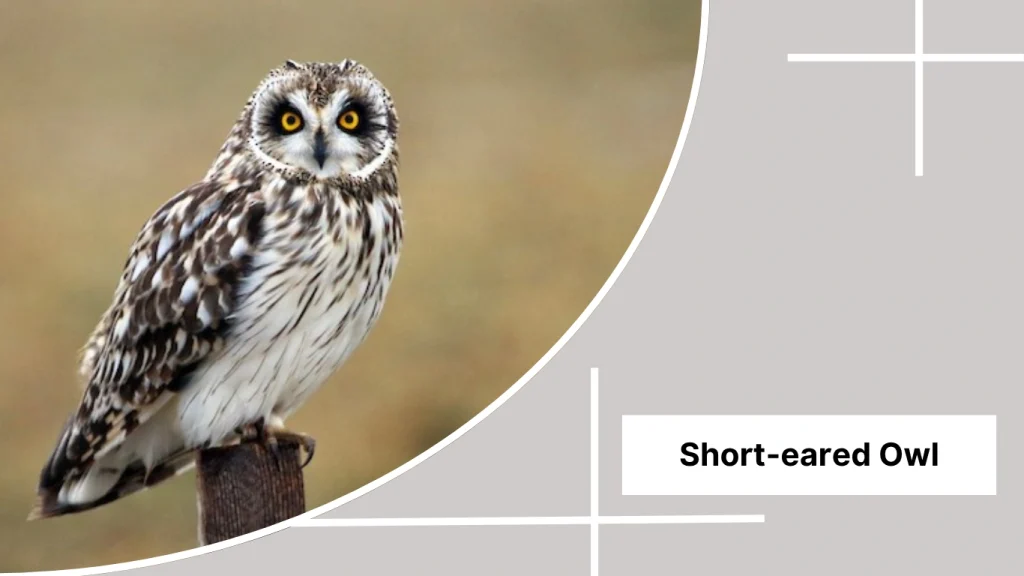
The Short-eared Owl (Asio flammeus) is one of the few owls that is commonly active during daylight. With a round face and barely visible ear tufts, it’s often seen flying low over grasslands in search of prey.
Identification
- Very short or nearly invisible ear tufts
- Pale face with dark circles around yellow eyes
- Streaked brown body and pale underwings with dark wrist marks
- Moth-like, buoyant flight style
- Length: 13–17 inches (33–43 cm)
- Wingspan: 33–43 inches (85–110 cm)
Habitat
Favors open country such as grasslands, marshes, tundra, and agricultural fields. Roosts on the ground or low perches.
Diet
Primarily eats voles, mice, and other small rodents. Occasionally consumes birds and insects.
Behavior
Often diurnal or crepuscular, especially during the breeding season. Migrates widely and can be seen in new areas during irruption years.
Reproduction
Builds shallow ground nests hidden in tall grass. Lays 4–7 eggs. The female incubates while the male hunts and defends the territory.
10. Burrowing Owl
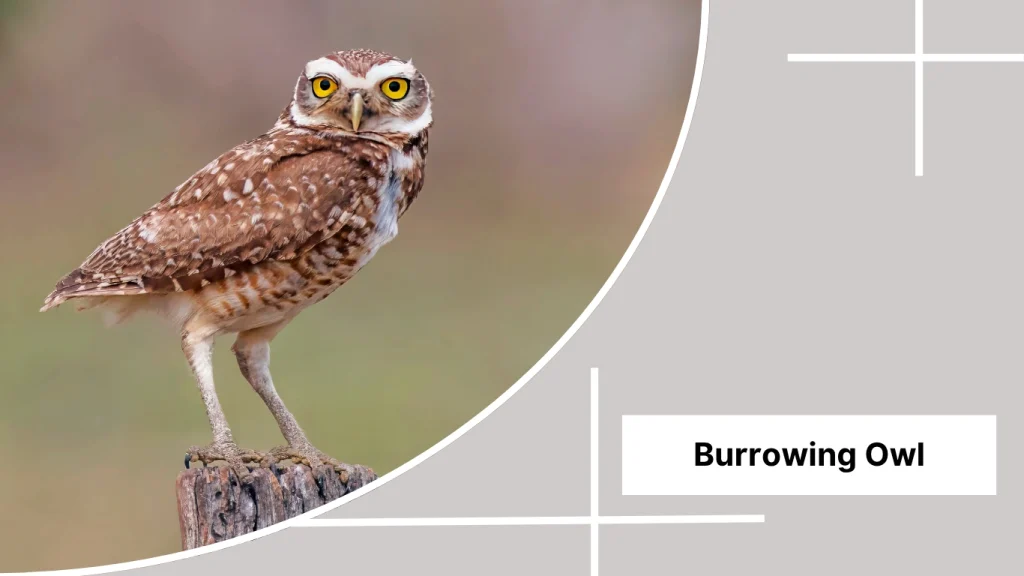
The Burrowing Owl (Athene cunicularia) is a small, long-legged owl known for its unusual behavior of living in burrows underground. Unlike most owls, it is active during both day and night and is commonly seen perched on fence posts or standing outside its burrow in open landscapes.
Identification
- Small size with long legs
- Round head with no ear tufts
- Yellow eyes and white eyebrows
- Speckled brown body with a pale chest
- Short tail and rounded wings
- Length: 7.5–10 inches (19–25 cm)
- Wingspan: 20–24 inches (51–61 cm)
Habitat
Lives in dry, open areas such as grasslands, deserts, prairies, and agricultural fields. Often uses abandoned burrows made by prairie dogs, ground squirrels, or tortoises.
Diet
Eats insects like beetles and grasshoppers, along with small mammals, birds, amphibians, and reptiles. Stores prey in underground caches.
Behavior
Unusually active during the day, especially early morning and late afternoon. Walks and runs on the ground with ease. Performs dramatic wing displays and bobbing dances during breeding.
Reproduction
Lays 6–11 eggs in underground nests. Both parents participate in feeding and defending the chicks. Young owls emerge from the burrow at about 2 weeks old.
11. Tawny Owl
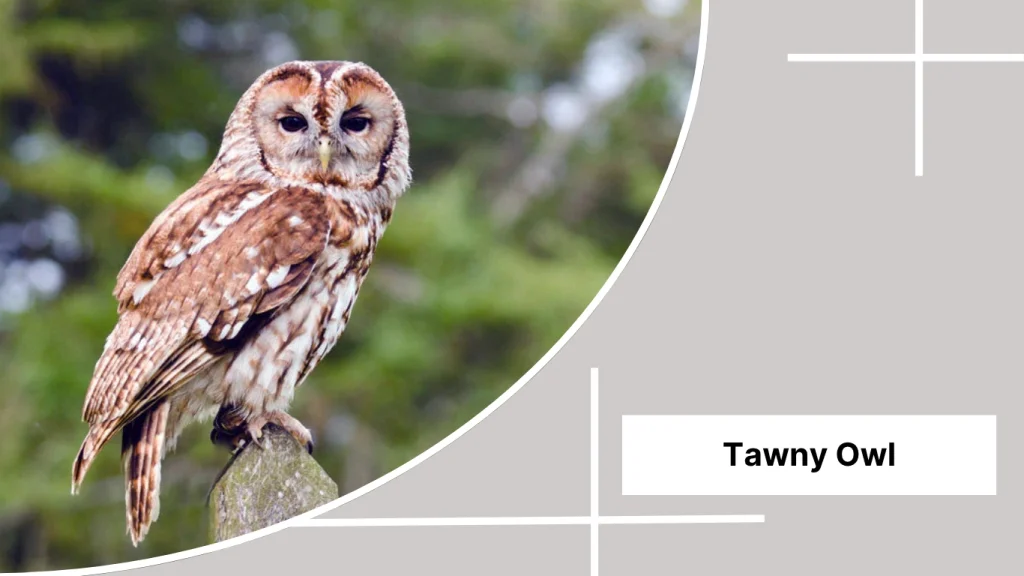
The Tawny Owl (Strix aluco) is a medium-sized, stocky owl native to Europe and parts of western Asia. It is famous for its classic “twit-twoo” call and often heard more than seen due to its secretive nature and excellent camouflage.
Identification
- Round head with no ear tufts
- Large black eyes
- Plumage varies from reddish-brown to gray-brown
- Streaked and mottled appearance for excellent camouflage
- Compact body with broad wings
- Length: 14–17 inches (36–43 cm)
- Wingspan: 33–39 inches (84–100 cm)
Habitat
Inhabits deciduous and mixed woodlands, parks, and gardens, often close to human settlements. Nests in tree cavities, building ledges, or nest boxes.
Diet
Primarily hunts small mammals like mice, voles, and shrews. Also eats birds, frogs, insects, and earthworms.
Behavior
Strictly nocturnal and highly territorial. Often calls loudly at night, especially during mating season. Has a powerful sense of hearing for detecting prey in total darkness.
Reproduction
Breeding starts in late winter. Lays 2–4 eggs in tree cavities. The female incubates while the male provides food. Chicks fledge after about 5 weeks.
12. Eurasian Eagle-Owl
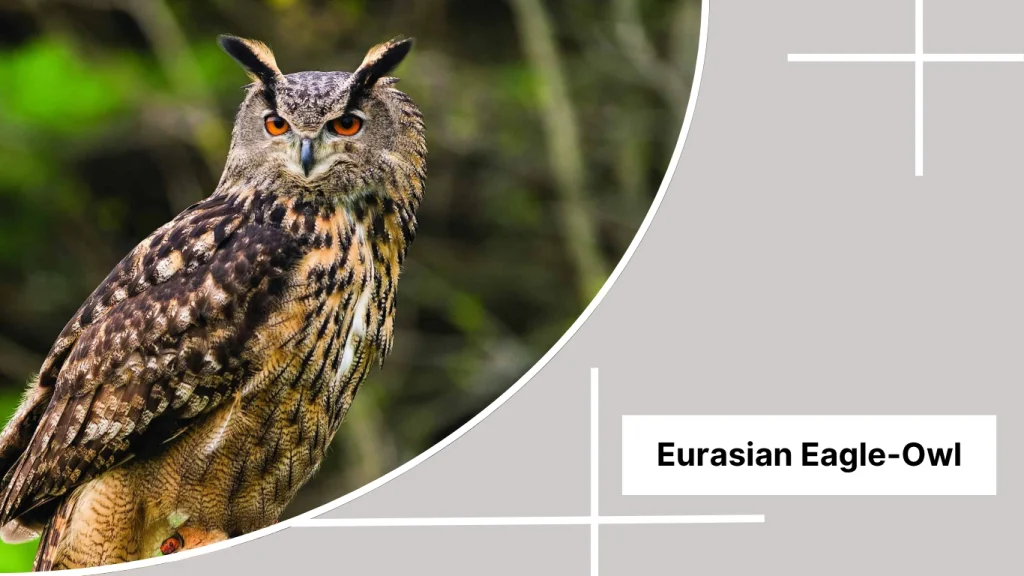
The Eurasian Eagle-Owl (Bubo bubo) is one of the largest and most powerful owls in the world. It is instantly recognizable with its large size, piercing orange eyes, and strong ear tufts. This majestic bird is widespread across Europe and Asia, typically inhabiting rocky landscapes and forests.
Identification
- Very large owl with thick, strong build
- Prominent ear tufts angled outward
- Bright orange eyes and massive talons
- Mottled brown, black, and tawny plumage
- Deep hooting call that carries far
- Length: 23–28 inches (58–71 cm)
- Wingspan: 61–74 inches (155–188 cm)
Habitat
Prefers mountainous areas, rocky cliffs, forested valleys, and open woodlands. Nests in caves, cliff ledges, or abandoned eagle or buzzard nests.
Diet
Feeds on a wide range of prey including hares, foxes, rodents, birds (including other owls), reptiles, and even fish in some regions.
Behavior
Mainly nocturnal, it perches high and silently surveys the landscape before swooping down on prey. Highly territorial and capable of taking down large animals.
Reproduction
Lays 1–4 eggs, usually in late winter or early spring. The female incubates while the male hunts. Chicks remain in the nest for about 5–6 weeks and are dependent on parents for several more weeks.
13. Northern Hawk Owl
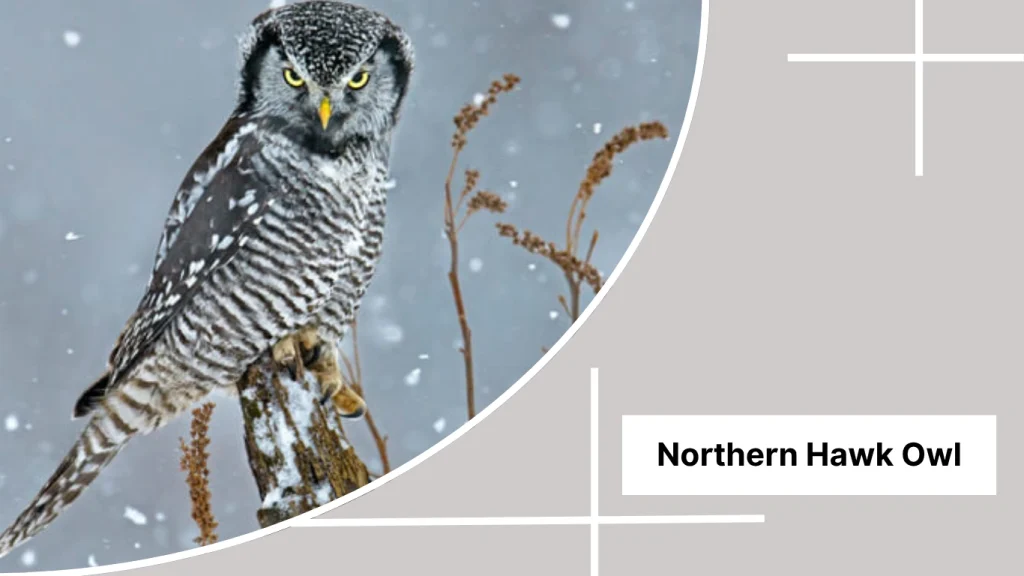
The Northern Hawk Owl (Surnia ulula) is a rare, slender-bodied owl that behaves much like a hawk. It hunts primarily during the day and is known for its long tail, fast flight, and diurnal habits, making it one of the most easily observed owls in the northern boreal forests.
Identification
- Medium-sized owl with a rounded head and no ear tufts
- Long, tapered tail and hawk-like profile
- Pale face with black border and yellow eyes
- Brown back with white spots; streaked underparts
- Narrow wings and fast, straight flight
- Length: 14–18 inches (36–46 cm)
- Wingspan: 27–30 inches (69–76 cm)
Habitat
Found in boreal forests of North America and Eurasia, especially in open woodland with scattered trees and meadows. Nests in old woodpecker holes or tree snags.
Diet
Primarily eats voles, mice, and other small mammals. Also preys on birds during winter when rodents are scarce.
Behavior
One of the few owls that hunts in daylight. Often perches atop treetops or poles, scanning the ground below. Will aggressively defend nests from predators and even humans.
Reproduction
Lays 3–9 eggs, usually in hollow tree trunks. Incubation and chick-rearing are mostly done by the female while the male provides food.
14. Boreal Owl
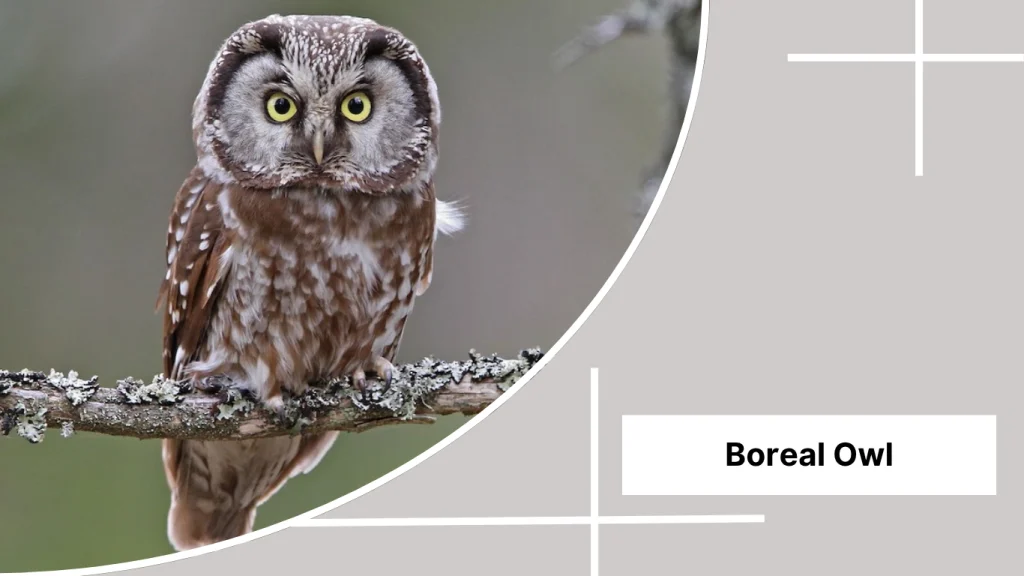
The Boreal Owl (Aegolius funereus) is a small, secretive owl native to the boreal forests of North America and Eurasia. It is known for its haunting, flute-like call and excellent hearing, which helps it locate prey beneath snow and vegetation in total darkness.
Identification
- Small owl with a large, square-shaped head
- No ear tufts
- Facial disc is pale with dark border; white “V” between the eyes
- Dorsal side is brown with white spots; underparts are pale with streaks
- Bright yellow eyes
- Length: 8–11 inches (20–28 cm)
- Wingspan: 21–24 inches (53–61 cm)
Habitat
Prefers dense coniferous or mixed forests in northern latitudes and high elevations. Nests in old woodpecker holes or artificial nest boxes.
Diet
Feeds mainly on small rodents, particularly voles and mice. Also consumes birds, insects, and occasionally shrews.
Behavior
Strictly nocturnal and very shy. Rarely seen during the day. Males sing persistent, melodic calls during mating season to attract females.
Reproduction
Lays 3–7 eggs. Female incubates while male hunts. Nestlings remain in the cavity for 3–4 weeks and are fed by both parents.
15. Spotted Owl
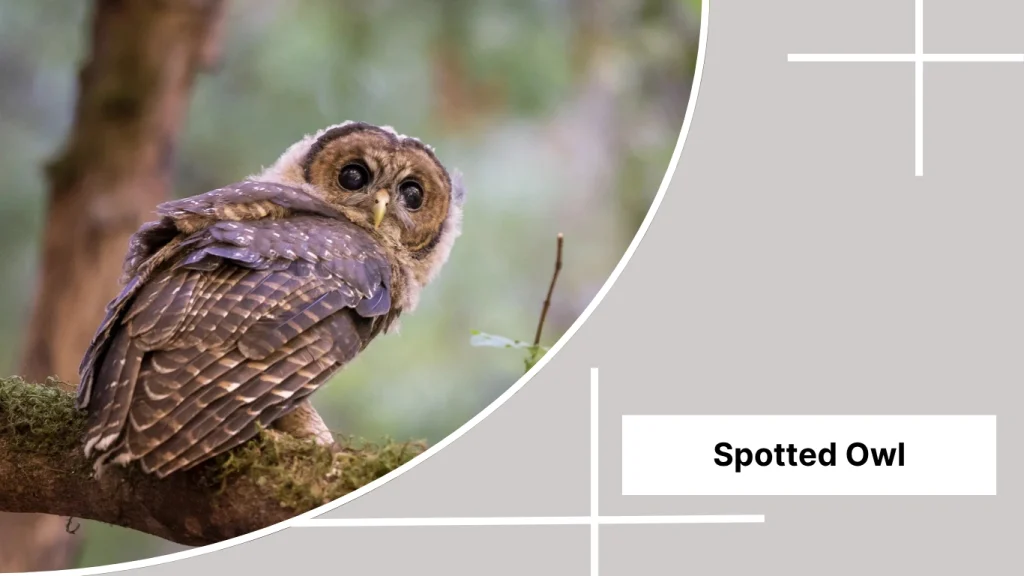
The Spotted Owl (Strix occidentalis) is a medium to large owl native to old-growth forests in North America. This species is notable for its dependence on mature forest ecosystems and has become a symbol of forest conservation efforts, particularly in the U.S. Pacific Northwest.
Identification
- Dark brown plumage with white spots on the head, back, and chest
- Large dark brown to black eyes
- Round head with no ear tufts
- Pale facial disc with dark border
- Short tail and rounded wings
- Length: 16–19 inches (40–48 cm)
- Wingspan: 39–49 inches (99–124 cm)
Habitat
Prefers dense, mature coniferous and mixed forests with a closed canopy. Found in the western United States and parts of Mexico. Nests in large tree cavities, broken tops of snags, or old raptor nests.
Diet
Mainly feeds on flying squirrels, wood rats, voles, and other small mammals. Occasionally takes birds, insects, and amphibians.
Behavior
Mostly nocturnal and sedentary. Very territorial and sensitive to habitat changes. Often roosts during the day in dense foliage.
Reproduction
Typically lays 2–3 eggs. Female incubates while male provides food. Young fledge at 4–5 weeks and may stay with parents for several months.
16. Elf Owl
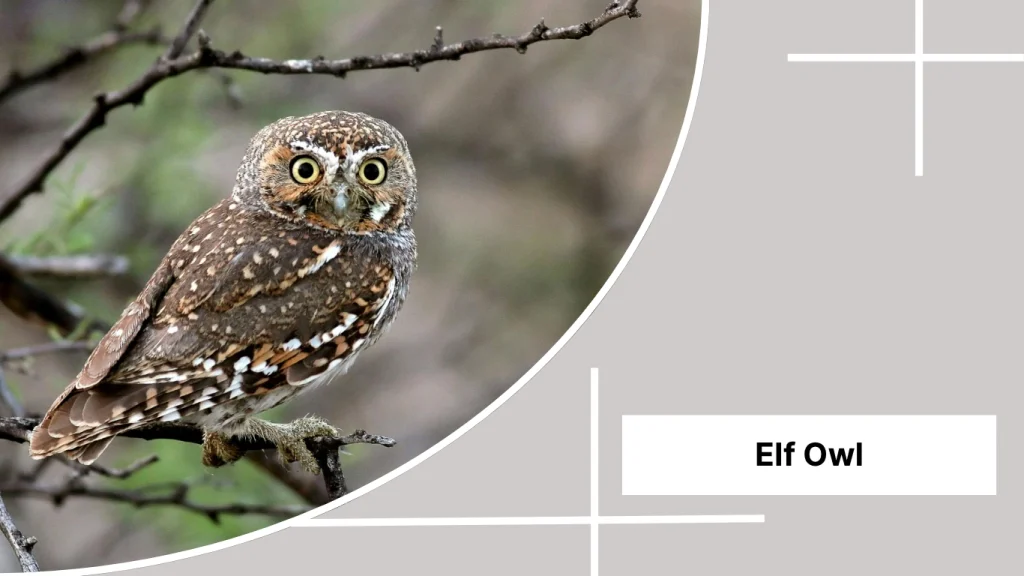
The Elf Owl (Micrathene whitneyi) is the smallest owl species in the world. Despite its tiny size, it is full of personality—quick, agile, and vocal. Native to the southwestern United States and Mexico, this insect-eating owl nests in abandoned woodpecker holes, especially in saguaro cacti and sycamores.
Identification
- Tiny owl with no ear tufts
- Gray-brown plumage with pale streaks
- Large yellow eyes and a short tail
- Compact body and rounded head
- Length: 4.9–5.7 inches (12.5–14.5 cm)
- Wingspan: 10.5–10.6 inches (27–27 cm)
Habitat
Found in desert scrub, canyon woodlands, and dry forests, especially in areas with saguaro cacti or sycamores. Nests in cavities created by woodpeckers, particularly Gila Woodpeckers.
Diet
Feeds almost exclusively on insects and arthropods such as beetles, moths, crickets, and scorpions. Occasionally eats small vertebrates like lizards or mice.
Behavior
Nocturnal and highly active. Produces a high-pitched, yapping call. Migratory in the northern part of its range, heading to Mexico for winter.
Reproduction
Lays 3–4 eggs per clutch. Female incubates while male provides food. Nestlings fledge about 3–4 weeks after hatching.
17. Flammulated Owl
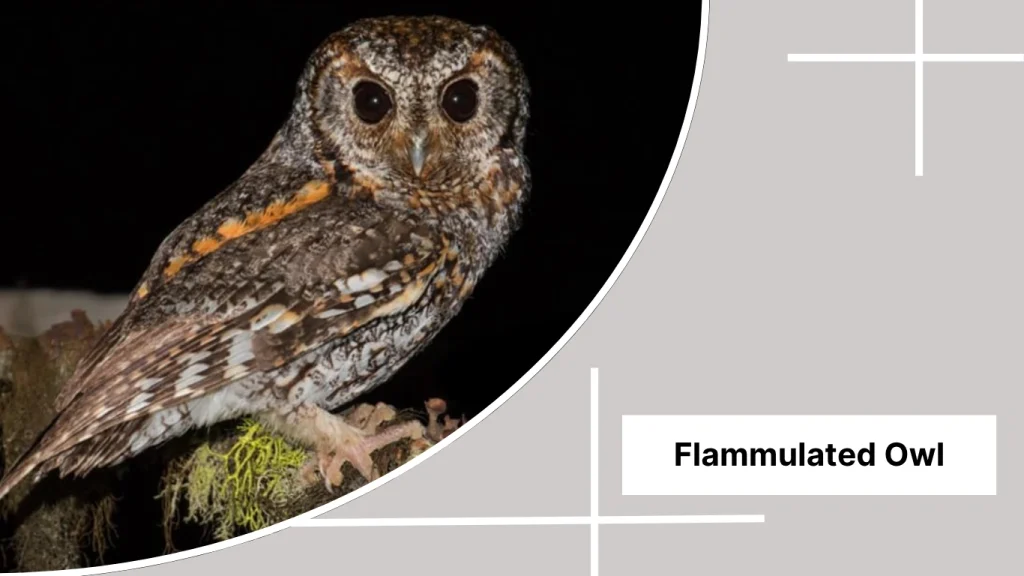
The Flammulated Owl (Psiloscops flammeolus) is a tiny, migratory owl of western North America. Named for its flame-like markings, this elusive bird is often detected by its soft, low-pitched hoots during breeding season rather than by sight.
Identification
- Very small owl with short ear tufts
- Gray or reddish mottled plumage with subtle flame-like streaks
- Large dark eyes and a rounded facial disc
- Blends seamlessly into tree bark
- Length: 5.9–6.7 inches (15–17 cm)
- Wingspan: 14–16 inches (36–40 cm)
Habitat
Inhabits mature coniferous forests, especially pine or fir at mid to high elevations. Nests in old woodpecker holes in dead or living trees.
Diet
Primarily insectivorous—feeds on moths, beetles, crickets, and other large insects. Occasionally takes spiders and small vertebrates.
Behavior
Nocturnal and migratory. Winters in Central America. Known for its low, monotonous hoots which can be difficult to localize.
Reproduction
Lays 2–4 eggs. Female incubates, and the male delivers food. Chicks fledge in about 3 weeks and stay with parents for a short time.
18. Blakiston’s Fish Owl
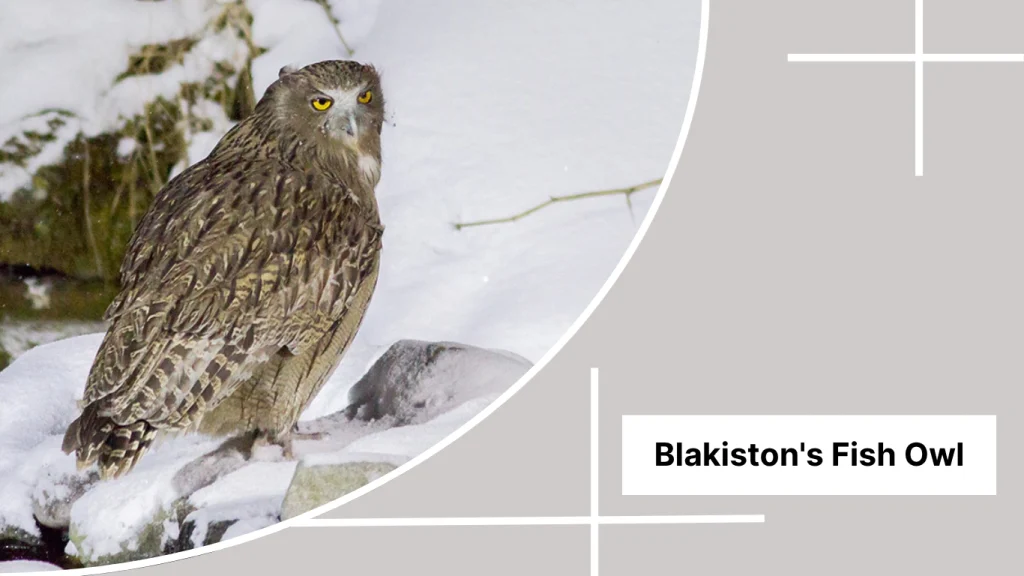
Blakiston’s Fish Owl (Bubo blakistoni) is the largest living owl species, both in weight and wingspan. It is a rare and endangered species found in remote riparian forests of Russia, Japan, China, and parts of Korea. It relies heavily on old-growth forests and clean rivers for survival.
Identification
- Extremely large owl with broad wings and thick build
- Bushy ear tufts that point sideways
- Yellow eyes and a deep, expressive face framed with coarse feathers
- Brownish upperparts with dark streaks and lighter underparts
- Feathered legs and massive talons
- Length: 26–28 inches (66–72 cm)
- Wingspan: 72–78 inches (183–198 cm)
Habitat
Inhabits riparian zones in dense, mature forests with access to ice-free streams or rivers, especially in northeast Asia. Requires large tree cavities for nesting.
Diet
Specializes in catching fish and aquatic prey—salmon, trout, frogs, and occasionally small mammals or birds.
Behavior
Nocturnal and crepuscular. Hunts by waiting on riverbanks or low perches and swooping silently onto prey. Solitary and elusive, with deep booming calls.
Reproduction
Breeds in late winter or early spring. Lays 1–2 eggs in tree cavities or broken snags. Both parents care for the chick, which fledges after 40–50 days.
19. Mottled Owl

The Mottled Owl (Strix virgata) is a medium-sized, widespread owl native to Central and South America. It’s known for its distinctive hooting calls, camouflage, and adaptability to different forest environments, from rainforests to plantations.
Identification
- Rounded head with no ear tufts
- Dark brown plumage with white streaks on breast and belly
- Brown facial disc with white edges
- Large dark brown to black eyes
- Tail marked with pale bars
- Length: 13–15 inches (33–38 cm)
- Wingspan: 30–36 inches (76–91 cm)
Habitat
Found in tropical and subtropical forests, secondary growth, coffee plantations, and urban parks throughout Central and northern South America.
Diet
Feeds on insects, small mammals, birds, reptiles, frogs, and occasionally fish. Very opportunistic and adjusts diet to local prey availability.
Behavior
Nocturnal and often vocal at night, with a rhythmic series of deep hoots. Perches quietly in foliage during the day and is difficult to spot.
Reproduction
Nests in tree cavities, palm crowns, or abandoned nests. Lays 1–2 eggs per clutch. The female incubates while the male provides food.
20. Spectacled Owl
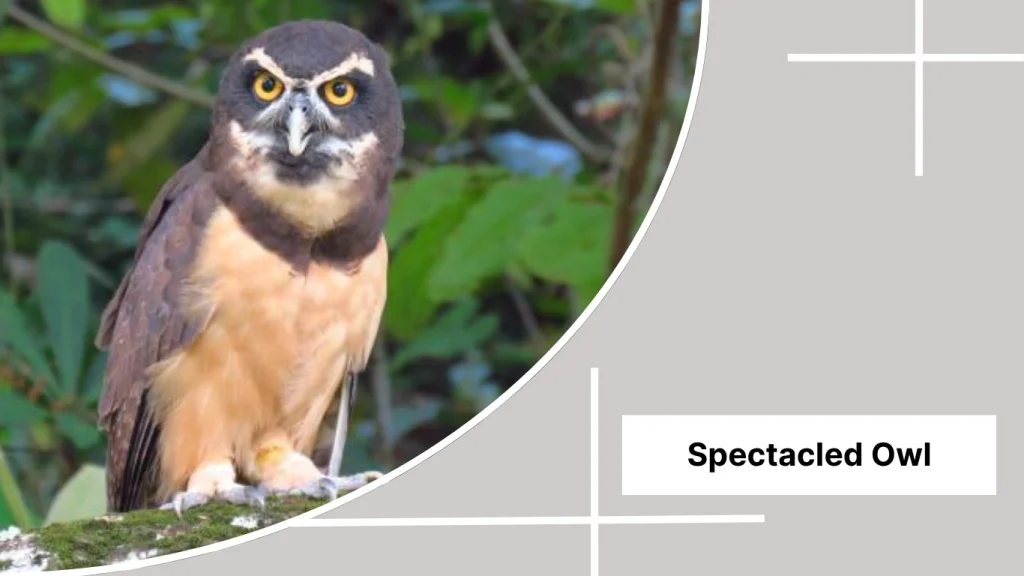
The Spectacled Owl (Pulsatrix perspicillata) is a large, tropical owl named for the striking white markings around its eyes that resemble spectacles. Native to Central and South America, it is a forest-dwelling species with a deep, booming call that echoes through the rainforest at night.
Identification
- Large owl with a dark brown head and upper body
- Creamy to yellowish underparts
- Bold white facial markings forming a “spectacled” appearance
- Yellow eyes and short, rounded wings
- Juveniles are mostly white with a dark facial mask
- Length: 16–20 inches (41–51 cm)
- Wingspan: 30–35 inches (76–89 cm)
Habitat
Inhabits lowland rainforests, wooded savannas, and tropical dry forests. Prefers areas with dense tree cover and proximity to rivers or streams.
Diet
Feeds on small mammals (bats, rodents), birds, insects, frogs, and reptiles. Often sits silently on a perch before swooping down on prey.
Behavior
Strictly nocturnal and usually solitary. Known for its deep, rhythmic “pop-pop-pop” call repeated every few seconds. Roosts quietly during the day in dense foliage.
Reproduction
Nests in tree cavities or abandoned nests. Typically lays 1–2 eggs. The female incubates while the male provides food. Young remain with parents for several months.
21. Striped Owl
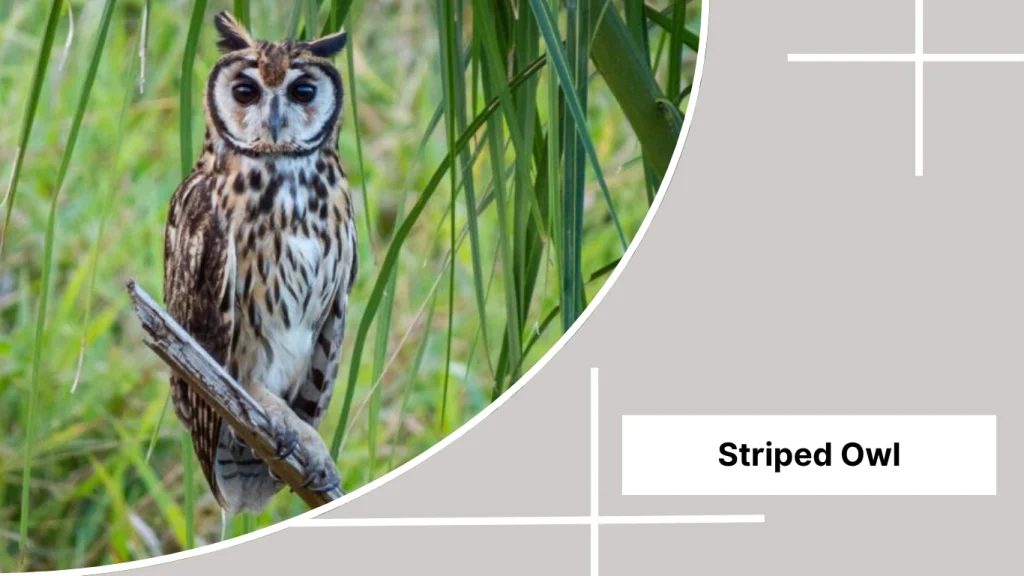
The Striped Owl (Asio clamator) is a medium-sized owl with long ear tufts and distinct dark vertical streaks. It ranges across Central and South America and is often found in savannas, agricultural areas, and forest edges. Its striking facial pattern makes it one of the more easily recognizable tropical owls.
Identification
- Prominent, tall ear tufts
- Creamy or buff facial disc bordered with black
- Tawny to reddish-brown plumage with bold vertical black streaks
- Yellow eyes and dark bill
- Slim body and rounded wings
- Length: 13–15 inches (33–38 cm)
- Wingspan: Approximately 35–40 inches (89–102 cm)
Habitat
Prefers open woodlands, savannas, wetlands, farmland edges, and semi-arid scrub. Avoids dense rainforest interiors. Often found near water sources.
Diet
Feeds on rodents, birds, bats, reptiles, frogs, and large insects. Hunts at night by flying low over open ground or from low perches.
Behavior
Nocturnal and elusive. Known for its slow, low, rhythmic calls and hissing when threatened. During the day, it roosts in thick vegetation or tall grasses.
Reproduction
Little is documented, but it likely nests in tree cavities, grassy clumps, or on the ground. Usually lays 1–3 eggs. Incubation is done by the female while the male hunts.
22. African Wood Owl
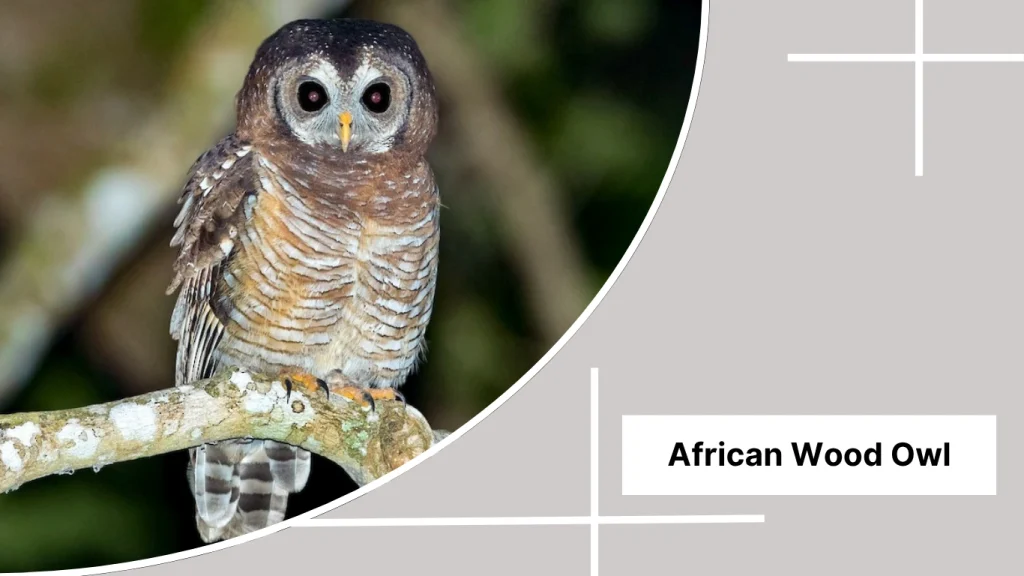
The African Wood Owl (Strix woodfordii) is a medium-sized owl native to sub-Saharan Africa. Known for its soft hoots and elegant barred pattern, it is a quiet forest dweller often heard rather than seen in the night canopy.
Identification
- Rounded head with no ear tufts
- Brown upperparts with white spotting
- Underparts are pale with fine dark barring
- Yellow facial disc outlined in dark brown
- Dark brown eyes
- Length: 12–14 inches (30–36 cm)
- Wingspan: 28–35 inches (71–89 cm)
Habitat
Inhabits dense woodlands, riverine forests, and moist evergreen forests throughout sub-Saharan Africa. Also found in gardens and plantations near forests.
Diet
Primarily feeds on insects like beetles, moths, and grasshoppers. Also eats small rodents, birds, frogs, and reptiles.
Behavior
Nocturnal and territorial. Emits a soft, melodious hooting call in a rhythmic “whoo-whoo” duet often performed by pairs. Roosts in tree canopies during the day, well hidden in foliage.
Reproduction
Breeds during the dry season. Nests in tree hollows or natural cavities. Typically lays 2 eggs, and the female incubates while the male delivers food.
23. Oriental Bay Owl
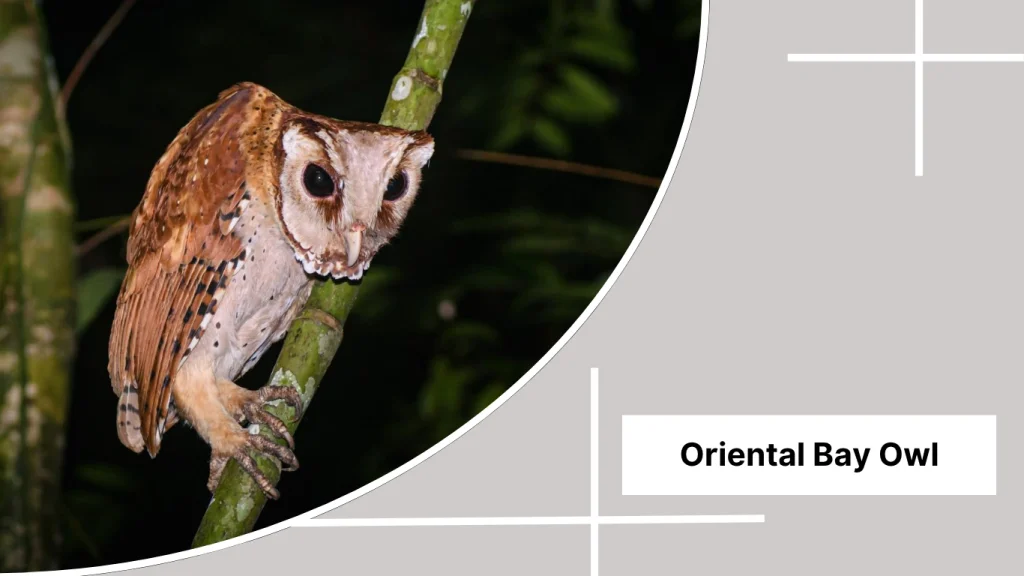
The Oriental Bay Owl (Phodilus badius) is a uniquely shaped and secretive owl from South and Southeast Asia. With a heart-shaped face and relatively long legs, it resembles the barn owl but has a more tropical lifestyle and distinct vocalizations.
Identification
- Heart-shaped facial disc with a deep cleft down the middle
- Rich chestnut to reddish-brown plumage
- Spotted and streaked with pale markings on wings and underparts
- Pale facial edges with dark eye patches
- Long legs and rounded wings
- Length: 9–12 inches (23–30 cm)
- Wingspan: 25–30 inches (64–76 cm)
Habitat
Found in lowland and hill rainforests, bamboo groves, mangroves, and plantations throughout South Asia and Southeast Asia. Prefers dense vegetation and tree cover.
Diet
Feeds on small mammals, insects, birds, and reptiles. Hunts by swooping silently from a low perch or gliding through understory vegetation.
Behavior
Very elusive and nocturnal. Emits high-pitched screeches and whistles. Typically seen alone or in pairs, roosting in tree hollows or vine tangles during the day.
Reproduction
Breeding habits are poorly known. Nests in natural cavities in trees. Generally lays 1–3 eggs, and the young remain in the nest for several weeks after hatching.
24. Jungle Owlet

The Jungle Owlet (Glaucidium radiatum) is a small, diurnal owl native to the Indian subcontinent. Unlike most owls, it is active during daylight, especially in the early morning and late afternoon. It has a compact build and a striking pattern that helps it blend into forest surroundings.
Identification
- Small, stocky body with rounded head and no ear tufts
- Grayish-brown to dark brown plumage with fine barring across the body
- Pale facial disc with yellow eyes and white throat patch
- Boldly barred tail
- Length: 7–8 inches (18–20 cm)
- Wingspan: Approximately 15–18 inches (38–46 cm)
Habitat
Found in deciduous and evergreen forests, scrublands, and gardens throughout India, Nepal, and Sri Lanka. Prefers wooded areas with dense foliage for roosting.
Diet
Feeds on insects, lizards, small birds, rodents, and occasionally frogs. Hunts both from a perch and in short glides through forest cover.
Behavior
Active at dawn and dusk but often seen during the day. Produces a series of fast, whistling hoots. Roosts in tree holes or thick foliage and often mobbed by smaller birds when spotted.
Reproduction
Breeds during the spring and summer months. Nests in natural cavities or abandoned woodpecker holes. Typically lays 2–4 eggs.
25. Collared Owlet
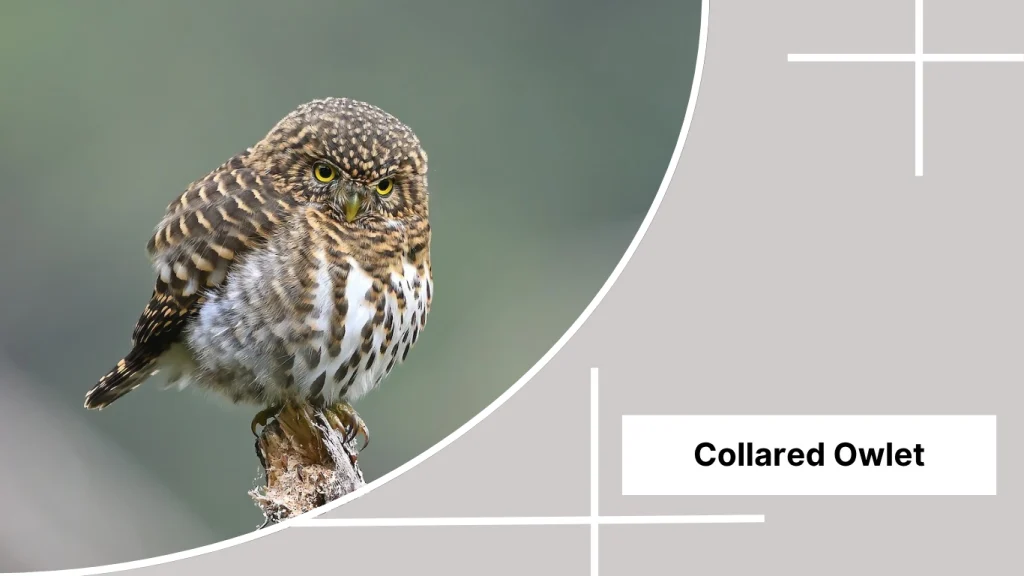
The Collared Owlet (Taenioptynx brodiei) is Asia’s smallest owl and one of the few truly diurnal species. It is known for its distinctive white “collar” on the back of its neck, which resembles a false face and may confuse predators.
Identification
- Tiny owl with rounded head and no ear tufts
- Olive-brown upperparts with fine white spotting
- Whitish underparts with dark streaks
- Prominent white nape band forming a “collar”
- Yellow eyes and tiny hooked beak
- Length: 6–7 inches (15–18 cm)
- Wingspan: 14–16 inches (36–40 cm)
Habitat
Inhabits subtropical and temperate forests in the Himalayas and Southeast Asia. Prefers dense woodlands at elevations from 800 to 3000 meters.
Diet
Feeds on insects, small birds, reptiles, and rodents. Frequently hunts during the day using short bursts of flight from low perches.
Behavior
Active during daylight, especially mornings and afternoons. Known for head-bobbing and tail-flicking when excited. Uses its false nape “eyes” to deter attacks from behind.
Reproduction
Breeds in spring. Nests in tree cavities, often made by woodpeckers. Typically lays 2–4 eggs. Female incubates while the male hunts.
26. Ferruginous Pygmy Owl
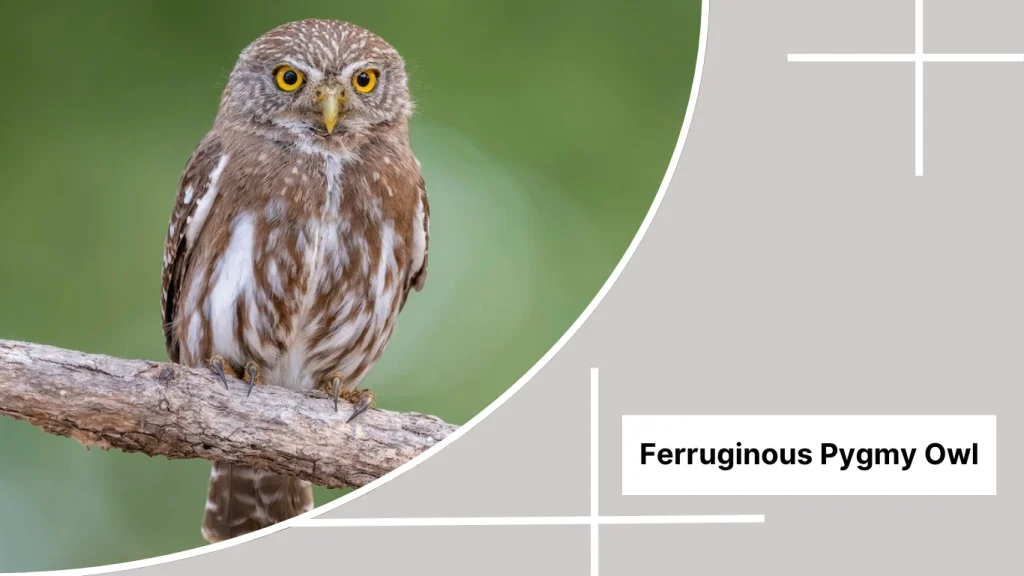
The Ferruginous Pygmy Owl (Glaucidium brasilianum) is a small but fierce predator found across the Americas. Despite its size, it’s known for taking down prey nearly as large as itself and for being active both day and night. It is often mobbed by songbirds due to its aggressive nature.
Identification
- Small owl with a rounded head and no ear tufts
- Rufous to grayish-brown upperparts with white spots
- Pale underparts streaked with brown
- Yellow eyes and a yellow beak
- Two dark “false eyes” on the nape of the neck
- Length: 6–7 inches (15–18 cm)
- Wingspan: 14–16 inches (36–41 cm)
Habitat
Found in woodlands, scrub, savannas, deserts, and suburban areas from southern Arizona to South America. Nests in natural tree cavities or old woodpecker holes.
Diet
Eats insects, lizards, small mammals, and birds. Often hunts by darting out quickly from a perch to capture prey in vegetation or on the ground.
Behavior
Active at dawn, dusk, and sometimes during the day. Emits a rapid, whistled “toot-toot” call. Bold and curious, frequently seen perched in open during daylight.
Reproduction
Breeding occurs in spring and summer. Lays 3–5 eggs. Female incubates while the male hunts. Chicks fledge in about a month.
27. Little Owl
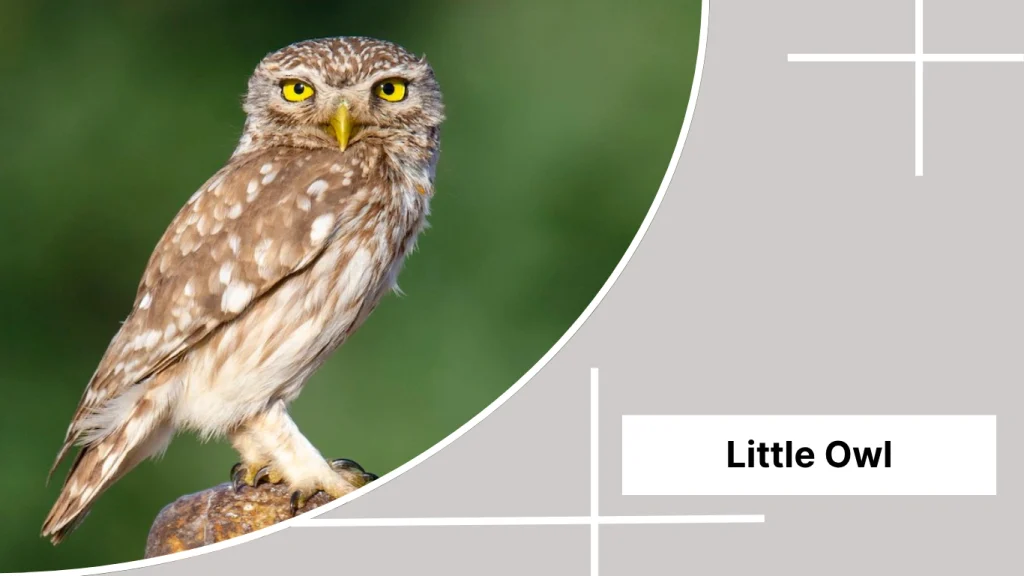
The Little Owl (Athene noctua) is a compact, expressive owl with a stern, frowning look. Common in Europe, North Africa, and parts of Asia, it is often seen perched on fence posts or rooftops. It has a strong presence in mythology and is famously associated with Athena, the Greek goddess of wisdom.
Identification
- Small size with flattened crown and white eyebrows
- Brownish-gray body with white spots on upperparts
- Pale underparts with brown streaking
- Bright yellow eyes and short tail
- Characteristic angry-looking facial expression
- Length: 8.5–10 inches (22–26 cm)
- Wingspan: 21–24 inches (53–60 cm)
Habitat
Prefers open countryside, farmlands, orchards, ruins, and even urban parks. Roosts in tree hollows, stone walls, or buildings.
Diet
Feeds on insects (especially beetles), small mammals, earthworms, reptiles, and birds. Hunts mostly at dusk and during the night.
Behavior
Territorial and often visible during the day. Walks or runs along the ground to chase prey. Emits a variety of calls, from harsh screeches to soft whistles.
Reproduction
Breeds from March to August. Nests in tree cavities, walls, or buildings. Lays 3–5 eggs per clutch. Female incubates, and both parents care for the young.
28. Brown Fish Owl
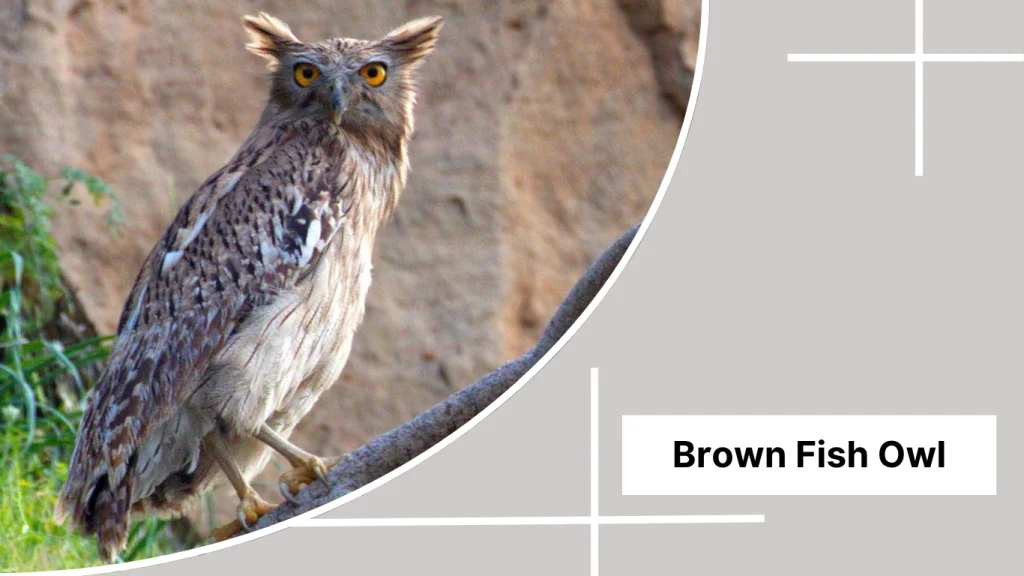
The Brown Fish Owl (Ketupa zeylonensis) is a large, robust owl commonly found near water in South and Southeast Asia. With its scruffy ear tufts and glaring yellow eyes, it’s a powerful presence along riverbanks and forested wetlands.
Identification
- Large owl with unkempt-looking, bushy ear tufts
- Deep brown plumage with fine darker streaks and mottling
- Yellow eyes and heavy, downward-curved beak
- Feathers extend down to the feet
- Facial disc is not well defined compared to other owls
- Length: 20–22 inches (50–55 cm)
- Wingspan: 48–54 inches (122–137 cm)
Habitat
Found in forested riversides, mangroves, swamps, and large ponds in India, Sri Lanka, Nepal, and parts of Southeast Asia. Nests in rock crevices, old buildings, or large trees near water.
Diet
Feeds mainly on fish, frogs, crustaceans, and aquatic snakes. Occasionally preys on birds, rodents, and bats.
Behavior
Primarily nocturnal but sometimes active at dusk and dawn. Often perches on overhanging branches above water. Known for its loud, growling call at night.
Reproduction
Breeding begins in late winter or early spring. Lays 1–2 eggs in cavities or rocky niches. Incubation lasts about 35 days, and chicks fledge at around 6–7 weeks.
29. Indian Eagle-Owl
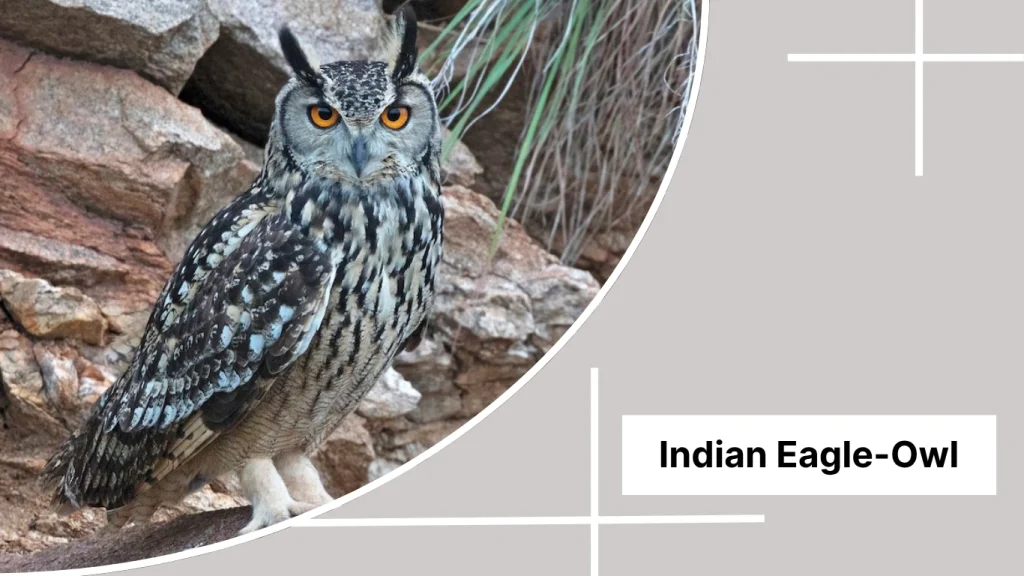
(also known as Rock Eagle-Owl or Bubo bengalensis)
The Indian Eagle-Owl is a large, horned owl with dramatic facial features and a deep, booming hoot. Found throughout the Indian subcontinent, it prefers rocky hillsides, ravines, and open woodlands where it can perch discreetly during the day.
Identification
- Large body with bold, upright ear tufts
- Orange to yellow eyes and heavily streaked plumage
- Facial disc buff-colored with dark edges
- Tawny-brown feathers with darker streaks and spots
- Strong legs feathered down to the talons
- Length: 20–22 inches (50–56 cm)
- Wingspan: 48–60 inches (122–152 cm)
Habitat
Inhabits dry rocky hills, scrub forests, and open countryside with sparse tree cover. Often nests on cliff ledges or in shallow caves.
Diet
Feeds on rodents, birds, reptiles, and occasionally small mammals such as hares. Hunts with patience and precision at dusk and night.
Behavior
Mostly nocturnal and elusive. Roosts quietly during the day in shaded, camouflaged spots. Males call with deep hoots during courtship and territory defense.
Reproduction
Nesting season typically begins in winter. Lays 2–4 eggs in rock crevices or ground scrapes. Incubation takes about 30–35 days; young fledge in 7–8 weeks.
30. Buffy Fish Owl
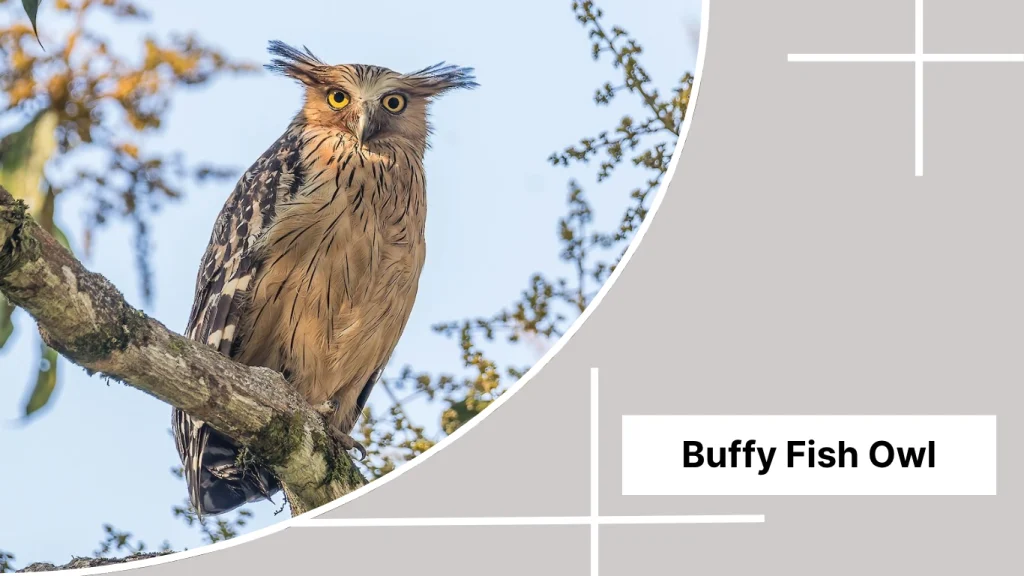
The Buffy Fish Owl (Ketupa ketupu) is a medium to large tropical owl native to Southeast Asia. It is a specialist of wet, swampy forests and is easily recognized by its bright yellow eyes, shaggy ear tufts, and strong presence near water sources.
Identification
- Prominent, messy-looking ear tufts
- Golden-buff to tawny-brown plumage with streaked underparts
- Large yellow eyes and dark brown facial disc
- Unfeathered legs (rare for owls) and strong talons
- Short tail and broad wings
- Length: 17–19 inches (43–48 cm)
- Wingspan: Approximately 40–48 inches (102–122 cm)
Habitat
Found in lowland rainforests, mangroves, swamps, and along streams in Malaysia, Indonesia, Thailand, and parts of Borneo and Sumatra. Always stays close to water.
Diet
Primarily feeds on fish, frogs, crabs, and other aquatic animals. Also eats insects, small mammals, and occasionally birds.
Behavior
Nocturnal and secretive. Hunts by watching from a perch over water, then swooping down silently. Its call is a harsh scream or screech, often heard during the rainy season.
Reproduction
Breeds throughout the year depending on region. Nests in tree hollows, forks of branches, or even old raptor nests. Lays 1–2 eggs per clutch.
31. Scops Owl
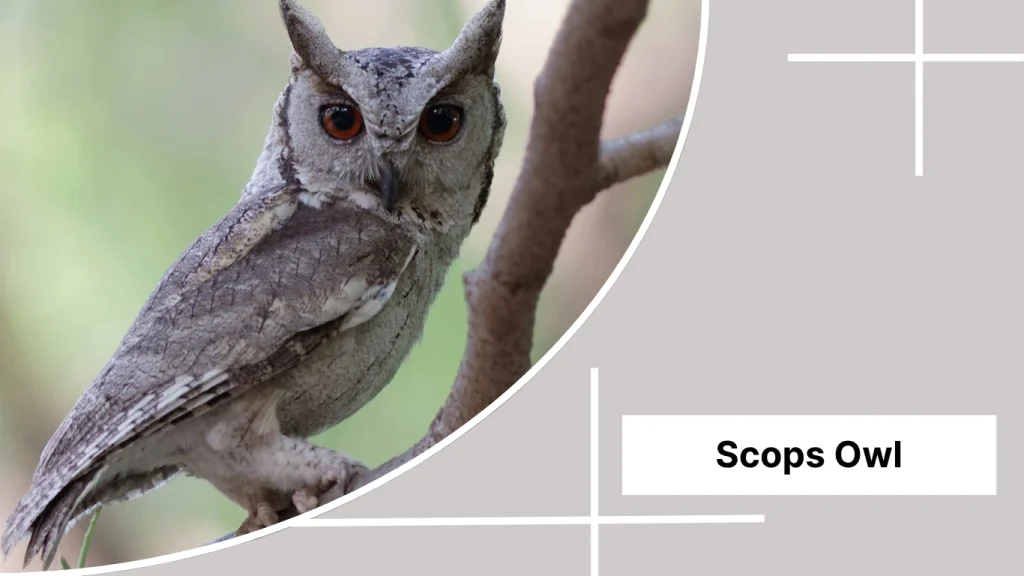
(General group – various species, including Eurasian, Indian, Sunda, and others)
Scops Owls (Genus: Otus) are small, compact owls with prominent ear tufts, found across Europe, Asia, and Africa. Despite being tiny, they’re excellent hunters and well camouflaged, often blending perfectly with tree bark.
Identification
- Small size with upright ear tufts
- Plumage color varies by species—typically gray, brown, or reddish, with streaking or mottling
- Yellow or orange eyes, depending on species
- Short tail and rounded wings
- Most species measure:
- Length: 6–9 inches (15–23 cm)
- Wingspan: 18–24 inches (46–61 cm)
- Length: 6–9 inches (15–23 cm)
Habitat
Found in woodlands, savannas, scrublands, and even gardens. Nest in tree holes, rock crevices, or nest boxes. Each species has its own regional range (e.g., Eurasian Scops Owl in Europe, Indian Scops Owl in South Asia).
Diet
Feed on insects, spiders, small lizards, and rodents. Some may take frogs or small birds. Usually hunt from a low perch at night.
Behavior
Primarily nocturnal and difficult to spot during the day due to excellent camouflage. Known for repetitive, monotone whistles or trills during the night.
Reproduction
Typically lays 3–6 eggs. Female incubates while male provides food. Nestlings fledge after about 3–4 weeks.
32. Sunda Scops Owl

The Sunda Scops Owl (Otus lempiji) is a small, forest-dwelling owl native to Southeast Asia, particularly found in the Sundaic region including Malaysia, Singapore, and Indonesia. It is known for its musical call and superb camouflage, often roosting motionless against tree trunks during the day.
Identification
- Small size with erect ear tufts
- Plumage varies between rufous and grey morphs
- Fine barring on underparts and streaking on upperparts
- Large dark eyes and yellowish to grey facial disc
- Short, rounded wings and tail
- Length: 7–8 inches (18–21 cm)
- Wingspan: Approximately 18–20 inches (46–51 cm)
Habitat
Inhabits lowland rainforests, forest edges, parks, gardens, and mangroves throughout the Malay Peninsula and surrounding islands. Nests in tree holes or crevices.
Diet
Primarily insectivorous—feeds on beetles, moths, crickets, and other nocturnal insects. Occasionally eats small vertebrates like geckos or frogs.
Behavior
Strictly nocturnal. Emits a soft, mellow “woop-woop” call at night. Roosts during the day in dense foliage or on tree branches, relying on camouflage to avoid predators.
Reproduction
Breeding typically occurs during the dry season. Lays 2–3 eggs in natural cavities. The female incubates, and the male provides food throughout the nesting period.
33. Northern White-faced Owl
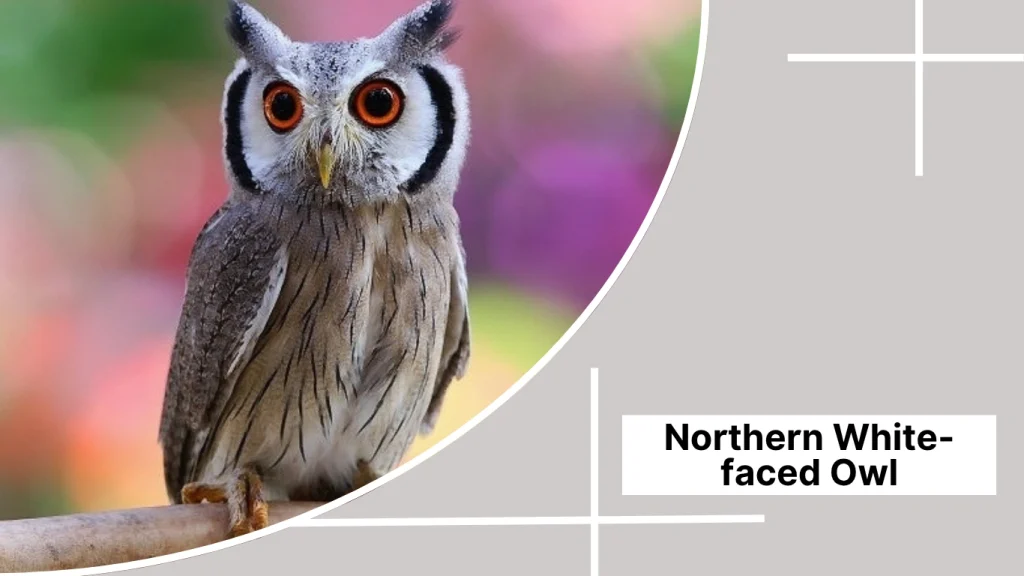
The Northern White-faced Owl (Ptilopsis leucotis) is a striking, small owl found across the dry savannas and woodlands of sub-Saharan Africa. Famous for its expressive facial disc and its ability to dramatically alter its appearance when threatened, it’s a favorite among bird photographers and owl enthusiasts.
Identification
- Small size with bold white facial disc outlined in black
- Prominent ear tufts angled outward
- Pale grey plumage with fine black streaks
- Bright orange or reddish eyes
- Length: 9–10 inches (23–25 cm)
- Wingspan: 22–24 inches (56–61 cm)
Habitat
Prefers dry woodland, thorn scrub, and savanna habitats. Commonly found in regions with scattered trees, especially acacia-dominated landscapes.
Diet
Feeds on large insects, small rodents, birds, and reptiles. Hunts at night using low glides from perches.
Behavior
Nocturnal and solitary. Known for its unique defense mechanism: it either fluffs up and spreads its wings to appear larger or slims down to resemble a broken branch. Vocalizations include a raspy, barking call.
Reproduction
Breeds in tree hollows, laying 2–3 eggs per clutch. Female incubates for around 30 days. Chicks fledge in 5–6 weeks and remain near the nest site for several more weeks.
34. Southern White-faced Owl
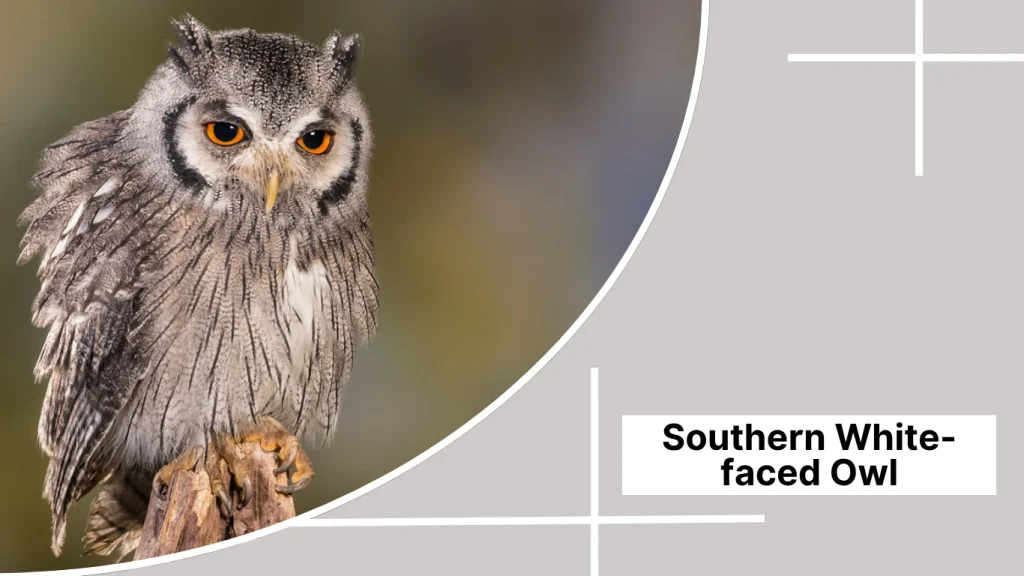
The Southern White-faced Owl (Ptilopsis granti) is closely related to the Northern White-faced Owl and is found in southern Africa. It’s known for its expressive face, striking white-and-black facial disc, and vocal presence. This small owl is both a skilled hunter and a master of disguise.
Identification
- Small owl with white facial disc bordered by black
- Ear tufts present and often held upright
- Pale gray plumage with fine dark streaks
- Orange or reddish eyes
- Very similar in appearance to its northern cousin but with minor vocal and plumage differences
- Length: 9–10 inches (23–25 cm)
- Wingspan: 21–24 inches (53–61 cm)
Habitat
Found in open woodland, dry savanna, and scrub across southern Africa including Namibia, Botswana, Zimbabwe, and South Africa. Prefers habitats with scattered trees and minimal undergrowth.
Diet
Feeds on insects, small birds, rodents, and reptiles. Hunts by watching from low perches and swooping down onto prey.
Behavior
Nocturnal and crepuscular. Known for its haunting, flutelike calls at dusk. When threatened, it either puffs up to appear larger or slims down vertically to blend into tree bark.
Reproduction
Nests in natural cavities or abandoned woodpecker holes. Lays 2–3 eggs, with incubation handled by the female. Chicks fledge after about 4–5 weeks.
35. Greater Sooty Owl
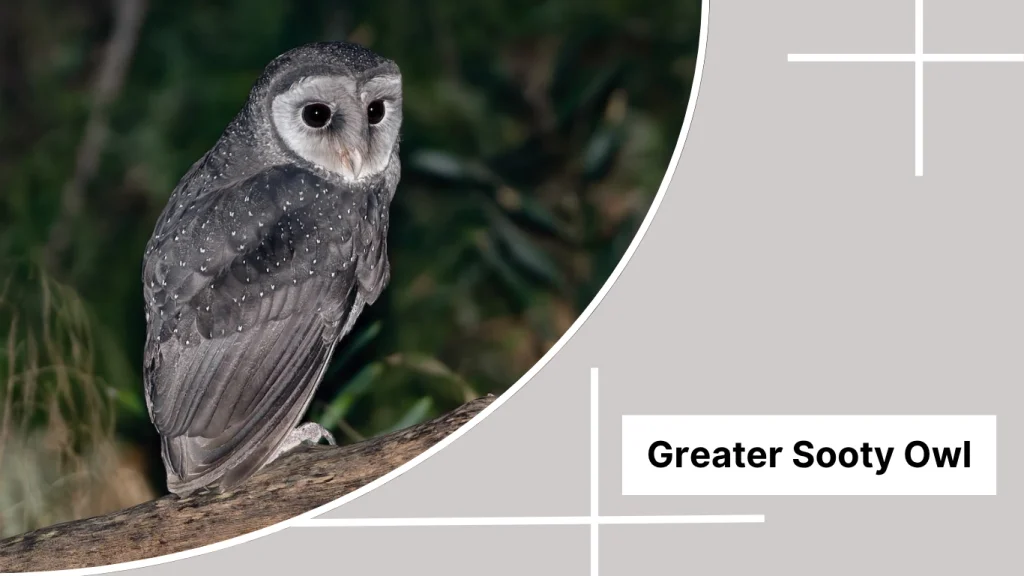
The Greater Sooty Owl (Tyto tenebricosa) is a large, elusive forest owl found in eastern Australia and parts of New Guinea. It is known for its dark plumage, ghostly appearance, and powerful, piercing scream that echoes through dense rainforests at night.
Identification
- Large owl with rounded, dark gray facial disc
- Eyes are black and very large
- Plumage is sooty black to dark gray with fine white spotting
- Legs are heavily feathered
- Lacks ear tufts
- Length: 14–18 inches (36–46 cm)
- Wingspan: 40–50 inches (102–127 cm)
Habitat
Inhabits dense, moist eucalypt forests, rainforests, and mountainous woodlands. Roosts in caves, tree hollows, or thick vegetation during the day.
Diet
Feeds mainly on small mammals such as gliders, bandicoots, and rodents. Also preys on birds, bats, and insects. Hunts from a perch in the understory or forest edge.
Behavior
Nocturnal and extremely shy. Emits a long, harsh scream unlike any other owl. Very sensitive to disturbance and rarely seen.
Reproduction
Breeds in tree hollows or rock crevices. Lays 1–2 eggs per clutch. The female incubates for 35–42 days while the male provides food.
36. Lesser Sooty Owl

The Lesser Sooty Owl (Tyto multipunctata) is a smaller and more localized relative of the Greater Sooty Owl. It inhabits the tropical rainforests of northeastern Queensland, Australia. With its ghostly appearance, haunting call, and secretive habits, it is rarely seen but often heard in its dense forest home.
Identification
- Medium-sized owl with a rounded, heart-shaped facial disc
- Plumage is dark sooty-gray to black with fine white spotting
- Underparts are pale with light speckles
- No ear tufts; legs fully feathered
- Eyes are large and dark brown to black
- Length: 12–14 inches (30–35 cm)
- Wingspan: 30–36 inches (76–91 cm)
Habitat
Restricted to upland and lowland tropical rainforests of northeastern Queensland. Prefers dense, wet forests and wooded gullies with high tree canopies.
Diet
Feeds mainly on small mammals such as rodents and bandicoots. May also take birds, insects, and reptiles. Hunts from perches within the forest understory.
Behavior
Nocturnal and highly elusive. Emits a high-pitched, descending whistle that can be heard over long distances. Rarely seen due to its shy nature and deep forest habitat.
Reproduction
Breeds in tree hollows or large cavities in rainforest trees. Lays 1–2 eggs per clutch. Female incubates while male provides food. Young remain dependent for several months.
37. Powerful Owl

The Powerful Owl (Ninox strenua) is the largest owl in Australia and a formidable predator. It’s recognized for its deep hooting calls and striking appearance. Often seen perched silently with prey dangling from its talons, this owl is a dominant nocturnal hunter of forested landscapes.
Identification
- Very large owl with rounded head and no ear tufts
- Dark brown upperparts with white spots
- Pale underparts with heavy dark barring
- Large yellow eyes and strong, hooked beak
- Legs are fully feathered
- Length: 20–26 inches (50–66 cm)
- Wingspan: 44–52 inches (112–132 cm)
Habitat
Inhabits temperate and subtropical forests, woodlands, and sometimes urban parks along the east coast of Australia. Requires large, old-growth trees for nesting.
Diet
Feeds primarily on arboreal mammals like possums, flying foxes, and sugar gliders. Occasionally takes birds, reptiles, and large insects.
Behavior
Nocturnal and highly territorial. Known for its slow, powerful hooting call repeated at intervals. Roosts in dense foliage during the day and hunts at night from high perches.
Reproduction
Breeds in large tree hollows, often 20+ meters above the ground. Lays 1–2 eggs per clutch. Incubation by the female lasts 38 days; young fledge at 6–8 weeks but stay with parents for several months.
38. Barking Owl

The Barking Owl (Ninox connivens) is a medium-sized Australian owl named for its unmistakable dog-like “bark” call. It’s also known for its eerie, human-like screams, making it one of the most vocal and easily recognized owls in its range. It’s widespread across Australia and southern New Guinea.
Identification
- Medium size with rounded head and no ear tufts
- Dark brown upperparts with white spotting
- Pale underparts with bold brown streaks
- Large yellow eyes and pale facial disc
- Slightly shorter tail than the Powerful Owl
- Length: 14–18 inches (35–45 cm)
- Wingspan: 31–39 inches (80–100 cm)
Habitat
Found in open forests, woodlands, riverine habitats, and rural farmlands. Often near water sources. Roosts in dense trees and hunts in open clearings.
Diet
Feeds on birds, rodents, bats, insects, and small marsupials. Known for taking prey larger than itself, including flying foxes and rabbits.
Behavior
Vocal both day and night. Its typical “wook-wook” bark sounds like a small dog. Also produces loud, rising screams that have earned it the nickname “screaming woman owl.” Territorial and pairs often duet.
Reproduction
Nests in large tree hollows. Lays 2–3 eggs per clutch. Female incubates while male hunts. Young fledge in about 6 weeks and may remain dependent for several months.
39. Australasian Grass Owl
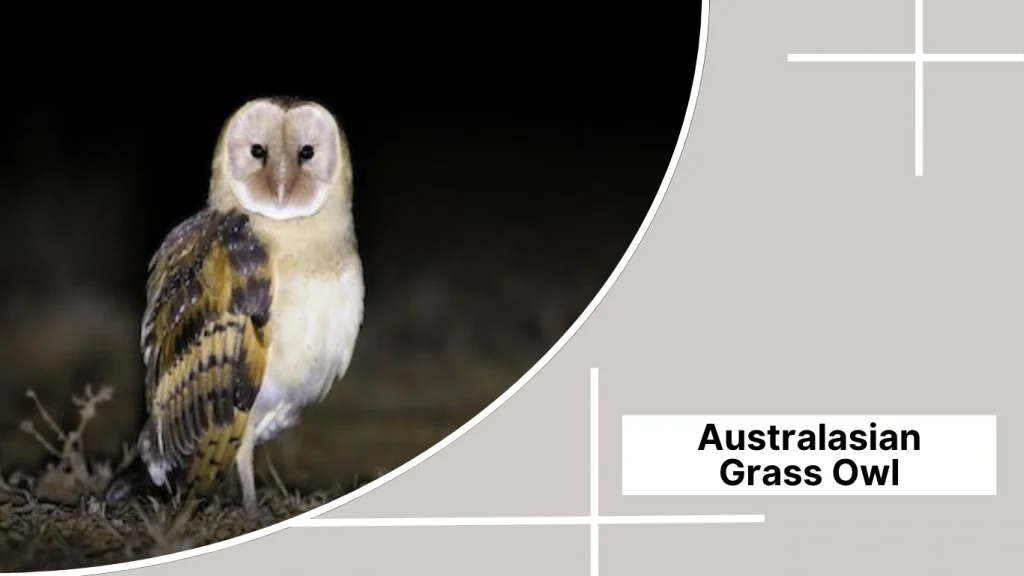
The Australasian Grass Owl (Tyto longimembris) is a slender, long-legged owl adapted to life in open grasslands and wetlands. With its pale facial disc and elegant gliding flight, it is most often seen at dusk flying low over tall grasses.
Identification
- Medium-sized owl with heart-shaped facial disc
- Pale face and underparts; buff to straw-colored upperparts with black speckles
- Long legs and rounded wings
- Dark eyes and short tail
- Length: 13–15 inches (33–38 cm)
- Wingspan: 33–39 inches (84–100 cm)
Habitat
Found in tall grasslands, swamps, sugarcane fields, and open floodplains across northern and eastern Australia, New Guinea, and Southeast Asia.
Diet
Specializes in hunting small mammals like mice and rats. Also feeds on frogs, reptiles, and large insects. Hunts by flying low over grass with slow, buoyant wingbeats.
Behavior
Nocturnal and crepuscular. Roosts in dense grass during the day, often creating a small flattened tunnel in vegetation. Rarely seen perched. Emits soft, raspy screeches and hissing calls.
Reproduction
Breeds in hidden ground nests within thick grasses. Lays 2–6 eggs per clutch. Female incubates while male provides food. Chicks fledge after 5–6 weeks.
40. Andean Pygmy Owl
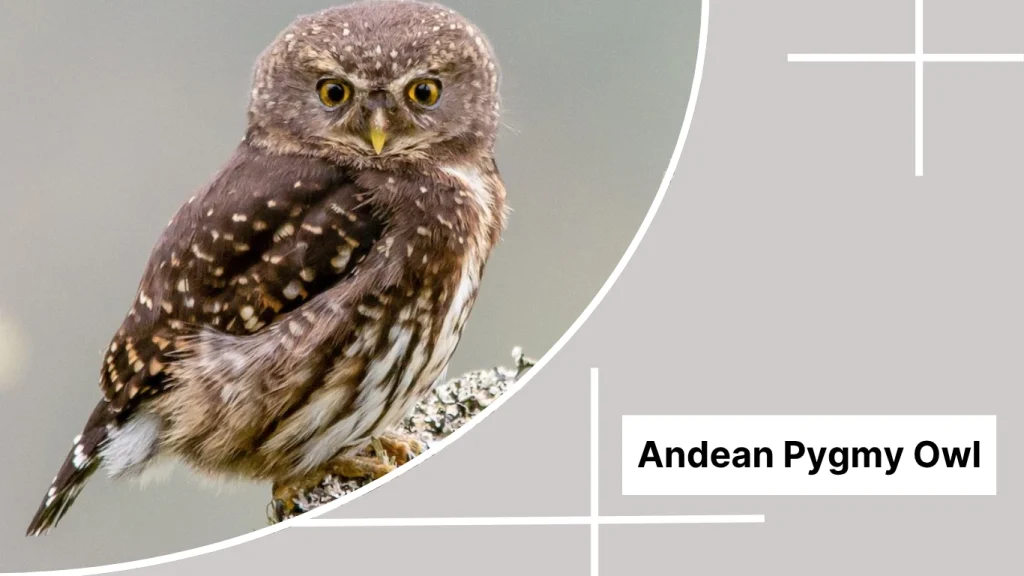
The Andean Pygmy Owl (Glaucidium jardinii) is a tiny but bold owl native to the cloud forests and highland woodlands of the Andes in South America. Despite its size, it is an aggressive predator and is often seen during the day perched on treetops or hunting among the forest canopy.
Identification
- Very small owl with a round head and no ear tufts
- Rich brown to chestnut plumage with white spotting on the crown and upperparts
- Underparts are whitish with dark vertical streaks
- Bright yellow eyes and yellow feet
- Dark nape with two black “false eyes” or ocelli
- Length: 6.5–7 inches (16–18 cm)
- Wingspan: Approximately 14–16 inches (36–41 cm)
Habitat
Found in montane cloud forests and high-elevation woodlands of the Andes, from Venezuela to Bolivia, typically between 1,500 and 3,500 meters above sea level. Prefers dense, mossy forests and wooded ravines.
Diet
Feeds on insects, small birds, lizards, and rodents. Frequently hunts in daylight (diurnal), using rapid sallying flights from perches.
Behavior
Bold and curious. Active during the day, especially in the morning and late afternoon. Often mobbed by small birds when discovered. Its call is a series of high-pitched, tooting whistles.
Reproduction
Breeding behavior is not extensively documented, but it likely nests in old woodpecker holes or natural cavities in trees. Typically lays 3–5 eggs, with incubation by the female while the male provides food.