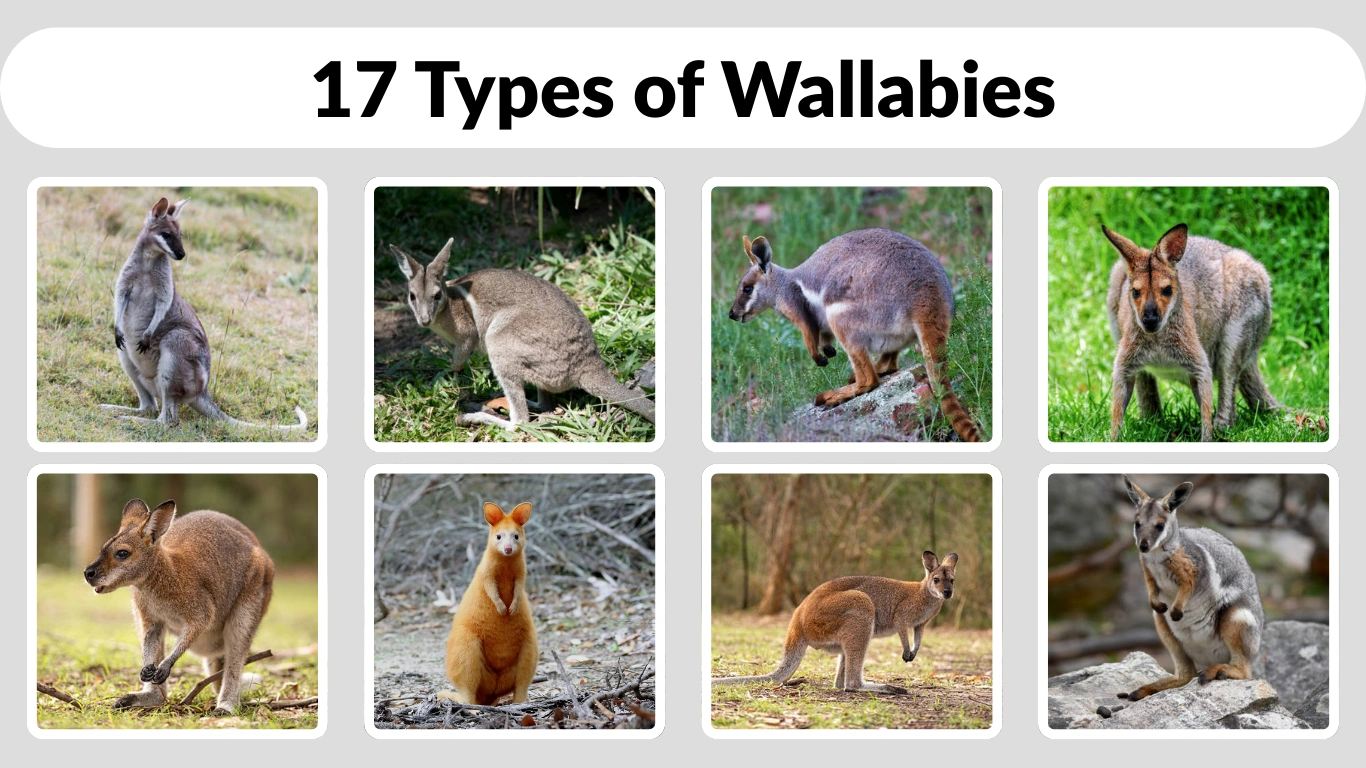
Wallabies are fascinating marsupials found across Australia, Tasmania, and Papua New Guinea, each species adapted to unique landscapes ranging from rainforests to rocky escarpments. This guide covers 17 distinct wallaby types, highlighting their identification traits, habitats, behaviors, and diets. Whether you’re learning for wildlife study or personal interest, these detailed profiles help you recognize and understand the incredible diversity of wallabies in the wild.
1. Agile Wallaby

The Agile Wallaby (Notamacropus agilis) is one of Australia’s most common mid-sized wallabies, known for its speed, adaptability, and preference for open woodlands and grasslands. It thrives in northern Australia and parts of Papua New Guinea, often forming loose groups near water sources.
Identification
- Medium-sized wallaby with a slender build
- Light brown to grey coat with pale underparts
- Distinctive white cheek stripe
- Long, powerful hind legs built for fast hopping
- Tail nearly as long as the body, used for balance
Habitat
Agile wallabies inhabit open forests, coastal plains, wetlands, and grassy savannas. They prefer areas with adequate vegetation cover and reliable water. Their range spans northern Australia, including Queensland, the Northern Territory, and Western Australia, extending into Papua New Guinea.
Behaviors
They are primarily crepuscular, active during early morning and late afternoon. Agile wallabies often move in small groups but are not highly social. They rely on speed to escape predators, using rapid zig-zag movements. Grooming, vigilance, and occasional “boxing” between males are common behaviors.
Diet
Agile wallabies are herbivores that feed mainly on grasses, fresh shoots, and leaves. They take advantage of seasonal vegetation changes and can survive dry periods by consuming hardy grasses. Their digestive system allows efficient processing of fibrous plant material.
2. Tammar Wallaby

The Tammar Wallaby (Notamacropus eugenii) is a small, compact wallaby native to southern and western Australia. Known for its agility and adaptability, it was one of the first macropods studied extensively for its unique reproductive biology and efficient energy use.
Identification
- Small body size with short limbs
- Grey-brown fur with a reddish tinge on the shoulders
- Dark stripe running from the head down the back
- Short, thick tail relative to other wallabies
- Rounded ears and a compact, stocky appearance
Habitat
Tammar wallabies inhabit coastal shrublands, open forests, and heathlands. They prefer dense vegetation for shelter during the day and open areas for feeding at night. Their natural range includes Western Australia and isolated populations in South Australia.
Behaviors
They are nocturnal, emerging at dusk to forage. Tammar wallabies are known for their strong homing ability, often returning to the same resting sites. They live in loose groups and communicate through foot-thumping and soft vocalizations. Their reproductive cycle includes delayed implantation, a rare mammalian trait.
Diet
Tammar wallabies feed primarily on grasses, leaves, and low shrubs. They choose high-moisture plants when available and can conserve water efficiently, allowing them to thrive in relatively dry environments. Their diet shifts seasonally depending on vegetation availability.
3. Red-necked Wallaby

The Red-necked Wallaby (Notamacropus rufogriseus) is a medium-sized, robust wallaby distinguished by the reddish fur around its neck and shoulders. Common in eastern Australia and Tasmania, it adapts well to forests, coastal scrubs, and farmlands.
Identification
- Grey body with a reddish neck and upper back
- Pale belly and darker muzzle
- Long, thick tail for balance
- Large rounded ears
- Strong hind legs suited for powerful hopping
Habitat
Red-necked wallabies occupy eucalypt forests, open woodlands, and scrublands, often choosing areas with thick undergrowth for cover. They are also frequently seen near farmlands and pasture edges. Their range includes eastern Australia, from Queensland to Tasmania.
Behaviors
They are mostly solitary but may gather loosely where food is abundant. Red-necked wallabies are crepuscular, active at dawn and dusk. They communicate with thumps, hisses, and soft grunts. Males may engage in sparring or boxing to establish dominance.
Diet
This species feeds on grasses, herbs, and shoots. They prefer fresh, young vegetation but can switch to tougher plants in lean seasons. Their foraging patterns follow moisture availability, often concentrating around wetter areas during dry periods.
4. Swamp Wallaby

The Swamp Wallaby (Wallabia bicolor) is a stocky, dark-furred wallaby native to eastern Australia. Known for its distinctive coloring and unique gait, it is often found in dense forests, wetlands, and scrubby habitats.
Identification
- Dark brown to black coat with rusty or orange highlights
- Pale cheek stripe and darker facial mask
- Shorter, broader snout compared to other wallabies
- Thick tail with a dark tip
- Compact build with strong limbs
Habitat
Swamp wallabies inhabit wet forests, heaths, woodlands, and thick scrub. They prefer areas with dense vegetation that provide cover. Their range stretches along the eastern coast of Australia from Queensland to Victoria, and they adapt well to varied environments including wetlands.
Behaviors
They are mostly solitary and secretive, often active at dusk, dawn, and nighttime. Swamp wallabies move with a distinctive “pigeon-toed” gait and can navigate dense undergrowth with ease. They exhibit strong territorial tendencies and may defend feeding areas with aggressive displays.
Diet
Swamp wallabies have a varied herbivorous diet that includes shrubs, leaves, ferns, and grasses. Unlike many other wallabies, they also eat woody plants and browse heavily. Their digestive system allows them to consume vegetation considered too tough or toxic for other macropods.
5. Parma Wallaby

The Parma Wallaby (Notamacropus parma) is a small, elusive species once believed to be extinct until rediscovered in the 1960s. Found mainly in New South Wales, it inhabits forested regions with dense understory vegetation.
Identification
- Small, slender build with soft grey-brown fur
- Distinct white cheek stripe and pale underparts
- Dark dorsal stripe along the back
- Long, thin tail often slightly bushy at the tip
- Narrow face and proportionally long limbs
Habitat
Parma wallabies live in moist eucalypt forests, coastal ranges, and thick understory shrublands. They prefer secluded habitats with plenty of cover for hiding. Their distribution is limited primarily to eastern New South Wales, often in hilly or mountainous terrain.
Behaviors
They are nocturnal and shy, avoiding open areas whenever possible. Parma wallabies typically remain solitary, though small groups may form around abundant food sources. They rely on stillness and camouflage to evade predators and may freeze before fleeing when threatened.
Diet
Their diet consists mostly of grasses, herbs, and tender shoots. They also browse on low shrubs and leaves depending on availability. Parma wallabies are selective feeders, often choosing high-quality vegetation and adjusting their diet seasonally to match plant growth patterns.
6. Black-flanked Rock-wallaby

The Black-flanked Rock-wallaby (Petrogale lateralis) is a striking, medium-sized rock-wallaby recognized for its dark side markings and impressive climbing agility. It inhabits rocky escarpments and rugged terrains in western and central Australia.
Identification
- Grey-brown coat with distinctive black flanks
- Pale underbelly and white side stripes
- Long, bushy tail with dark tip
- Strong, muscular hind legs adapted for climbing
- Compact body suited for maneuvering rocky surfaces
Habitat
These wallabies thrive in steep rocky outcrops, cliffs, and gorges where they can shelter in crevices. Their natural range includes Western Australia, South Australia, and parts of the Northern Territory. They prefer landscapes with scattered vegetation and low predator presence.
Behaviors
Black-flanked Rock-wallabies are shy and agile, often active at dawn and dusk. They use rock ledges for basking and rely on their powerful hind limbs for leaping between boulders. Social structure is loose, with small colonies forming around reliable shelter sites.
Diet
Their diet includes grasses, shrubs, leaves, and bark. They browse selectively on vegetation growing in rocky environments, often feeding on hardy plants adapted to arid conditions. During dry periods, they depend on moisture-rich plants to maintain hydration.
7. Yellow-footed Rock-wallaby

The Yellow-footed Rock-wallaby (Petrogale xanthopus) is one of Australia’s most colorful wallabies, easily recognized by its bright limbs, banded tail, and striking facial markings. It is native to rocky ranges in central and southeastern Australia.
Identification
- Bright yellow-orange forearms, feet, and hind legs
- Distinct facial stripes and pale cheek patches
- Long, ring-banded tail used for balance
- Soft grey-brown body fur with white underparts
- Slender build with strong legs for climbing and leaping
Habitat
Yellow-footed Rock-wallabies inhabit steep cliffs, rocky gorges, and rugged ranges. They prefer habitats with plenty of ledges and crevices for shelter. Their range spans parts of South Australia, Queensland, and New South Wales, though populations are fragmented.
Behaviors
They are crepuscular, active mainly during dawn and dusk. These wallabies live in colonies, showing more social behavior than many other species. Agile and sure-footed, they vault between rock surfaces with ease. Vocalizations, scent marking, and tail postures are used for communication.
Diet
Their diet consists of grasses, herbs, leaves, and shrubs found in arid rocky environments. They are highly efficient water conservers and often rely on moisture-rich plants during dry periods. Seasonal shifts in vegetation influence their feeding patterns throughout the year.
8. Brush Wallaby

The Brush Wallaby is a general term often applied to several species within the Notamacropus genus, but traditionally refers to wallabies adapted to forested and shrubby regions. These medium-sized wallabies are known for their agility and preference for dense cover.
Identification
- Medium build with grey-brown to reddish fur
- Pale underparts and darker facial markings
- Long, muscular tail for balance
- Slender limbs designed for quick movement through brush
- Generally compact body shape
Habitat
Brush wallabies inhabit forests, woodlands, heathlands, and scrubby areas with thick vegetation. They prefer habitats that provide shelter from predators and easy access to varied plant food sources. Their distribution spans regions across eastern and southeastern Australia, depending on the specific species referenced.
Behaviors
They are mostly solitary or form loose groups. Brush wallabies are crepuscular to nocturnal, emerging at dusk to forage. They use dense vegetation as protective cover and rely on speed and maneuverability to evade predators. Territorial behaviors may occur in feeding areas.
Diet
Brush wallabies feed on grasses, herbs, shrubs, and leaves. They are adaptable browsers, adjusting their diets based on local vegetation. Seasonal changes influence their food choices, often leading them to favor tender new growth during wetter periods.
9. Whiptail Wallaby

The Whiptail Wallaby (Notamacropus parryi) is a slender, graceful wallaby known for its exceptionally long, thin tail and distinctive facial markings. It is native to eastern Australia, commonly found in open forests and grassy woodlands.
Identification
- Very long, thin “whip-like” tail
- Slender body with grey to brown fur
- Dark facial stripe running from the nose to the eyes
- Pale underparts and lightly built limbs
- Large ears and elongated face
Habitat
Whiptail wallabies inhabit open woodlands, grassy plains, and forest edges. They prefer environments with scattered trees and abundant grass cover. Their range extends from northern New South Wales through Queensland and into parts of the Northern Territory.
Behaviors
They are social compared to many wallabies, often seen in small to medium groups. Whiptail wallabies are primarily crepuscular, active during early morning and late afternoon. They communicate through foot-thumping and subtle vocalizations, and males may engage in sparring to establish dominance.
Diet
Their diet consists mainly of grasses and low herbs. Whiptail wallabies are selective grazers, choosing tender shoots when available. During dry seasons, they shift to tougher grasses and browse lightly on shrubs to maintain their nutritional needs.
10. Shy Wallaby

The Shy Wallaby (also commonly known as the Mala or Rufous Hare-wallaby, Lagorchestes hirsutus) is a small, timid wallaby species once widespread across central Australia. Today, it survives mainly through conservation programs and protected habitats.
Identification
- Small body size with reddish-brown fur
- Soft, fluffy coat with pale underparts
- Large eyes and rounded ears
- Slender limbs designed for quick, agile hopping
- Shorter tail compared to many other wallaby species
Habitat
Shy wallabies historically inhabited spinifex grasslands, desert plains, and arid scrublands across central and western Australia. Due to declines from predators and habitat loss, they now persist mostly in fenced reserves, offshore islands, and managed reintroduction sites.
Behaviors
As their name suggests, Shy wallabies are secretive and easily startled. They are nocturnal, spending daylight hours hidden in dense vegetation or burrow-like shelters. Agile and fast, they use quick zig-zag movements to escape threats. Small social groups may form, especially in safe habitats.
Diet
Their diet consists largely of grasses, seeds, leaves, and desert herbs. Shy wallabies are adapted to arid environments and can obtain most of their moisture from food. They feed selectively, choosing nutrient-rich vegetation when available and relying on hardy plants during dry periods.
11. Pretty-faced Wallaby

The Pretty-faced Wallaby (Notamacropus parryi), also known as the Whiptail Wallaby, is a slender and elegantly built species native to eastern Australia. Its delicate facial markings and graceful posture make it one of the most visually distinctive wallabies.
Identification
- Soft grey-brown fur with pale underparts
- Delicate, light facial stripes giving a “pretty” appearance
- Long, thin tail used for balance
- Slender limbs and narrow build
- Large, expressive ears
Habitat
Pretty-faced wallabies inhabit open forests, grassy woodlands, and savannas. They prefer areas with scattered trees and abundant grass. Their range extends throughout Queensland and northern New South Wales, where they thrive in both wild and agricultural landscapes.
Behaviors
They are social wallabies, often forming loose groups while feeding. Pretty-faced wallabies are crepuscular, being most active at dawn and dusk. They communicate through foot-thumping and subtle body postures. When threatened, they rely on speed and agility to escape predators.
Diet
Their diet mainly consists of grasses, herbs, and shoots. Pretty-faced wallabies are selective grazers, preferring nutrient-rich young growth. During dry seasons, they may consume tougher grasses and browse lightly on shrubs to supplement their nutritional needs.
12. Proserpine Rock-wallaby
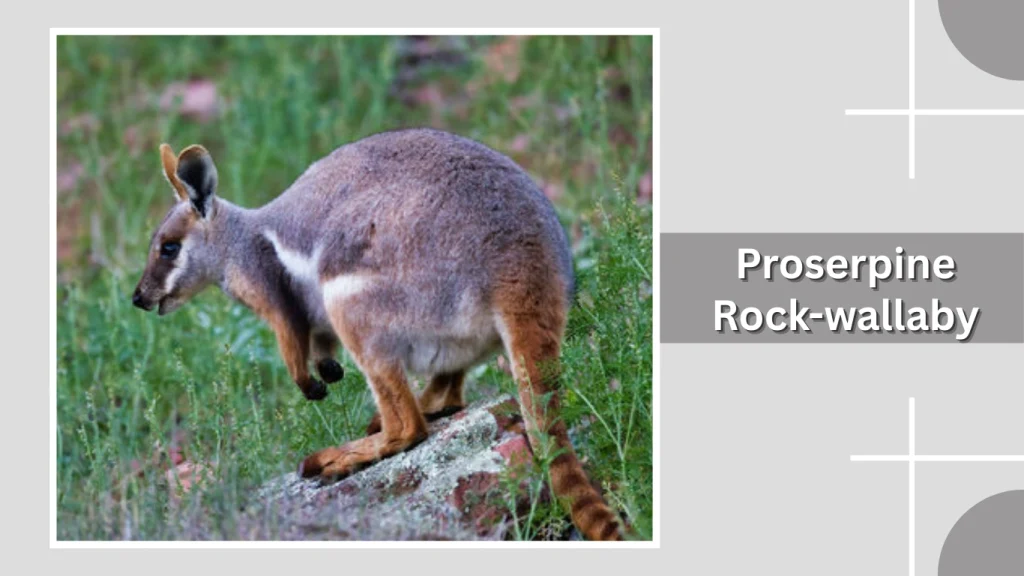
The Proserpine Rock-wallaby (Petrogale persephone) is a rare and endangered wallaby species found only in a small region of Queensland, Australia. Known for its shy nature and preference for rocky habitats, it is one of the most conservation-dependent macropods.
Identification
- Soft grey-brown fur with paler underparts
- Darker facial markings and subtle cheek stripes
- Long, bushy tail with a slightly darker tip
- Slender build with strong hind limbs for climbing
- Smaller size compared to many other rock-wallabies
Habitat
This species is restricted to rocky outcrops, cliffs, and forested slopes in the Proserpine region of Queensland. It prefers rugged terrain with plenty of crevices for shelter. Habitat loss and fragmentation make its distribution highly limited and vulnerable.
Behaviors
Proserpine Rock-wallabies are shy, secretive, and mostly nocturnal. They spend daylight hours hiding in rocky shelters and emerge at dusk to forage. Social groups are small, usually consisting of females and their young. Their agility allows them to navigate steep, uneven terrain with ease.
Diet
They feed primarily on grasses, leaves, and shrubs. This species also browses on native herbs and moisture-rich vegetation. Seasonal changes influence their diet, and in drier periods they rely more heavily on hardy plants growing between rocks.
13. Rothschild’s Rock-wallaby

The Rothschild’s Rock-wallaby (Petrogale rothschildi) is a medium-sized, striking rock-wallaby native to northwestern Australia. Known for its agility and bold coloration, it thrives in rugged, rocky landscapes where it can easily hide and climb.
Identification
- Light grey to brown coat with distinct dark markings
- Pale cheek stripe and contrasting facial patterns
- Long, ringed tail with a darker tip
- Strong hind limbs suited for steep climbing
- Compact, muscular build typical of rock-wallabies
Habitat
Rothschild’s Rock-wallabies inhabit rocky escarpments, cliffs, and rugged gorges in the Pilbara and nearby regions of Western Australia. They favor habitats with plentiful crevices for shelter and vantage points for observing predators.
Behaviors
They are primarily nocturnal and crepuscular, sheltering in rocky caves during the day. Social groups are usually small but stable, often consisting of females and juveniles. Agile and sure-footed, they leap confidently between boulders and ledges to evade predators or reach food sources.
Diet
Their diet includes grasses, leaves, herbs, and shrubs found in rocky environments. They are selective feeders, often choosing moisture-rich plants during dry periods. Seasonal variations in vegetation influence their foraging habits.
14. Lumholtz’s Tree-kangaroo

The Lumholtz’s Tree-kangaroo (Dendrolagus lumholtzi) is a unique macropod species adapted for life in the trees. Although not a true wallaby, it is often included in extended wallaby lists due to its close evolutionary relationship and similar ecological role in rainforest environments.
Identification
- Dark brown to blackish fur with lighter underparts
- Strong, muscular forearms suited for climbing
- Long, thick tail used for balance in trees
- Shorter hind limbs compared to ground-dwelling wallabies
- Compact body ideal for navigating dense canopy branches
Habitat
This species inhabits rainforests and wet, mountainous regions of northeastern Queensland, particularly the Atherton Tablelands. It prefers dense canopy cover and cooler, moist environments. Habitat fragmentation remains a major concern for its long-term survival.
Behaviors
Lumholtz’s Tree-kangaroos are mostly solitary and highly arboreal. They move slowly and deliberately through the trees, using powerful limbs for climbing. Despite their calm appearance, they can leap significant distances between branches. They are generally crepuscular, active in low-light hours.
Diet
Their diet consists mainly of leaves, fruits, and flowers from various rainforest plants. They browse selectively, often choosing nutrient-rich foliage. Slow metabolisms allow them to process fibrous plant material efficiently, enabling them to thrive in dense forest ecosystems.
15. Bridled Nail-tail Wallaby

The Bridled Nail-tail Wallaby (Onychogalea fraenata) is a small, rare wallaby distinguished by a unique “bridle” marking across its shoulders and back. Once thought extinct, it was rediscovered in 1973 and now survives through active conservation programs.
Identification
- Slender body with soft grey-brown fur
- Distinct pale “bridle” stripe from the neck to the shoulders
- Small, sharp nail-like spur at the tip of the tail
- Large eyes and long ears
- Delicate limbs suited for quick hopping
Habitat
This species inhabits open woodlands, grassy plains, and lightly forested areas. Today, its distribution is highly restricted, with surviving populations found mainly in protected reserves within Queensland and New South Wales. Dense grass cover is important for shelter and nesting.
Behaviors
Bridled Nail-tail Wallabies are mostly nocturnal and shy. They spend daylight hours resting in shallow scrapes or hiding in dense grass. When threatened, they sprint quickly with a zig-zag motion. Social structure is loose, though small groups may form in optimal feeding areas.
Diet
Their diet includes grasses, herbs, and tender shoots. They preferentially graze on young, nutrient-rich plants but will shift to tougher vegetation in dry seasons. Moisture-rich greens help sustain them during arid periods.
16. Northern Nail-tail Wallaby

The Northern Nail-tail Wallaby (Onychogalea unguifera) is a sleek, lightly built wallaby found across northern Australia. It is named for the small, nail-like spur at the end of its tail, a distinctive feature of the nail-tail wallabies.
Identification
- Light brown to grey coat with pale underparts
- Slender body and long hind limbs
- Small horny “nail” at the tail tip
- Long, narrow face with large ears
- Compact but agile build for fast hopping
Habitat
Northern Nail-tail Wallabies inhabit open woodlands, grasslands, and lightly timbered regions. Their range spans across northern Australia, including the Northern Territory, Queensland, and Western Australia. They prefer habitats with grassy cover and scattered shrubs for shelter.
Behaviors
They are mostly nocturnal, spending the day resting in shade or shallow depressions. Northern Nail-tail Wallabies are solitary or seen in small groups. They rely on speed and alertness to evade predators, often using sudden bursts of hopping to escape threats.
Diet
Their diet consists primarily of grasses, herbs, and leaves. They graze selectively on fresh shoots when available and can shift to tougher, drier grasses during dry seasons. Their efficient digestion supports survival in hot, open environments.
17. Doria’s Tree-kangaroo

The Doria’s Tree-kangaroo (Dendrolagus dorianus) is a large, arboreal macropod native to the montane forests of Papua New Guinea. Although not a true wallaby, it is often included in extended wallaby lists due to its close evolutionary ties and similar ecological niche.
Identification
- Thick brown to reddish-brown fur with pale underside
- Strong forelimbs specialized for climbing
- Long, heavy tail used for balance in trees
- Shorter hind legs than ground-dwelling wallabies
- Robust body suited for arboreal life
Habitat
Doria’s Tree-kangaroos inhabit high-altitude rainforests and cloud forests, usually between 600–3,000 meters elevation. These dense, humid environments provide abundant foliage and canopy cover. They rely heavily on tall trees for movement, shelter, and feeding.
Behaviors
They are largely solitary and slow-moving, spending most of their time in trees. Doria’s Tree-kangaroos are crepuscular, active mainly during early morning and late afternoon. They climb with powerful forelimbs and can leap between branches when needed. When threatened, they may freeze, hide, or descend to escape.
Diet
Their diet includes leaves, fruits, flowers, and tender shoots from a variety of rainforest plants. They browse selectively, often choosing soft young leaves. A slow metabolism allows them to digest fibrous vegetation efficiently, supporting their lifestyle in dense, shaded forests.
FAQs
1. What is the main difference between a wallaby and a kangaroo?
Wallabies are generally smaller, more compact, and adapted to dense forests or rocky areas, while kangaroos are larger and suited for open plains. Their body proportions differ too—wallabies have shorter legs and more varied coloration.
2. Are wallabies dangerous to humans?
Wallabies are typically shy and avoid confrontation. They are not considered dangerous, though they may defend themselves with kicks or scratches if threatened or cornered. In the wild, they prefer to flee rather than fight.
3. What do wallabies eat in the wild?
Most wallabies are herbivores that eat grasses, leaves, shrubs, shoots, and herbs. Rock-wallabies also browse on tougher vegetation. Diet varies by species and habitat, especially between forest-dwelling and arid-region wallabies.
4. Where are wallabies commonly found?
Wallabies are native to Australia, Tasmania, and Papua New Guinea. Different species inhabit forests, rocky escarpments, grasslands, wetlands, and savannas. Some populations live on offshore islands and in conservation reserves.
5. Why are some wallaby species endangered?
Threats include habitat loss, invasive predators (like foxes and cats), disease, climate change, and human development. Several species rely on conservation programs, predator-free enclosures, and reintroduction efforts to survive.