
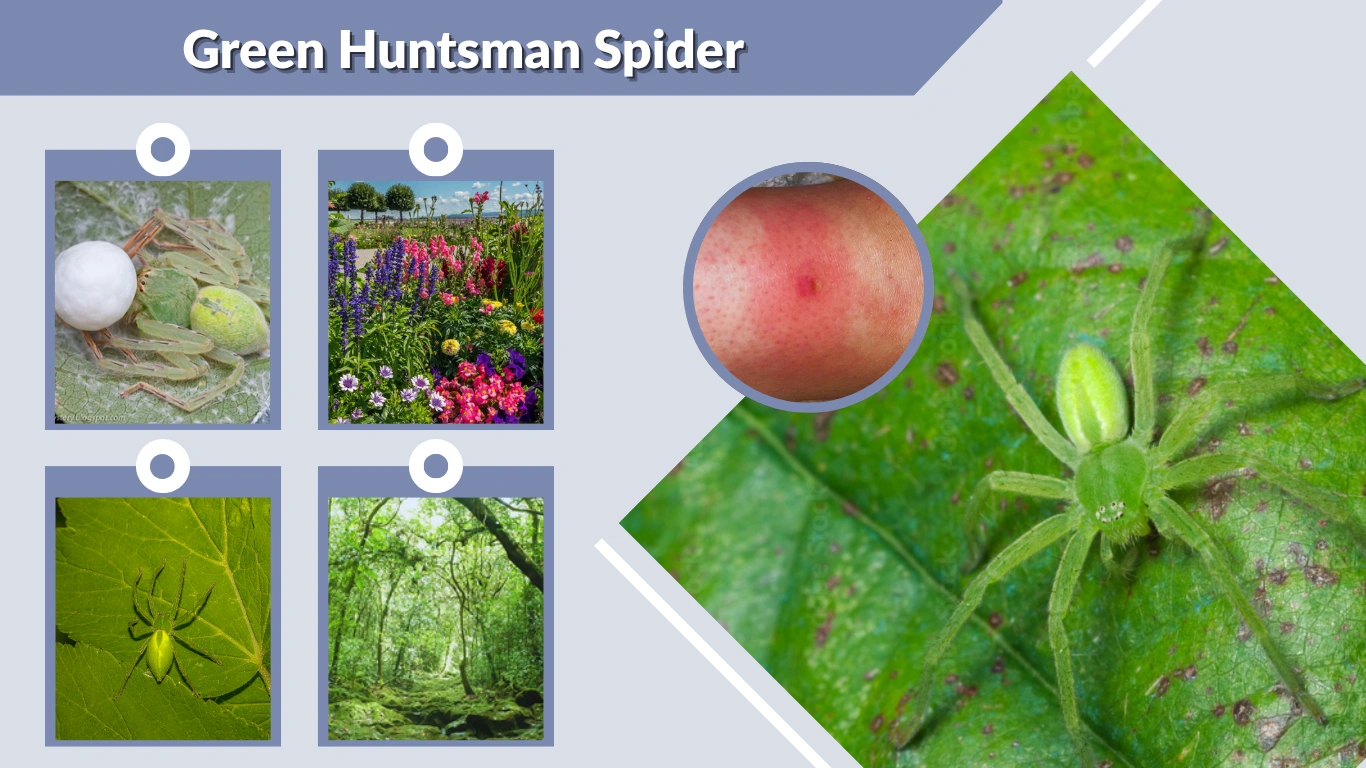
The green huntsman spider (Micrommata virescens) is one of the most fascinating arachnids recognized for its bright green coloring and unique hunting style. Unlike many spiders that weave webs, it relies on stealth and ambush tactics. Its striking appearance often raises questions about its size, venom, and whether it is dangerous to humans. Found in various parts of the world, this spider is both admired and feared, making it a subject of curiosity across different regions.
Identification and Appearance

The green huntsman spider is easily identified through its vivid coloring and slim body design. Here are the key identification features:
- Bright green body with variations such as the green-bellied and giant green-bellied huntsman.
- Females are larger and display deeper, more intense shades of green than males.
- Baby spiders or juveniles are lighter in color, developing their characteristic shade as they mature.
- Regional differences exist, with unique adaptations such as Thailand’s black and green banded legs.
This natural camouflage not only helps them blend into leaves and grasses but also confuses predators and assists in ambushing prey.
Habitat and Global Distribution

The green huntsman spider has a surprisingly wide distribution, inhabiting parts of Australia, South Africa, India, Malaysia, Thailand, France, Portugal, Ireland, Cyprus, and the UK. While its scientific name Micrommata virescens applies mainly to the European species, similar green-colored huntsman variants exist across other continents.
In Australia, these spiders are frequently reported in Sydney and other forested areas, often spotted in shrubs and gardens. South African populations prefer dense vegetation and grasslands. Across Europe, especially in France, Portugal, and Ireland, they are often sighted in spring and summer. In Asia, particularly in India, Malaysia, and Thailand, they adapt well to warm tropical climates, using forests and leaf litter as their natural habitat.
This broad spread has led to several localized names and descriptions, but all share the same fundamental traits of camouflage, speed, and ambush-style hunting.
Size and Physical Characteristics

The green huntsman spider is medium-sized when compared with other huntsman spiders. On average:
- Males measure between 10–15 mm in body length.
- Females range from 12–18 mm, though giant forms in Australia and South Africa can exceed 20 mm.
Their bodies are slim, and their long legs allow for fast movements, making them effective hunters. The female’s larger size not only helps in reproduction but also gives her an advantage when guarding egg sacs.
In regions such as Australia, sightings of giant green-bellied huntsman spiders have contributed to myths about their enormous size. While they are large compared to European species, they are not among the largest huntsman spiders overall.
Venom, Bite, and Human Interaction

The green huntsman spider is often a source of fear due to its color and size, but its danger to humans is relatively low.
Are Green Huntsman Spiders Poisonous or Venomous?
These spiders are venomous, like most spider species, meaning they use venom to immobilize prey. However, they are not poisonous if ingested. Their venom is designed for small insects, not humans. Confusion often arises because people mistakenly use “poisonous” and “venomous” interchangeably. In reality, the green huntsman’s venom is not considered medically significant for humans.
Green Huntsman Spider Bite
Bites from this spider are uncommon because it tends to avoid humans. When they do occur, the effects are generally mild, including:
- Localized redness and swelling
- A stinging or burning sensation
- Mild pain that usually resolves within a few hours to a couple of days
In the UK and European regions, green huntsman bites are exceptionally rare due to their shy nature and limited distribution. In Australia and South Africa, where larger forms exist, bites may be slightly more noticeable but remain non-lethal.
While not dangerous, individuals with sensitivities or allergies to spider venom should exercise caution and seek medical advice if symptoms persist.
Behavior and Hunting Style
Green huntsman spiders are active hunters that rely on stealth rather than webs. Their slim body and long legs allow them to move quickly across leaves and branches. Instead of weaving webs, they use ambush tactics, waiting in camouflage until prey comes within striking distance. Their diet includes insects such as flies, grasshoppers, and moths.
They are also daytime hunters, which is unusual for many spider species. Their vivid green coloring not only aids camouflage in foliage but also provides cover while they move in search of prey.
Interesting Facts

Here are some unique facts about the green huntsman spider:
- The scientific name of the European species is Micrommata virescens.
- Their lifespan is 1–2 years in natural environments.
- Females guard egg sacs carefully, often staying with them until spiderlings hatch.
- They are often mistaken for grass or leaves due to camouflage.
- Their bright color helps both in avoiding predators and ambushing unsuspecting prey.
Green Huntsman Spider in Australia

Australia is home to several variations, including the Australian green huntsman and the giant green-bellied huntsman.
Australian Green Huntsman Spider
These spiders are found in Sydney and surrounding forests, where they hide in shrubs and leaf clusters. Despite their larger size compared to European species, they are generally harmless to humans.
Green-Bellied and Giant Variants
Some Australian populations are larger and display more intense coloring, earning them names like giant green-bellied huntsman. These have become the subject of viral photos due to their intimidating size, although they pose no major threat to people.
Green Huntsman Spider in Europe and the UK
Across France, Portugal, Ireland, and the UK, the green huntsman is less common but still recognized. In the UK, reports are rare, and many people question whether bites are dangerous. The truth is that while they can bite, the effects are mild and usually limited to short-term irritation.
In France and Portugal, they are more frequently observed in gardens, forests, and meadows during warmer months. Their presence in Europe has made them a subject of fascination in wildlife studies and photography.
Green Huntsman Spider in Asia and Africa
In India and Malaysia, the green huntsman thrives in humid, tropical forests. Their camouflage helps them survive in areas dense with predators and competing insect species.
South Africa also has a notable population, where they inhabit grasslands and woodlands. Locals often recognize them by their bright coloration, but they are not considered a serious danger.
One particularly striking variant exists in Thailand, where some huntsman spiders have black and green banded legs, making them stand out compared to the solid green European type.
Photos and Visual Identification
Images of green huntsman spiders highlight their stunning appearance:
- Bright green adults with long legs and slim bodies
- Australian specimens often appear larger in photos compared to European ones
- Juvenile spiders start off pale and gradually develop their vivid coloration
- Females, when photographed, are visibly larger than males
Photography of these spiders often showcases their camouflage skills, with many blending perfectly into leaves, making them difficult to spot.
Green Huntsman Spider and Other Species
In nature, the green huntsman competes and interacts with various species. Comparisons with jumping jack ants highlight their role as both predators and prey in ecosystems. While the huntsman’s speed and venom make it a skilled insect hunter, larger predators such as birds and reptiles also keep its numbers in check.
This delicate balance ensures that the green huntsman continues to thrive without becoming invasive or overly abundant in its environments.
FAQs
Is the green huntsman spider poisonous?
No, the green huntsman spider is not poisonous. It is venomous, like most spiders, but its venom is mild and not harmful to humans. The confusion often comes from mixing up “poisonous” with “venomous.”
Where can you find the green huntsman spider?
They are found across several regions including Australia, South Africa, India, Malaysia, Thailand, France, Portugal, Ireland, Cyprus, and the UK. They prefer shrubs, gardens, grasslands, and forests where their camouflage provides protection.
How big can a green huntsman spider get?
Males average 10–15 mm, while females reach 12–18 mm. In some regions like Australia and South Africa, giant green-bellied variants can grow over 20 mm in body length, appearing much larger in photos.
What happens if a green huntsman spider bites you?
A bite usually causes mild pain, swelling, and redness, similar to a bee sting. Symptoms fade within a few hours to days. Severe reactions are extremely rare, but medical advice is recommended for those with allergies.
How long does a green huntsman spider live?
The average lifespan is 1–2 years, depending on habitat and conditions. Females tend to live longer than males, especially during breeding, as they guard egg sacs until spiderlings hatch.