
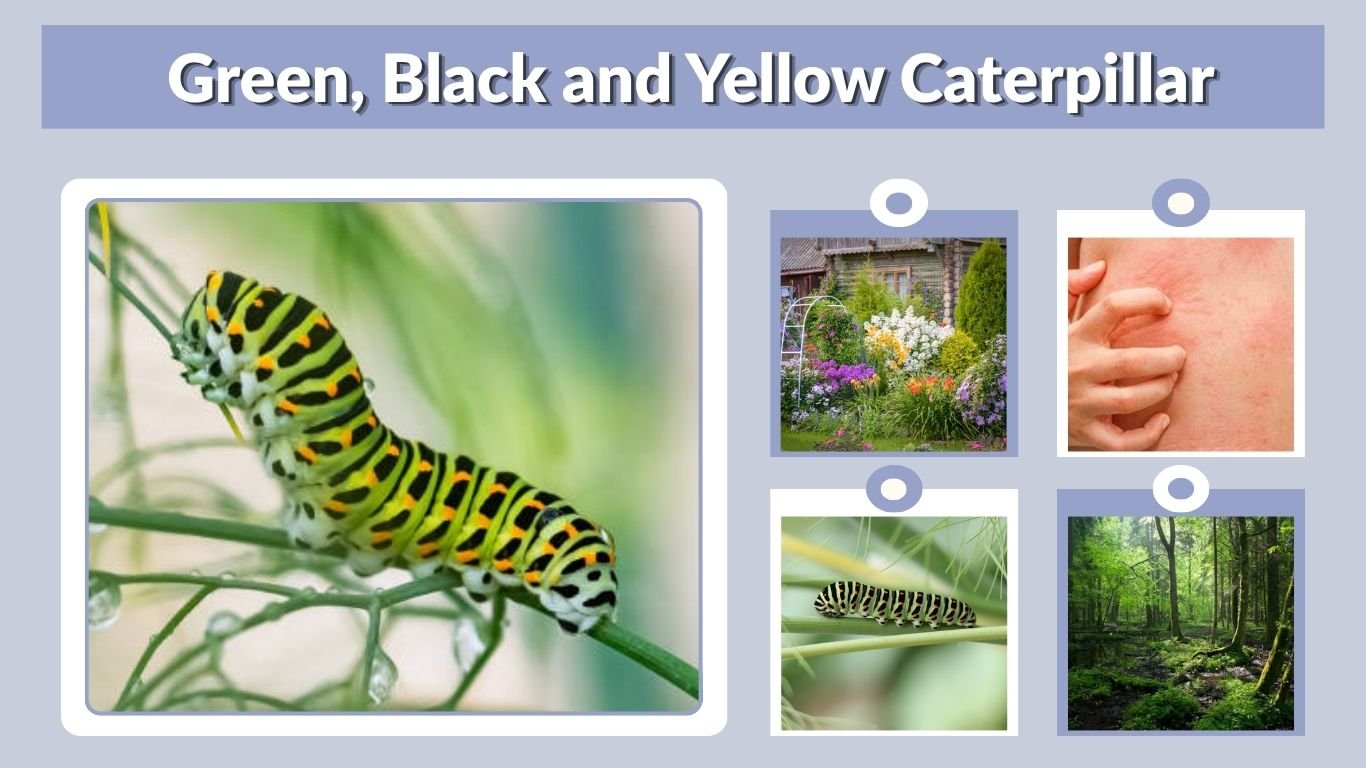
Green, black and yellow caterpillars are often eye-catching because their colors appear in bold stripes, spots, bands, or rings. Some are harmless garden visitors, while others may feed heavily on vegetables, herbs, trees, or ornamental plants. This guide explains how to identify common green, black and yellow caterpillars, what they may turn into, whether they are poisonous, and when you should leave them alone or manage them carefully.
What Is a Green, Black and Yellow Caterpillar?
A green, black and yellow caterpillar is not one single species. Many moth and butterfly larvae can show this color combination at different growth stages. Some have black stripes with yellow dots, others have yellow bands, black heads, green bodies, or spotted patterns.
These caterpillars are usually found on host plants, where they feed before pupating. Their colors may help them blend with leaves, warn predators, or mimic bird droppings when young.
Common Appearance
Most green, black and yellow caterpillars share a few visual features:
- Green body color, often lime, bright green, or pale green
- Black stripes, rings, dots, or bands
- Yellow spots, lines, patches, or side markings
- Smooth, slightly hairy, or spiky body texture
- Found on leaves, stems, herbs, shrubs, or trees
The exact pattern is important. A green caterpillar with black stripes and yellow dots may be a swallowtail larva, while a large green caterpillar with black and yellow markings may be a moth larva.
Why These Colors Matter
Green helps caterpillars hide among leaves. Black markings can break up the body shape, making the caterpillar harder for birds to detect. Yellow spots or bands may act as warning colors, especially in species that store bitter chemicals from their host plants.
In some cases, the colors change as the caterpillar grows. A young caterpillar may look black and white, then later become green with yellow and black spots.
Quick Identification Table
| Feature | What It May Suggest |
| Green body with black bands and yellow dots | Swallowtail caterpillar |
| Large green body with yellow and black diagonal stripes | Hornworm or sphinx moth larva |
| Green body with black head and yellow markings | Early-stage butterfly or moth larva |
| Green caterpillar on parsley, dill, or fennel | Black swallowtail caterpillar |
| Green caterpillar on tomato or tobacco plants | Tomato or tobacco hornworm |
| Spiky or hairy body | Avoid touching until identified |
Common Green, Black and Yellow Caterpillars
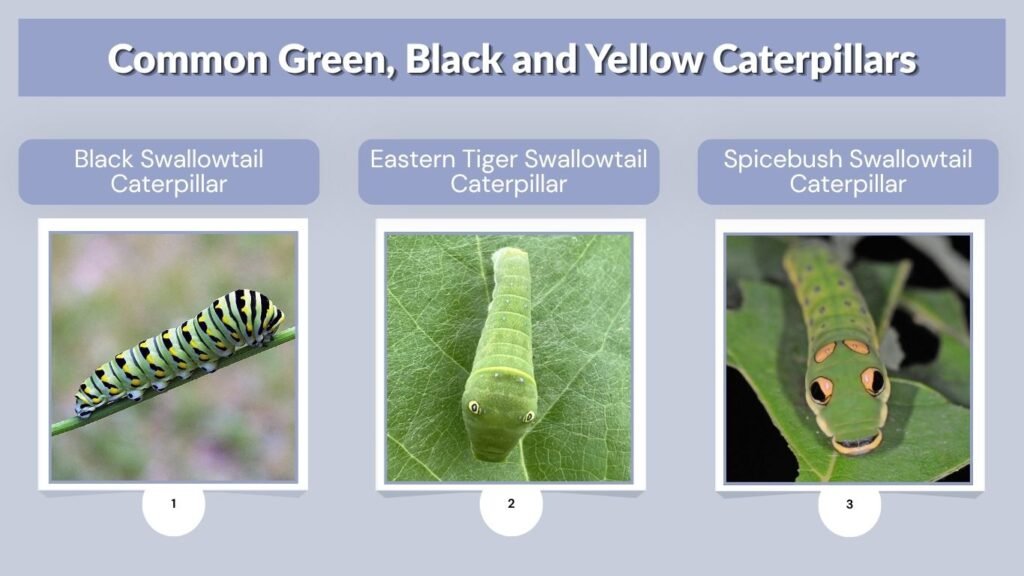
Several caterpillars match this color pattern. Some are butterflies, while others become moths. Identification depends on body shape, host plant, location, and markings.
Look closely at whether the caterpillar has stripes, dots, horns, spines, or a black head. Also check what plant it is eating, because host plants are one of the best clues.
Black Swallowtail Caterpillar
The black swallowtail caterpillar is one of the most common green, black and yellow caterpillars. It often has a bright green body with black bands and yellow or orange-yellow dots. It is commonly found on parsley, dill, fennel, carrot tops, celery, and Queen Anne’s lace.
This caterpillar later becomes a black swallowtail butterfly. It is not harmful to humans, but it may eat leaves from herb plants. Gardeners often move it to extra parsley or dill instead of killing it.
Eastern Tiger Swallowtail Caterpillar
The eastern tiger swallowtail caterpillar is usually green in its later stage, with eye-like markings near the head. Some individuals may show yellow and black details, especially around the false eyes or body lines.
It often feeds on trees such as tulip tree, cherry, birch, ash, and sweetbay magnolia. Unlike black swallowtail larvae, it is usually not found on herbs. Its large false eyes help scare away predators.
Tomato Hornworm
The tomato hornworm is a large green caterpillar with pale diagonal stripes and a horn at the rear. It can sometimes appear green, black and yellow because of its body markings, dark horn, and yellowish side lines.
It feeds on tomato, pepper, eggplant, and potato plants. It can remove leaves quickly and damage fruit. This caterpillar becomes a large sphinx moth, but gardeners often remove it by hand when it appears in vegetable gardens.
Spicebush Swallowtail Caterpillar
The spicebush swallowtail caterpillar is green with large false eye spots. While it is not always strongly black and yellow, some individuals show yellowish markings with dark borders. It rolls or hides inside leaves during the day.
Its main host plants include spicebush and sassafras. It is harmless to people and becomes a beautiful dark swallowtail butterfly. Its snake-like appearance helps protect it from birds and other predators.
Cabbage Looper and Related Green Caterpillars
Some green garden caterpillars may have faint yellow stripes and small black marks. Cabbage loopers are usually pale green and move by arching their bodies. They feed on cabbage, kale, broccoli, cauliflower, and other leafy greens.
They do not usually have bold black and yellow spots, but damaged leaves and pale green bodies may cause confusion. These caterpillars become moths and can be garden pests if numbers are high.
How to Identify a Green Caterpillar With Black Stripes and Yellow Spots
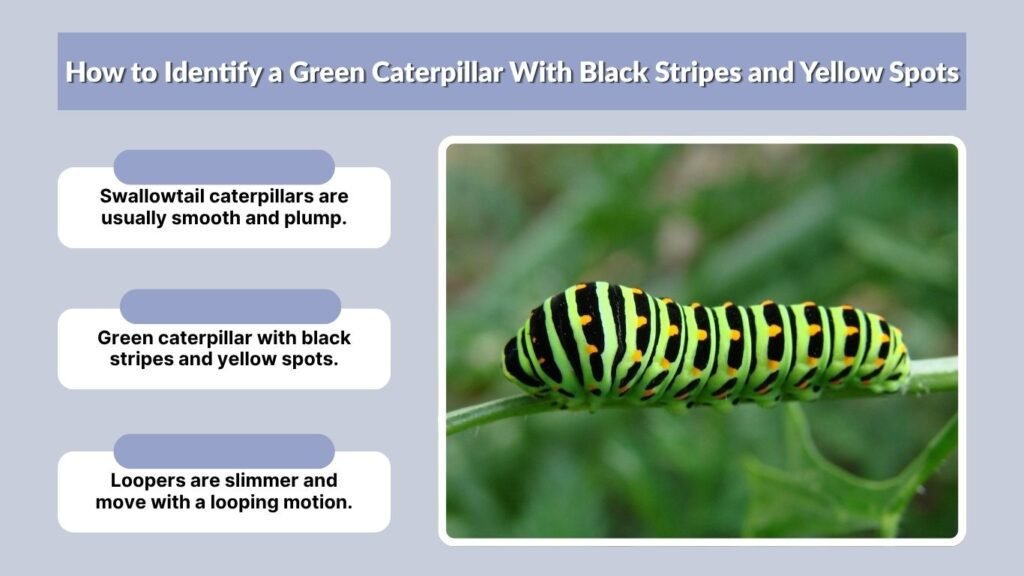
A green caterpillar with black stripes and yellow spots is often a swallowtail caterpillar, especially if it is feeding on herbs. However, identification should not depend on color alone. Size, plant choice, body shape, and markings all matter.
Check the caterpillar in good light and compare its pattern from head to tail. Avoid touching it if it has hairs, spines, or an unknown texture.
Check the Host Plant
The plant where you find the caterpillar is one of the strongest identification clues.
- Parsley, dill, fennel, carrot tops: often black swallowtail
- Tomato, pepper, eggplant, potato: often hornworm
- Milkweed: may be monarch or milkweed tussock moth
- Cabbage, kale, broccoli: cabbage worm or cabbage looper
- Cherry, birch, tulip tree: possible tiger swallowtail
- Spicebush or sassafras: possible spicebush swallowtail
If the caterpillar is on parsley and has green, black and yellow bands, it is very likely a black swallowtail caterpillar.
Look at the Body Shape
Body shape gives another useful clue. Swallowtail caterpillars are usually smooth and plump. Hornworms are large and thick, with a visible horn on the rear end. Loopers are slimmer and move with a looping motion.
Hairy or spiky caterpillars need more caution. Some hairy caterpillars can irritate skin, even if they are not truly poisonous.
Notice Stripes, Dots, and Bands
Markings can separate similar species. A black swallowtail caterpillar usually has black bands with yellow or orange dots. A hornworm has diagonal pale lines and may have dark or yellowish markings. Some moth caterpillars have scattered black spots rather than clean bands.
Clear banding usually points toward swallowtails, while diagonal stripes and a tail horn often point toward sphinx moth caterpillars.
Is a Green, Black and Yellow Caterpillar Poisonous?
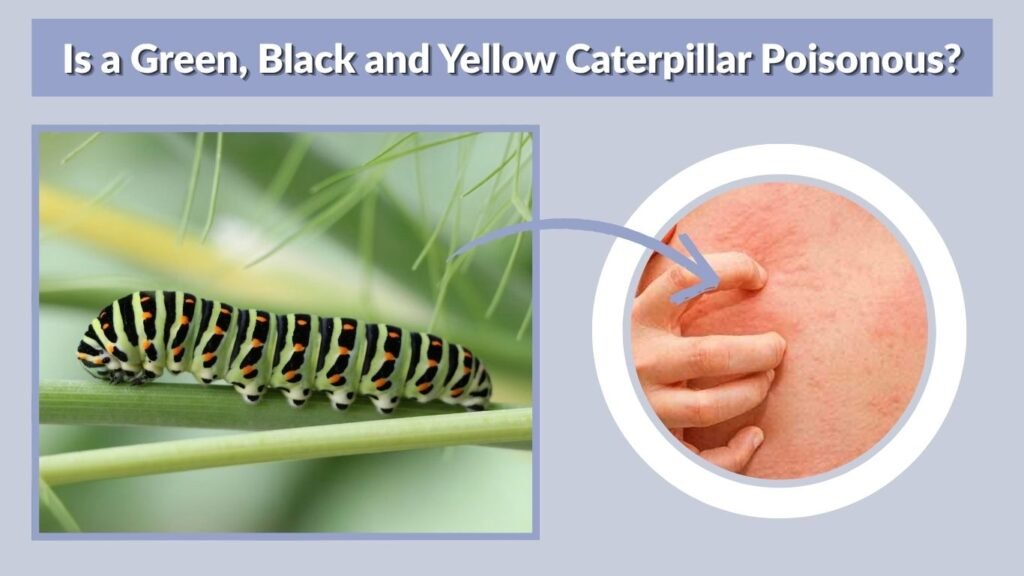
Most green, black and yellow caterpillars are not dangerous to humans. However, “poisonous” can mean different things. Some caterpillars are toxic if eaten by predators, while others may irritate skin if touched.
The safest rule is simple: do not handle unknown caterpillars with bare hands, especially if they have hairs, spines, or bright warning colors.
Harmless to Humans
Many common green, black and yellow caterpillars are harmless to people. Black swallowtail caterpillars, tiger swallowtail caterpillars, and spicebush swallowtail caterpillars do not sting. They can be observed safely on plants.
Still, avoid rough handling. Caterpillars are soft-bodied and can be injured easily. If you need to move one, use a leaf or small stick.
Toxic to Predators
Some caterpillars feed on plants that contain strong chemicals. These chemicals can make the caterpillar taste bad to birds or other predators. This does not always mean the caterpillar will harm humans by touch.
Bright colors, yellow spots, and black markings may warn predators that the caterpillar is not a good meal. In nature, color often works as a defense signal.
When to Avoid Touching
Avoid touching a caterpillar if it has:
- Dense hairs or bristles
- Sharp-looking spines
- Unknown black spikes
- Bright warning colors with fuzzy texture
- Skin-irritating host plants nearby
- No clear identification
If you accidentally touch one and develop itching, redness, or burning, wash the area with soap and water. Seek medical advice if symptoms become severe.
Where Green, Black and Yellow Caterpillars Are Found
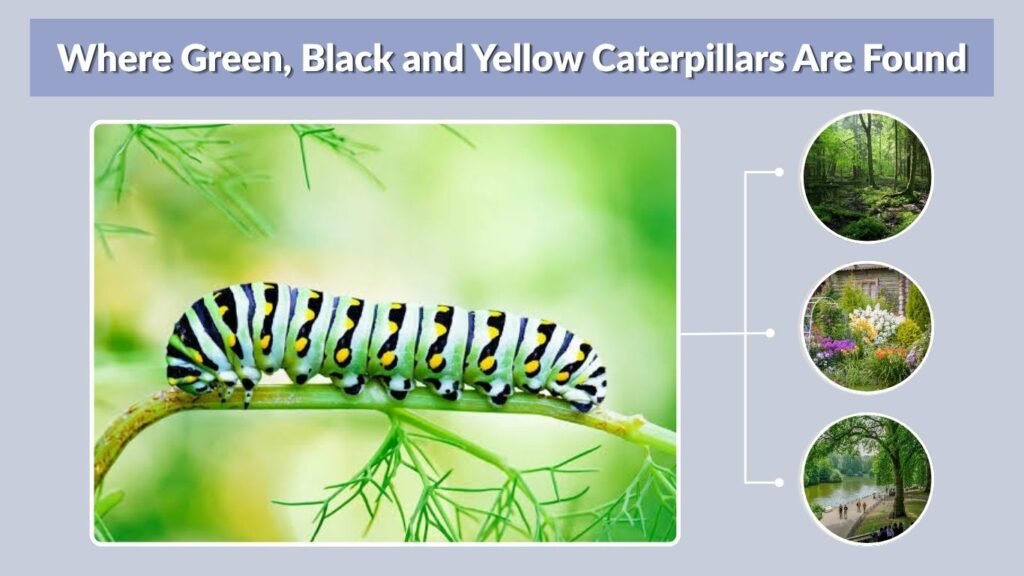
These caterpillars can appear in gardens, forests, meadows, yards, farms, parks, and roadside areas. Their location depends on the host plants available.
Many people notice them in spring, summer, or early fall, when butterflies and moths are actively laying eggs. Warm weather and fresh plant growth make caterpillars easier to find.
In Gardens
Garden herbs and vegetables attract many caterpillars. Parsley, dill, fennel, carrot tops, tomato plants, cabbage, kale, and broccoli are common feeding sites.
Some caterpillars are welcome butterfly larvae, while others are garden pests. Before removing them, identify the species. A black swallowtail caterpillar on dill may be worth keeping, while a hornworm stripping tomato leaves may need control.
On Trees and Shrubs
Some green, black and yellow caterpillars feed on tree leaves. Swallowtail species may use cherry, birch, tulip tree, sassafras, spicebush, or magnolia. These caterpillars are often less noticeable because they blend into foliage.
Tree-feeding caterpillars usually do not cause serious damage unless there are many larvae on a small or stressed plant.
Regional Clues
Searches for green yellow and black caterpillars often include locations such as Ohio, Michigan, Tennessee, Nebraska, New England, New Jersey, and the UK. Location can narrow identification, but plant type and body pattern are still more reliable.
For example, a green caterpillar with black and yellow bands on parsley in Ohio is more likely a black swallowtail than a tropical species.
What Do Green, Black and Yellow Caterpillars Turn Into?
Most of these caterpillars turn into moths or butterflies after pupation. The adult form may look very different from the larva. A striped green caterpillar may become a dark butterfly, a large brown moth, or a colorful swallowtail.
Caterpillars go through several growth stages before becoming pupae. Their color may change as they mature.
Butterfly Caterpillars
Many green, black and yellow caterpillars become butterflies. Black swallowtail, tiger swallowtail, and spicebush swallowtail larvae are good examples.
These caterpillars often have smooth bodies and defensive tricks, such as false eyes or a scent organ called an osmeterium. When disturbed, swallowtail caterpillars may extend this orange fork-like organ to discourage predators.
Moth Caterpillars
Some green caterpillars with yellow and black markings become moths. Hornworms become sphinx moths, also called hawk moths. These adult moths are strong flyers and may visit flowers at dusk.
Other moth larvae may be green with black dots, yellow lines, or fuzzy markings. Some are harmless, while others may damage crops or ornamental plants.
Pupa Stage
After feeding enough, the caterpillar stops eating and finds a safe place to pupate. Butterfly caterpillars may form a chrysalis attached to a stem or branch. Moth caterpillars may pupate in soil, leaf litter, or a cocoon.
During this stage, the larva transforms into an adult butterfly or moth.
Should You Remove These Caterpillars?
Whether you should remove a green, black and yellow caterpillar depends on the species and the plant damage. Some are beneficial because they become pollinating butterflies. Others can damage vegetable gardens.
Start by identifying the caterpillar before taking action. Killing every caterpillar can reduce butterflies and disrupt the garden ecosystem.
Leave Beneficial Caterpillars Alone
Leave the caterpillar alone if it is a swallowtail larva on parsley, dill, fennel, spicebush, or tree leaves and the damage is minor. These caterpillars usually do not destroy healthy plants.
You can plant extra herbs as “host plants” for butterfly larvae. Many gardeners grow dill or fennel specifically to support swallowtails.
Remove Heavy Garden Pests
Remove caterpillars if they are causing serious damage to vegetables. Tomato hornworms, cabbage loopers, and cabbage worms can quickly reduce plant health if many are present.
Handpicking is often enough for small gardens. Drop pests into soapy water or move them far from valuable crops. For organic control, many gardeners use row covers or encourage natural predators.
Use Safe Handling Methods
Do not crush unknown caterpillars with bare hands. Use gloves, a leaf, or a small container. If you want to identify one, take clear photos of the top, side, head, rear end, and host plant.
Good photos make identification much easier and reduce the risk of misidentifying a harmless butterfly larva as a pest.
FAQs
What is a green caterpillar with black stripes and yellow dots?
A green caterpillar with black stripes and yellow dots is often a black swallowtail caterpillar, especially if it is found on parsley, dill, fennel, carrot tops, or Queen Anne’s lace. However, other species may look similar, so check the host plant, body shape, and markings before confirming the identification.
Is a green black and yellow caterpillar poisonous?
Most green, black and yellow caterpillars are not poisonous to humans by touch. Some may be toxic to predators if eaten, and hairy or spiny species may irritate skin. Avoid handling unknown caterpillars with bare hands until you know the species, especially if it has bristles or spikes.
What does a black swallowtail caterpillar turn into?
A black swallowtail caterpillar turns into a black swallowtail butterfly. The adult butterfly is mostly black with yellow markings and blue or orange accents, depending on sex and region. The caterpillar commonly feeds on parsley, dill, fennel, carrots, celery, and related plants.
Why is there a green caterpillar on my parsley?
A green caterpillar on parsley is commonly a black swallowtail caterpillar. Female black swallowtail butterflies lay eggs on parsley-family plants because the larvae use them as food. If you want butterflies in your garden, leave some parsley or dill for the caterpillars to eat.
Should I kill green caterpillars with yellow and black spots?
Do not kill them immediately. First identify the species and check plant damage. If it is a swallowtail caterpillar, it may become a beneficial butterfly. If it is heavily damaging vegetables, you can remove it by hand, relocate it, or use gentle garden control methods.
