
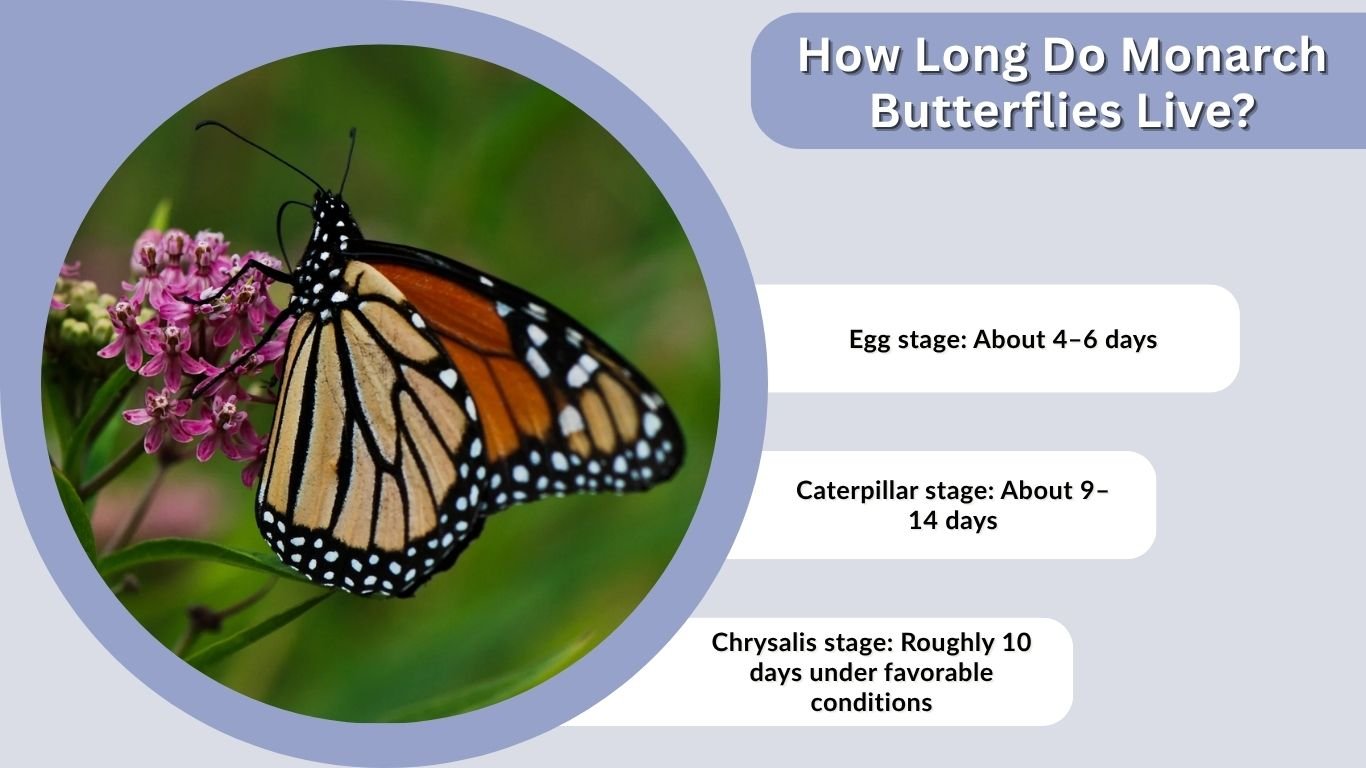
How long do monarch butterflies live? Most adult monarchs born during spring and summer live only about 2 to 6 weeks, but the special migratory generation can survive for 6 to 9 months. This dramatic difference results from migration, reproductive diapause, weather, food availability, predators, and seasonal conditions. Monarchs also spend several weeks developing as eggs, caterpillars, and chrysalises before adulthood. Understanding their complete life cycle explains why one monarch may survive just a few weeks while another can live through migration and an entire winter.
How Long Do Monarch Butterflies Live?
There is no single lifespan that applies to every monarch butterfly. Most breeding-season adults live relatively short lives because they quickly mate and reproduce. Monarchs emerging near the end of summer behave differently. Instead of immediately reproducing, they delay sexual maturity, migrate hundreds or thousands of miles, overwinter, and survive until the following spring.
Monarch Lifespan at a Glance
Typical lifespan patterns include:
- Spring and summer adults: About 2–6 weeks
- Migratory generation: About 6–9 months
- Egg stage: About 4–6 days
- Caterpillar stage: About 9–14 days
- Chrysalis stage: Roughly 10 days under favorable conditions
- Total life from egg to death: Varies greatly with generation and season
Monarch Joint Venture reports that summer generations generally live only several weeks as adults, while successful migratory monarchs can survive up to about nine months.
How Long Do Adult Monarch Butterflies Live?
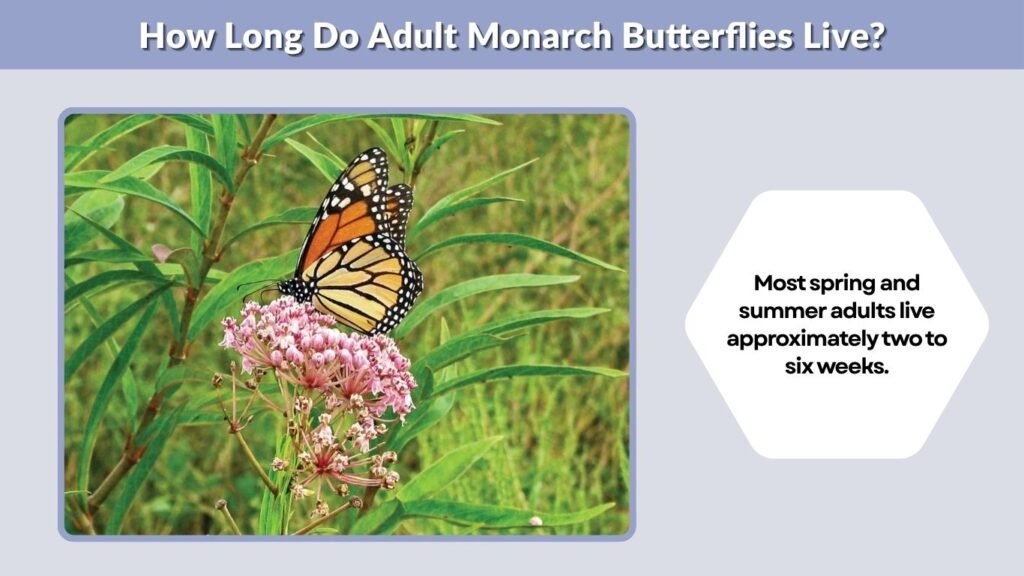
Adult lifespan depends mainly on whether the monarch belongs to a normal reproductive generation or the long-lived migratory generation. Summer monarchs mature quickly, mate, lay eggs, and complete their reproductive role within weeks. This intense reproductive activity consumes energy that long-lived migratory butterflies instead conserve for traveling and surviving winter.
Summer Monarch Lifespan
Most spring and summer adults live approximately two to six weeks.
Monarch Joint Venture describes summer adults as living roughly a month, with reproduction beginning only a few days after emergence. Females spend much of their adult lives searching for milkweed and laying eggs, while males search for mates.
These adults normally do not survive long enough to migrate to Mexico and overwinter.
Why Their Lives Are Short
Reproduction is energetically expensive.
Female monarchs must develop and lay hundreds of eggs, while males invest energy in searching for and mating with females. Once monarchs become reproductively active, their stored energy is directed toward reproduction rather than long-term survival.
This explains why breeding generations generally have much shorter adult lives than fall migrants.
How Long Do Migrating Monarch Butterflies Live?
The fall migratory generation is extraordinary because it can live many times longer than a typical summer monarch. These butterflies emerge during late summer or early fall as shortening days, cooling temperatures, and aging milkweed signal that winter is approaching. Their biology changes accordingly, allowing them to postpone reproduction and concentrate on migration and survival.
Migratory Monarch Lifespan
Migrating monarchs commonly survive 6 to 9 months.
Their long lives allow them to:
- Travel south during fall
- Reach overwintering habitat
- Survive several winter months
- Become reproductive in spring
- Begin flying north again
- Lay eggs before dying
Monarch Joint Venture describes the migratory generation as living six to nine months, compared with only two to six weeks for summer adults.
Why Migrating Monarchs Live Longer
The key adaptation is called reproductive diapause.
Instead of becoming sexually mature immediately, fall monarchs delay reproductive development. They spend their energy feeding on nectar, building fat reserves, migrating, and surviving winter.
Once spring approaches, reproduction begins. They then mate and lay eggs during the first part of the northward journey before eventually dying.
How Long Do Monarchs Live in Winter?
Monarchs from the eastern migratory population spend winter primarily in mountainous forests of central Mexico. Western monarchs often overwinter along the California coast. During this period, butterflies reduce activity and cluster together under cool conditions that help them conserve stored energy until spring.
Overwintering Period
Eastern monarchs typically reach central Mexico around early November and remain there until approximately March.
Their overwintering habitat must be cool enough to reduce metabolism but not so cold that butterflies freeze. They also remain in reproductive diapause for most of winter.
By March, colonies begin breaking apart and butterflies start their northward movement.
Do Monarchs Eat During Winter?
Overwintering monarchs rely heavily on fat reserves accumulated during migration.
They may occasionally drink water or nectar when conditions allow, but conserving energy is essential because food is much less abundant than during the summer breeding season.
Their reduced activity allows a butterfly that emerged months earlier to survive until spring.
Monarch Butterfly Life Cycle and Lifespan
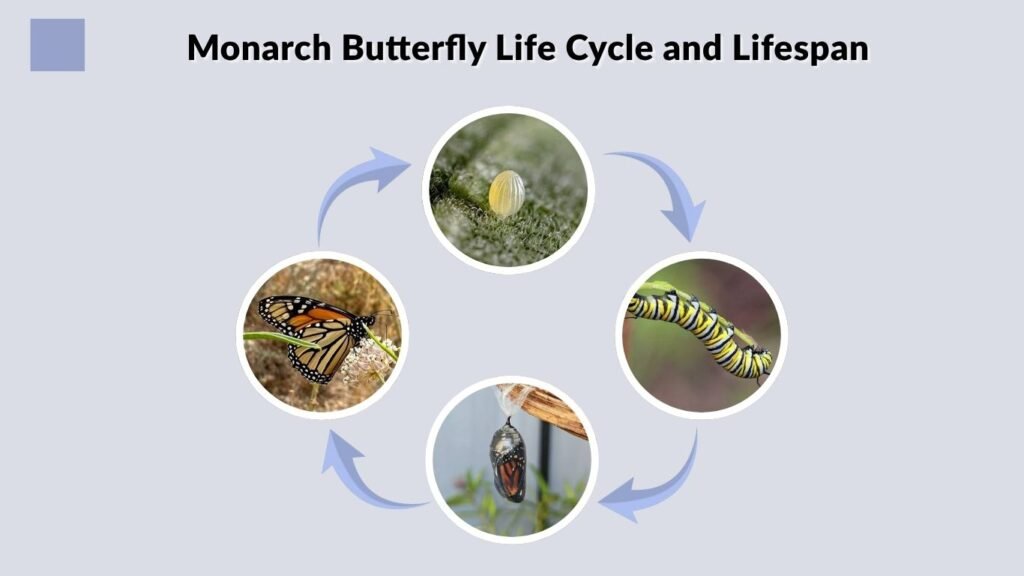
Adult lifespan represents only one part of a monarch’s total life. Before becoming a butterfly, every monarch passes through an egg, caterpillar, and chrysalis stage. Temperature and environmental conditions influence how quickly these stages develop, so exact timing varies throughout the year.
Monarch Life Cycle Timeline
A typical life cycle includes:
- Egg: About 4–6 days
- First through fifth caterpillar instars: About 9–14 days
- Chrysalis: Around 10 days, depending on temperature
- Adult summer monarch: Usually several weeks
- Adult migratory monarch: Potentially 6–9 months
Monarch Joint Venture reports that eggs hatch after roughly four to six days and caterpillars complete their five larval stages in about nine to fourteen days.
From Caterpillar to Adult
The caterpillar’s main job is eating and growing.
After passing through five instars, it leaves its milkweed host and finds a protected place to pupate. Inside the chrysalis, its body undergoes dramatic transformation before the adult butterfly emerges.
The new adult then begins either a short reproductive life or, in the fall generation, a much longer migratory one.
How Long Do Monarch Butterflies Live in Captivity?
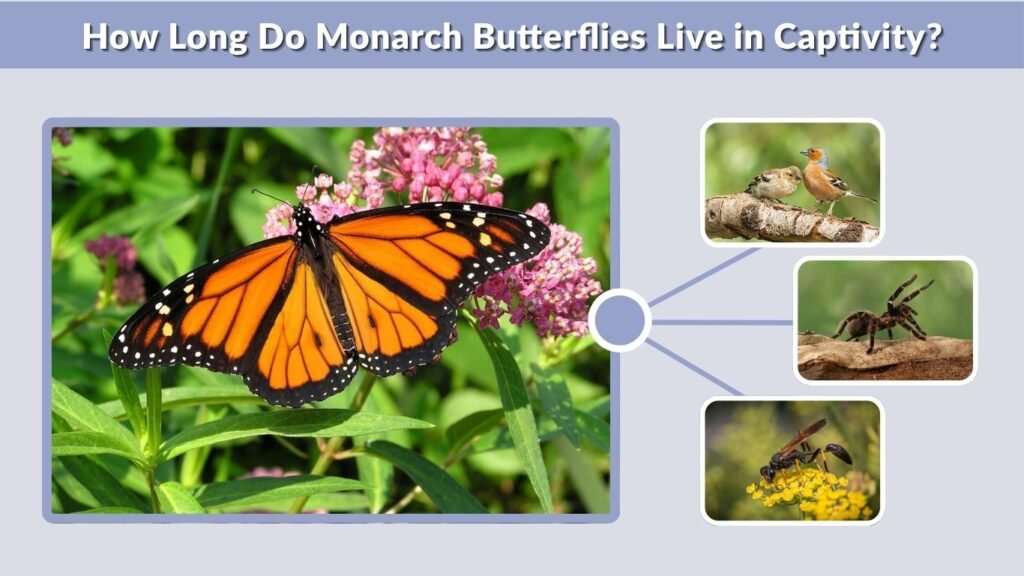
Captive lifespan varies greatly according to temperature, food, disease, stress, genetics, and whether the butterfly belongs to a reproductive or migratory generation. Captivity does not automatically make a monarch live for many months. A normal summer monarch still follows its short reproductive life cycle even when protected from many predators.
Captive vs Wild Monarchs
Captive monarchs may avoid some wild threats, including:
- Birds
- Spiders
- Wasps
- Severe storms
- Vehicle collisions
- Lack of nectar
- Some accidental injuries
However, captive conditions can create other problems, including crowding, disease transmission, unsuitable temperatures, damaged wings, and poor nutrition.
Monarch Joint Venture emphasizes habitat creation rather than bringing large numbers of monarchs indoors for protection.
Does Captivity Double Their Lifespan?
Not necessarily.
The generation of the butterfly matters more than simply whether it lives indoors or outdoors. A reproductive summer monarch is biologically programmed to mature and reproduce rapidly.
A fall migratory monarch can naturally live many months because it enters reproductive diapause.
Do Male and Female Monarchs Live the Same Length?
Male and female monarchs follow broadly similar seasonal lifespan patterns, but their individual longevity varies. Both sexes can belong to either short-lived reproductive generations or the long-lived migratory generation.
Male Monarch Lifespan
Summer males typically survive for several weeks.
Their adult lives revolve largely around obtaining nectar and searching for females. Males become reproductively mature several days after emerging from the chrysalis.
Migratory males delay reproductive maturity just as migratory females do and can therefore survive through winter.
Female Monarch Lifespan
Summer females also generally live only several weeks.
They begin developing eggs soon after adult emergence and may lay hundreds during their lifetime. Monarch Joint Venture estimates that wild females commonly lay around 300–400 eggs over a two-to-five-week egg-laying period.
Migratory females postpone this reproductive investment until spring.
What Affects a Monarch Butterfly’s Lifespan?
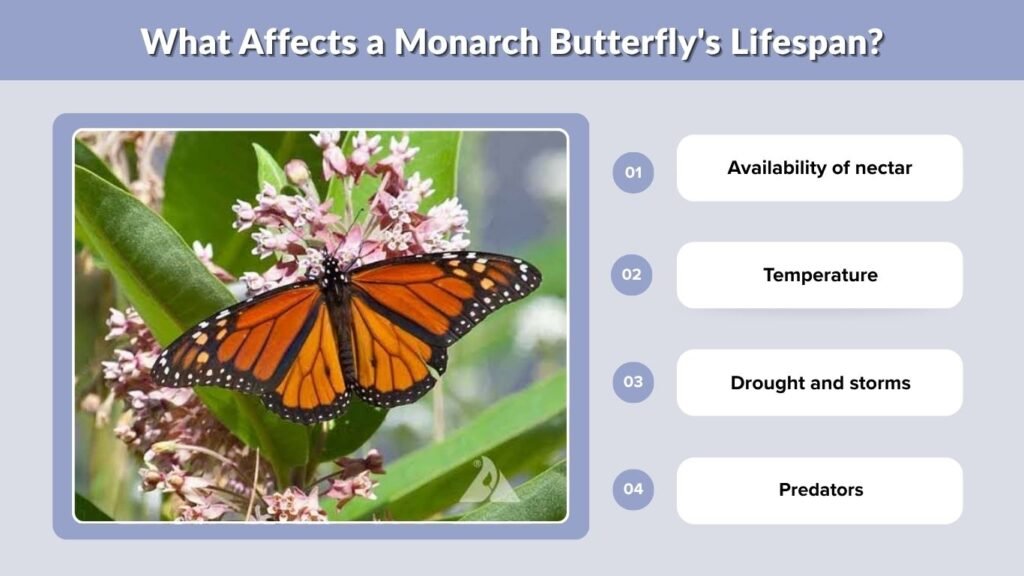
Even within the same generation, not every monarch survives equally long. Weather, predators, parasites, food availability, and physical condition can shorten life dramatically. Many monarchs die before even reaching adulthood, which makes the survival of long-distance migrants particularly impressive.
Major Lifespan Factors
Important factors include:
- Availability of nectar
- Temperature
- Drought and storms
- Predators
- Parasites and disease
- Wing damage
- Pesticide exposure
- Migration conditions
- Reproductive activity
- Quality of overwintering habitat
Fewer than 10% of monarch eggs typically survive to become adults in the wild, according to Monarch Joint Venture.
How Long Do Monarch Butterflies Live in Florida?
Southern Florida differs from much of North America because its warm climate can support monarch breeding throughout the year. Continuous milkweed and nectar availability allow a small non-migratory population to remain rather than joining the major migration to Mexico.
Florida Monarch Lifespan
Year-round breeding means many southern Florida monarchs behave more like reproductive summer generations than long-lived migrants.
They therefore should not automatically be expected to live six to nine months simply because they are present during winter.
Monarch Joint Venture confirms that southern Florida supports a small non-migratory population because warm conditions and year-round food resources allow continued reproduction.
Monarch Lifespan in New Zealand and Australia
Monarchs also occur outside North America, including New Zealand and Australia. Their seasonal behavior differs because they do not participate in the famous Mexico migration. However, cooler-season adults can still delay reproduction and survive much longer than summer butterflies.
New Zealand Monarchs
New Zealand monarchs can overwinter as adults, often gathering in sheltered trees.
Tagging work there has documented butterflies surviving for many months; one monarch tagged in March 2025 was observed again seven months later. New Zealand tagging studies have not found a consistent nationwide migration route comparable to the North American migration.
Australian Monarchs
In Australia, where monarchs are often called Wanderer butterflies, summer adults typically live about one month to six weeks.
In cooler regions, autumn adults may postpone reproduction and remain alive through winter for several months, sometimes gathering in large clusters.
FAQs
1. How long does the average monarch butterfly live?
Most spring and summer adult monarchs live about two to six weeks. The migratory generation can survive six to nine months.
2. Why do migrating monarch butterflies live longer?
They enter reproductive diapause, delaying mating and egg production while conserving energy for migration and overwintering.
3. How long does a monarch live after emerging from its chrysalis?
A normal breeding adult usually lives several weeks, while a fall migratory adult may survive for six to nine months.
4. Can a monarch butterfly live for a year?
Nine months is a more typical upper range cited for successful migratory monarchs. Surviving an entire year would be unusual.
5. How long is the complete monarch life cycle?
Development from egg to adult usually takes several weeks, after which adult life may last only a few weeks or, for migratory monarchs, many months.
