
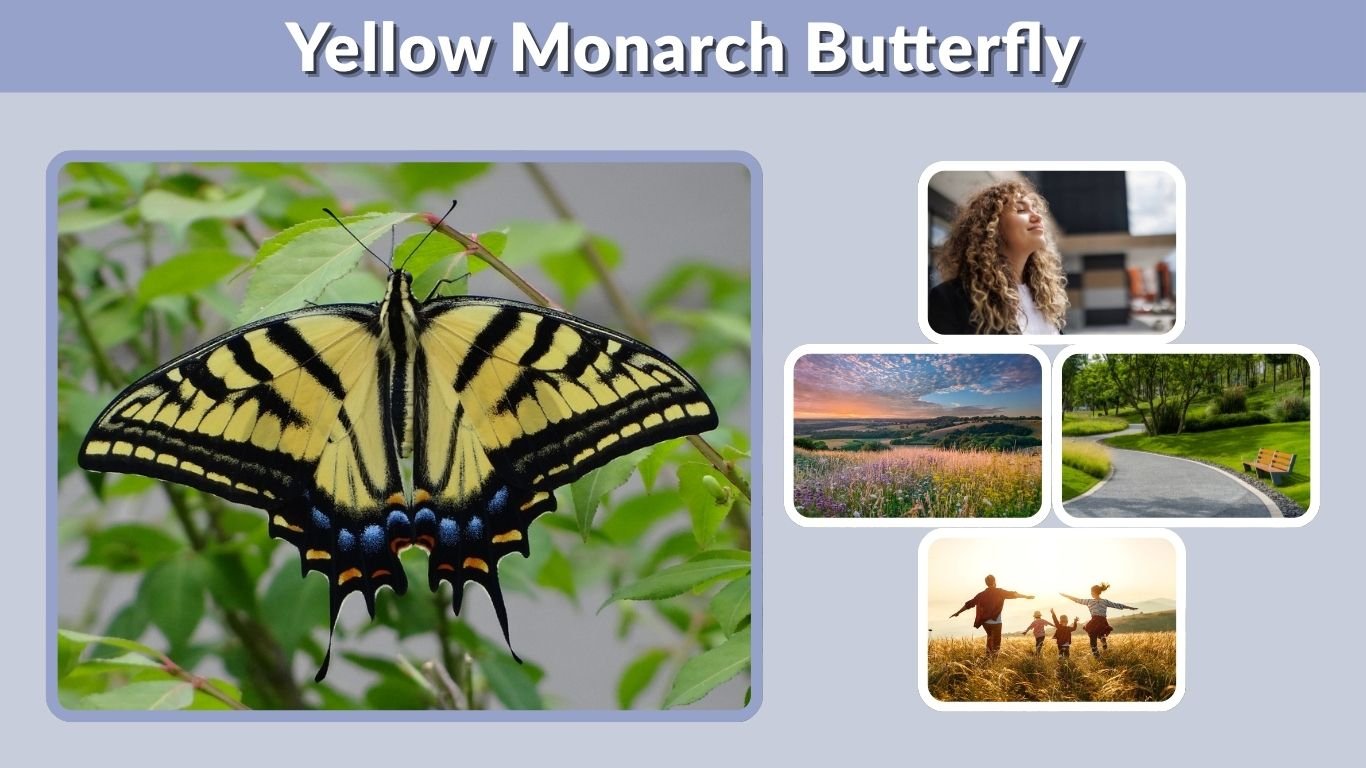
A yellow monarch butterfly may sound like a rare color form of the familiar monarch, but true monarchs (Danaus plexippus) are normally orange and black rather than bright yellow. Their underside can appear paler or yellow-orange, however, and lighting can make the color look even lighter. Some yellow-and-black butterflies, especially swallowtails, are also mistaken for monarchs. This guide explains whether yellow monarchs are real, how to identify genuine monarchs, common yellow lookalikes, caterpillar colors, and the symbolic meaning associated with seeing a yellow butterfly.
Is There a Yellow Monarch Butterfly?
Adult monarch butterflies are best identified by their orange wings, bold black veins, thick black borders, and small white spots. A bright lemon-yellow adult is therefore not the normal appearance of a monarch. The underside of a monarch’s hindwings is noticeably paler and may look yellow-orange, which can explain some reports and photographs described as yellow monarch butterflies.
What Color Is a Real Monarch Butterfly?
A typical adult monarch has:
- Orange upper wings
- Heavy black wing veins
- Thick black outer borders
- Small white spots inside the black borders
- A black body with white markings
- Paler orange or yellow-orange coloring underneath
Male monarchs also have a dark scent patch on each hindwing, while females generally have broader black veins.
Can a Monarch Butterfly Look Yellow?
Yes, a monarch can sometimes look yellowish without actually being a yellow species. The undersides of the wings are naturally paler than the upper surfaces, and certain lighting conditions can emphasize golden or yellow-orange tones.
A female may also appear somewhat duller than a brightly colored male. Camera exposure, shade, viewing angle, and the condition of the wing scales can further affect perceived color.
Why Does a Monarch Sometimes Look Yellow?
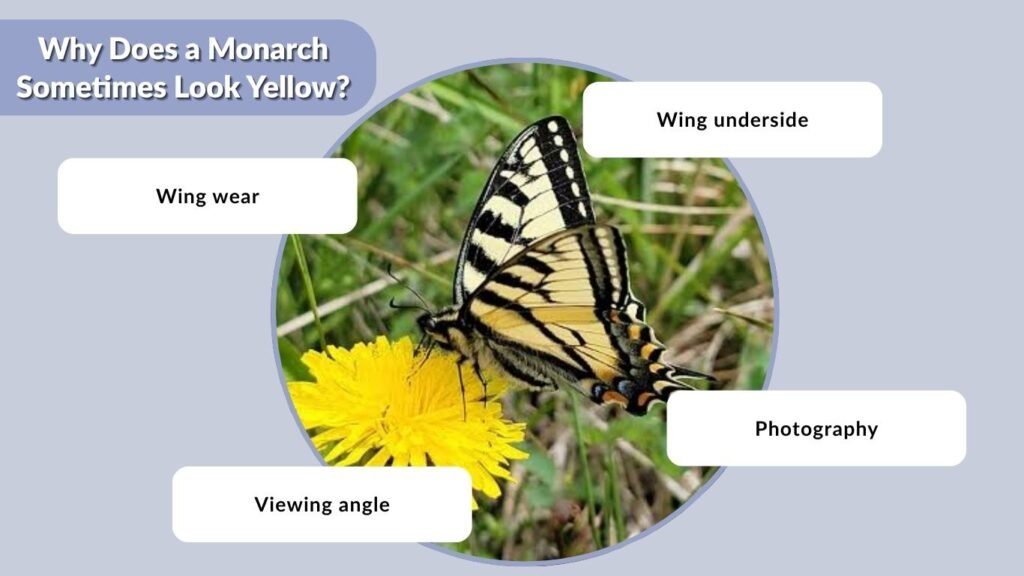
Color is one of the first characteristics people notice when identifying butterflies, but it can also be misleading. A monarch seen with closed wings may look substantially lighter than one displaying its upper wings. Photographs taken in strong sunlight or with unusual camera settings may also shift orange toward gold or yellow, creating the impression of an unusual yellow monarch.
Reasons a Monarch May Appear Yellow
Several factors can contribute:
- Wing underside: The ventral hindwing is naturally paler yellow-orange.
- Sunlight: Strong illumination can make orange appear golden.
- Photography: Exposure and white balance may alter apparent colors.
- Wing wear: Older butterflies may lose some scales and appear duller.
- Viewing angle: Wing scales reflect light differently from different angles.
- Individual variation: Monarch coloration naturally varies somewhat among individuals.
Yellow vs. Orange Monarch Butterfly
The strongest identification clues are the pattern rather than the exact shade of orange.
A genuine monarch should show prominent black veins extending across the wings and a broad black margin containing orderly white spots. If the butterfly is strongly yellow and has long tail-like projections from its hindwings, it is probably a swallowtail rather than a monarch.
Yellow Butterfly That Looks Like a Monarch
Many searches for a yellow butterfly that looks like a monarch are likely attempts to identify a large yellow-and-black butterfly seen in a garden. Several swallowtail species have bold black markings that can produce a vaguely monarch-like appearance from a distance. Looking for hindwing tails and differences in vein patterns usually makes identification much easier.
Common Yellow Monarch Lookalikes
Possible yellow-and-black lookalikes include:
- Eastern tiger swallowtail: Large yellow wings crossed by bold black stripes.
- Western tiger swallowtail: Yellow with vertical black bands and hindwing tails.
- Two-tailed swallowtail: Large yellow butterfly with black striping and two tails.
- Anise swallowtail: Yellow-and-black pattern with obvious hindwing tails.
- Giant swallowtail: Has strong yellow markings, especially noticeable on the underside.
- Common yellow swallowtail: Yellow with prominent black patterning and distinctive tails.
Monarch vs. Yellow Swallowtail
The easiest difference is the hindwing shape. Monarchs have smooth, rounded hindwings without long tails. Many yellow swallowtails have obvious projections extending from the back of their hindwings.
Monarchs also display a network of black veins over orange wings. Tiger swallowtails instead have broader black stripes crossing a largely yellow background. Their body shape and flight style can also look different.
Black and Yellow Monarch Butterfly Identification
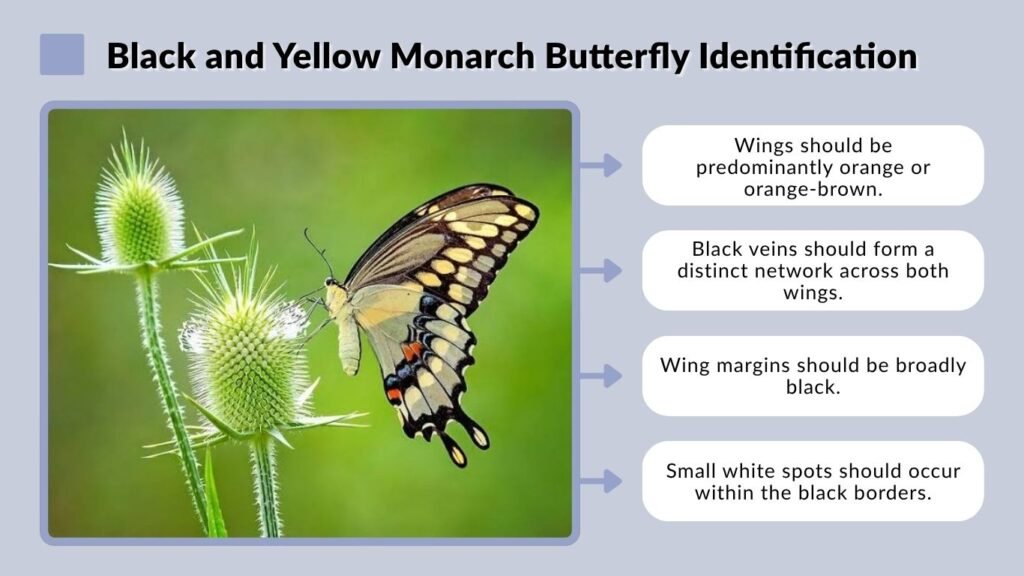
Someone describing a black and yellow monarch butterfly may have seen a swallowtail, or they may have noticed a monarch from below where its color appeared much lighter. Accurate identification requires considering the whole butterfly rather than relying on yellow coloration alone. Wing shape, black vein arrangement, white spotting, tails, and body markings provide much stronger evidence.
How to Identify a Monarch Correctly
Check these features:
- Wings should be predominantly orange or orange-brown.
- Black veins should form a distinct network across both wings.
- Wing margins should be broadly black.
- Small white spots should occur within the black borders.
- Hindwings should not have swallowtail-like tails.
- The body should be black with white spotting.
- Wingspan is commonly around 3.5–4 inches or somewhat larger.
Monarch vs. Viceroy
The viceroy is one of the best-known monarch lookalikes, although it is usually orange rather than yellow.
A useful field mark is the extra dark line crossing each viceroy’s hindwing. Monarchs lack this transverse line. Viceroys are also somewhat smaller, although size can be difficult to judge when only one butterfly is present.
Yellow Monarch Butterfly Caterpillar
Although adult monarchs are orange and black, the caterpillar really does contain a significant amount of yellow. Mature monarch caterpillars have alternating bands of yellow, black, and white along their bodies. This colorful pattern makes them highly recognizable when feeding on milkweed and may contribute to searches for a “yellow monarch butterfly caterpillar.”
What Does a Monarch Caterpillar Look Like?
A mature monarch caterpillar has:
- Black, yellow, and white transverse bands
- Two long black filaments near the head
- Two shorter filaments near the rear
- A smooth, elongated body
- A length approaching about two inches when mature
- A strong association with milkweed plants
These distinctive stripes make mature larvae relatively easy to distinguish from many other garden caterpillars.
Are Monarch Eggs Yellow?
Fresh monarch eggs are better described as cream, whitish, or pale rather than strongly yellow. Females usually deposit individual eggs on milkweed.
The egg later hatches into a tiny caterpillar that begins feeding on the host plant. Therefore, seeing a tiny pale object on milkweed does not mean it will produce a specially colored yellow adult monarch.
Yellow Monarch Butterfly Meaning and Symbolism
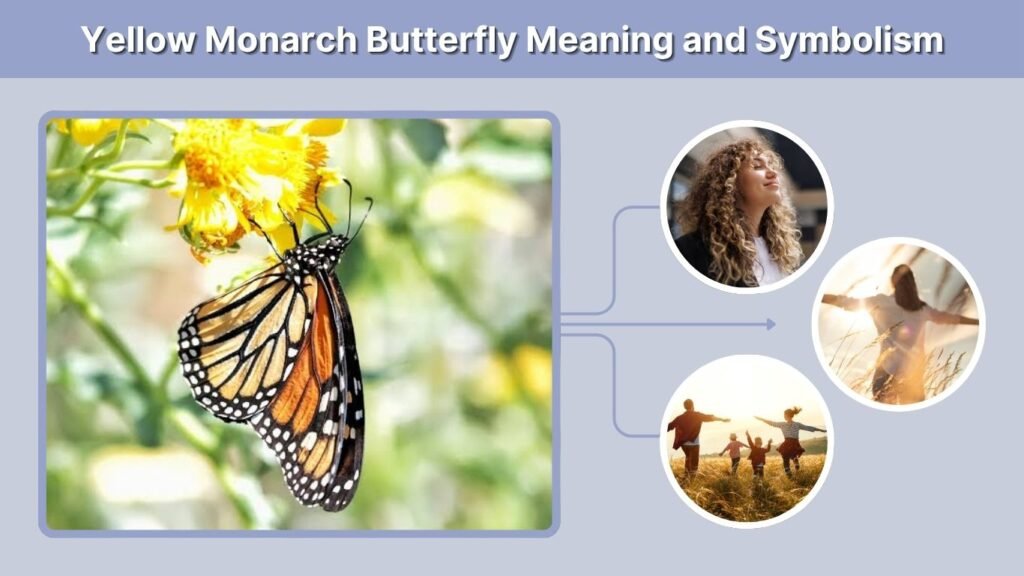
Searches for yellow monarch butterfly meaning and yellow monarch butterfly spiritual meaning usually relate to personal, cultural, or spiritual interpretation rather than entomology. Science does not assign symbolic meanings to butterfly colors. Nevertheless, butterflies have long inspired human ideas about transformation, change, beauty, and renewal because of their dramatic metamorphosis.
Common Symbolic Interpretations
People may personally associate a yellow monarch-like butterfly with:
- Optimism: Yellow is often culturally associated with brightness and positive feelings.
- Transformation: Butterflies are commonly used as symbols of personal change.
- New beginnings: Metamorphosis can represent entering a new phase of life.
- Hope: A bright butterfly may be interpreted as an encouraging sight.
- Joy: Yellow coloration is frequently associated with warmth and happiness.
- Freedom: Butterfly flight is often used symbolically to represent independence.
These are cultural or personal interpretations, not biological properties of the butterfly.
What Does Seeing a Yellow Monarch Mean?
There is no scientifically established message attached to seeing a yellow monarch butterfly. If a yellow butterfly has personal significance to someone, its meaning depends on that person’s beliefs, traditions, and experiences.
From a biological perspective, the more useful question is whether the insect was actually a monarch or a yellow swallowtail or another lookalike.
Where Do Real Monarch Butterflies Live?
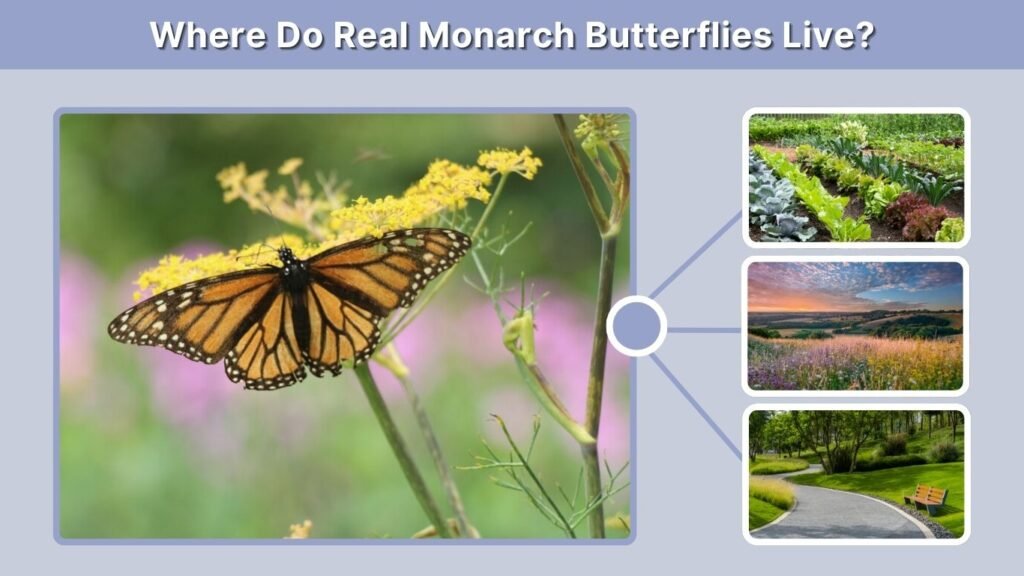
Monarchs occur broadly across North America and have also established populations in other regions. They use open habitats where milkweed is available for caterpillars and nectar-producing flowers feed adults. Their extraordinary migrations make them especially noticeable during seasonal movements, when large numbers may pass through suitable flowering areas.
Monarch Habitat and Host Plants
Monarchs can occur in gardens, meadows, fields, roadsides, parks, pastures, and other sunny environments.
Milkweed is essential because monarch caterpillars depend on it as their host plant. Adult monarchs use a much broader variety of nectar-producing flowers. Therefore, a monarch seen resting on a yellow flower is simply feeding or stopping there; the flower does not change the butterfly’s natural wing color.
Interesting Yellow Monarch Butterfly Facts
The popularity of the phrase “yellow monarch butterfly” demonstrates how easily butterfly identification can become confusing when color is viewed under changing conditions. Looking closely at anatomy and pattern is much more dependable. Monarchs also have genuinely yellow features during other stages of life, particularly the yellow bands of their caterpillars.
Quick Facts
- Normal adult monarchs are orange and black.
- Their wing undersides can appear paler yellow-orange.
- Monarch caterpillars have yellow, black, and white stripes.
- A bright yellow monarch-like butterfly may actually be a swallowtail.
- Monarch hindwings do not have long swallowtail-like tails.
- Monarchs have strong black veins across their wings.
- White spots appear inside their black wing borders.
- Female monarchs usually have thicker black veins.
- Male monarchs have distinctive scent patches on their hindwings.
- Yellow-monarch symbolism is cultural or personal rather than scientific.
FAQs
This keyword often creates identification questions because people naturally focus on the butterfly’s most noticeable color. The following answers clarify whether true yellow monarchs exist, which butterflies are commonly confused with them, and how to interpret yellow coloration in adults and caterpillars.
1. Is there really a yellow monarch butterfly?
A typical Danaus plexippus monarch is orange and black, not bright yellow. However, the underside of its hindwings is paler and can appear yellow-orange. Lighting, photographs, viewing angle, and natural variation may also make an individual appear more golden than expected.
2. What yellow butterfly looks like a monarch?
Tiger swallowtails are among the most likely yellow-and-black butterflies to be described as monarch-like. They can be distinguished by their predominantly yellow wings, broad black stripes, and tail-like hindwing projections. Monarchs instead have orange wings crossed by black veins and lack long hindwing tails.
3. Can a monarch butterfly be yellow instead of orange?
Normal adult monarch coloration ranges through orange and orange-brown tones rather than vivid yellow. The underside can appear much paler and sometimes yellow-orange. If an insect is strongly lemon-yellow with prominent black bands or hindwing tails, it is more likely another butterfly species rather than a typical monarch.
4. What does a yellow monarch butterfly symbolize?
There is no scientific meaning associated with seeing a yellow monarch. In symbolic or spiritual interpretations, people may connect a yellow butterfly with optimism, hope, joy, transformation, or new beginnings. These meanings come from cultural and personal beliefs and should be separated from factual butterfly biology.
5. Are monarch butterfly caterpillars yellow?
Monarch caterpillars contain plenty of yellow, but they are not entirely yellow. Mature larvae have repeating black, yellow, and white bands, along with black fleshy filaments at both ends of the body. They feed on milkweed before forming a green chrysalis and eventually emerging as orange-and-black adults.
