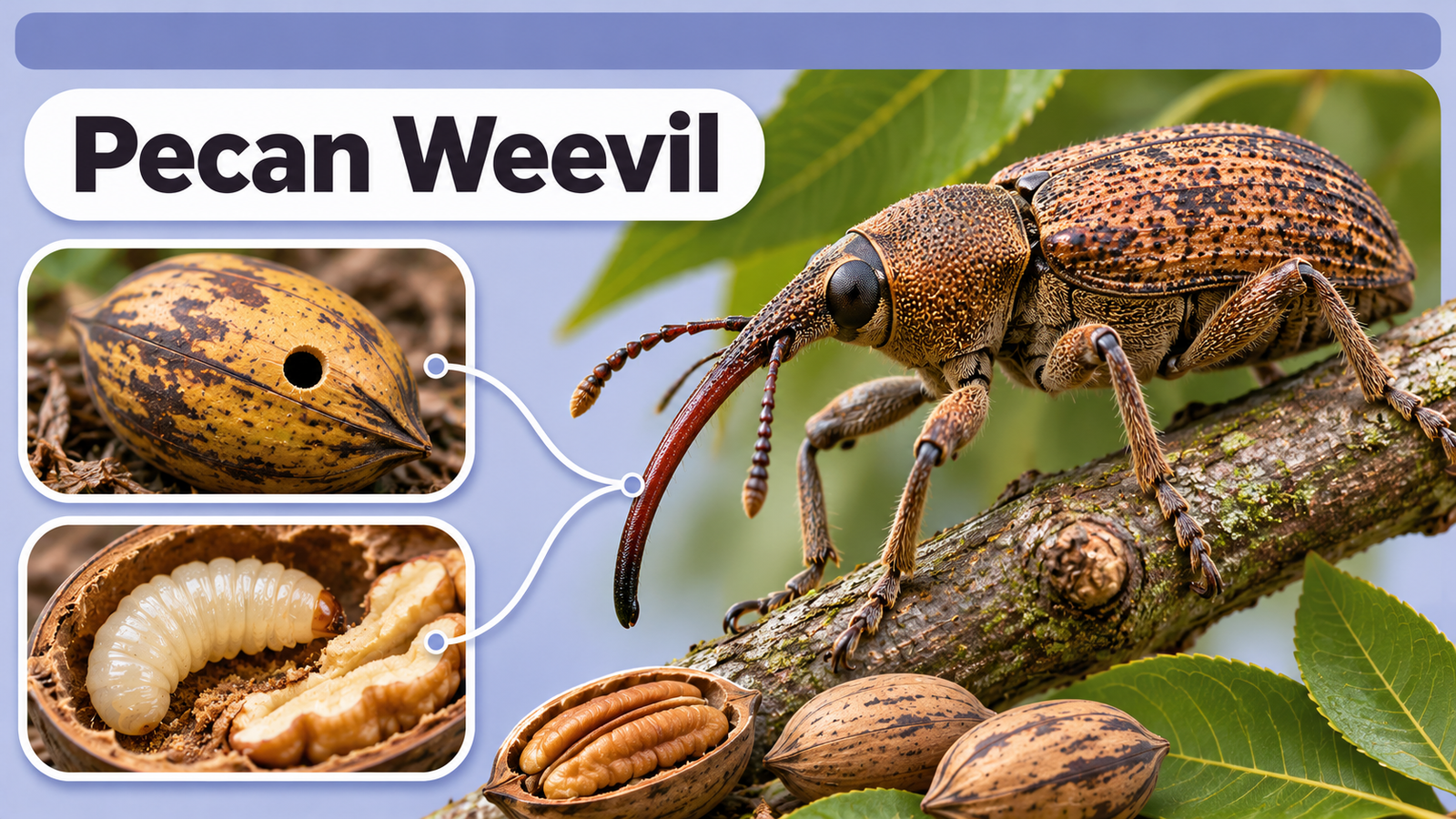
Pecan weevils are snout beetles whose larvae feed inside developing pecans and hickory nuts. They can cause early nut drop, hollow shells, and kernels destroyed from within. The adult beetle is easiest to notice in late summer, often after rain softens the soil, while the grub stays hidden inside a nut. Learning how to identify pecan weevils, recognize their damage, and time control measures to their life cycle can help homeowners and orchard managers protect a crop without relying on unnecessary spraying.
What Is a Pecan Weevil?
The pecan weevil (Curculio caryae) is a native North American beetle in the snout beetle family. Pecan is its main economic host, though it can also develop in hickory nuts. Adults feed and mate in trees, and females lay eggs inside developing nuts. The larvae consume the kernel before leaving the nut and entering the soil, where they continue developing.
Because much of the insect’s life is spent inside a nut or underground, people may not see the pest until nuts start falling or empty shells appear at harvest. A single season’s infestation can also affect later crops because adults emerging this year may have spent one or more years beneath the tree.
How to Identify a Pecan Weevil
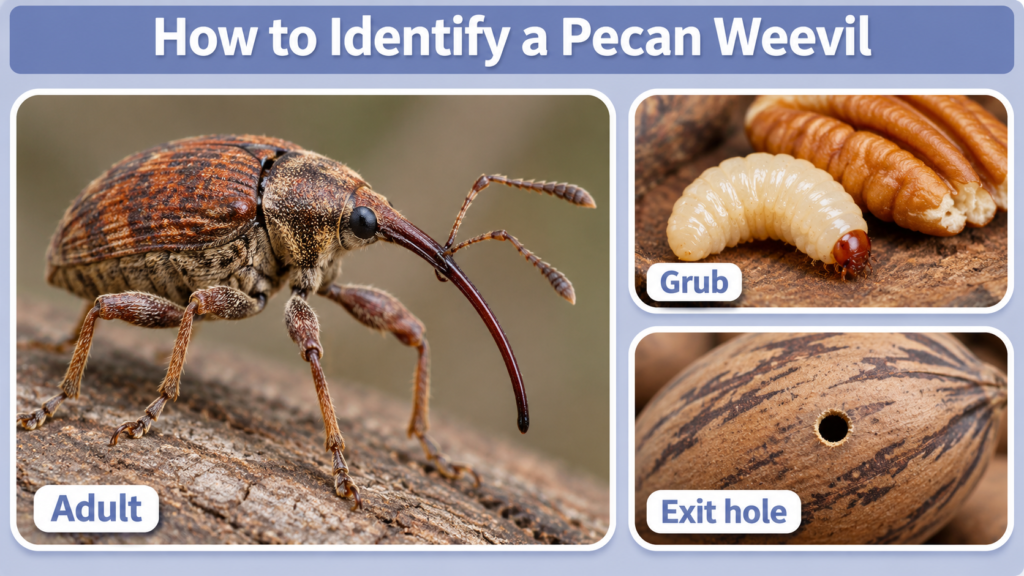
Adult pecan weevils are hard-shelled beetles about half an inch long. They range from reddish brown to gray and have long, slender snouts, thin legs, and elbowed antennae attached around the middle of the snout. The female’s snout is generally longer than her body; the male’s is slightly shorter. Adults may be seen crawling on tree trunks, branches, or nuts.
The immature pecan weevil is a creamy-white, legless grub with a reddish-brown head and a soft, curved body. It develops inside the nut, so it is usually found when a damaged pecan is opened or after larvae have chewed their way out. The grub is not a caterpillar and does not have visible legs.
Signs to Look for on Pecans
- Early nut drop: Nuts punctured by adults while still watery can lose fluid and fall within a few days.
- Dark puncture marks: Feeding holes may leave dark stains on the outside of the shuck.
- Grubs in the kernel: One or more pale larvae may be found inside a nut; their feeding can destroy the kernel.
- Round exit holes: A mature larva chews a neat, round hole through the shell before dropping to the ground.
- Empty or damaged shells: At harvest, some affected nuts contain little usable kernel or are hollow.
Not every fallen pecan is a sign of weevil activity. Drought, poor pollination, disease, other insects, and natural fruit thinning can also cause nut drop. Inspect several fallen nuts and compare the timing and visible damage before deciding what is happening.
Pecan Weevil Life Cycle
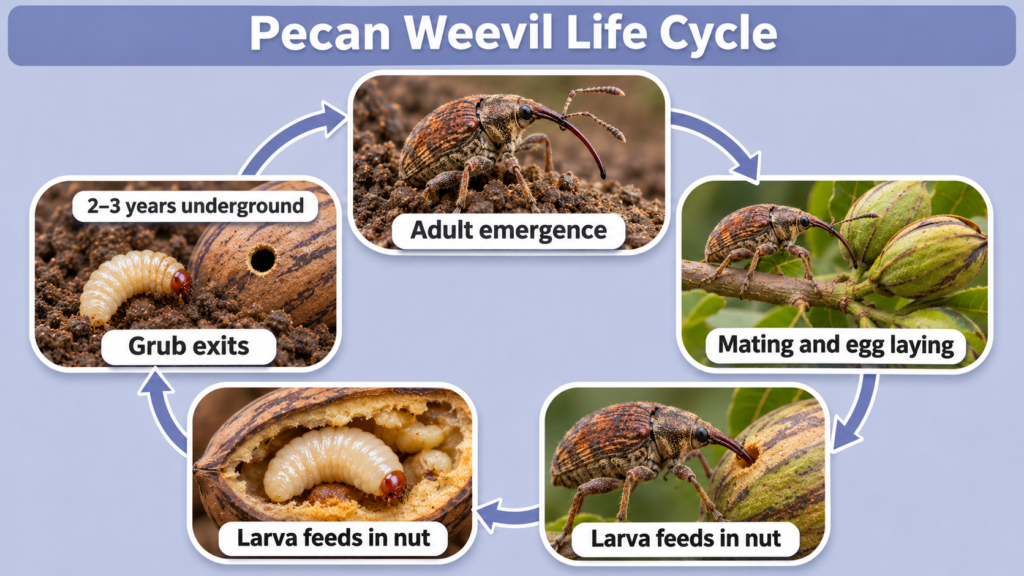
The pecan weevil life cycle spans two or three years for many individuals. Adults emerge from the soil from late July into October, with activity commonly peaking from August into September in parts of the southern and central United States. The exact timing changes by location, weather, soil moisture, tree variety, and nut development. A significant rainfall can stimulate a flush of emergence, while drought may delay it.
After emerging, adults climb or fly into trees, feed on nuts, and mate. Females begin laying eggs when nuts reach the gel stage and later the dough stage. A female uses her snout to make an opening in a developing nut and deposits eggs inside. The eggs hatch, and the larvae feed on the developing kernel for about a month.
When mature, the grubs chew through the shell, fall to the ground, and burrow into the soil. They remain underground as larvae before pupating. Some emerge as adults after about two years in the soil, while others take an additional year. This long development means a pecan weevil population may not be eliminated by a single season of control.
What Damage Do Pecan Weevils Cause?
Pecan weevil damage depends partly on the stage of nut development. Early in the season, adults pierce young nuts to feed. If the nut is still in the watery stage, the puncture can cause it to dry out and drop from the tree. These losses may look like ordinary summer nut drop unless the punctures or dark marks are checked.
Later, the more serious damage comes from larvae feeding inside the nut. Infested kernels may be hollowed out or completely consumed. When the grubs leave, the round exit holes provide a clear clue that a weevil developed inside. In commercial orchards, severe infestations can reduce both the number of marketable nuts and the quality of the harvest. A home grower may notice many empty shells beneath a tree or grubs among harvested nuts.
When Are Pecan Weevils Active?
Adult pecan weevil activity is usually a late-summer and early-fall concern, but calendar dates alone are not reliable. Warm or dry conditions can change nut development, and drought can keep adults in the soil until rain arrives. The most useful approach is to monitor both adult activity and the condition of the developing nuts.
Trapping often begins in mid- to late summer in areas where pecan weevils have been a problem. Check traps frequently, especially after substantial rain or irrigation, and continue monitoring while susceptible nuts remain on the tree. Extension specialists may recommend different traps and thresholds for different regions and orchard conditions.
How to Control Pecan Weevils
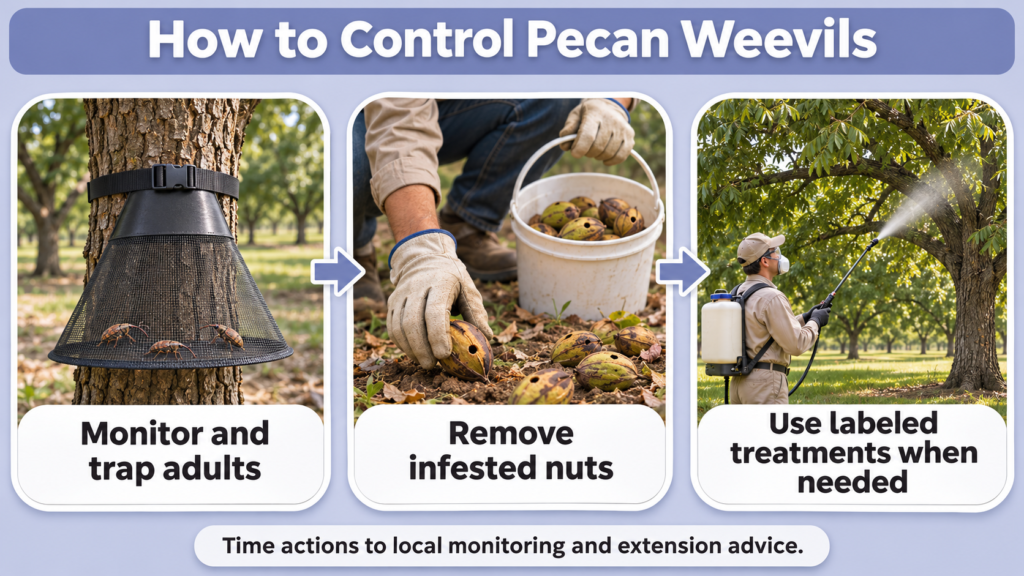
Pecan weevil control works best when it is based on monitoring and timed to the pest’s vulnerable stage. Sprays applied before adults emerge or after eggs and larvae are protected inside nuts may not provide the intended result. For this reason, homeowners and commercial growers should combine scouting, trapping, sanitation, and careful use of labeled treatments.
Monitor and Trap Adults
Use pecan weevil traps on trees with a history of damage or where adults have been found. Circle traps around the trunk intercept many weevils as they climb into the canopy; other trap designs can be used to monitor activity. Set traps before expected emergence, check them regularly, and record captures. Traps can help detect activity and, when properly installed, may reduce the number of adults reaching the tree.
Remove Infested Nuts
Collect and dispose of fallen nuts that contain larvae or show obvious weevil damage. Prompt cleanup can reduce the number of mature grubs that reach the soil and continue the life cycle beneath the tree. Where practical, pick up nuts regularly during the period of nut drop and remove old infested nuts after harvest. Sanitation alone may not eliminate an established population because larvae can be underground for multiple years, but it supports other control steps.
Use Insecticides Only When Appropriate
Insecticide timing for pecan weevil depends on adult emergence, nut maturity, local recommendations, and the product label. Extension guidance commonly focuses on protecting nuts around the dough stage and on responding to continued trap captures. Once eggs and larvae are inside the nut, contact sprays cannot reach them. Applications should never be based only on a fixed date or a neighbor’s schedule.
For a backyard tree, spraying a mature canopy thoroughly can be difficult and may require specialized equipment. Some products are restricted to licensed applicators. Ask a local university extension office or certified arborist for region-specific advice, and hire a licensed professional when needed. Always use only products labeled for pecan trees and pecan weevil, follow the label exactly, observe preharvest intervals, and protect people, pets, pollinators, and other beneficial insects. Do not apply broad-spectrum insecticides while bees are visiting flowering plants.
Support Overall Tree Health
A healthy pecan tree is better able to produce a crop and tolerate stress, though good watering or fertilizing does not directly kill pecan weevils. Follow local recommendations for soil testing, irrigation, and pruning. Avoid treating unrelated symptoms as weevil damage; correct identification can prevent unnecessary pesticide use and help distinguish weevil injury from disease, drought stress, or other nut-feeding insects.
Can Pecan Weevils Be Prevented?
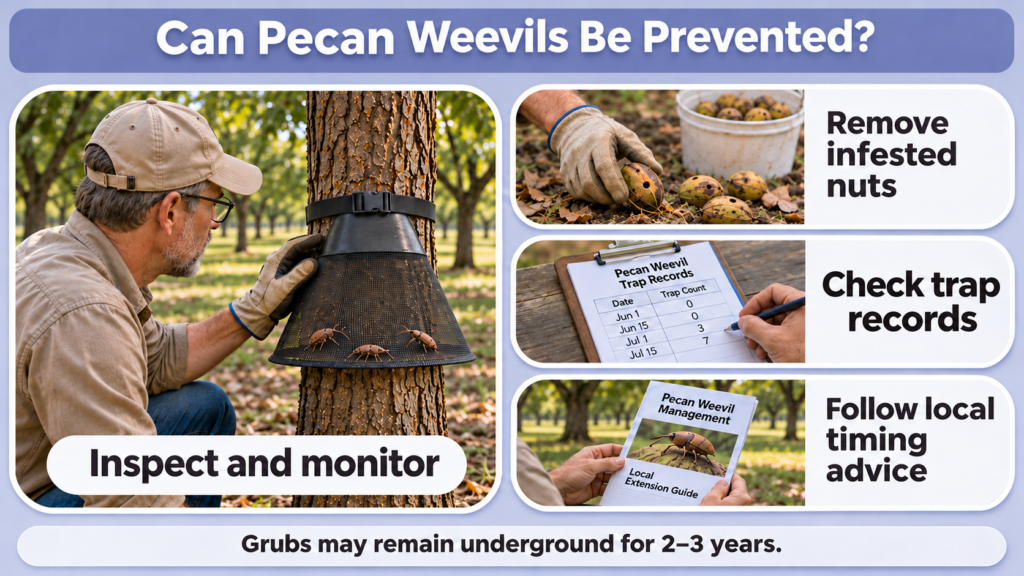
It is difficult to prevent every adult from reaching a pecan tree, especially where hickory and pecan trees are common. However, a regular monitoring routine, trunk traps, prompt nut cleanup, and timely region-specific treatment can reduce damage. Start checking trees before the usual local emergence period, and keep watching after rain because adults may emerge in a sudden wave.
Since larvae can remain underground for two or three years, successful management takes persistence. Compare trap counts and nut damage from year to year, and adjust the plan with guidance from local extension specialists. Avoid routine sprays when monitoring shows little activity; unnecessary treatments can harm beneficial insects and may trigger other pest problems.
FAQs
Are pecan weevils harmful to people?
No. Pecan weevils damage pecan and hickory nuts but are not known to bite or harm people. The concern is crop loss and ruined kernels, not a risk to household members or pets from the beetle itself.
What does a pecan weevil grub look like?
A pecan weevil grub is a small, creamy-white, legless larva with a reddish-brown head. It has a soft, curved body and is usually found inside an infested nut or near a round exit hole in the shell.
Why are pecans falling from my tree in summer?
Pecan weevils can puncture young nuts while feeding, causing some to lose fluid and drop within a few days. But summer nut drop has other causes too. Check fallen nuts for punctures, stains, or grubs, and consider weather, pollination, and other pests before choosing a treatment.
When should pecan weevil traps be set?
In areas where the pest is established, traps are commonly placed before adult emergence, often by mid- to late summer. Local timing varies. Check with your county extension service for the best trap type and deployment schedule for your region, and keep checking after rainfall.
What is the best way to get rid of pecan weevils?
There is no single treatment that removes every stage at once. Monitor adults with traps, collect infested fallen nuts, and use any pesticide only when local guidance and trap activity support it. Treatments need to target exposed adults before eggs and larvae become protected inside the nuts.