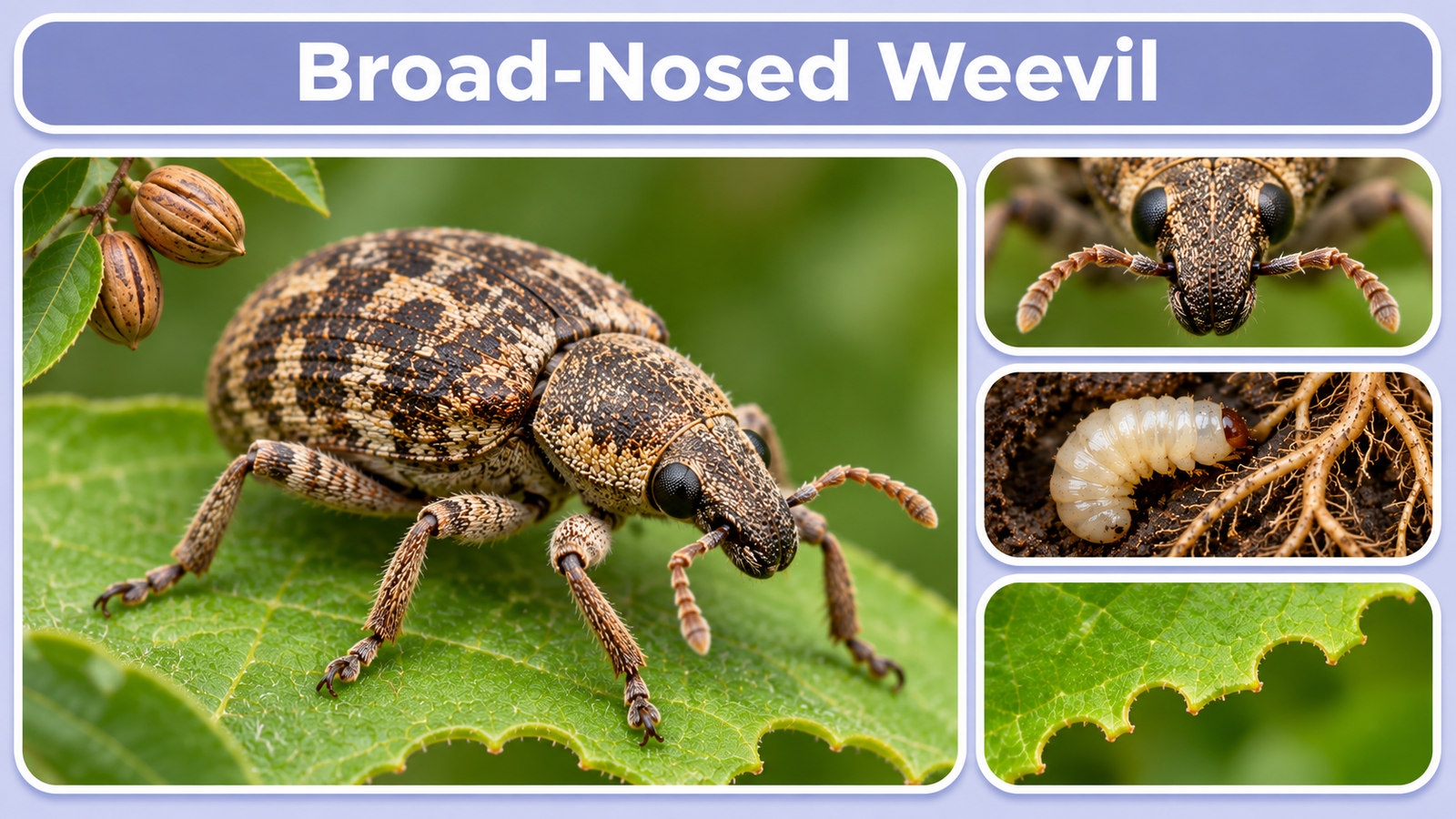
Broad-nosed weevil is a common name for many beetles in the subfamily Entiminae, rather than one single species. These short-snouted weevils occur in gardens, forests, fields, and landscapes around the world. Some are harmless visitors, while others feed on leaves as adults and roots as larvae. Their habits vary by species, so identifying the beetle and checking the affected plant are important before choosing a control method.
What Is a Broad-Nosed Weevil?
Broad-nosed weevils belong to Entiminae, one of the large subfamilies in the weevil family Curculionidae. Entiminae contains thousands of described species, and the group is widespread. Its members are called broad-nosed weevils because the snout, or rostrum, is generally short and wide compared with the long, narrow snout of many other weevils.
The name covers a diverse group, not a single pest with one host plant or life cycle. A familiar example is the black vine weevil (Otiorhynchus sulcatus), but strawberry root weevils, lilac root weevils, and many other beetles also belong to or are closely associated with broad-nosed weevil groups. Some eat a wide range of plants, while others are more selective. The insect’s appearance, host, and damage pattern help narrow down its identity.
How to Identify Broad-Nosed Weevils
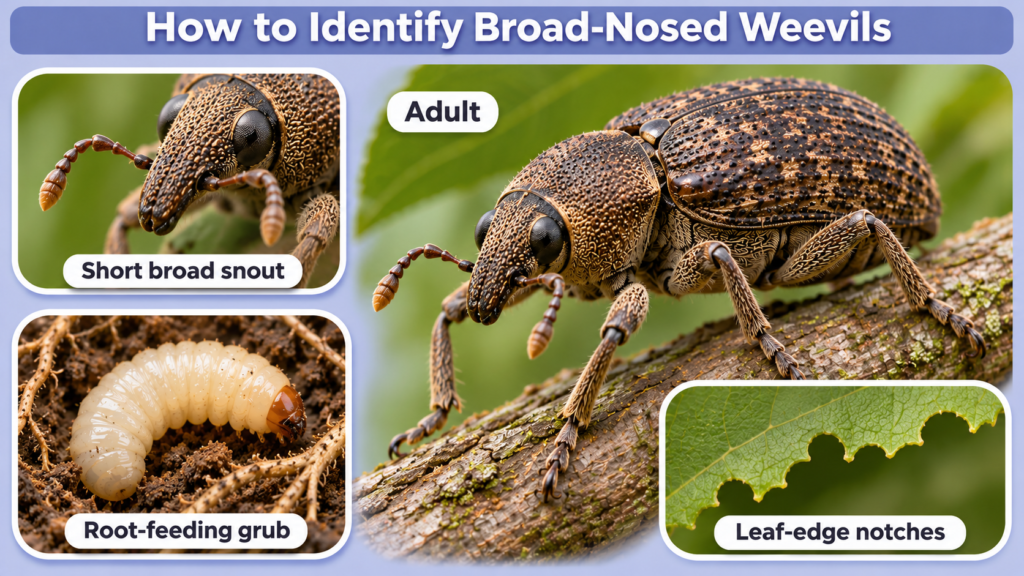
Many broad-nosed weevils have a compact, oval or pear-shaped body, a short broad snout, elbowed antennae, and a hard outer covering. Their colors range from black and brown to gray, bronze, or green. Some species have small scales or flecks that create mottled patterns; these scales can rub off, making an older beetle look darker or patchy. Size varies substantially across the group.
A broad snout alone is not enough to identify a species. Note the beetle’s size, color, markings, host plant, location, and the kind of damage present. Some adult root weevils are active at night and hide near the soil or beneath leaves during the day. When disturbed, certain species drop from a plant and remain still, which can make them easy to miss.
Adult and Larval Features
- Adult body: Usually oval, rounded, or pear-shaped, with a distinct but relatively short snout.
- Antennae: Often elbowed and attached to the snout.
- Legs: Six sturdy legs; some species have grooves or ridges along the body.
- Larvae: Commonly cream or white, legless grubs with a brownish head, though details differ among species.
- Typical signs: Irregular notches along leaf edges, weakened roots, or grubs in soil around a host plant.
To distinguish a weevil from a tick, count the legs: adult weevils have six, while ticks have eight. For a precise species identification, use a clear close-up photo and record the plant it was found on. A local extension or plant diagnostic service can help when the insect is damaging valuable plants.
Broad-Nosed Weevil Life Cycle
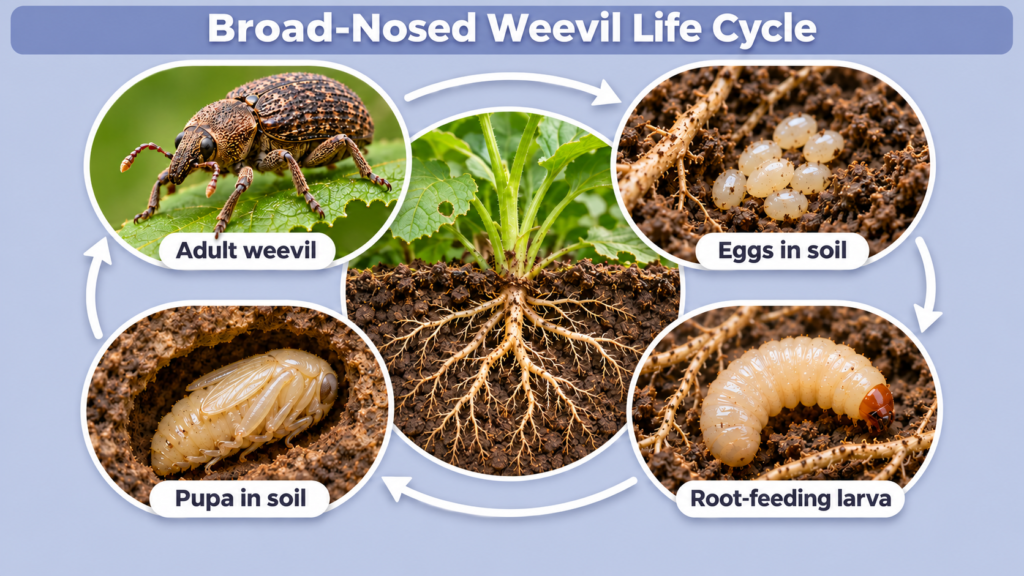
The broad-nosed weevil life cycle differs from one species to another, but many familiar garden root weevils share a general pattern. Adults feed above ground, and eggs are deposited in soil or leaf litter near host plants. The larvae hatch and feed on roots or other plant parts. They may remain in the soil through winter before pupating and emerging as adults in a later season.
For common root weevils, adults are often active from spring through fall, with many feeding at night. Eggs are usually laid near host plants during warmer months. The small larvae move into the soil and feed on roots, and the mature larvae pupate in the soil. In some species, a generation takes about a year; however, broad-nosed weevils include species with different schedules, so these dates are not universal.
Some black vine weevil populations reproduce without males, while other related species have both male and female beetles. This is one reason not to assume that every broad-nosed weevil has the same reproductive habits. Weather, local climate, host plant, and species all affect when eggs, grubs, and adults are present.
What Damage Do Broad-Nosed Weevils Cause?
The damage depends on the species and the stage of its life cycle. Adult leaf-feeding weevils chew small, irregular or U-shaped notches from the edges of leaves. This can make a plant look ragged, but light feeding often affects appearance more than plant health. Notches alone do not prove that a broad-nosed weevil is responsible; caterpillars, slugs, and other insects can also damage foliage.
Root-feeding larvae can be more serious, particularly in pots, nursery stock, and plants with a concentrated root system. Grubs may chew fine roots or damage larger roots and plant crowns. Affected plants may wilt, grow poorly, turn yellow, or decline despite watering. However, these symptoms can also result from drought, root disease, poor drainage, or other soil pests. Confirming larvae around roots is more useful than treating based on symptoms alone.
Some adults wander indoors, especially when outdoor conditions are hot or dry. These beetles are generally nuisance invaders rather than household pests: they do not feed on pantry food or damage buildings, and the species commonly found indoors do not reproduce in the home.
Where Do Broad-Nosed Weevils Live?
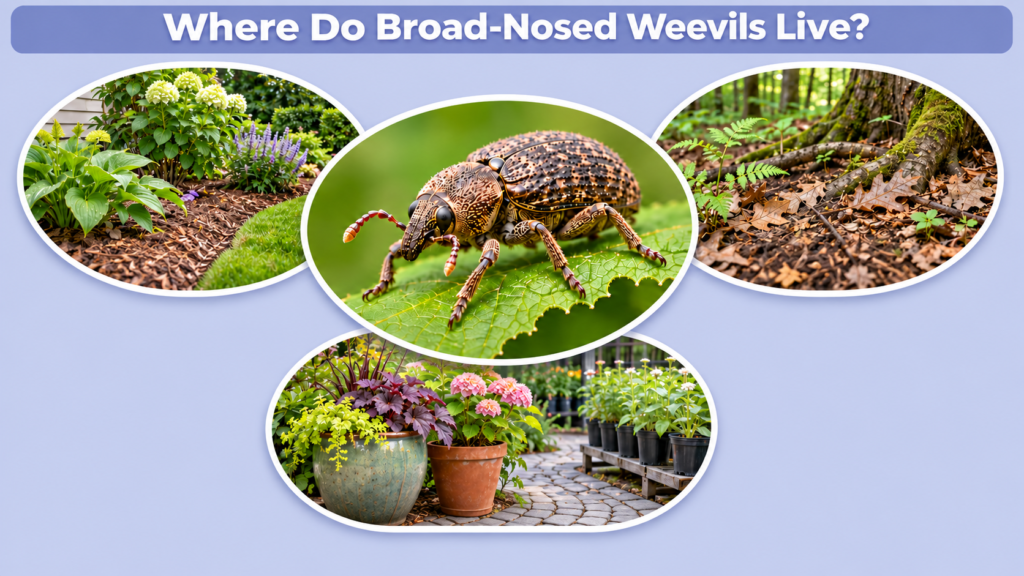
Broad-nosed weevils are found in many habitats, including gardens, forests, fields, orchards, and landscaped areas. Their ranges and host plants differ by species. Root weevils may be found around strawberries, raspberries, ornamental shrubs, broad-leaved evergreens, trees, and container plants. Other broad-nosed weevils feed on different plants, so finding one species on a particular plant does not mean that all members of the group prefer it.
Adults often hide during daylight beneath mulch, leaf litter, plant debris, pots, or other sheltered cover. Nocturnal species climb onto leaves after dusk to feed. Larvae live in the soil near host plants, where they feed on roots or other underground plant structures. A weevil found inside a house may have crawled in through a gap from nearby outdoor vegetation rather than emerging from indoor food or furniture.
How to Control Broad-Nosed Weevils
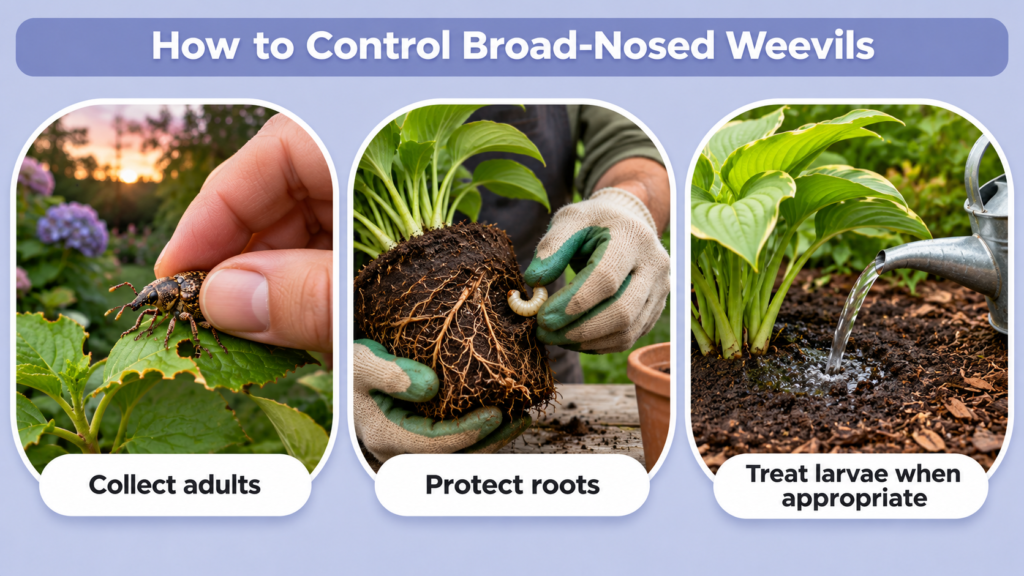
Control starts with identifying the weevil and deciding whether the damage is significant. A few leaf notches may not justify treatment, particularly on established shrubs. If plants are wilting or losing roots, inspect the soil and root zone for grubs. Because broad-nosed weevils include many species, a method effective against a particular root weevil may not fit every species in the group.
Inspect Plants and Collect Adults
Check damaged plants at dusk or after dark with a flashlight, when many adult root weevils are active. Look beneath leaves, around the base of plants, and under nearby pots or debris during the day. Where numbers are low, hand-pick beetles or shake branches over a light-colored sheet or container. Remove hiding places such as unnecessary plant debris, and inspect new nursery plants before adding them to a garden.
Protect Roots and Containers
If a potted plant shows root damage, remove it from the container and examine the root ball for grubs. Pick out visible larvae and replace heavily infested potting mix when practical. Check the drainage holes and container exterior, as adult beetles may hide under pots and later climb onto plants. For landscape plants, maintain suitable watering and drainage, and avoid moving infested soil or plant material to clean areas.
Entomopathogenic nematodes, sometimes called beneficial nematodes, are used against larvae of certain root weevils. Their success depends on selecting a compatible nematode and applying it when larvae are present and soil temperature and moisture are suitable. They are not a universal remedy for every broad-nosed weevil. Follow the product directions and local extension guidance.
Use Pesticides Carefully
For severe, confirmed infestations, a pesticide may be considered if it is labeled for the plant and target pest in your area. Some extension recommendations for specific root weevils target adult beetles as they feed or crawl onto plants; other approaches target soil-dwelling larvae. The proper timing and treatment site depend on the species. Do not use a pesticide merely because leaf edges are notched.
Always follow the product label, including instructions about protective equipment, pollinators, edible crops, and re-entry intervals. Avoid applying insecticides to flowering plants visited by bees and other pollinators. If the plant is large, valuable, or difficult to treat, contact a local extension office or licensed pest professional for an identification and management plan.
Are Broad-Nosed Weevils Harmful to People?
Broad-nosed weevils are plant-feeding beetles and are not considered a threat to people or pets. The adults do not sting, and the root weevils that occasionally enter homes do not normally damage buildings, furniture, or stored food. If one appears indoors, sweep or vacuum it up and seal gaps around doors, windows, and the foundation to reduce further entry.
Their main impact is on plants. Some species cause noticeable feeding or root injury, while others are occasional visitors with little effect on garden health. Correct identification helps separate a serious plant pest from a harmless beetle and prevents unnecessary treatment.
FAQs
What does a broad-nosed weevil look like?
Many broad-nosed weevils are oval or pear-shaped beetles with a short, wide snout and elbowed antennae. They can be black, brown, gray, or patterned with scales. Their size and markings vary, so a photo and host plant are useful for species identification.
Are broad-nosed weevils one species?
No. Broad-nosed weevils are a large group of beetles in the subfamily Entiminae. The common name includes many species with different sizes, host plants, distributions, and life cycles. “Broad-nosed weevil” describes a group, not one particular insect.
What do broad-nosed weevil larvae eat?
Larval diets vary among species. Many familiar garden root weevils have grubs that feed on plant roots or underground structures, while other members of the group may have different host associations. Check the roots and soil around the affected plant to confirm whether grubs are present.
Why are there notches along my plant leaves?
Adult root weevils often chew irregular notches along leaf margins, usually at night. Similar damage can come from other insects or slugs, so inspect the plant after dark for beetles before treating. Minor leaf notching may not seriously harm an established plant.
How do I get rid of broad-nosed weevils in my home?
Occasional weevils indoors can be removed with a vacuum or broom. They are usually wandering in from outside and do not infest stored food or reproduce inside the home. Seal cracks near doors, windows, and the foundation, and reduce outdoor hiding places close to entry points.