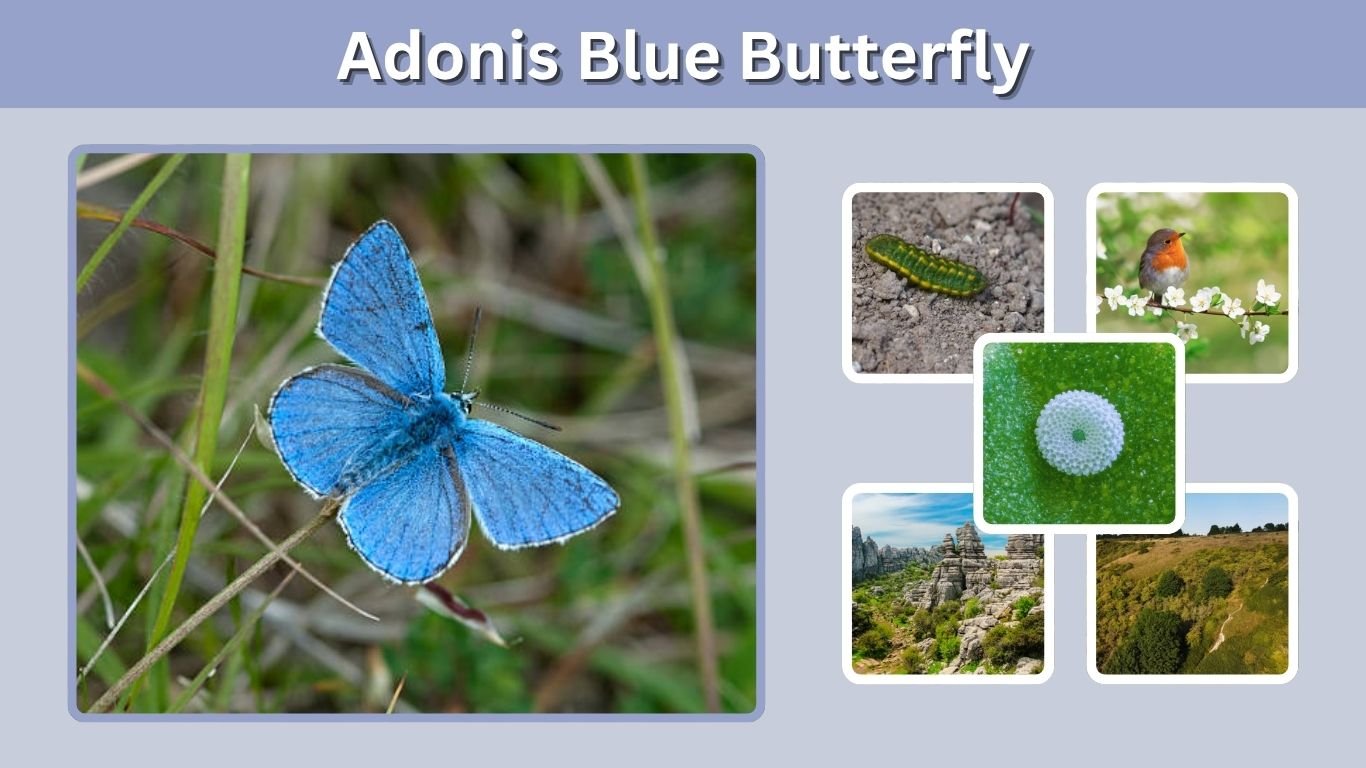
The Adonis Blue butterfly is one of Europe’s most beautiful blue butterflies, famous for its brilliant turquoise-blue wings and delicate appearance. This small butterfly is commonly associated with sunny chalk grasslands, where it flies among wildflowers during spring and summer. Males display vibrant blue wings, while females are generally chocolate brown with orange markings. Beyond its remarkable appearance, the Adonis Blue butterfly has an interesting life cycle and a special relationship with ants. Understanding its identification, size, habitat, diet, caterpillar, and conservation needs reveals what makes this butterfly unique.
What Is an Adonis Blue Butterfly?
The Adonis Blue butterfly (Lysandra bellargus, also known as Polyommatus bellargus) belongs to the Lycaenidae family, commonly called the gossamer-winged butterflies.
This species occurs across parts of Europe and western Asia, including southern England, France, Spain, Italy, and other regions with suitable habitats.
It prefers warm, open grasslands containing horseshoe vetch, the primary food plant for its caterpillars. The butterfly is particularly recognizable because of the male’s remarkable blue coloration and distinctive black-and-white wing fringes.
In Britain, the species is considered vulnerable because its populations depend on increasingly restricted chalk grassland habitats.
Adonis Blue Butterfly Identification
Identifying an Adonis Blue butterfly requires examining its wing colors, distinctive markings, and physical size. Males and females have noticeably different appearances, making this species an excellent example of sexual dimorphism.
Male Adonis Blue Butterfly Appearance
Male Adonis Blue butterflies are recognized by their brilliant sky-blue or turquoise upper wings.
Their wings have narrow black borders surrounded by white fringes crossed by dark lines, creating a distinctive checkered appearance.
The wing undersides are pale grayish-brown with small black spots surrounded by white rings and orange markings near the edges.
Freshly emerged males often display particularly vibrant blue coloration, making them stand out among other European blue butterflies.
Female Adonis Blue Butterfly Appearance
Female Adonis Blue butterflies are usually chocolate brown, although some have blue scales near the wing bases or across larger portions of their wings.
Their upper hindwings feature a row of orange crescent-shaped markings accompanied by darker spots and sometimes blue scales.
Females also possess black-and-white checkered wing fringes, similar to males.
Because females resemble other brown-colored blue butterflies, examining their wing markings carefully is important for accurate identification.
Adonis Blue Butterfly Size and Wingspan
The Adonis Blue is a relatively small butterfly, although its bright coloration makes it visually striking.
- Wingspan: Approximately 1.2–1.6 inches (30–40 mm).
- Male color: Brilliant turquoise or sky blue.
- Female color: Chocolate brown with orange markings.
- Wing fringes: White with distinctive black crossbars.
- Scientific name: Lysandra bellargus (syn. Polyommatus bellargus).
Individuals belonging to the late-summer generation are often slightly larger than those emerging during spring.
Adonis Blue Butterfly Habitat and Distribution
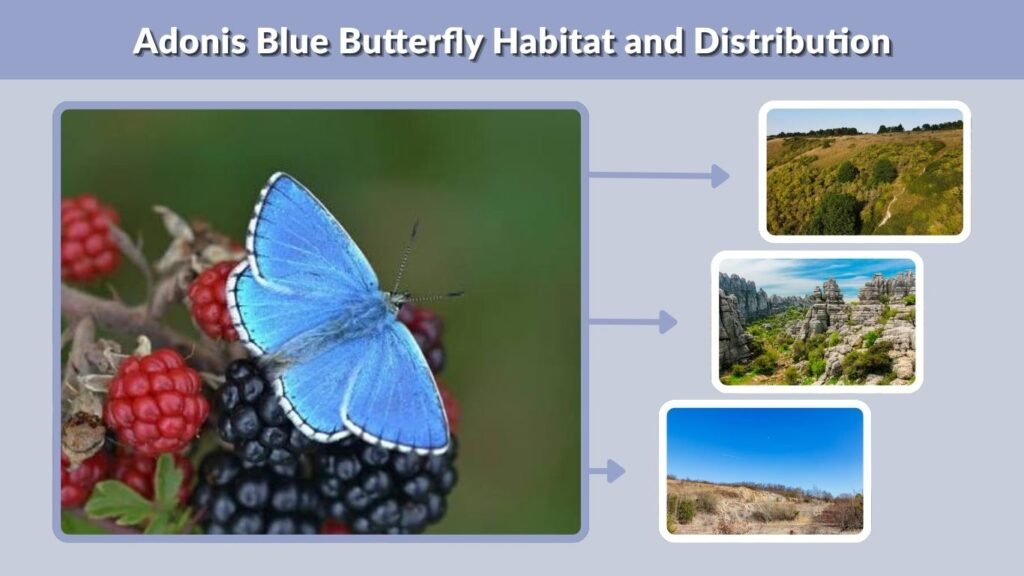
Adonis Blue butterflies require specialized habitats where suitable temperatures, vegetation, and caterpillar host plants occur together.
Where Do Adonis Blue Butterflies Live?
The Adonis Blue primarily inhabits dry chalk and limestone grasslands, particularly areas with short vegetation and abundant horseshoe vetch.
Its preferred habitats include:
- Chalk downlands: Warm grasslands containing calcium-rich soils.
- Limestone slopes: Sunny areas supporting suitable host plants.
- Short-grazed pastures: Open habitats maintained by grazing animals.
- Sheltered quarries: Locations with warm microclimates and sparse vegetation.
In the United Kingdom, the butterfly is mainly restricted to southern England, including parts of Dorset, Sussex, Wiltshire, Kent, Surrey, and the Isle of Wight.
Its broader natural range includes southern and central Europe and parts of western Asia.
When Are Adonis Blue Butterflies Active?
In Britain, Adonis Blue butterflies normally produce two generations each year.
The first generation usually appears from mid-May through June, while the second flies from early August through September.
Warm spring weather can cause some adults to emerge earlier.
These butterflies are particularly active during sunny conditions when temperatures are suitable for flying and feeding.
What Do Adonis Blue Butterflies Eat?
Adonis Blue butterflies have different dietary requirements during their adult and caterpillar stages.
Adults obtain energy from flower nectar, while caterpillars depend on specific host plants for development.
Adult Adonis Blue Butterfly Diet
Adult Adonis Blue butterflies primarily feed on nectar collected from wildflowers growing in their grassland habitats.
They may visit horseshoe vetch, scabious, and other nectar-producing flowers during their flight season.
Nectar provides the energy needed for flight, mating, and reproduction.
Adult butterflies may also obtain moisture and dissolved minerals from damp ground or other natural sources.
Adonis Blue Caterpillar Host Plant
The principal caterpillar host plant is horseshoe vetch (Hippocrepis comosa).
In Britain, this plant is essential for successful reproduction because female butterflies lay their eggs on it and developing caterpillars feed on its leaves.
Horseshoe vetch grows naturally in dry, calcium-rich grasslands and produces clusters of small yellow flowers.
Its availability strongly influences where Adonis Blue butterflies can establish breeding colonies.
Adonis Blue Butterfly Life Cycle
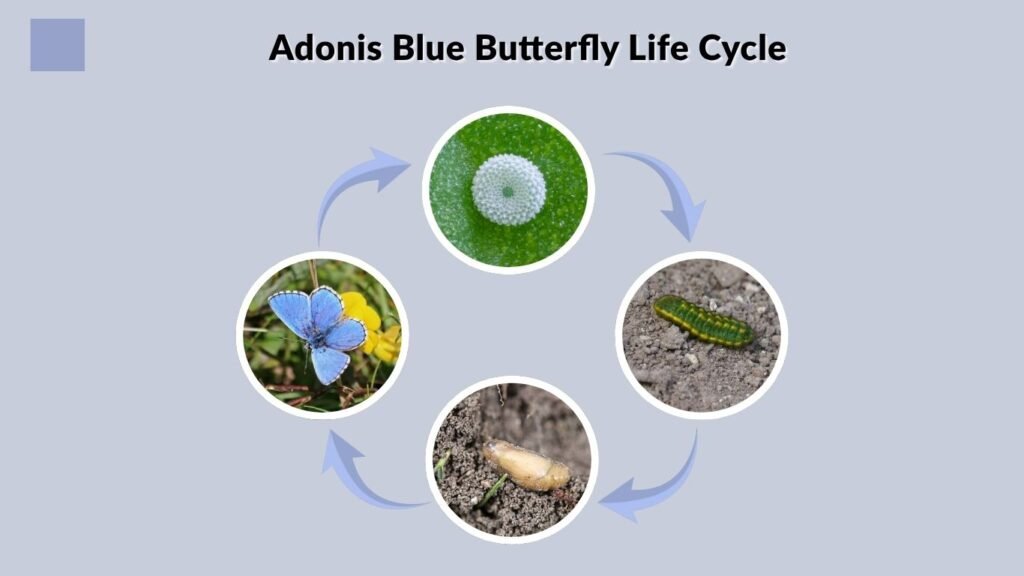
The Adonis Blue butterfly undergoes complete metamorphosis, developing through four stages: egg, caterpillar, chrysalis, and adult.
Its development is closely connected to seasonal temperatures, host plant availability, and interactions with ants.
1. Egg Stage
Female Adonis Blue butterflies generally lay individual eggs on horseshoe vetch plants.
The eggs are very small and are often positioned on the undersides of leaves, where newly hatched caterpillars can access food.
After development, tiny larvae emerge and begin feeding on their host plant.
2. Adonis Blue Caterpillar Stage
Adonis Blue caterpillars have flattened green bodies with yellowish markings that help them blend into vegetation.
They feed on horseshoe vetch leaves as they grow and pass through several developmental stages.
One remarkable characteristic is their close relationship with ants.
The caterpillars produce sugary secretions that attract ants, which frequently protect them from predators and parasitoids.
Caterpillars belonging to the late-summer generation survive winter before completing their development the following spring.
3. Chrysalis Stage
After completing larval development, the caterpillar transforms into a chrysalis.
Pupation generally occurs close to the ground, often with ants continuing to attend the developing butterfly.
During this stage, the caterpillar’s body transforms into an adult butterfly.
The pupal stage of the spring generation usually lasts several weeks, depending on environmental conditions.
4. Adult Butterfly Stage
The adult butterfly eventually emerges from its chrysalis and expands its wings before flying.
Males begin searching for females, while females locate suitable horseshoe vetch plants for egg-laying.
Adult Adonis Blue butterflies generally live around one to two weeks, although survival varies with weather, predation, and other conditions.
Adonis Blue Butterfly and Ants
One of the most fascinating Adonis Blue butterfly facts is its relationship with ants, known as myrmecophily.
Adonis Blue caterpillars produce sugary substances that ants collect as food. In exchange, the ants provide some protection against predators and parasitic insects.
Ants may also attend the chrysalises and help conceal them close to the ground.
This relationship benefits the developing butterflies and explains why suitable ant populations are important in Adonis Blue breeding habitats.
Adonis Blue vs. Common Blue Butterfly
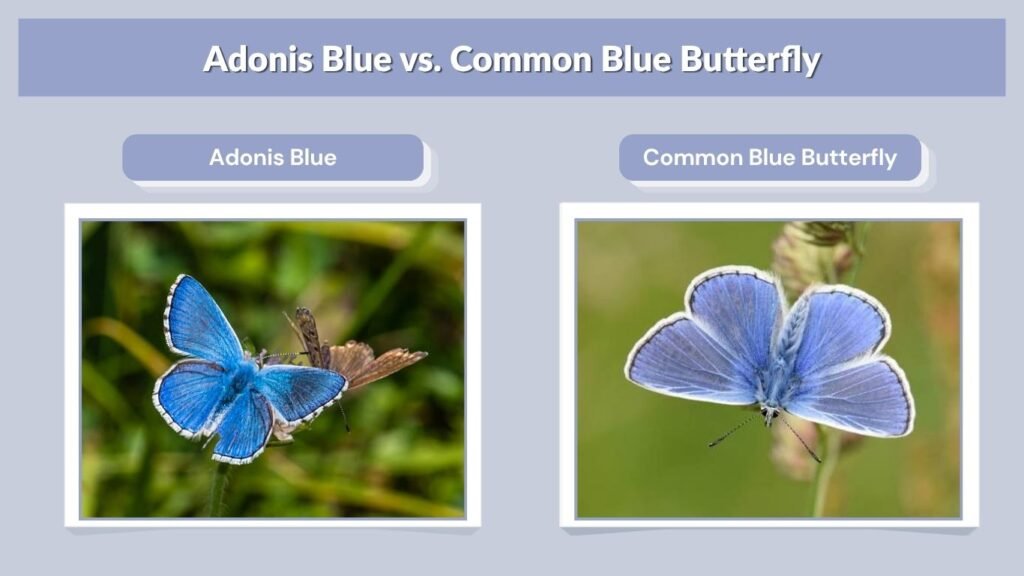
The Adonis Blue and Common Blue butterflies resemble each other, particularly when observing males in flight. However, several differences help distinguish them.
| Feature | Adonis Blue | Common Blue |
| Scientific name | Lysandra bellargus | Polyommatus icarus |
| Male wing color | Brilliant turquoise-blue | Usually violet-blue |
| Female appearance | Mainly brown with orange markings | Brown to blue with orange markings |
| Wing fringes | Black-and-white checkered | Usually plain white |
| Main UK caterpillar host | Horseshoe vetch | Common bird’s-foot-trefoil |
| Habitat | Mainly chalk and limestone grasslands | Wide variety of open habitats |
The most useful identification feature is the black crossbars extending through the white wing fringes of the Adonis Blue.
Adonis Blue Butterfly Predators and Conservation
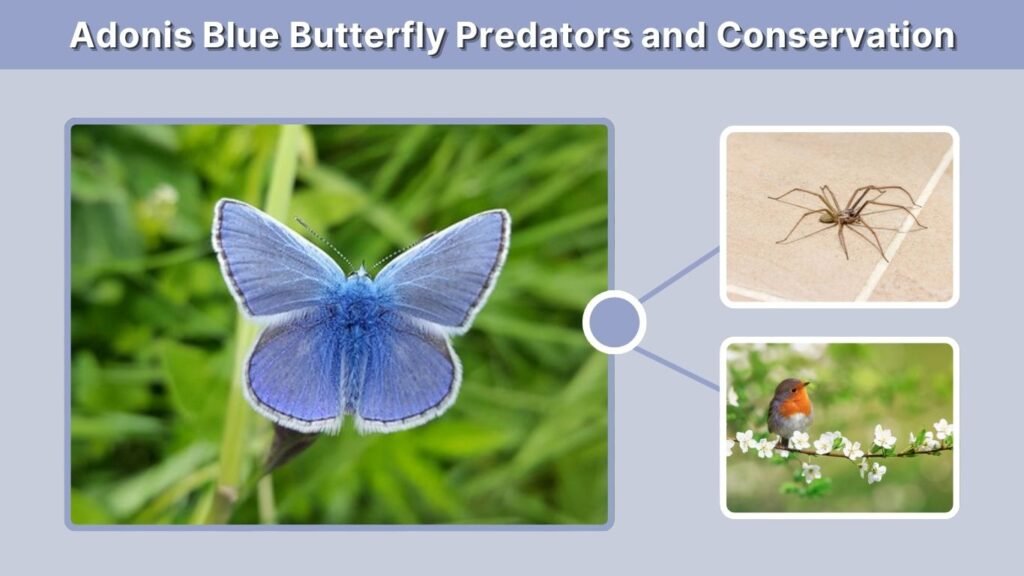
Adonis Blue butterflies face natural threats from spiders, insect-eating birds, predatory insects, and parasitoids.
However, habitat loss is a major conservation concern.
Without appropriate grazing, chalk grasslands can become overgrown with tall grasses and shrubs. These changes reduce the warm, open conditions needed by horseshoe vetch and developing caterpillars.
Important conservation measures include maintaining suitable grazing, protecting chalk grasslands, preserving horseshoe vetch populations, and restoring degraded habitats.
In Great Britain, the Adonis Blue is listed as Vulnerable and receives legal protection under the Wildlife and Countryside Act 1981.
FAQs
1. Is the Adonis Blue Butterfly Rare?
The Adonis Blue is locally rare in Britain and restricted mainly to southern England. However, its abundance varies across its wider European range and between individual breeding sites.
2. What Does an Adonis Blue Caterpillar Look Like?
An Adonis Blue caterpillar has a small, flattened green body with yellowish markings. It feeds on horseshoe vetch leaves and is commonly attended by ants.
3. How Long Does an Adonis Blue Butterfly Live?
Adult Adonis Blue butterflies typically live approximately one to two weeks. Their complete life cycle is longer because the late-summer generation overwinters as caterpillars.
4. Are Adonis Blue Butterflies Dangerous?
No. Adonis Blue butterflies are harmless to humans. They do not sting, and adults feed primarily on flower nectar.
5. What Makes the Adonis Blue Butterfly Special?
Its brilliant turquoise wings, black-and-white checkered wing fringes, specialized dependence on horseshoe vets, and protective relationship with ants make the Adonis Blue butterfly particularly distinctive.