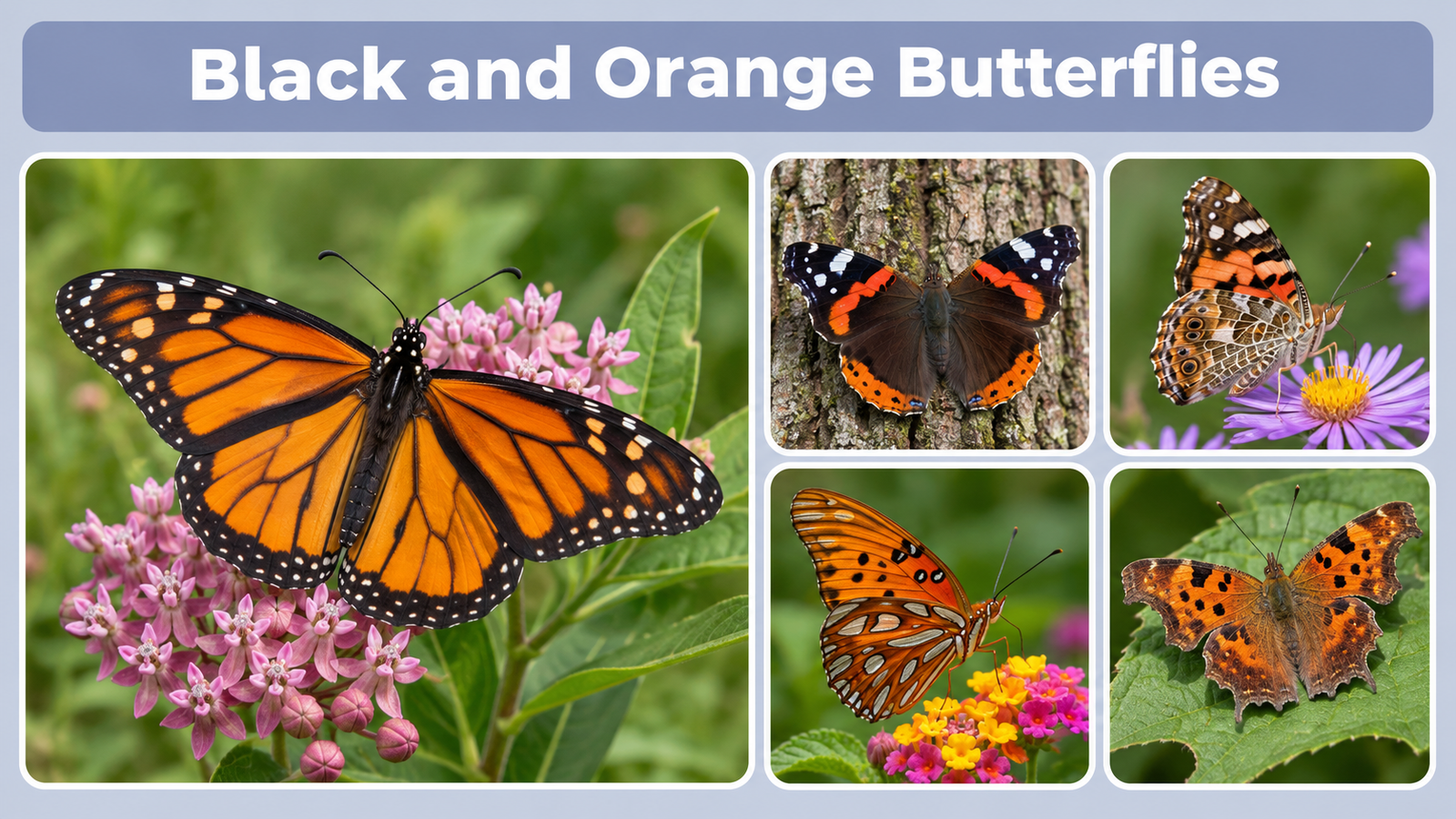
Black and orange butterflies are easy to notice but surprisingly easy to confuse. A monarch, a viceroy, and a queen can look similar as they fly past, while a painted lady and an American lady may be hard to tell apart even in a photograph. The best clues are often small. Look for a line across the hindwing, count the eyespots underneath, or notice where the orange appears. This guide focuses on 10 butterflies found in North America and explains what to look for, where you might see them, and how to separate the most common look-alikes.
10 Types of Black and Orange Butterflies
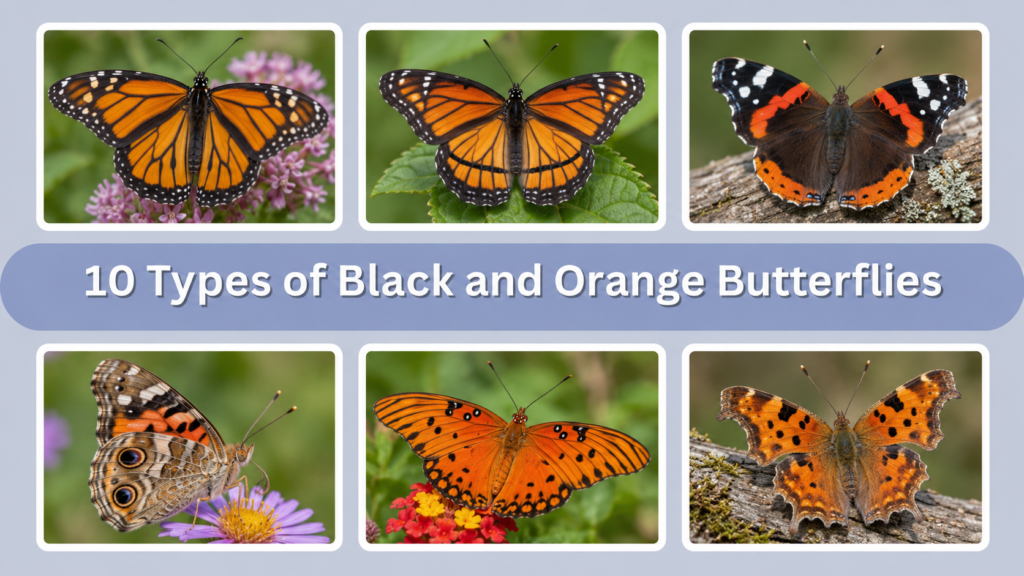
Some of these butterflies have mostly orange wings with black markings. Others have dark wings with an orange band or patch. The descriptions below identify which side of the wings to look at so you can use the right clues whether the butterfly is basking with its wings open or feeding with its wings closed.
1. Monarch (Danaus plexippus)
The monarch has broad orange wings divided by black veins. A thick black border with white spots runs around the wings, creating the familiar stained-glass pattern. Males typically have a small black spot on a vein of each hindwing. Females lack those spots and often have thicker black veins.
Look for monarchs in open areas with flowering plants, including gardens, meadows, and roadsides. Adult monarchs visit many kinds of flowers for nectar, while their caterpillars depend on milkweeds. When checking a possible monarch, examine the hindwing. A curved black line crossing the veins is a clue that you may be looking at a viceroy.
2. Viceroy (Limenitis archippus)
The viceroy shares the monarch’s orange wings, black veins, and white-spotted borders. Its most useful distinguishing feature is a narrow black line that curves across each hindwing, crossing the veins. This line is usually visible when the butterfly holds its wings open and can also be seen underneath.
Viceroys often occur near ponds, streams, and other moist areas where willows grow. Their caterpillars feed on willow and related trees such as poplars. A viceroy is generally smaller than a monarch, although the hindwing line is more reliable than size, especially when you have a single butterfly or a photo without a scale.
3. Queen (Danaus gilippus)
The queen typically has warm chestnut-orange or reddish-brown wings with a dark border. Viewed from above, its wing veins are less strongly outlined than a monarch’s, giving the orange areas a more even appearance. Small white spots near the forewing tips are another clue. Dark veins are easier to see on the underside of the hindwings.
In the United States, queens are most likely to be seen in warmer southern areas, including Florida, Texas, and parts of the Southwest. Like monarchs, they use milkweeds and related plants as caterpillar hosts. If you see a monarch-like butterfly with darker orange wings and white spots on the upper forewings, check for a queen.
4. Painted Lady (Vanessa cardui)
The painted lady has mottled orange and black upper wings, with white spots near the dark forewing tips. Its underside looks quite different. The hindwing is streaked with tan, brown, and gray, with a row of small eyespots along the outer part of the wing.
Turn to those eyespots when you need to separate a painted lady from an American lady. A painted lady typically has four small eyespots on the underside of each hindwing, while an American lady has two much larger ones. Painted ladies visit gardens, fields, and other open habitats. Their caterpillars feed on plants that include thistles and mallows.
5. American Lady (Vanessa virginiensis)
The American lady has orange and black upper wings with white markings near the forewing tips. A small white spot within the orange area of the forewing can help identify it when the wings are open. The clearest feature is underneath, where each hindwing carries two large eyespots against a mottled background.
American ladies visit sunny gardens, roadsides, and open fields. Their caterpillars feed on plants such as pussytoes and cudweeds. When you spot an adult on a flower, watch as it opens and closes its wings. A clear side view often gives you a better identification than a more colorful overhead photo.
6. Red Admiral (Vanessa atalanta)
The red admiral is mainly black or very dark brown, with a vivid red-orange band crossing each forewing. A band of the same color follows the outer edge of the hindwings, and white spots sit near the forewing tips. The orange areas look like bold stripes, even when the butterfly is moving.
Red admirals visit gardens, woodland edges, and other sites near stands of nettles, which their caterpillars use as host plants. An adult resting with closed wings can blend into bark or leaf litter because the underside is mottled brown. Wait for it to open its wings to see the pattern clearly.
7. Great Spangled Fritillary (Speyeria cybele)
The great spangled fritillary has orange upper wings with rows of black spots and dark markings near the edges. The underside of each hindwing has reflective silver spots and a broad pale band near the outer edge. These features are especially helpful when the butterfly is feeding with its wings partly closed.
Look for adults in meadows, pastures, and open woodland edges, where they often visit flowers such as milkweed and thistles. Their caterpillars feed on violets. Several fritillaries have orange upper wings and silver markings underneath, so use the pale band together with your location when narrowing down the species.
8. Gulf Fritillary (Dione vanillae, also Agraulis vanillae)
The gulf fritillary has bright orange upper wings dotted with black, and its long forewings give it a narrower outline than many other orange butterflies. The undersides are marked with elongated silver spots that stand out when it closes its wings. An overhead photo and a side photo can look like two different butterflies.
Gulf fritillaries are familiar garden visitors in warmer parts of the United States, especially where passionflowers grow. Their caterpillars feed on passionflower vines. If a bright orange butterfly repeatedly circles a passionflower, look for the narrow wing shape and silvery underside before deciding which species it is.
9. Pearl Crescent (Phyciodes tharos)
The pearl crescent is much smaller than a monarch or a great spangled fritillary. Its upper wings have orange patches broken up by fine black lines and dark borders. On the underside of the hindwing, a pale crescent near the outer edge sits within a darker patch.
Pearl crescents often fly low over sunny lawns, fields, and roadsides, pausing on small flowers or bare ground. Their caterpillars feed on asters. Several related crescents have similar markings, so a close photo and the location of the sighting are useful, particularly where their ranges overlap.
10. Eastern Comma (Polygonia comma)
The eastern comma has orange upper wings with prominent black spots and sharply scalloped edges. The underside is mottled brown, resembling a dry leaf or a piece of bark. A small silvery comma-shaped mark near the center of the hindwing gives the butterfly its name.
Eastern commas often occur around woodland edges, trails, and stream corridors. They may land on tree trunks or feed on sap, giving you a chance to see the underside. A similar species, the question mark, usually has a small silver dot beside its curved mark. A close side view makes this difference easier to see.
Quick Identification Guide
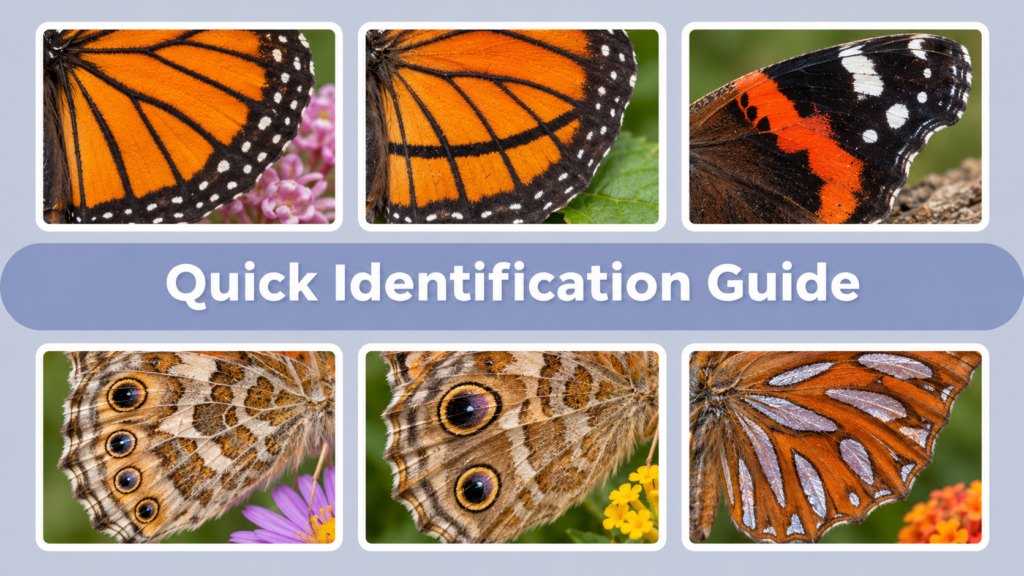
Start with the largest visible marking. If the wings are mostly orange, check whether the black forms veins, spots, or a fine network of lines. If the wings are mostly dark, look at where the orange sits. Then turn to the underside for eyespots, silver spots, or other markings that may be hidden from above.
| What you see | Likely butterfly | What to check next |
|---|---|---|
| Orange wings with bold black veins | Monarch | Check whether a curved black line crosses the hindwing veins |
| Curved black line across the hindwing | Viceroy | Look for the line on either wing surface |
| Chestnut-orange wings with white forewing spots | Queen | Check whether the upper wing veins are faint |
| Four small eyespots under the hindwing | Painted lady | Look for the row of small spots near the outer edge |
| Two large eyespots under the hindwing | American lady | Check for a small white spot in the orange forewing area |
| Dark wings with red-orange bands | Red admiral | Look for white spots near the forewing tips |
| Orange wings with black spots and silver markings underneath | Great spangled or gulf fritillary | Compare wing shape and look for the great spangled fritillary’s pale hindwing band |
| Scalloped wings with a silver comma underneath | Eastern comma | Check for a separate silver dot, which suggests a question mark |
Frequently Asked Questions
Are all black and orange butterflies monarchs?
Several butterflies share those colors, including viceroys, painted ladies, and fritillaries. A monarch’s bold black veins and white-spotted border help narrow the identification. Check the hindwing for the viceroy’s curved black line before settling on a monarch.
What is the easiest way to tell a monarch from a viceroy?
Look at the hindwing. A viceroy has a curved black line that crosses the veins. A monarch has black veins and a dark outer border, with no matching line across the hindwing.
Which black and orange butterfly has silver spots?
Both the great spangled fritillary and the gulf fritillary have silver spots underneath. The gulf fritillary has longer, narrower wings and elongated silver spots. The great spangled fritillary has a broad pale band near the outer edge of the hindwing.
Why do some orange butterflies look brown with their wings closed?
The upper and lower wing surfaces often have different patterns. An eastern comma shows orange and black when its wings are open, then blends into bark or dead leaves when it closes them and exposes the mottled brown underside.
What plants attract black and orange butterflies?
Native asters, goldenrods, and other nectar-rich flowers can attract adults. Add caterpillar host plants for the species you want to support. Milkweed supports monarch caterpillars, violets support great spangled fritillaries, and passionflower vines support gulf fritillaries.