

The blue carpenter bee, scientifically known as Xylocopa caerulea, is one of the most visually stunning insects in the world. Its deep metallic-blue body glistens under sunlight, resembling a living gemstone in motion. These solitary bees are admired for their beauty, gentle nature, and essential role in pollination. Despite their large size and loud buzz, blue carpenter bees are calm, harmless, and vital contributors to ecological balance.
Appearance and Identification
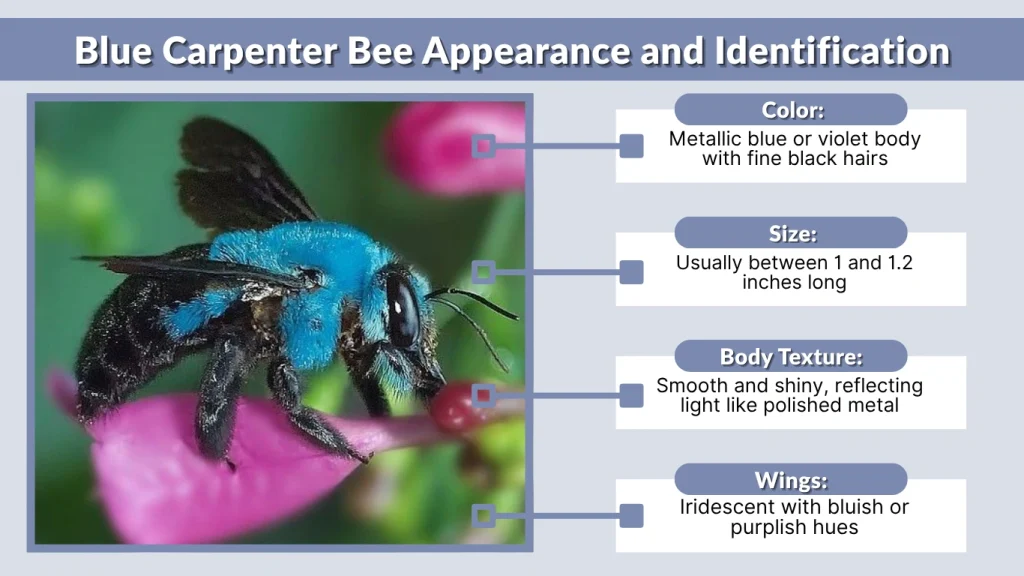
The blue carpenter bee stands out with its dazzling metallic-blue coloration. Unlike the yellow and black bumblebee or the glossy black carpenter bee, this species exhibits a shimmering appearance that captures attention instantly.
Key identification traits include:
- Color: Metallic blue or violet body with fine black hairs
- Size: Usually between 1 and 1.2 inches long
- Wings: Iridescent with bluish or purplish hues
- Body Texture: Smooth and shiny, reflecting light like polished metal
- Flight Sound: A deep, low buzz indicating strong wingbeats
Males often have slightly lighter shades of blue compared to females. The shimmering hues result from structural coloration, not pigmentation — a unique trait caused by the microscopic structure of the bee’s exoskeleton that refracts light.
Scientific Classification
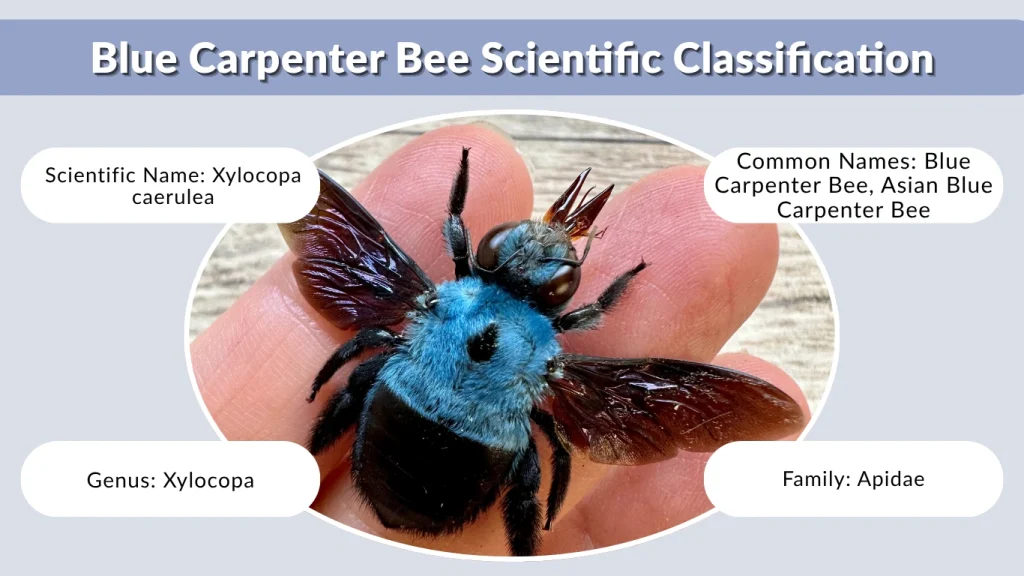
The blue carpenter bee belongs to the Apidae family, the same group that includes bumblebees and honeybees.
Key Classification
- Scientific Name: Xylocopa caerulea
- Common Names: Blue Carpenter Bee, Asian Blue Carpenter Bee, Violet Carpenter Bee
- Genus: Xylocopa
- Family: Apidae
- Order: Hymenoptera
Related Species
- Xylocopa violacea – European violet carpenter bee
- Xylocopa tranquebarica – Found in Southeast Asia
- Xylocopa aerata – Native to Australia
All these species share the distinctive carpenter bee behavior of drilling into wood or bamboo to create nesting tunnels.
Habitat and Distribution

The blue carpenter bee is native to Southeast Asia and Australia, thriving in tropical and subtropical climates. These bees prefer regions abundant with flowering plants and softwood for nesting.
Primary locations include:
- Thailand
- Malaysia
- Indonesia
- Southern China
- The Philippines
- Northern India
- Eastern Australia
In Australia, Xylocopa aerata is commonly found in New South Wales, Queensland, and Victoria, where it inhabits eucalyptus forests and dry woodlands.
Preferred habitats:
- Old tree trunks and dead wood
- Bamboo stalks and wooden beams
- Garden fences and wooden sheds
- Tropical gardens rich in nectar sources
Their ability to adapt makes them frequent visitors to home gardens, especially where native flowering plants are abundant.
Male vs. Female Blue Carpenter Bees

Although both sexes share the same blue sheen, subtle physical and behavioral differences help distinguish them:
- Male Blue Carpenter Bees:
- Usually lighter in color with turquoise tones
- Territorial and seen hovering protectively near nesting sites
- Harmless and cannot sting
- Usually lighter in color with turquoise tones
- Female Blue Carpenter Bees:
- Slightly larger and darker metallic blue
- Responsible for drilling nesting tunnels
- Possess a stinger but rarely sting unless threatened
- Slightly larger and darker metallic blue
These differences are especially noticeable during the breeding season, when males guard potential mates while females focus on nest construction and provisioning.
Behavior and Nesting Habits
Blue carpenter bees are solitary pollinators, meaning they don’t form hives or colonies like honeybees. Each female builds her own nest, usually inside softwood or bamboo.
The nesting process follows an intricate pattern:
- The female bores a nearly perfect round entrance hole about ½ inch wide.
- She tunnels inward and then turns at a right angle, forming a long gallery.
- Within this tunnel, she creates separate brood cells using chewed wood pulp.
- Each cell contains one egg laid on a ball of pollen and nectar paste, which serves as food for the larva.
- Once sealed, the larvae develop over several weeks before emerging as adult bees.
These nests are often reused by new generations, expanding over time. While this can occasionally cause minor wood damage, their nesting behavior rarely poses a significant threat to buildings.
Sting and Danger

Despite their large size and intimidating buzz, blue carpenter bees are gentle and non-aggressive. Only females have the ability to sting, but they almost never do unless handled roughly or cornered.
Their sting is mild compared to wasps or hornets and rarely causes allergic reactions. The sensation is similar to that of a light bee sting and usually subsides quickly.
Sting treatment steps:
- Clean the area with soap and water
- Apply ice or a cold compress to reduce swelling
- Use a topical antihistamine or aloe vera for comfort
Because males cannot sting and females avoid confrontation, blue carpenter bees are often considered among the most peaceful bee species.
Why Are Blue Carpenter Bees Blue?
The breathtaking color of blue carpenter bees isn’t from pigment but from a microscopic structural phenomenon called structural coloration. Tiny ridges and layers in their exoskeleton scatter light waves, reflecting primarily blue and violet hues.
This natural effect, similar to the shimmer seen in peacock feathers and morpho butterflies, gives the bee its metallic blue glow. The brightness can vary with lighting conditions and viewing angle, which is why their color often looks iridescent.
The blue hue is not only stunning but may also help regulate heat absorption — reflecting sunlight and keeping the bee cool in tropical climates.
Role in Pollination

Blue carpenter bees play an important ecological role as buzz pollinators. They use powerful vibrations from their flight muscles to shake loose pollen from flowers — a process that many smaller bees can’t achieve.
Their large size and strength allow them to pollinate robust flowers such as:
- Passionflowers (Passiflora spp.)
- Tomatoes and eggplants
- Hibiscus and bougainvillea
- Native orchids and tropical wildflowers
These bees are especially valuable in ecosystems with thick-petaled plants, helping maintain biodiversity and supporting agricultural pollination.
Cultural and Symbolic Meaning
The blue carpenter bee carries deep symbolism across different cultures. In Asian folklore, it represents creativity, patience, and rebirth. Its constant building of nests within wood reflects determination and the power to create beauty from simplicity.
In spiritual contexts, the bee’s blue color is often linked to tranquility, intuition, and inspiration. Seeing a blue carpenter bee is sometimes viewed as a sign to stay calm under pressure and keep working toward one’s goals with persistence.
For artists and tattoo enthusiasts, this bee symbolizes resilience and individuality, reminding people that strength doesn’t require aggression — sometimes, quiet persistence is enough to leave a lasting mark.
Blue Carpenter Bee vs. Other Species

Blue carpenter bees are often mistaken for black carpenter bees or bumblebees. While they share certain traits, their differences are easy to recognize once you know what to look for:
| Feature | Blue Carpenter Bee | Black Carpenter Bee | Bumblebee |
| Color | Metallic blue or violet | Glossy black | Yellow and black striped |
| Body Texture | Smooth and shiny | Shiny but darker | Fuzzy and hairy |
| Social Behavior | Solitary | Solitary | Lives in colonies |
| Habitat | Tropical and subtropical | Temperate and wooded | Ground burrows or hives |
| Aggression | Very docile | Non-aggressive | Can defend hive if threatened |
These distinctions help naturalists, photographers, and homeowners identify the bees correctly and appreciate their ecological role.
Blue Carpenter Bee in Australia
Australia is home to one of the most beautiful regional variants — Xylocopa aerata. Known as the Australian Blue Carpenter Bee, it features a brilliant blue-green metallic sheen and is found across New South Wales, Queensland, and Victoria.
Key Traits of the Australian Blue Carpenter Bee
- Feeds primarily on native wildflowers like grevillea and tea tree
- Nests inside dead eucalyptus wood and soft stems
- Active mainly during spring and summer
- Plays a vital role in pollinating Australian flora
However, environmental threats have affected its numbers. Bushfires and habitat destruction have caused significant population declines in southern regions, making conservation efforts critical. Gardeners can help by planting native flowering plants and leaving small logs or bamboo stems for nesting sites.
Are Blue Carpenter Bees Endangered?
Globally, blue carpenter bees are not listed as endangered, but several regional populations are in decline. In Australia, their habitats have been severely impacted by deforestation, land clearing, and climate-related disasters.
The biggest threats include:
- Loss of nesting sites due to removal of dead wood and trees
- Pesticide use that harms pollinators and their food sources
- Extreme weather events, including drought and wildfires
- Decline in native flowering plants
Conservationists are now focusing on pollinator gardens and habitat restoration to support bee populations. These projects aim to encourage natural nesting and protect pollinator corridors in both urban and rural landscapes.
Blue Carpenter Bee Honey

One common question is whether blue carpenter bees make honey. The answer is no — they are solitary bees, not social insects like honeybees. They do not live in hives, produce wax, or store honey.
However, you may find products online labeled as “blue carpenter bee honey.” These are typically artisan honeys made by local beekeepers or color-enhanced blends marketed under the exotic name. True blue carpenter bees collect pollen and nectar only to feed their offspring, not for storage or human use.
Their role lies in pollination, not honey production — a reminder that even without making honey, these bees are vital to plant reproduction and biodiversity.
Blue Carpenter Bee Symbolism in Art and Tattoos
The stunning appearance of the blue carpenter bee has made it a popular subject in art, jewelry, and tattoos.
Artistic Symbolism
- Blue hues: Represent calm, wisdom, and emotional depth.
- Wings in motion: Symbolize persistence and freedom.
- Wood-boring behavior: Reflects creativity and transformation — carving new paths through life’s obstacles.
In tattoo designs, the blue carpenter bee is often chosen as a symbol of peaceful strength or self-made success. Artists love capturing its reflective metallic tones, often blending realism with spiritual motifs like flowers or light beams.
It also appears in resin art, natural taxidermy frames, and photography projects, admired for its unmatched color and intricate body structure.
Conservation and Coexistence Tips
Protecting the blue carpenter bee requires awareness and small efforts from everyone. Since they are harmless and beneficial pollinators, the goal is coexistence, not extermination.
How to Protect Blue Carpenter Bees
- Avoid pesticides: Use natural pest control methods in gardens.
- Provide nesting materials: Leave bamboo pieces, untreated logs, or wooden blocks outdoors.
- Plant bee-friendly flowers: Include hibiscus, passionflower, lavender, and native wildflowers.
- Support conservation initiatives: Participate in local pollinator programs and habitat restoration.
By creating pollinator-friendly spaces, you contribute to preserving one of nature’s most beautiful insects — the shimmering blue carpenter bee.
FAQs
Are blue carpenter bees real?
Yes, they are real and scientifically recognized as Xylocopa caerulea. Native to tropical Asia and Australia, their metallic-blue bodies make them one of the most beautiful and distinctive bee species in the world.
Do blue carpenter bees sting?
Only females have stingers, but they are calm and sting only when handled roughly. Males cannot sting at all, making encounters with these bees completely safe.
Where do blue carpenter bees live?
They live in Southeast Asia, southern China, India, Indonesia, and northern Australia. Their nests are often found in dead wood, bamboo, and tree trunks, especially near flowering plants.
Are blue carpenter bees endangered?
Not globally, but regional populations — especially in Australia — are at risk due to habitat loss and climate change. Conservationists are working to preserve their native habitats through replanting and pollinator protection programs.
Do blue carpenter bees make honey?
No, they do not produce honey or wax. Blue carpenter bees are solitary and only gather pollen and nectar for their larvae. Their value lies in pollination, which supports natural ecosystems and agriculture.
