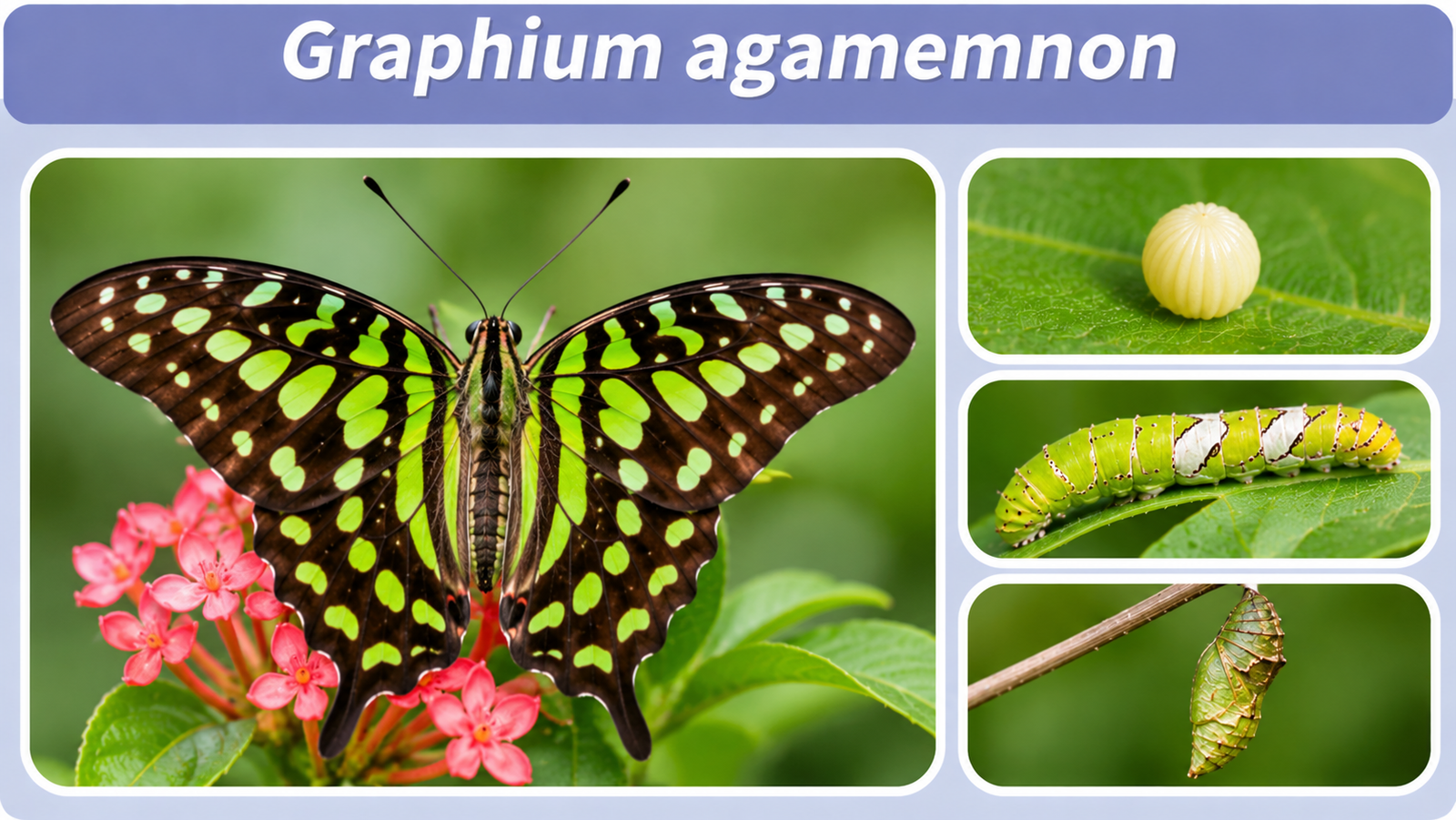
Graphium agamemnon, commonly known as the tailed jay butterfly, is a beautiful tropical butterfly recognized by its bright green spots and dark wings. It belongs to the swallowtail family and occurs across South Asia, Southeast Asia, and parts of Australia. This energetic butterfly is famous for its fast flight, distinctive wing patterns, and unusual caterpillar appearance. It is often seen visiting flowers in gardens, forests, and tropical landscapes. Understanding the tailed jay’s identification, habitat, food plants, and life cycle reveals the fascinating characteristics of this colorful butterfly species.
What Is Graphium agamemnon?
Graphium agamemnon is a swallowtail butterfly belonging to the Papilionidae family. It is commonly called the tailed jay, green-spotted triangle, or green triangle butterfly. Unlike many swallowtails with broad wing bands, this species has numerous bright green spots scattered across dark wings, giving it a distinctive appearance.
Scientific Name and Classification
The tailed jay was scientifically described by Carl Linnaeus in 1758. Its classification includes:
- Scientific name: Graphium agamemnon
- Common name: Tailed jay
- Family: Papilionidae
- Genus: Graphium
- Order: Lepidoptera
- Class: Insecta
- Wingspan: Approximately 6–8 cm
- Other names: Green-spotted triangle and green triangle
Graphium agamemnon Butterfly Identification
The upper wings of Graphium agamemnon are dark brown to black, decorated with numerous apple-green spots.
Its forewings are elongated and pointed, while the hindwings have short tail-like extensions. The underside is brownish with pale green spots and small reddish markings near the hindwing base.
Its slender body and pointed wings contribute to its streamlined appearance. When flying, the green markings create a noticeable contrast against the surrounding vegetation.
Male vs. Female Tailed Jay
Male and female tailed jay butterflies look very similar, making identification by color alone difficult.
Both have bright green wing spots and dark backgrounds. However, female butterflies generally have slightly longer hindwing tails.
These differences are subtle, and distinguishing the sexes can be challenging without examining their physical characteristics closely.
Where Does Graphium agamemnon Live?
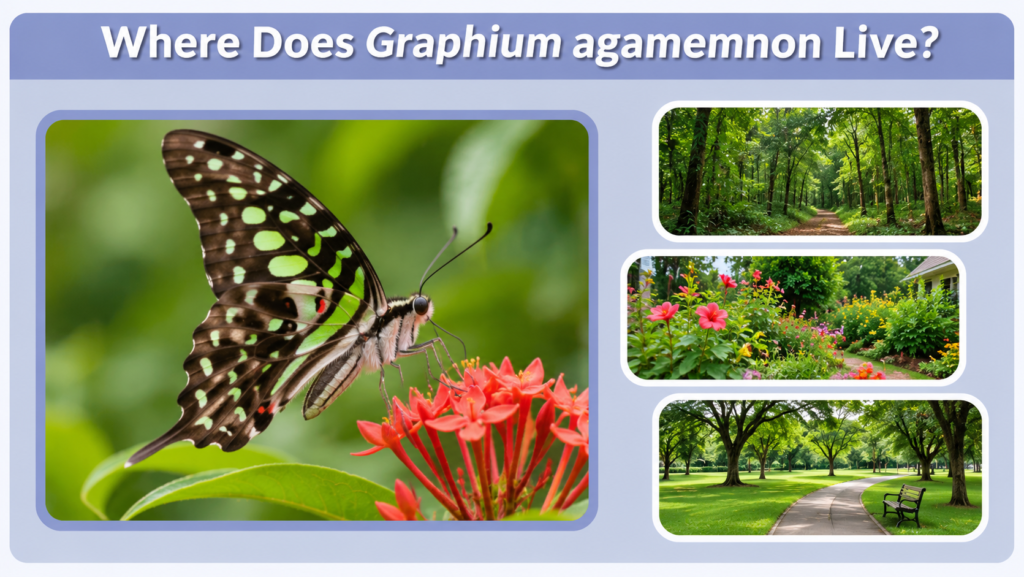
The tailed jay butterfly is widely distributed across tropical and subtropical regions. It thrives in environments with warm temperatures, suitable host plants, and abundant flowering vegetation. Unlike some butterflies restricted to dense forests, Graphium agamemnon can also survive in gardens, parks, and other green spaces near human settlements.
Geographic Distribution
The tailed jay occurs in several countries and regions, including:
- India: Found across many tropical and subtropical areas
- Bangladesh: Present in suitable forests and vegetated landscapes
- Sri Lanka: Occurs in tropical habitats
- Thailand: Found in forests, gardens, and parks
- Malaysia and Singapore: Common in suitable green environments
- Indonesia: Present on several islands
- Australia: Occurs in northeastern tropical Queensland
Its distribution also extends to Myanmar, the Philippines, and other parts of Southeast Asia.
Graphium agamemnon Habitat
Tailed jay butterflies inhabit tropical forests, secondary woodlands, plantations, parks, and gardens.
They often visit sunny areas containing nectar-producing flowers. Their caterpillars depend on particular trees and shrubs for food, making suitable vegetation essential for reproduction.
Adults are strong fliers and frequently move between flowering plants. Gardens containing appropriate host plants and nectar sources may support breeding populations.
What Does Graphium agamemnon Eat?
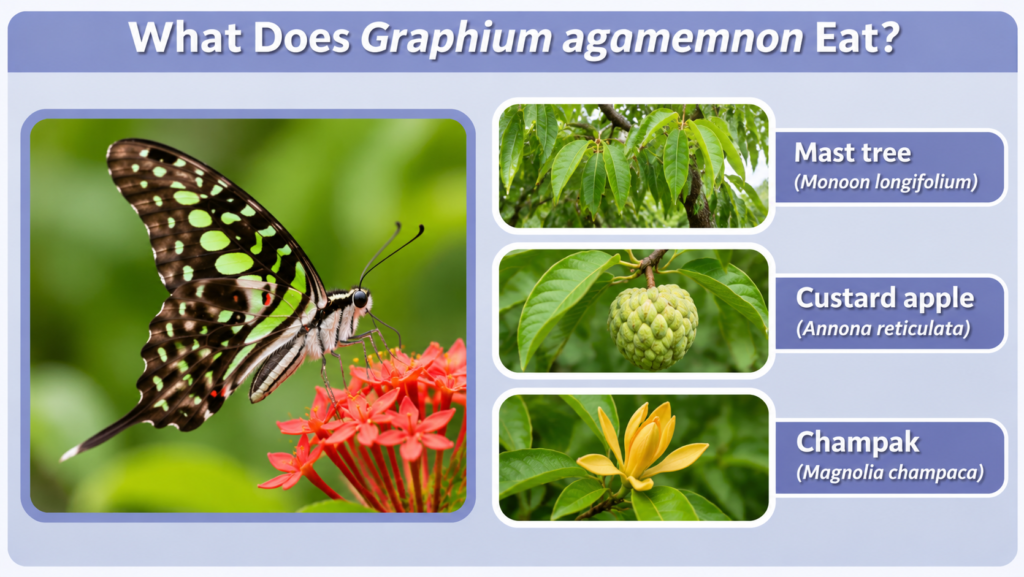
The diet of Graphium agamemnon changes throughout its development. Adult butterflies feed mainly on flower nectar, while caterpillars consume leaves from specific host plants. Both food sources are important because they support different stages of the butterfly’s life cycle. The availability of appropriate host plants also influences where female butterflies lay their eggs.
Graphium agamemnon Host Plants
Tailed jay caterpillars feed on several plant species, particularly members of the custard apple family, Annonaceae.
Commonly recorded host plants include:
- Mast tree (Monoon longifolium): Formerly known as Polyalthia longifolia
- Custard apple (Annona reticulata): A tropical fruit tree
- Sugar apple (Annona squamosa): Another important larval host
- Soursop (Annona muricata): A tropical tree with edible leaves for larvae
- Champak (Magnolia champaca): A flowering tree belonging to the Magnoliaceae family
- Climbing ylang-ylang (Artabotrys hexapetalus): A plant also recorded as a host
Female butterflies select suitable leaves for egg-laying, allowing young caterpillars to begin feeding after hatching.
Adult Tailed Jay Butterfly Food
Adult tailed jay butterflies mainly consume nectar from flowers.
They frequently visit lantana and ixora flowers, using their long proboscis to collect nectar.
Their quick movements allow them to visit numerous blossoms within a short period. While feeding, they can also transfer pollen between flowers, contributing to pollination.
Graphium agamemnon Life Cycle
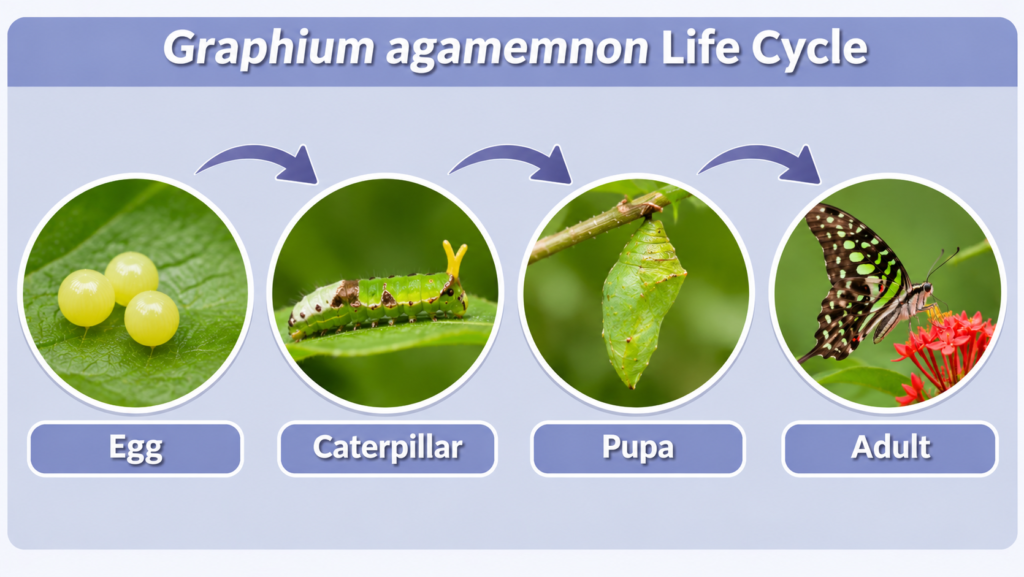
The tailed jay undergoes complete metamorphosis, passing through four distinct developmental stages: egg, caterpillar, pupa, and adult butterfly. Each stage has a different purpose, from feeding and growth to reproduction. Under conditions documented in one Indian study, development from egg to adult emergence took approximately 33–36 days, although timing varies with environmental conditions.
1. Egg Stage
Female tailed jay butterflies usually deposit eggs individually on young host plant leaves.
The eggs are small, rounded, and pale yellowish.
In a published study, the eggs hatched after approximately three to four days. Newly emerged caterpillars begin feeding on the surrounding leaves.
Selecting young leaves provides the larvae with suitable food during their early development.
2. Graphium agamemnon Caterpillar
Young tailed jay caterpillars have dark brown or greenish bodies with a noticeable white patch near the rear.
Their appearance changes considerably as they develop. Older caterpillars become plump and green, with small dark markings and soft spines.
The caterpillar also possesses an osmeterium, a defensive organ hidden behind its head. When disturbed, it extends this yellowish, fork-shaped structure and releases an unpleasant odor.
The caterpillar passes through five growth stages, called instars, before becoming a pupa.
3. Graphium agamemnon Pupa
Once mature, the caterpillar stops feeding and prepares for pupation.
It attaches itself to a suitable leaf or plant surface using silk and forms a chrysalis. The pupa is generally green, sometimes with brownish markings.
Inside the chrysalis, the caterpillar transforms into an adult butterfly.
One field study recorded a pupal period of approximately 13–14 days.
4. Adult Butterfly Stage
After metamorphosis, the adult butterfly emerges from its chrysalis.
Its wings expand and dry before it begins flying.
Adult tailed jays search for nectar, locate mates, and reproduce. Female butterflies eventually lay eggs on suitable host plants, beginning another generation.
Graphium agamemnon Behavior and Interesting Facts
The tailed jay is known for its energetic behavior and rapid flight. Unlike butterflies that spend long periods resting on flowers, this species frequently moves between blossoms. Its pointed wings, green spots, and defensive caterpillar adaptations make it especially interesting to butterfly enthusiasts and researchers.
Fast Flying Behavior
The tailed jay is an exceptionally active butterfly.
Its strong, rapid wingbeats allow it to move quickly between flowers and through vegetation.
During nectar feeding, it may remain airborne rather than settling completely on each flower. This behavior makes it challenging to photograph.
Interesting Facts About Graphium agamemnon
- Bright green wings: The butterfly has numerous apple-green spots on a dark background.
- Short hindwing tails: Females usually have slightly longer tails than males.
- Rapid development: One study recorded an egg-to-adult development period of 33–36 days.
- Defensive caterpillars: Larvae can extend a foul-smelling osmeterium.
- Multiple generations: In favorable tropical conditions, several generations may develop annually.
- Garden visitor: Adults regularly visit flowering plants in parks and gardens.
Graphium agamemnon ligatum
Graphium agamemnon ligatum is a recognized subspecies of the tailed jay butterfly found in Australia.
It shares the characteristic black wings and green spots of the species.
Subspecies represent geographically distinct populations that may show small differences in appearance. Australian populations have adapted to local environmental conditions and use suitable native and introduced host plants.
FAQs
1. What is the common name of Graphium agamemnon?
The common name of Graphium agamemnon is the tailed jay butterfly. It is also known as the green-spotted triangle or green triangle butterfly. These names describe its distinctive green-spotted wings and the short tail-like extensions found on its hindwings.
2. What does a Graphium agamemnon caterpillar look like?
Young caterpillars are dark brown or greenish with a prominent whitish patch. Older caterpillars develop plump green bodies with small dark markings and soft spines. They also possess a yellowish defensive organ called an osmeterium, which releases an unpleasant odor when the caterpillar feels threatened.
3. How long does the Graphium agamemnon life cycle take?
A published study recorded approximately 33–36 days from egg-laying to adult emergence. Eggs hatched after three to four days, caterpillars developed over 15–16 days, and pupae lasted around 13–14 days. These periods can change with temperature, humidity, food availability, and other environmental conditions.
4. Is Graphium agamemnon endangered?
The tailed jay is relatively common in several parts of its geographic range, including Singapore. However, its abundance can differ between regions. Local habitat destruction and the removal of host plants may affect populations. A local conservation classification should not be confused with a global IUCN assessment.
5. What is the wingspan of Graphium agamemnon?
The tailed jay butterfly typically has a wingspan of approximately 6–8 centimeters, or about 2.4–3.1 inches. Its elongated forewings and short hindwing tails give it a distinctive shape. Wingspan varies between individuals, geographic populations, and sexes.