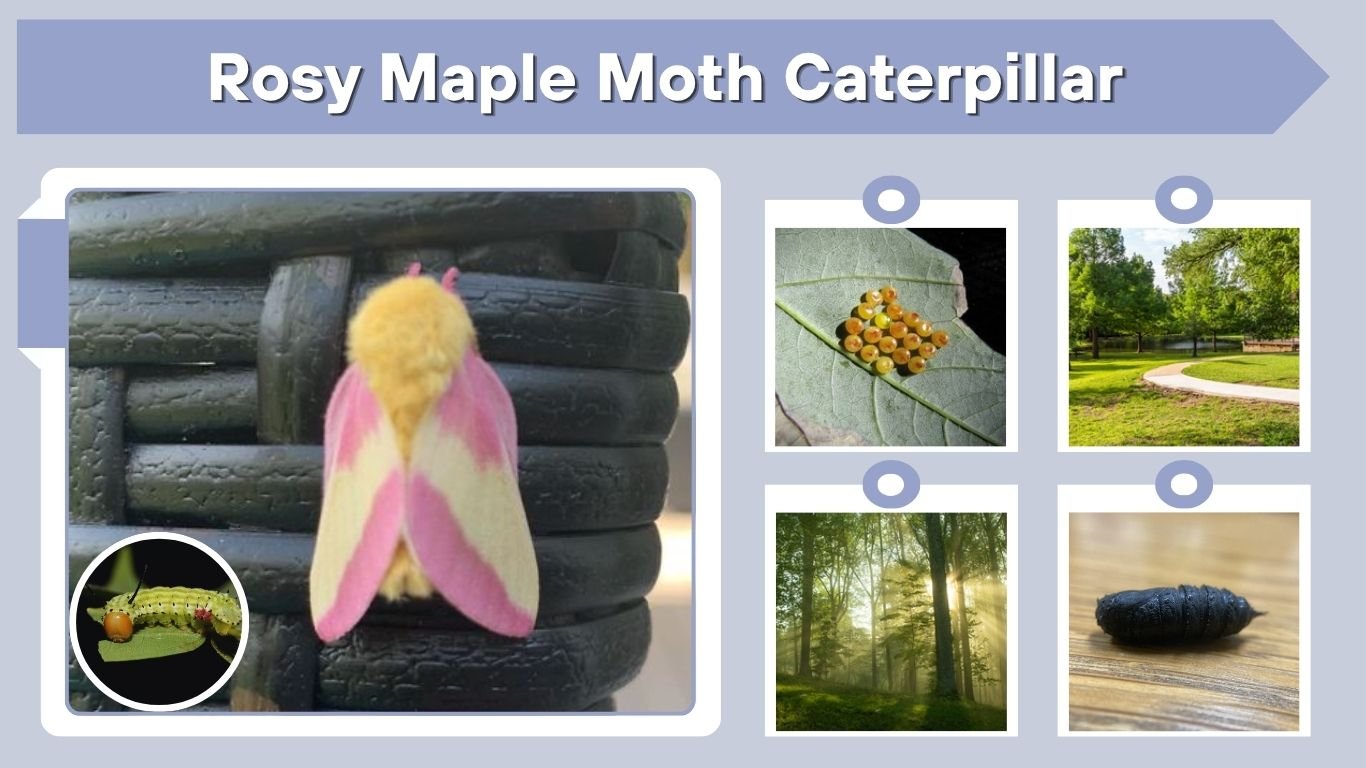
The rosy maple moth caterpillar is a fascinating green insect that eventually transforms into one of North America’s most colorful moths. Scientifically known as Dryocampa rubicunda, this caterpillar is also called the green-striped mapleworm. It features a bright green body, distinctive stripes, and small black horns near its head. Although its appearance may seem intimidating, it is generally harmless to humans. Understanding the rosy maple moth caterpillar’s appearance, diet, habitat, life cycle, and behavior can help you identify this remarkable insect in the wild.
What Is a Rosy Maple Moth Caterpillar?
The rosy maple moth caterpillar is the larval stage of the rosy maple moth, a member of the Saturniidae family. While adult moths are famous for their pink and yellow wings, their caterpillars have an entirely different appearance. These green caterpillars spend most of their development feeding on maple leaves before transforming into adult moths.
Scientific Classification
| Classification | Details |
| Common name | Rosy Maple Moth Caterpillar |
| Other name | Green-striped Mapleworm |
| Scientific name | Dryocampa rubicunda |
| Family | Saturniidae |
| Order | Lepidoptera |
| Caterpillar size | Approximately 1.5–2 inches |
| Main food | Maple leaves |
| Distribution | Eastern North America |
Why Is It Called a Green-Striped Mapleworm?
The name green-striped mapleworm describes the caterpillar’s physical appearance and feeding habits. Its body has alternating light and dark green stripes, while its preferred food comes from maple trees.
Unlike the colorful adult moth, the caterpillar’s green coloration helps it blend into surrounding foliage. This natural camouflage provides some protection against predators, especially when the insect rests beneath leaves.
How to Identify a Rosy Maple Moth Caterpillar
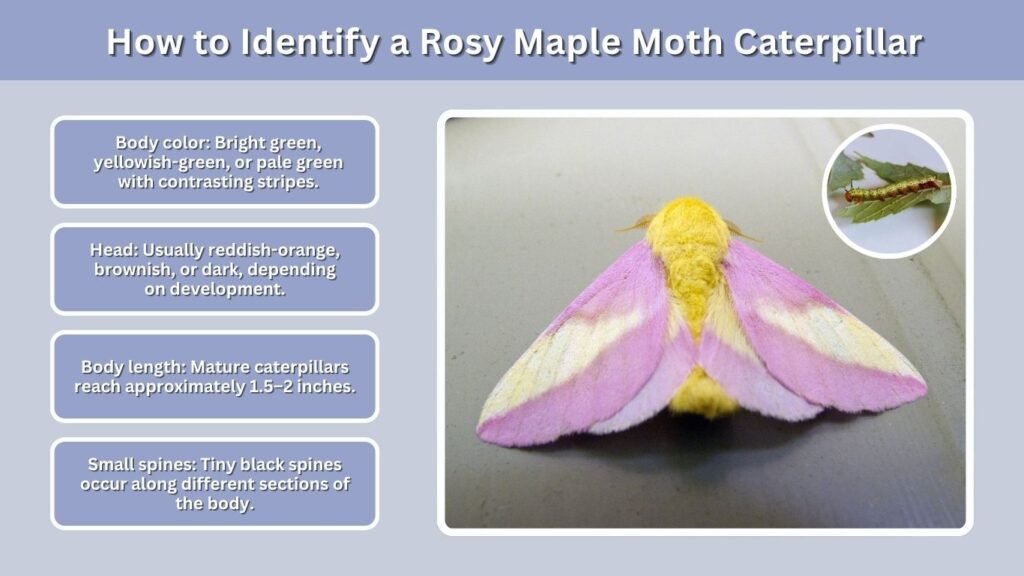
Identifying a rosy maple moth as a caterpillar is relatively easy once you recognize its distinctive characteristics. Mature caterpillars usually have green bodies with contrasting stripes, reddish heads, and two black projections near the front. However, younger caterpillars may look slightly different because their appearance changes as they develop.
Key Identification Features
- Body color: Bright green, yellowish-green, or pale green with contrasting stripes.
- Head: Usually reddish-orange, brownish, or dark, depending on development.
- Body length: Mature caterpillars reach approximately 1.5–2 inches.
- Black horns: Two noticeable horn-like projections appear just behind the head.
- Small spines: Tiny black spines occur along different sections of the body.
- Red markings: Some mature caterpillars develop reddish patches toward the rear.
What Does a Baby Rosy Maple Moth Caterpillar Look Like?
Young rosy maple moth caterpillars are considerably smaller than mature individuals. They often have pale green or yellowish bodies and darker heads.
Newly hatched caterpillars usually feed together in groups. As they grow, they develop more visible stripes and become increasingly independent.
The caterpillar molts several times before reaching its final larval stage. Its recognizable black horns and green body markings become more noticeable during development.
What Do Rosy Maple Moth Caterpillars Eat?
Rosy maple moth caterpillars are herbivores that primarily consume tree leaves. Their diet consists mainly of maple foliage, although certain oak species can also serve as host plants. Young caterpillars usually feed in groups, while older individuals spread out and consume larger portions of individual leaves.
Common Host Plants
- Red Maple: One of the most frequently used host trees.
- Sugar Maple: Provides suitable foliage for developing larvae.
- Silver Maple: Another preferred host throughout much of their range.
- Boxelder: A maple relative that can support caterpillar feeding.
- Oak Trees: Certain oak species serve as occasional alternative hosts.
Can Rosy Maple Moth Caterpillars Damage Trees?
Yes, large populations can damage maple trees by consuming significant amounts of foliage.
Young caterpillars often skeletonize leaves, leaving visible veins behind. Older individuals can consume most of the leaf blade.
Fortunately, healthy mature trees generally recover from occasional defoliation. However, young or stressed trees may suffer more significant damage when numerous caterpillars feed simultaneously.
Are Rosy Maple Moth Caterpillars Poisonous?
Rosy maple moth caterpillars are not considered poisonous or venomous to humans. Although their bodies contain small black spines and prominent horns, these structures are not known to deliver venom.
Their unusual appearance sometimes causes people to mistake them for dangerous caterpillars.
Can a Rosy Maple Moth Caterpillar Sting?
No, rosy maple moth caterpillars are not recognized as stinging caterpillars.
The two black horns located behind their heads may appear threatening, but they do not function as venomous stingers.
Unlike genuinely stinging caterpillars, such as saddleback caterpillars, green-striped mapleworms do not possess specialized venom-delivering hairs.
Is It Safe to Touch One?
A correctly identified rosy maple moth caterpillar is generally safe to touch gently. However, unnecessary handling should be avoided because caterpillars have delicate bodies.
Always wash your hands after handling insects, and never squeeze or pull a caterpillar from a leaf.
If you are uncertain about the species, avoid touching it until you can identify it accurately.
Rosy Maple Moth Caterpillar Life Cycle
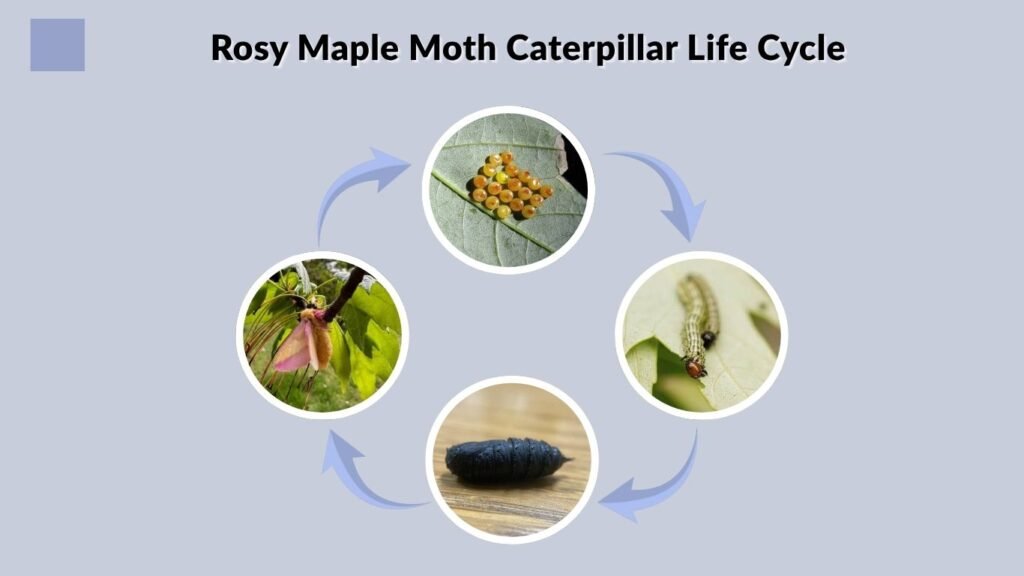
The rosy maple moth undergoes complete metamorphosis, passing through four main developmental stages: egg, larva, pupa, and adult. Its caterpillar stage is particularly important because this is when the insect feeds and grows. Development varies depending on environmental conditions, geographical location, and seasonal temperature.
1. Egg Stage
Female rosy maple moths lay clusters of approximately 10–30 eggs on the undersides of host plant leaves.
The eggs are initially yellowish and typically hatch after about two weeks, depending on temperature.
2. Caterpillar Stage
After hatching, the larvae begin feeding on nearby foliage.
They pass through five larval instars, gradually increasing in size. Young caterpillars remain together, while mature larvae usually feed individually.
This feeding period generally lasts several weeks.
3. Pupal Stage
Once fully grown, the caterpillar leaves its host tree and travels toward the ground.
It burrows into shallow soil, where it transforms into a pupa. Unlike some other silk moths, rosy maple moths do not normally construct large aboveground silk cocoons.
4. Adult Moth Stage
The adult eventually emerges with soft, colorful wings that expand and harden.
Depending on location, rosy maple moths may produce one or several generations annually. Adults have no functional feeding mouthparts and rely on stored energy.
Where Do Rosy Maple Moth Caterpillars Live?
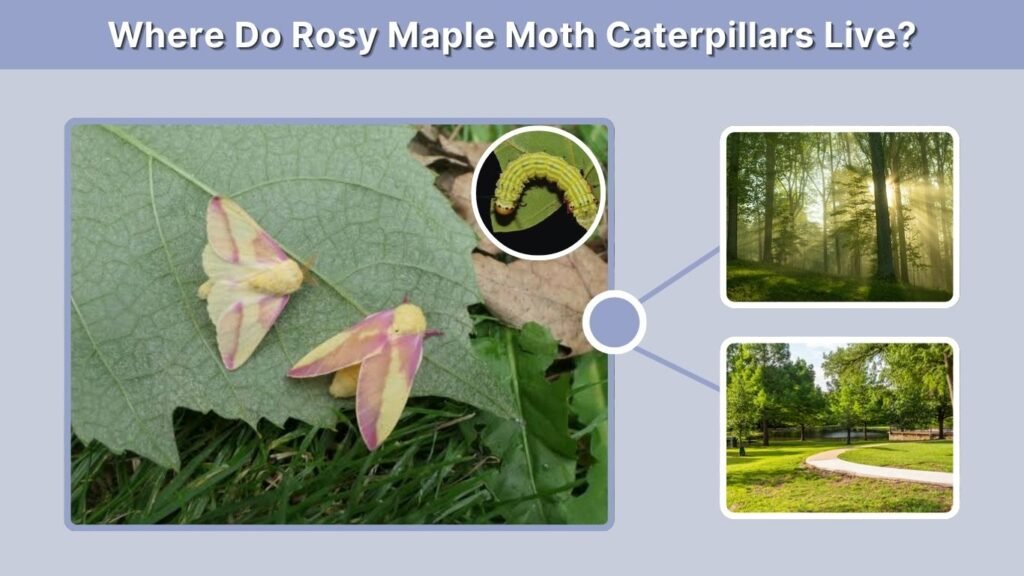
Rosy maple moth caterpillars inhabit deciduous forests, wooded neighborhoods, parks, and other environments containing suitable host trees. Their distribution extends across much of eastern North America, including portions of Canada and the United States.
Rosy Maple Moth Caterpillar in Pennsylvania
Rosy maple moth caterpillars occur naturally in Pennsylvania, where several suitable maple species grow.
They may appear in wooded areas, residential gardens, and forest edges during the warmer months.
Summer is an important period for observing these caterpillars, although exact activity dates depend on weather and local development.
Examining the undersides of maple leaves can help locate young larvae.
Where to Look for Caterpillars
The most promising locations include:
- Maple trees in forests and public parks.
- Backyard maple trees with visible feeding damage.
- Undersides of leaves where young caterpillars gather.
- Low branches of red, sugar, or silver maple trees.
Rosy Maple Moth Caterpillar vs. Luna Moth Caterpillar
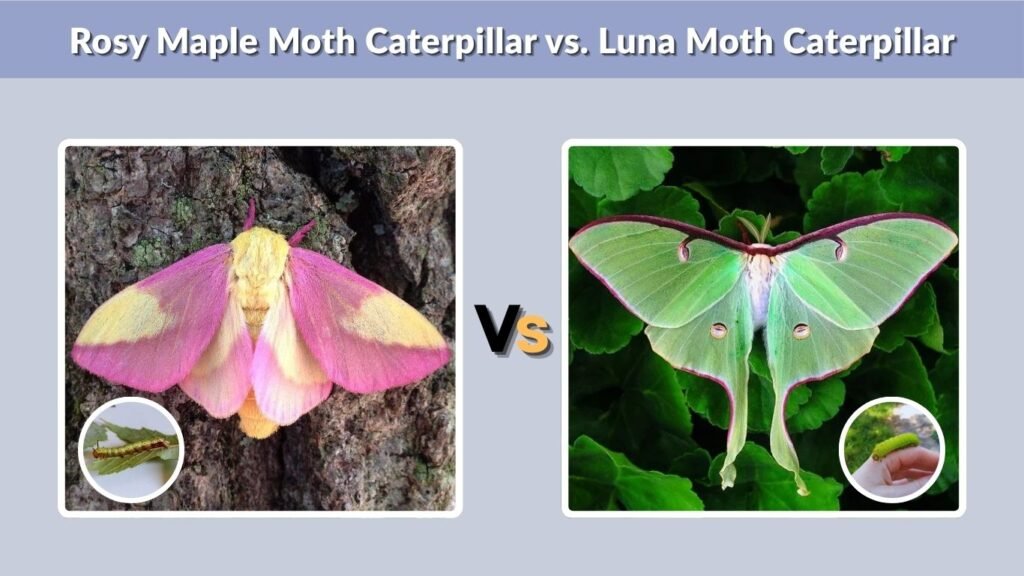
Rosy maple moth and luna moth caterpillars belong to the same moth family, but they have different physical characteristics. Both are commonly green, which can make identification confusing. However, their body markings, horns, host plants, and adult appearances provide useful distinctions.
| Feature | Rosy Maple Moth Caterpillar | Luna Moth Caterpillar |
| Scientific name | Dryocampa rubicunda | Actias luna |
| Body color | Green with lengthwise stripes | Green with pale markings |
| Horns | Prominent black pair near head | No comparable long black horns |
| Mature size | About 1.5–2 inches | About 2.5–3.5 inches |
| Adult appearance | Pink and yellow moth | Pale green moth with long hindwing tails |
The rosy maple moth caterpillar’s paired black horns are among its most useful identifying characteristics.
Can You Keep a Rosy Maple Moth Caterpillar as a Pet?
Some insect enthusiasts raise rosy maple moth caterpillars to observe their transformation into adult moths. However, successful rearing requires appropriate host leaves, proper ventilation, and suitable environmental conditions. The caterpillars also need access to an appropriate substrate when they are ready to pupate.
Basic Caterpillar Care
- Provide host leaves: Offer fresh leaves from a suitable maple tree.
- Maintain ventilation: Use a secure enclosure with adequate airflow.
- Keep the enclosure clean: Remove droppings and decaying leaves regularly.
- Provide pupation space: Offer suitable soil when the caterpillar approaches maturity.
Rosy Maple Moth Caterpillar for Sale
Rosy maple moth caterpillars are sometimes sought by insect enthusiasts interested in observing metamorphosis.
However, availability can be seasonal and limited. Anyone considering purchasing live caterpillars should check local wildlife regulations and avoid sellers who cannot verify responsible sourcing.
Wild-caught caterpillars are usually best left in their natural habitat, where they can contribute to the local ecosystem.
FAQs
1. Is a rosy maple moth caterpillar poisonous to dogs?
Rosy maple moth caterpillars are not known to be poisonous to dogs. However, dogs should not be encouraged to eat unfamiliar insects. Contact a veterinarian if a dog develops unusual symptoms after consuming a caterpillar.
2. How long does a rosy maple moth stay a caterpillar?
The caterpillar stage generally lasts several weeks, often around a month, depending on temperature, food availability, and other environmental conditions.
3. Do rosy maple moth caterpillars bite humans?
Rosy maple moth caterpillars are not known to bite humans defensively. Their mouthparts are adapted for chewing leaves rather than attacking people.
4. What does a rosy maple moth caterpillar turn into?
It transforms into an adult rosy maple moth, a beautiful silk moth recognized by its fuzzy body and distinctive pink and yellow wings.
5. Are rosy maple moth caterpillars rare?
Rosy maple moth caterpillars are not universally rare, but their abundance varies by location. They may be common around suitable maple trees while remaining difficult to notice because of their green camouflage.