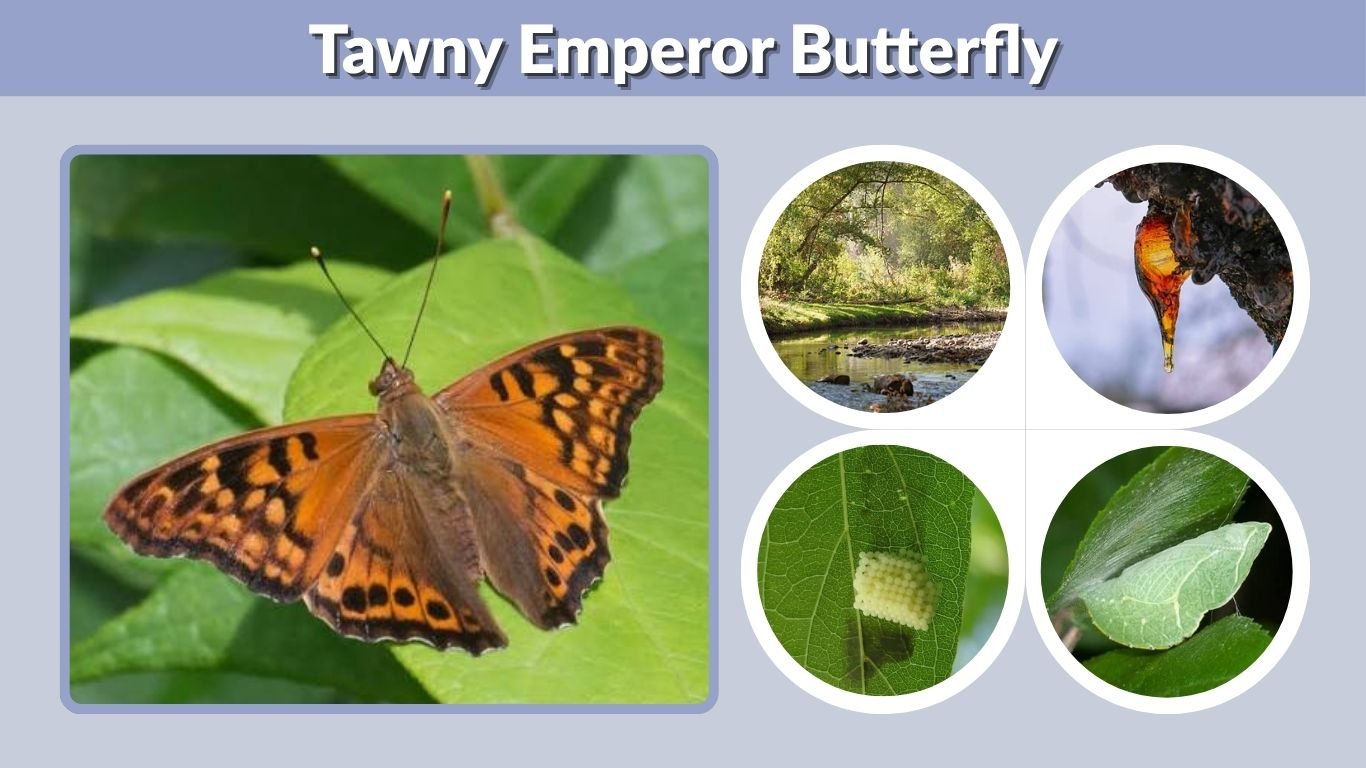
The tawny emperor butterfly (Asterocampa clyton) is a fascinating North American butterfly known for its orange-brown wings, distinctive markings, and unusual feeding habits. Unlike many butterflies that frequently visit flowers, tawny emperors prefer tree sap, rotting fruit, and other natural food sources. They are commonly associated with hackberry trees, which provide essential food for their caterpillars. Because they closely resemble hackberry emperor butterflies, identification can sometimes be challenging. This guide explores tawny emperor identification, caterpillars, host plants, habitat, life cycle, feeding behavior, and the important differences between these two species.
Tawny Emperor Butterfly Identification
The tawny emperor belongs to the Nymphalidae family, commonly known as brush-footed butterflies. Its scientific name is Asterocampa clyton. Adults display warm brown, orange, and rust-colored wings with distinctive dark markings. Although coloration varies geographically, several physical characteristics help distinguish this species from other butterflies.
Tawny Emperor Physical Characteristics
The adult tawny emperor has several recognizable features:
- Wingspan: Approximately 1.6–2.75 inches (4.2–7 cm).
- Wing color: Chestnut-brown, tawny-orange, or reddish-brown.
- Forewing markings: Two dark, unbroken bars near the center of each forewing.
- Hindwing pattern: Often orange-brown with dark spots near the outer edge.
- Wing edges: Slightly scalloped, with pale markings along the margins.
- Body: Brownish with slender, club-shaped antennae.
The absence of a prominent black eyespot on the upper forewing is particularly useful for identification.
Male vs. Female Tawny Emperor
Male tawny emperor butterflies are generally smaller than females and have more noticeably concave outer wing margins.
Females tend to have broader, more rounded wings and larger bodies. Their increased size supports egg production during reproduction.
Both sexes share similar wing patterns, making careful examination necessary to distinguish them.
Tawny Emperor vs. Hackberry Emperor
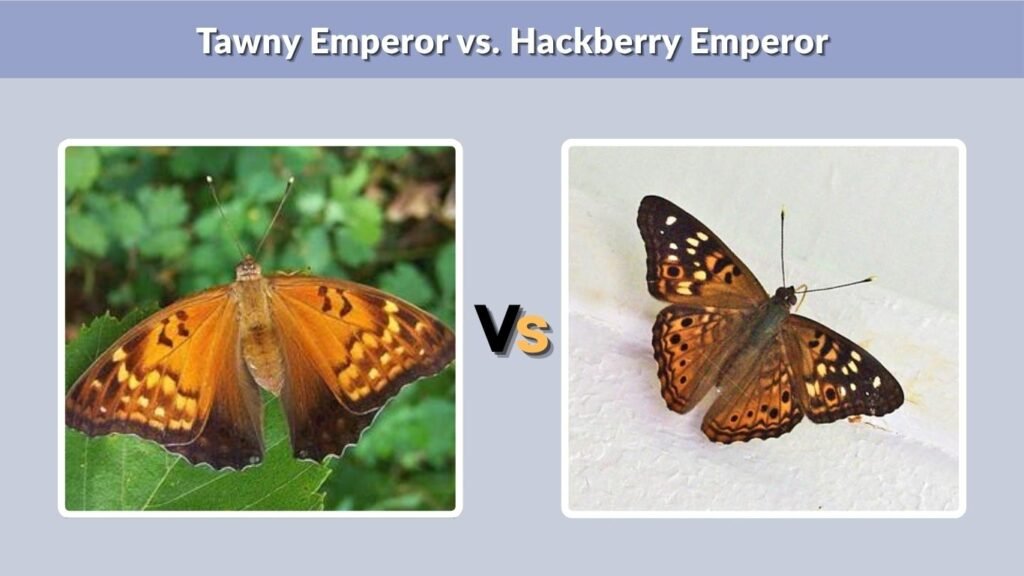
The tawny emperor and hackberry emperor are closely related butterflies belonging to the same genus. Both occur in similar habitats and depend on hackberry trees during their caterpillar stages. However, their wing patterns provide reliable identification clues. Learning these differences is especially helpful because both species may appear together.
Key Differences Between the Two Butterflies
- Tawny emperor: Usually has richer reddish-orange or rusty-brown wings.
- Hackberry emperor: Generally appears lighter brown or tan.
- Tawny emperor forewings: Display two complete dark bars near the wing base.
- Hackberry emperor forewings: Have one complete dark bar and two separated dark spots.
- Tawny emperor eyespots: Lack a distinct black eyespot on the upper forewing.
- Hackberry emperor eyespots: Have a noticeable dark forewing eyespot.
The underside of the hindwings also differs. Tawny emperors have relatively blurred eyespots, while hackberry emperors display more distinct, ringed eyespots.
Which Butterfly Is More Common?
Hackberry emperors are generally encountered more frequently than tawny emperors in many shared habitats.
Both species use similar host trees, but their caterpillars may reduce competition by feeding on different leaf ages. Tawny emperor larvae often consume older leaves, while hackberry emperor larvae favor younger foliage.
Tawny Emperor Caterpillar Identification
Tawny emperor caterpillars have a distinctive appearance that differs considerably from the adult butterfly. Their green coloration helps them blend into hackberry foliage, protecting them from predators. Young caterpillars often feed together in groups, while older larvae become more independent as they grow and prepare for pupation.
What Does a Tawny Emperor Caterpillar Look Like?
A mature tawny emperor caterpillar is approximately 1.5 inches (3.8 cm) long.
Its body is green with pale yellow and white longitudinal stripes. The head has two short, horn-like projections, while the rear of the body ends in two small tails.
These caterpillars have smooth-looking bodies rather than the long, prominent spines seen in some other butterfly larvae.
Tawny Emperor Caterpillar Host Plants
Tawny emperor caterpillars feed almost exclusively on hackberry trees belonging to the genus Celtis.
Important host plants include:
- Common hackberry (Celtis occidentalis): A widespread host throughout eastern and central North America.
- Sugarberry (Celtis laevigata): An important host in southern regions.
- Dwarf hackberry (Celtis tenuifolia): Supports populations where it naturally occurs.
- Netleaf hackberry (Celtis reticulata): Used by some western populations.
Female butterflies select suitable hackberry trees for egg laying, ensuring newly hatched caterpillars have immediate access to foliage.
Tawny Emperor Butterfly Life Cycle
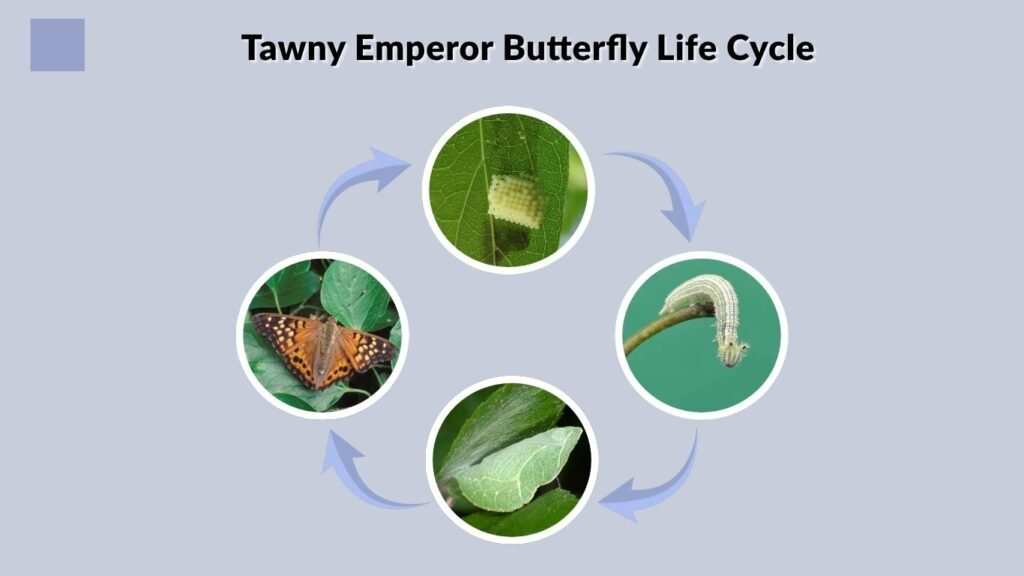
The tawny emperor undergoes complete metamorphosis, passing through four developmental stages: egg, caterpillar, chrysalis, and adult. Its life cycle is closely connected to seasonal temperatures and the growth of hackberry leaves. Northern populations generally produce one generation annually, while warmer southern populations may produce multiple generations.
Egg Stage
Female tawny emperors usually deposit large clusters containing approximately 200–500 eggs on hackberry bark or the undersides of mature leaves.
The eggs are initially pale and gradually darken before hatching.
Unlike butterflies that scatter individual eggs, tawny emperors often produce tightly grouped egg masses.
Caterpillar Stage
After hatching, young caterpillars begin feeding together on hackberry leaves.
They follow silk trails and move collectively between feeding locations. Group feeding may help them use tougher, mature foliage.
During autumn, some caterpillars enter a dormant stage and shelter together inside curled leaves attached to hackberry branches.
They survive winter in these protected shelters before becoming active again during spring.
Chrysalis Stage
Once fully grown, the caterpillar attaches itself to a suitable surface using silk and transforms into a chrysalis.
The tawny emperor chrysalis is usually green, with pale yellow markings that help it blend into nearby leaves.
Inside the chrysalis, the caterpillar’s body undergoes metamorphosis, eventually developing into an adult butterfly.
Adult Butterfly Stage
Adults emerge after completing pupal development.
Male butterflies often perch in sunny locations while watching for potential mates. After mating, females locate suitable hackberry trees and begin laying eggs, continuing the species’ reproductive cycle.
Tawny Emperor Habitat and Geographic Range
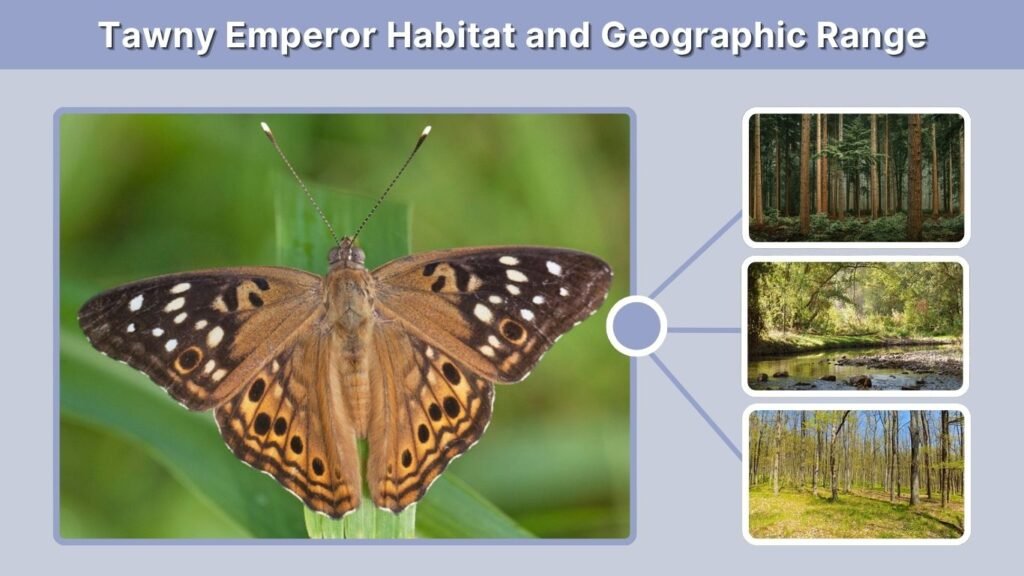
Tawny emperor butterflies inhabit various wooded environments throughout much of the eastern and central United States. Their distribution is closely connected to the presence of hackberry trees. Although they can occupy natural forests, they also occur in parks, neighborhoods, and woodland edges where suitable host trees grow.
Preferred Natural Habitat
These butterflies commonly inhabit deciduous forests, wooded riverbanks, forest openings, and brushy woodland edges.
They are particularly associated with riparian forests, where hackberry trees often grow abundantly.
However, they can also survive in relatively dry woodlands and urban parks containing mature host trees.
Tawny Emperor Range and Flight Season
The tawny emperor occurs from parts of southern New England westward through the central United States and south toward Texas and Florida. Scattered populations also occur in parts of the Southwest.
Northern adults typically fly during summer, especially June through August.
In warmer southern regions, adults may appear across a longer season because multiple generations can develop annually.
What Do Tawny Emperor Butterflies Eat?
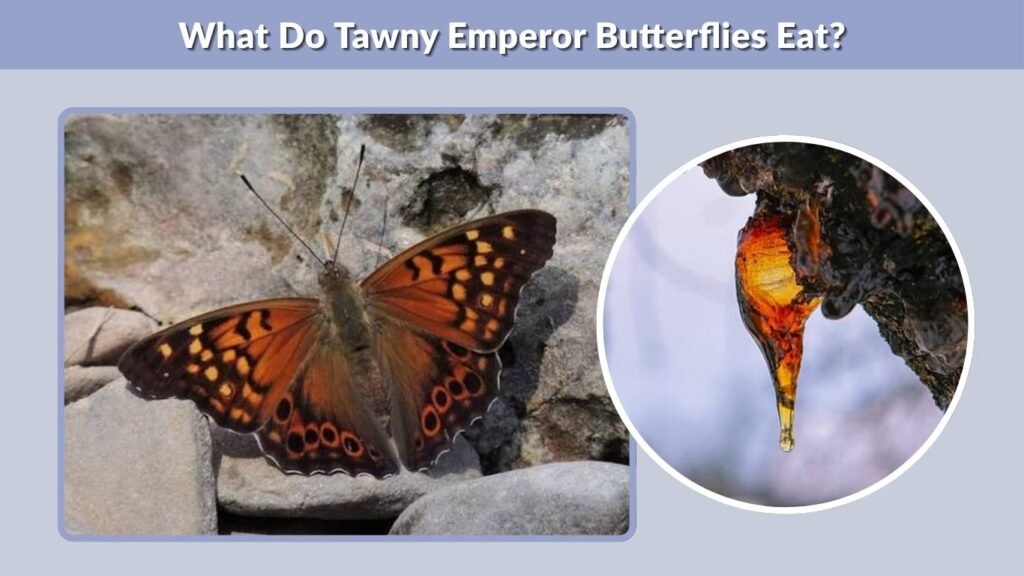
Unlike many familiar butterfly species, adult tawny emperors rarely visit flowers for nectar. Instead, they obtain sugars, minerals, and other nutrients from alternative food sources. Their unusual feeding behavior explains why they are frequently observed around trees, damp ground, and fallen fruit rather than colorful flower gardens.
Adult Tawny Emperor Diet
Adult tawny emperors primarily feed on fermenting fruit, leaking tree sap, animal droppings, and decaying organic material.
They may also visit wet soil to absorb moisture and dissolved minerals.
These feeding habits help provide energy and nutrients needed for flight, survival, and reproduction.
Why Do Tawny Emperors Land on People?
Tawny emperor butterflies occasionally land on human skin because they are attracted to dissolved minerals, particularly sodium, found in perspiration.
This behavior is generally harmless and does not indicate aggression.
They may remain briefly on exposed skin before flying away in search of another mineral source.
Tawny Emperor Behavior and Conservation
Tawny emperors contribute to woodland food webs, particularly during their caterpillar stages. Their development depends on healthy hackberry trees and suitable shelter during winter. Although the species is generally considered globally secure, maintaining woodland habitats remains important for sustaining local butterfly populations.
Natural Predators and Defense
Tawny emperor eggs and caterpillars are vulnerable to birds, predatory insects, and parasitic wasps.
Young caterpillars may respond to threats by moving together and swinging their heads. Their green coloration also provides camouflage against foliage.
These behaviors can improve survival, although grouped larvae may still be vulnerable when predators discover them.
How to Support Tawny Emperor Butterflies
Protecting native hackberry trees is one of the most effective ways to support this butterfly.
Avoid unnecessary insecticide applications, particularly around host plants during caterpillar development.
Preserving curled leaves and natural tree vegetation through winter can also protect dormant caterpillars.
FAQs
1. Are Tawny Emperor Butterflies Rare?
Tawny emperors are not globally endangered, but they can be uncommon or localized in certain areas. They are generally observed less frequently than hackberry emperors, even where both species share similar habitats.
2. Do Tawny Emperor Caterpillars Sting?
Tawny emperor caterpillars are not considered stinging caterpillars. They have horn-like projections on their heads, but these are not venomous stingers. It is still best to avoid unnecessary handling.
3. What Is the Main Tawny Emperor Host Plant?
Hackberry trees are the primary host plants. Common hackberry and sugarberry are especially important, although other Celtis species can support caterpillars in different regions.
4. What Is the Spiritual Meaning of a Tawny Emperor Butterfly?
Some people associate tawny emperor butterflies with transformation, resilience, or personal growth. These meanings are cultural or individual interpretations rather than scientifically established characteristics of the species.
5. Do Tawny Emperor Butterflies Drink Nectar?
Tawny emperor butterflies rarely feed on flower nectar. Adults usually obtain nutrients from tree sap, rotting fruit, animal droppings, and other natural sources.