
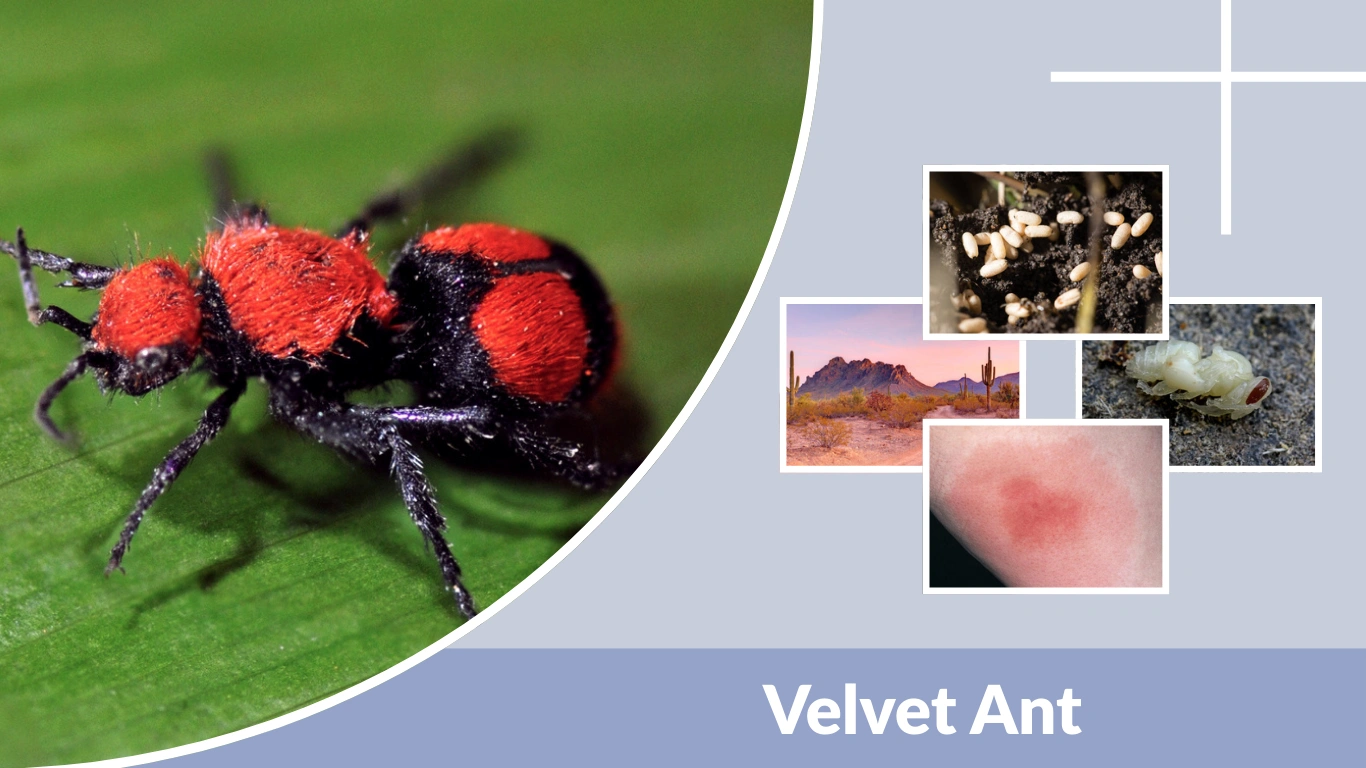
Velvet ants are a fascinating group of insects often mistaken for ants due to their name and appearance. In reality, velvet ants are wasps from the family Mutillidae. They are well-known for their striking colors, fuzzy bodies, and extremely painful sting. Found mostly in sandy or dry habitats, these insects are solitary, ground-dwelling, and have a unique parasitic lifestyle. While they rarely pose a serious threat to humans, their presence can be alarming, especially when seen crawling in yards, gardens, or open fields. This guide explores everything you need to know about velvet ants, including their species, life cycle, diet, habitat, and stinging behavior.
What Is a Velvet Ant?
Despite their common name, velvet ants are not true ants. They are wasps with distinct physical and behavioral traits. Females are wingless, covered in dense, colorful hairs that give them a velvety appearance, while males have wings and can fly. Velvet ants use bright colors as a warning signal to predators, indicating that they can sting and are not easy prey.
Velvet ants are solitary insects, meaning they do not form colonies like true ants or bees. They are often observed wandering over the ground during warm days, especially in sandy soils where they search for nests of other insects to parasitize.
Velvet Ant Identification
Physical Appearance
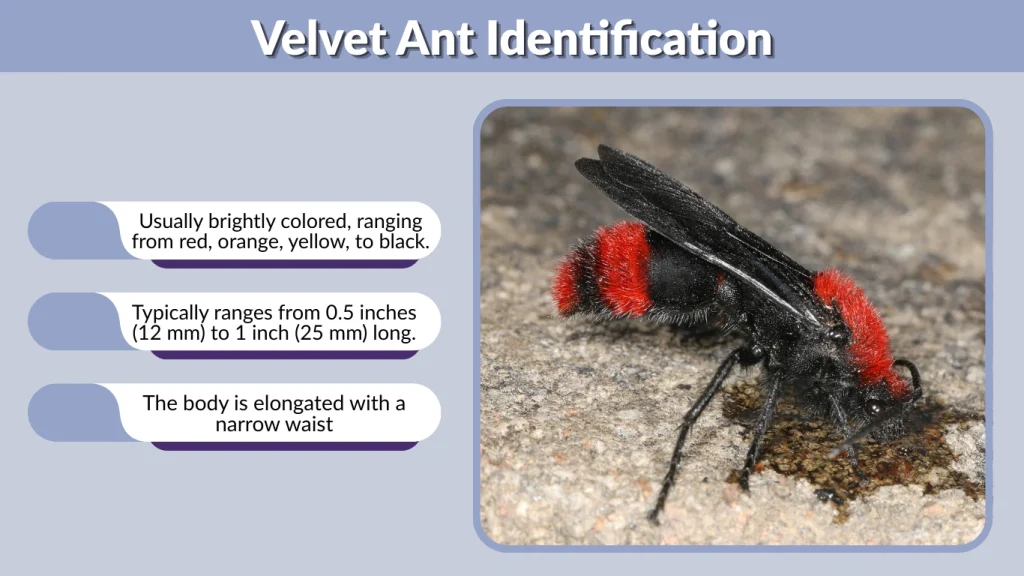
Velvet ants are usually brightly colored, ranging from red, orange, yellow, to black. Their hairy or fuzzy bodies help protect them from predators and give them a distinctive velvety texture. The body is elongated with a narrow waist, and females lack wings, making them appear ant-like. Males, on the other hand, have wings and are more wasp-like in appearance.
Velvet Ant Size
The size of velvet ants varies by species but typically ranges from 0.5 inches (12 mm) to 1 inch (25 mm) long. Females tend to be larger and more robust than males. Their hard exoskeletons make them extremely tough to handle, further enhancing their defense mechanisms.
Velvet Ant vs True Ants
True ants have a three-segmented body with elbowed antennae and workers, queens, or soldiers forming colonies. Velvet ants lack a worker caste, and females are solitary. Unlike ants, velvet ant females cannot fly and rely on crawling and speed for protection. Males have wings but do not display the social behavior of ants.
Velvet Ant Species
There are over 8,000 known species of velvet ants worldwide, with a large number found in North America. These species vary in size, color, and habitat preferences. Some notable species include:
- Red velvet ant (Dasymutilla occidentalis) – Also called the “cow killer” for its painful sting.
- Eastern velvet ant – Common in forests and grasslands of the eastern U.S.
- Desert velvet ant – Adapted to arid conditions, often bright red or orange.
- Parasitic species – Lay eggs inside the nests of ground-nesting bees and wasps.
Different species are adapted to specific climates, with coloration often serving as a warning for predators.
Velvet Ant Male vs Female
Velvet Ant Male
Males have wings and are capable of flight, allowing them to search for females during mating season. They are less commonly seen on the ground and do not possess the same stinging capability as females. Male velvet ants are usually smaller and less brightly colored than females.
Velvet Ant Female
Females are wingless, larger, and have a powerful sting. They are the ones most often encountered by humans. Females are the primary foragers and also responsible for laying eggs by locating the nests of host insects. Their tough exoskeleton and vibrant warning colors make them difficult for predators to handle.
Velvet Ant Habitat

Velvet ants prefer warm, dry, and sandy habitats. They are commonly found in open fields, grasslands, deserts, and forest edges. Some species thrive in gardens and yards, particularly those with sandy soil or loose, dry dirt.
Velvet Ant Habitat in Georgia
In Georgia and other southern U.S. states, velvet ants are frequently seen in sandy pine forests, meadows, and disturbed lands. They are more active during the hot summer months when adult females search for nests of solitary ground-nesting bees or wasps to parasitize.
Velvet Ant Distribution
Worldwide Distribution
Velvet ants are found on every continent except Antarctica. Their diversity is highest in arid and temperate regions where ground-nesting host insects are abundant.
North American Distribution
In the U.S., velvet ants are most commonly observed in southern and western states. States like Texas, Arizona, and Georgia have frequent sightings. Their presence in deserts, grasslands, and forest edges is common due to the abundance of host insect nests.
Velvet Ant Nest and Living Behavior
Velvet ants do not build their own nests. Instead, females locate the underground nests of solitary bees and wasps. They enter these nests and lay eggs directly on the host larvae. The developing velvet ant larvae feed on the host insect, consuming it from the inside out. This parasitic behavior is a defining characteristic of the species.
While they do not form colonies, velvet ants are often found in areas where host insects are abundant, leading to concentrated activity in certain soil patches.
Velvet Ant Diet
Adult Velvet Ant Diet
Adult velvet ants primarily feed on nectar from flowers and other sugary substances. They may also sip plant sap and honeydew from aphids. This diet provides energy for females as they search for host nests to lay eggs and for males to locate mates.
Larval Velvet Ant Diet
Velvet ant larvae are parasitic and feed exclusively on the larvae or pupae of ground-nesting bees and wasps. The female lays eggs inside the host nest, and once hatched, the larvae consume the host insect, developing safely underground until they are ready to pupate.
Velvet Ant Larvae
Velvet ant larvae are soft-bodied and white or cream-colored. They have strong mandibles for consuming the host insect. Larvae remain protected within the host’s nest until they undergo pupation. This stage is critical for their development and survival, as it provides both food and protection from predators.
Velvet Ant Life Cycle

The life cycle of velvet ants is fascinating and consists of several stages:
- Egg Stage: Females lay eggs inside the nests of solitary bees or wasps. Eggs are tiny, smooth, and inconspicuous.
- Larval Stage: Upon hatching, the larvae feed on the host insect. This parasitic stage can last several weeks, depending on environmental conditions.
- Pupa Stage: After feeding, larvae pupate within the host nest. The pupa develops into an adult over several weeks.
- Adult Stage: Adult velvet ants emerge from the ground. Females remain wingless and search for host nests, while males fly to locate mates. Adults are free-living and primarily feed on nectar.
This life cycle is unusual among insects, as females do not build nests and rely entirely on parasitism for reproduction.
Velvet Ant Sting and Bite

Velvet Ant Sting
Velvet ant stings are famously painful. The female’s sting delivers venom that produces immediate, intense pain, earning some species nicknames like “cow killer.” The sting is defensive; females sting when handled or threatened. The venom is not usually life-threatening but can cause swelling, redness, and temporary discomfort.
Velvet Ant Bite
Velvet ants rarely bite. Most of their defensive capability comes from their sting. If a bite occurs, it is minor and usually harmless.
What a Velvet Ant Sting Feels Like
People describe the sting as sharp, burning, and radiating, lasting several minutes. The site may remain sore for a few hours, and allergic reactions are rare but possible.
Velvet Ant Behavior and Defense
Velvet ants are solitary and elusive. They rely on several defenses:
- Bright warning coloration signals danger to predators.
- Their dense, velvety hair protects them from stings of other insects.
- They can produce squeaking sounds when disturbed.
- Their hard exoskeleton makes them difficult to crush.
- Females can deliver extremely painful stings to deter predators.
These adaptations make velvet ants successful at avoiding predation and surviving in harsh environments.
Velvet Ant Facts
- Velvet ants are actually wasps, not ants.
- Females are wingless; males are winged.
- Some species are called “cow killers” for their sting.
- Velvet ants are solitary insects.
- Their larvae are parasitic, feeding on other insects’ young.
- Bright coloration acts as a warning signal.
- Velvet ants are commonly found in sandy soil and open habitats.
- The exoskeleton is extremely tough, helping avoid predators.
Velvet Ant Around Homes and Gardens
Velvet ants sometimes appear in gardens, lawns, and yards, particularly where there is sandy soil or host insect activity. They are not aggressive toward humans but should not be handled. Awareness and avoidance are the best ways to prevent stings.
How to Avoid Velvet Ant Stings
- Wear shoes and protective clothing when walking in sandy or open areas.
- Avoid handling the insects directly.
- Keep children and pets away from areas with high velvet ant activity.
- Reduce exposed sandy soil or loose dirt around homes if possible.
Velvet Ant Conservation and Ecological Role
Velvet ants play a unique ecological role by controlling populations of ground-nesting bees and wasps. Despite their painful sting, they are beneficial insects and should not be killed unnecessarily. Their presence helps maintain insect balance in natural ecosystems.
FAQs
Do velvet ants really kill cows?
No. The nickname “cow killer” refers to the intense pain of the female sting, not actual lethality to large animals.
How painful is a velvet ant sting?
The sting is extremely painful, often described as one of the most intense insect stings. Pain is temporary and typically lasts a few minutes to a couple of hours.
Can velvet ants infest homes?
No. Velvet ants are solitary ground-dwelling insects and do not form colonies or infest homes.
What do velvet ant larvae eat?
Larvae feed parasitically on the larvae or pupae of ground-nesting bees and wasps.
Where are velvet ants most commonly found?
They are most common in sandy, dry areas, open fields, deserts, grasslands, and forests across North America and other warm climates worldwide.
