
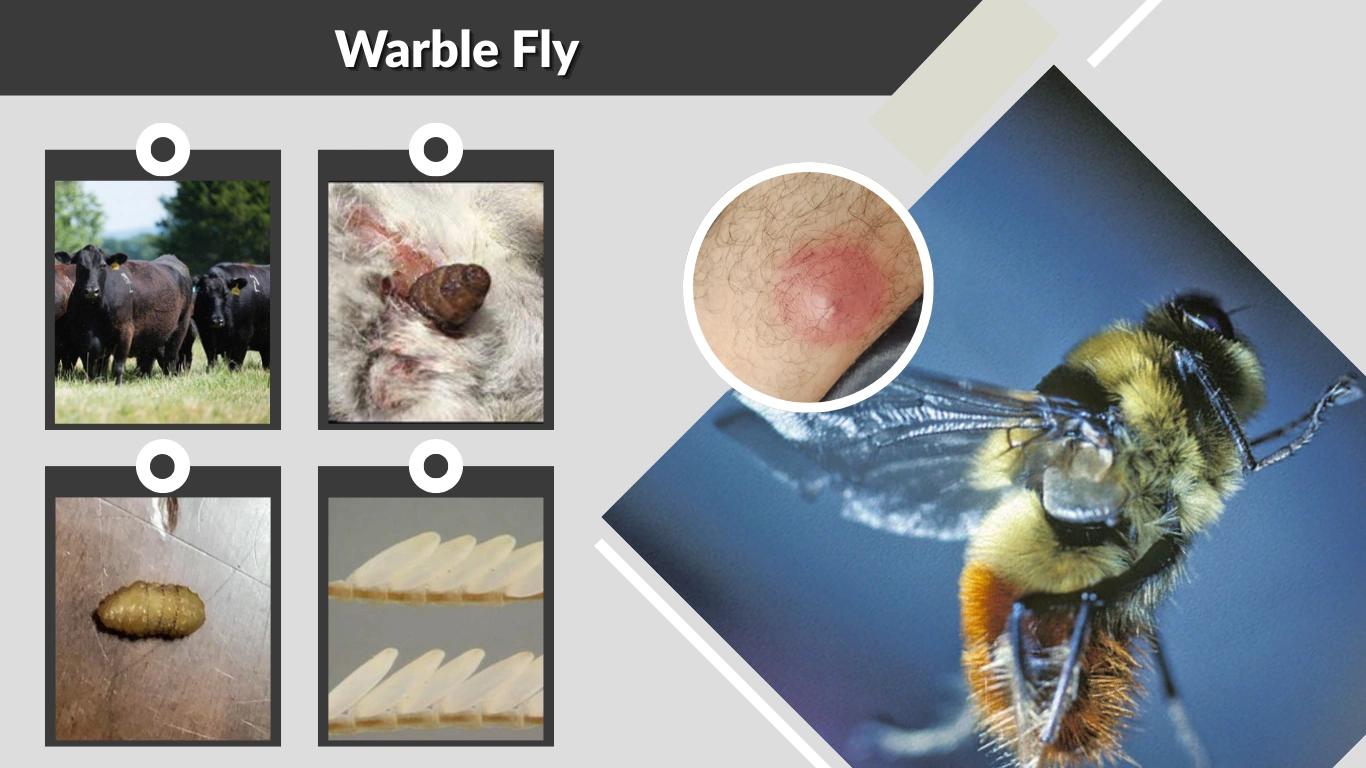
Warble flies are parasitic insects belonging to the family Oestridae, known for their unusual and sometimes harmful interactions with mammals. These flies primarily affect cattle, deer, and other livestock, but in rare cases, humans can also become hosts. Understanding their biology, range, and impact is important for farmers, veterinarians, and people living in regions where warble flies are common.
Scientific Classification of Warble Fly
Warble flies belong to the genus Hypoderma, a group of large, hairy flies within the botfly family. They are closely related to botflies but differ in their host preferences and life cycle.
- Family: Oestridae
- Genus: Hypoderma
- Main species: Hypoderma bovis (common warble fly), Hypoderma lineatum (northern warble fly)
- Other species exist depending on geography, often infesting deer, reindeer, or other wild mammals.
Their scientific categorization highlights how specialized they are for parasitizing mammals, particularly cattle, which makes them significant in veterinary science.
Identification and Physical Features

General Appearance
Adult warble flies resemble large bees because of their hairy bodies and buzzing flight. This mimicry helps them avoid predators, even though they do not sting.
- Coloration: Yellowish to brown with dark stripes
- Body: Thick and robust, giving a wasp-like appearance
- Eyes: Large, noticeable compound eyes
- Wings: Clear with slight veining
Farmers often recognize them by their loud buzzing sound when they fly around cattle.
Warble Fly Size
Adult warble flies measure around 1–1.5 cm in length, which makes them fairly large compared to houseflies. The larvae, however, can grow up to 2–3 cm while developing inside the host animal.
Warble Fly Sound
Warble flies produce a loud, buzzing flight sound similar to that of bees. Livestock, especially cattle, become extremely agitated when they hear this sound, often running or stamping to escape. This behavior is one of the early indicators of warble fly presence in grazing fields.
Warble Fly Life Cycle

The life cycle of warble flies is complex and involves a parasitic relationship with their host. Each stage is carefully adapted to ensure the survival of the species.
Warble Fly Eggs
Female warble flies do not feed but instead focus entirely on reproduction. During the summer, they lay eggs on the hairs of cattle or wild mammals.
- Placement: On the legs, belly, or lower body of the host
- Quantity: Each female can lay hundreds of eggs
- Duration: Eggs hatch within 3–7 days, releasing larvae that actively search for entry into the host
Larvae Development in Hosts
Once hatched, the larvae crawl onto the skin and penetrate through hair follicles or natural body openings. They then migrate internally before settling under the skin.
- Stage 1: Larvae enter through the skin and travel inside connective tissues
- Stage 2: They move to the back or flanks of the host
- Stage 3: They form noticeable lumps under the skin, known as “warbles”
Inside these warbles, the larvae feed and grow for several weeks. The lumps often have small breathing holes, which can be seen on the animal’s skin surface.
Pupation and Adult Emergence
After several months, the larvae bore out of the skin, drop to the ground, and pupate in the soil. This stage may last weeks to months depending on climate conditions. Finally, they emerge as adult flies, restarting the cycle.
Warble Fly in Humans

While warble flies primarily target cattle and other mammals, humans can occasionally become accidental hosts. This condition, known as cutaneous myiasis, happens when larvae burrow into human skin.
Warble Fly Larvae in Humans
Cases are rare but have been reported in people who live or work near livestock. Symptoms include:
- Painful, boil-like swellings on the skin
- Itching or burning sensations around the site
- Visible breathing holes in severe cases
Doctors usually remove the larvae through minor surgical procedures or suffocation methods that force the larva to surface.
Warble Fly Bite and Sting
It is important to clarify that warble flies do not bite or sting. The discomfort and health problems come from larvae penetrating the skin, not from adult fly behavior. The adult flies lack mouthparts strong enough to bite and instead rely solely on reproduction.
Warble Fly Behavior and Habitat

Warble flies are seasonal insects, with adults typically active during warmer months. Their behavior is highly adapted to finding suitable hosts and reproducing effectively.
- Flight patterns: Short, quick flights targeting grazing cattle
- Host-seeking behavior: Females hover around livestock, searching for the right spot to lay eggs
- Survival strategy: Adults live only long enough to reproduce, while larvae spend months inside the host
Natural Range
Warble flies are found across Europe, Asia, North America, and parts of Africa, usually in areas with large cattle populations. Their range is closely tied to livestock farming, since cattle provide the most reliable hosts.
Warble Fly Range Expansion
Their spread has historically been linked to cattle trade and the movement of infested animals. Today, control measures have reduced their presence in some regions, but climate change and shifting agricultural practices may influence future distribution.
Warble Fly vs Botfly

Warble flies and botflies are often confused because they belong to the same family (Oestridae). However, there are important differences:
- Appearance: Both are bee-like, but botflies tend to be smaller and less hairy than warble flies.
- Hosts: Warble flies primarily target cattle, deer, and reindeer, while botflies infest a wider range of mammals, including rodents and humans.
- Infestation method: Warble fly females lay eggs directly on the host’s hair, while some botflies use other insects (like mosquitoes) to transfer their larvae.
- Geographic distribution: Botflies are more common in Central and South America, while warble flies are widespread in Europe, Asia, and North America.
Understanding these differences helps farmers and medical professionals identify infestations correctly.
Warble Fly Impact on Animals

Livestock Infestation
Warble flies are a major veterinary problem in regions where cattle farming is common. Their larvae not only damage the animal’s hide but also cause economic losses.
- Hide damage: Larvae create holes in the skin, reducing the quality of leather.
- Weight loss: Infested animals expend energy avoiding flies, leading to reduced growth and lower meat yield.
- Milk production issues: Stress and discomfort decrease milk output in dairy cattle.
- Veterinary costs: Farmers must spend money on treatment and preventive medicine.
Wildlife Infestation
Wild mammals such as deer, antelope, and reindeer are also frequent hosts. In northern regions, warble flies are considered serious pests of reindeer herds. Heavy infestations can cause:
- Skin lesions and secondary infections
- Reduced grazing efficiency
- Weakening of the herd, which may affect survival during winter
Are Warble Flies Dangerous?
To Animals
For livestock and wildlife, warble flies can be very harmful. Repeated infestations may weaken animals and cause economic challenges for farmers. In severe cases, untreated infestations can lead to death from secondary infections.
To Humans
While warble fly larvae occasionally infest humans, such cases are rare. The larvae do not spread from person to person and are usually limited to one or two sites on the body. The condition can be treated with minor procedures.
Thus, warble flies are considered low-risk to human health but high-risk to livestock health and economics.
Prevention and Treatment
Control in Livestock
Veterinary medicine has developed effective ways to control warble flies. Preventive measures are usually taken seasonally, just before or after adult fly activity.
- Insecticides: Cattle are treated with pour-on or injectable medications that kill larvae.
- Monitoring: Regular inspection of herds for signs of warbles.
- Eradication programs: Some regions have reduced warble fly populations through coordinated national campaigns.
Human Safety Measures
For people living in or visiting areas where warble flies are present, basic precautions can help reduce risk:
- Avoid close contact with untreated livestock during peak fly seasons.
- Wear protective clothing if working outdoors around cattle.
- Seek medical attention immediately if a boil-like swelling appears after exposure to cattle areas.
Conclusion
The warble fly is a fascinating yet troublesome insect that shows how closely humans, animals, and parasites are linked. While adult flies do not bite or sting, their larvae can cause significant damage to livestock, reducing productivity and harming animal welfare. Humans are rarely affected, but awareness is important for both medical and veterinary reasons. Effective prevention programs and treatments have made it possible to reduce warble fly numbers, but in many parts of the world, they remain a serious agricultural concern.
FAQs
What is the scientific name of the warble fly?
The most common species are Hypoderma bovis (common warble fly) and Hypoderma lineatum (northern warble fly), both belonging to the Oestridae family.
Do warble flies bite humans?
No, warble flies do not bite or sting. The problems come from larvae burrowing into the skin of animals or, rarely, humans.
How big can a warble fly get?
Adult warble flies measure around 1–1.5 cm, while their larvae can grow up to 2–3 cm inside a host.
Are warble flies and botflies the same?
They belong to the same family but are different insects. Warble flies usually infest cattle and deer, while botflies target other mammals, including humans.
How can farmers prevent warble fly infestations?
Farmers can protect cattle with seasonal insecticide treatments, monitoring, and coordinated eradication programs that target larvae before they mature.
