



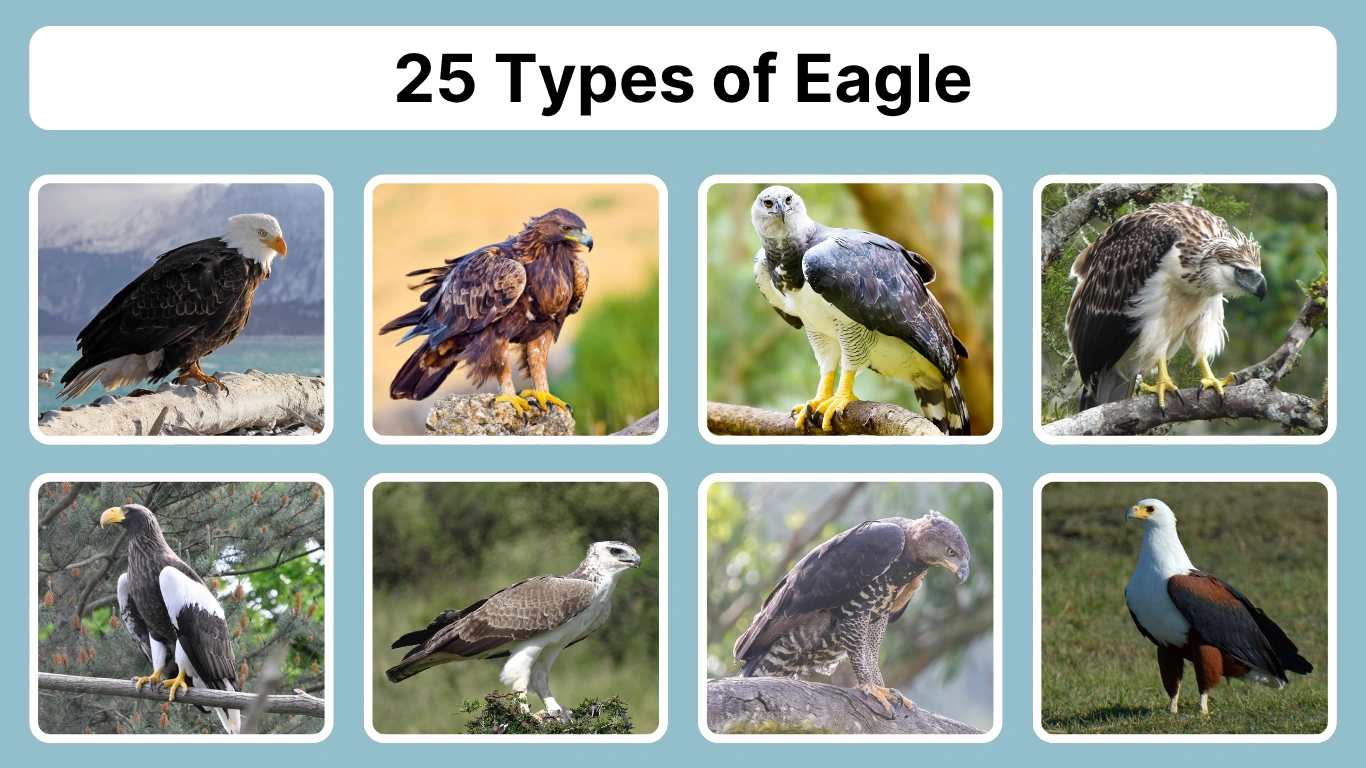
Eagles are among the most powerful and admired birds of prey, symbolizing strength, freedom, and sharp vision across many cultures. With over 60 known species around the world, each eagle has its own unique features, habitat preferences, and hunting behaviors. From the iconic Bald Eagle of North America to the rare Philippine Eagle of Southeast Asia, these raptors dominate skies across forests, mountains, deserts, and coastal regions.
In this guide, we’ll explore 25 fascinating types of eagles from different continents, highlighting how to identify them, where they live, what they eat, and why some of them are endangered. Whether you’re a birdwatcher, wildlife enthusiast, or student of nature, this resource will give you a detailed look at the diverse world of eagles—one majestic species at a time.
1. Bald Eagle

The Bald Eagle (Haliaeetus leucocephalus) is one of the most iconic birds in North America, best known as the national bird and symbol of the United States. It is a large bird of prey with a striking white head and tail contrasted against a dark brown body and wings.
Identification
- Size: 28 to 40 inches long with a wingspan of 6 to 7.5 feet
- Head: Pure white in adults (brown in juveniles)
- Body: Dark brown plumage
- Beak: Large, hooked, and bright yellow
- Eyes: Pale yellow with a piercing look
- Legs: Bare and yellow, with strong talons
- Tail: White and fan-shaped in adults
- Juveniles: Mottled brown and white; attain full adult plumage by 4–5 years
Habitat and Range
Bald Eagles are typically found near large bodies of open water such as lakes, rivers, and coastal habitats. They range throughout most of North America, from Alaska and Canada down to northern Mexico.
Behavior
Bald Eagles are known for their impressive flight, often soaring at great altitudes. They are primarily solitary but may gather in large numbers around abundant food sources during winter.
Diet
They primarily eat fish, which they snatch from water using their sharp talons. They also consume birds, small mammals, and carrion when fish are scarce.
Conservation Status
Once endangered due to pesticide use and habitat loss, Bald Eagle populations have rebounded significantly due to conservation efforts and legal protections. They are currently listed as Least Concern but remain protected under U.S. law.
2. Golden Eagle
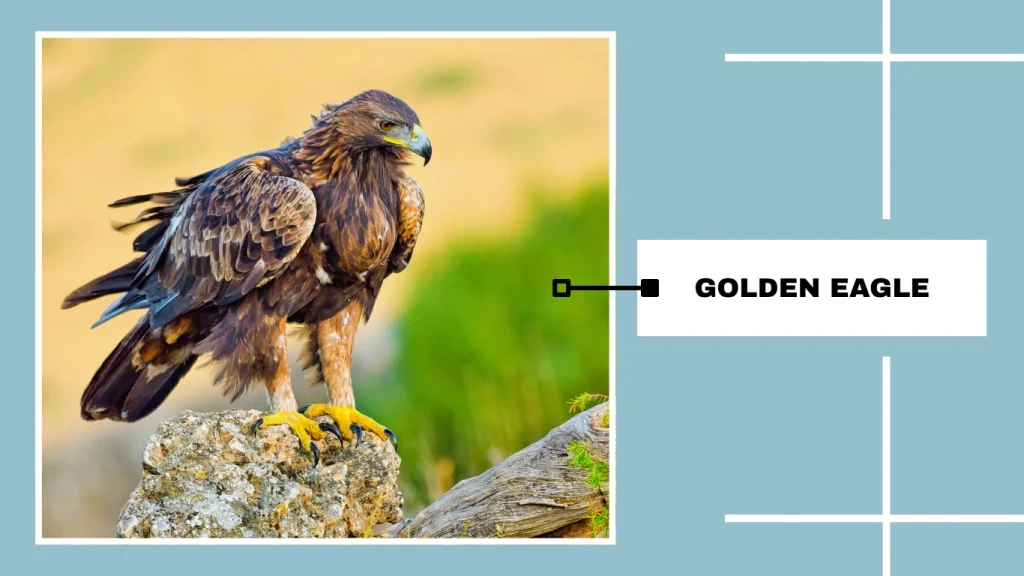
The Golden Eagle (Aquila chrysaetos) is one of the most powerful raptors in the Northern Hemisphere. With a golden-brown crown and nape, it is revered in many cultures and known for its strength, speed, and hunting skills.
Identification
- Size: 26 to 40 inches in length, wingspan of 6 to 7.5 feet
- Plumage: Dark brown overall with golden feathers on the back of the head and neck
- Beak: Dark at the tip with a lighter yellow base
- Legs: Feathered down to the toes
- Tail: Broad and slightly rounded, banded in juveniles
- Eyes: Dark brown
- Juveniles: White patches at the base of the tail and on the wings
Habitat and Range
Golden Eagles prefer open and semi-open habitats such as mountains, cliffs, and grasslands. They are found across North America, Europe, Asia, and parts of North Africa.
Behavior
They are solitary hunters, often seen soaring high in search of prey. They form long-term pair bonds and build large nests on cliffs or tall trees.
Diet
Golden Eagles hunt a variety of prey, including rabbits, hares, marmots, and birds. They may also scavenge when necessary.
Conservation Status
Though not globally threatened, habitat disturbance and persecution have led to population declines in some regions. Conservation efforts continue to monitor and support stable populations.
3. Harpy Eagle
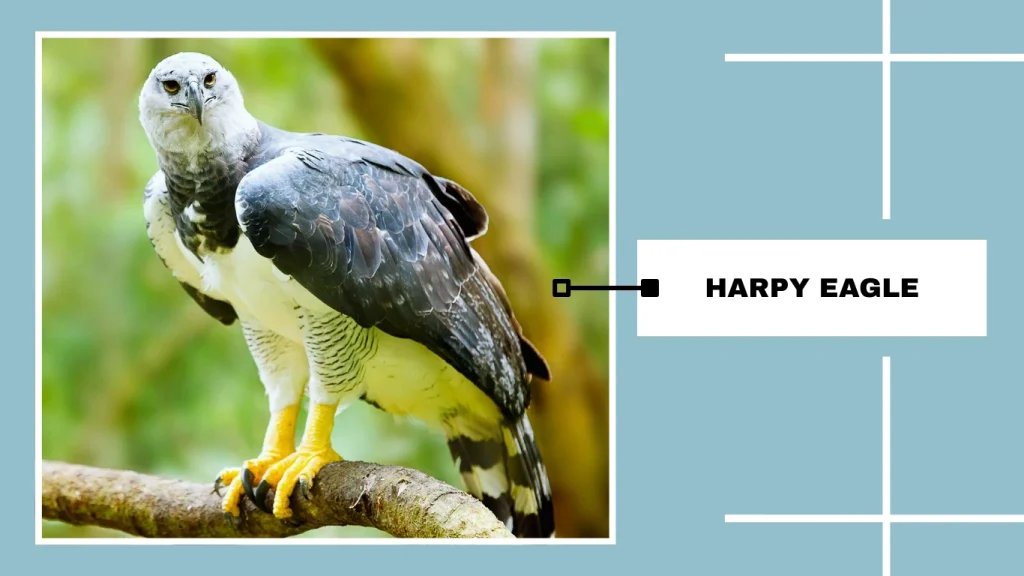
The Harpy Eagle (Harpia harpyja) is one of the largest and most powerful eagles in the world. It has a striking appearance with a double crest of feathers and strong, robust legs, adapted for hunting in dense tropical forests.
Identification
- Size: 34 to 42 inches in length; wingspan around 6.5 feet
- Crest: Prominent feathered double crest
- Plumage: Slate gray upperparts, white underside with a black chest band
- Beak: Strong, curved, and dark-colored
- Legs: Exceptionally thick and powerful with long black talons
- Eyes: Pale gray or blue
- Tail: Long and banded with black and white bars
Habitat and Range
Harpy Eagles live in tropical lowland rainforests from southern Mexico through Central America and into South America, especially in the Amazon Basin.
Behavior
They are secretive and territorial birds that require large tracts of undisturbed forest to thrive. They build large nests high in trees and may use the same nest for years.
Diet
Specialized hunters of medium-sized arboreal mammals, including monkeys, sloths, and opossums. They are apex predators in their ecosystem.
Conservation Status
Threatened by deforestation and habitat loss, Harpy Eagles are listed as Near Threatened. Conservation programs are ongoing to protect nesting sites and raise awareness.
4. Philippine Eagle
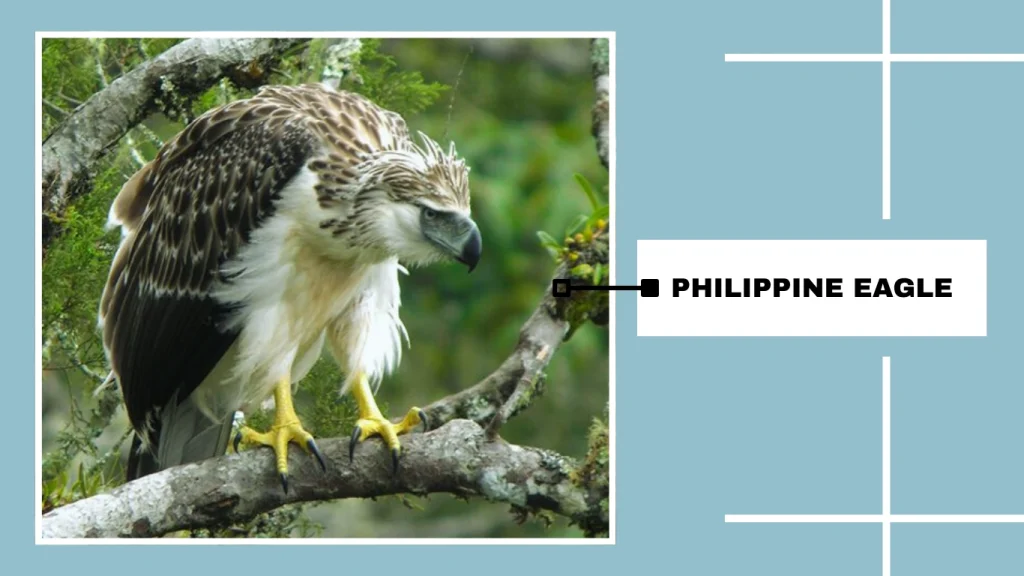
The Philippine Eagle (Pithecophaga jefferyi), also known as the monkey-eating eagle, is one of the rarest and largest forest-dwelling eagles in the world. It is the national bird of the Philippines and a symbol of wildlife conservation in the country.
Identification
- Size: 34 to 39 inches long; wingspan up to 7.2 feet
- Crest: Long, shaggy crest of brown and white feathers
- Plumage: Brown upperparts, white underside
- Beak: Deep, arched, and bluish-gray
- Eyes: Pale blue-gray
- Legs: Powerful and feathered
- Tail: Long and broad, with subtle barring
Habitat and Range
Found only in the Philippines, primarily on the islands of Luzon, Leyte, Mindanao, and Samar. It lives in primary tropical rainforests at various elevations.
Behavior
A solitary and territorial raptor, the Philippine Eagle requires a vast hunting range. It builds large nests in tall trees and typically raises one chick every two years.
Diet
Feeds on a variety of animals including flying lemurs, civets, snakes, bats, and birds. Its powerful beak and talons are suited for hunting arboreal prey.
Conservation Status
Critically Endangered due to massive deforestation, habitat fragmentation, and human hunting. Fewer than 400 individuals remain in the wild. Conservation breeding and awareness campaigns are vital for its survival.
5. Steller’s Sea Eagle

The Steller’s Sea Eagle (Haliaeetus pelagicus) is among the largest and most striking sea eagles, recognized by its bold black and white plumage and massive yellow beak.
Identification
- Size: 34 to 42 inches long; wingspan up to 8.2 feet
- Plumage: Dark brown to black body with contrasting white shoulders, thighs, and tail
- Beak: Huge, deep, and bright yellow
- Legs: Yellow and heavily scaled with strong talons
- Tail: Wedge-shaped and pure white
- Eyes: Yellow with a fierce gaze
Habitat and Range
Primarily found in coastal northeastern Asia, especially around the Sea of Okhotsk and Kamchatka Peninsula in Russia. Winters in Japan and Korea.
Behavior
Steller’s Sea Eagles are usually solitary or seen in pairs but may gather in large numbers where food is abundant. They are powerful fliers and adept at fishing.
Diet
Feeds mainly on fish such as salmon and trout, but also takes waterbirds and carrion when available.
Conservation Status
Listed as Vulnerable due to habitat loss, pollution, and declining fish populations. International conservation efforts are in place to protect this majestic eagle.
6. White-tailed Eagle
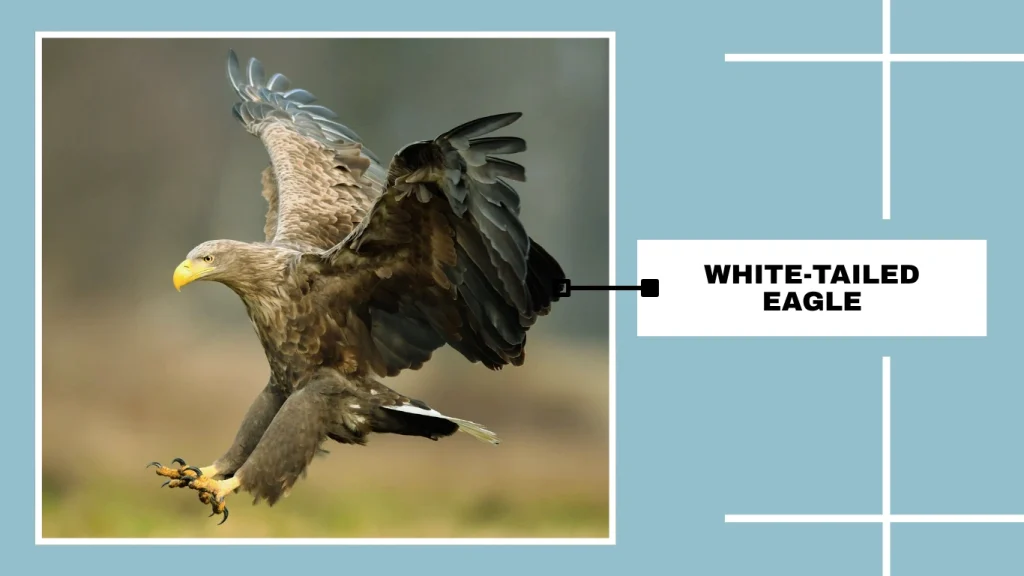
The White-tailed Eagle (Haliaeetus albicilla) is one of Europe’s largest birds of prey and is closely related to the Bald Eagle. Sometimes called the “flying barn door” due to its broad wings, it’s known for its majestic presence along coasts, lakes, and rivers.
Identification
- Size: 30 to 37 inches long; wingspan up to 8 feet
- Plumage: Overall brown with a paler head and neck
- Tail: Short, wedge-shaped, and pure white in adults
- Beak: Large, powerful, and yellow
- Eyes: Pale yellow
- Legs: Yellow and unfeathered
- Juveniles: Darker plumage with mottled brown and less obvious white tail
Habitat and Range
Found across Europe and northern Asia, especially around large water bodies such as fjords, lakes, rivers, and seacoasts. Breeding populations are found in Scandinavia, Germany, and parts of Eastern Europe.
Behavior
White-tailed Eagles are territorial and monogamous, often returning to the same nest site year after year. They soar with slow wingbeats and are often seen perched in tall trees or cliffs near water.
Diet
Primarily fish and waterbirds such as ducks and gulls. They also scavenge carrion and steal prey from other birds, including ospreys.
Conservation Status
Once driven to extinction in parts of Europe, this species has made a strong comeback thanks to legal protection, habitat restoration, and reintroduction programs. It is now listed as Least Concern globally, though still protected in many regions.
7. Martial Eagle
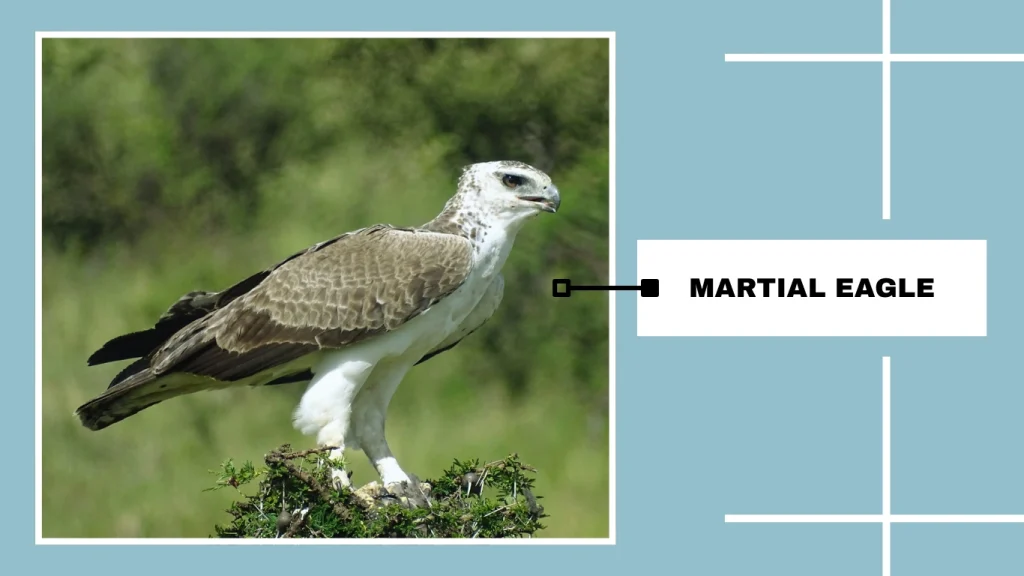
The Martial Eagle (Polemaetus bellicosus) is the largest eagle in Africa and a formidable aerial predator. It’s known for its fearsome hunting abilities and striking spotted belly.
Identification
- Size: 31 to 38 inches long; wingspan up to 7.6 feet
- Plumage: Dark brown upperparts, white underparts with dark brown spots
- Head: Dark and robust with piercing eyes
- Beak: Heavy and curved, slate-colored
- Legs: Yellow and powerful with large talons
- Eyes: Deep yellow
- Tail: Dark with faint barring
Habitat and Range
Found throughout sub-Saharan Africa in savannas, open woodlands, and thornbush areas. Prefers areas with tall trees or cliffs for nesting.
Behavior
Martial Eagles are solitary and highly territorial. They soar at great heights and can spot prey from remarkable distances. Nests are usually built high in trees and reused over multiple years.
Diet
Preys on birds (such as guineafowl), mammals (like monkeys and small antelope), and reptiles (including monitor lizards). It can take down prey heavier than itself.
Conservation Status
Listed as Endangered due to habitat loss, human persecution, and decline in prey availability. Conservation efforts focus on reducing conflict with farmers and preserving nesting habitats.
8. Crowned Eagle

The Crowned Eagle (Stephanoaetus coronatus) is a powerful and secretive forest-dwelling eagle native to sub-Saharan Africa. It is sometimes called the African crowned eagle due to the feathered crest on its head.
Identification
- Size: 31 to 39 inches long; wingspan up to 6 feet
- Plumage: Dark upperparts with a boldly barred black-and-white chest and belly
- Crest: Raised black crest on the head
- Beak: Dark gray, hooked, and strong
- Eyes: Reddish-brown to amber
- Legs: Feathered and powerful, with massive talons
- Juveniles: Lighter and more mottled with less defined barring
Habitat and Range
Inhabits dense rainforests and wooded areas across central and southern Africa. Often found in regions with tall trees for nesting.
Behavior
Crowned Eagles are elusive and primarily hunt in the forest canopy. They are territorial and monogamous, known for their loud and far-carrying calls.
Diet
Feeds mainly on monkeys, small antelope, and large birds. It is one of the few eagle species capable of killing prey larger than itself.
Conservation Status
Classified as Near Threatened due to habitat degradation and deforestation. Protection of forest habitats is crucial to their survival.
9. Steppe Eagle
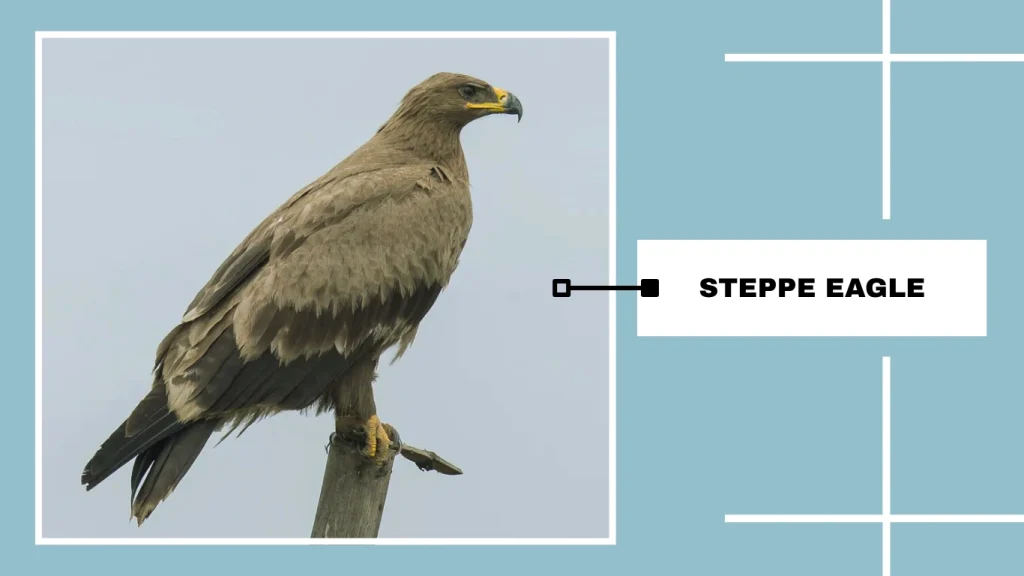
The Steppe Eagle (Aquila nipalensis) is a large migratory raptor known for its association with open landscapes like steppes and deserts.
Identification
- Size: 24 to 32 inches long; wingspan up to 7.2 feet
- Plumage: Dark brown with slightly lighter flight feathers
- Beak: Yellow base with a black tip
- Eyes: Brown to dark amber
- Legs: Yellow and feathered halfway
- Tail: Long, broad, and slightly rounded
- Juveniles: Paler brown with distinct wing coverts and nape band
Habitat and Range
Breeds in the open plains and steppes of Central Asia, migrates to Africa and the Indian subcontinent in winter.
Behavior
Solitary or found in loose flocks during migration. Often perches on rocks or poles, scanning for prey.
Diet
Feeds on small mammals, birds, reptiles, and carrion. Frequently seen near roadkill or refuse.
Conservation Status
Classified as Endangered due to habitat loss, electrocution from power lines, and declining prey.
10. Tawny Eagle
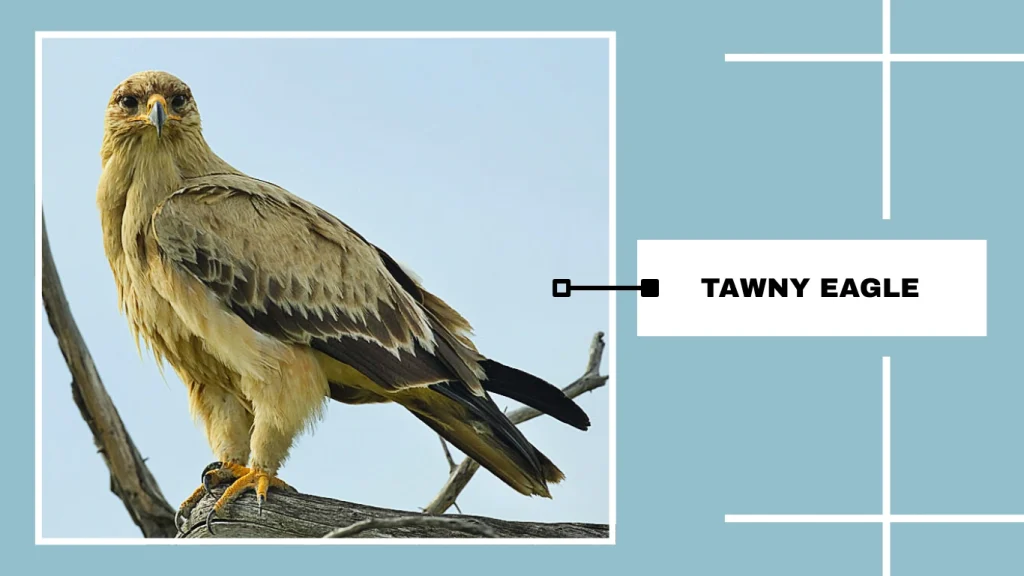
The Tawny Eagle (Aquila rapax) is a broad-winged, medium to large eagle that thrives in arid environments and savannas.
Identification
- Size: 24 to 28 inches long; wingspan around 6 feet
- Plumage: Varies from pale tawny to dark brown
- Beak: Yellow base with dark hooked tip
- Eyes: Deep brown
- Legs: Feathered down to the feet
- Tail: Long and slightly rounded, matches body color
- Juveniles: Often darker with mottled markings
Habitat and Range
Widely distributed in Africa, parts of the Middle East, and the Indian subcontinent. Prefers open dry regions, savannas, and scrublands.
Behavior
Spends time soaring or perched in open areas. Often seen alone or in pairs, especially near carcasses.
Diet
Feeds on small to medium-sized mammals, reptiles, and carrion. Known to scavenge frequently.
Conservation Status
Listed as Vulnerable, with populations declining due to poisoning, power line electrocution, and habitat changes.
11. Spanish Imperial Eagle
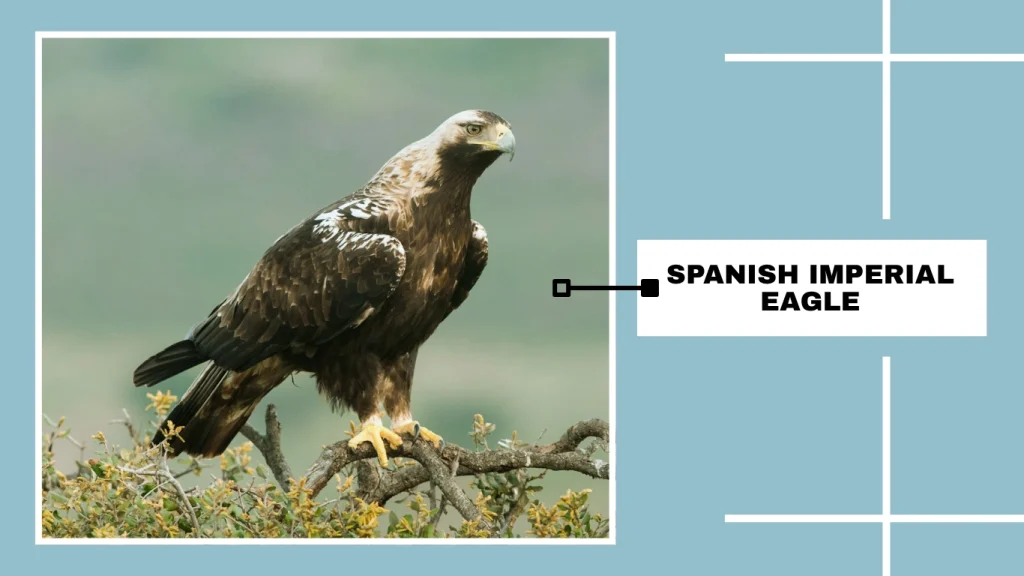
The Spanish Imperial Eagle (Aquila adalberti) is a rare and majestic bird of prey found only in the Iberian Peninsula. It’s a close relative of the Eastern Imperial Eagle but is slightly darker and more regionally restricted.
Identification
- Size: 28 to 33 inches long; wingspan up to 7.2 feet
- Plumage: Dark brown with distinctive white shoulders
- Beak: Powerful and yellow-based with a dark tip
- Eyes: Yellow to amber
- Legs: Yellow and feathered to the toes
- Tail: Broad and slightly rounded
- Juveniles: Paler with buffy-brown overall plumage
Habitat and Range
Endemic to Spain and small parts of Portugal, usually found in dehesa woodlands and open plains with scattered trees. Prefers areas with minimal human disturbance.
Behavior
A territorial and monogamous eagle, often seen soaring over its domain. It builds large nests in trees and returns to them for years.
Diet
Primarily preys on rabbits, which make up the majority of its diet. It also takes birds, reptiles, and carrion.
Conservation Status
Critically endangered in the 20th century due to persecution and habitat loss, but thanks to conservation efforts, it is now listed as Vulnerable. Its population is slowly recovering.
12. Eastern Imperial Eagle

The Eastern Imperial Eagle (Aquila heliaca) is a large and powerful eagle known for its preference for open steppe landscapes and tall trees or cliffs for nesting.
Identification
- Size: 28 to 33 inches long; wingspan up to 7.5 feet
- Plumage: Dark brown with pale golden head and neck; white patches on shoulders
- Beak: Strong, curved, and dark-tipped
- Eyes: Deep brown to amber
- Legs: Feathered and yellow
- Tail: Broad and evenly rounded
- Juveniles: Light brown with prominent cream streaking
Habitat and Range
Ranges from Eastern Europe and Central Asia to parts of the Middle East. It prefers open dry habitats like steppe, grasslands, and semi-desert areas with isolated trees.
Behavior
Solitary and territorial. Often perches on poles or tall trees to scan for prey. Known for its strong and soaring flight style.
Diet
Feeds on ground squirrels, hares, small mammals, birds, reptiles, and carrion. It is an opportunistic hunter.
Conservation Status
Listed as Vulnerable due to habitat destruction, electrocution from power lines, and reduced prey availability. Conservation programs focus on nest protection and habitat preservation.
13. African Fish Eagle
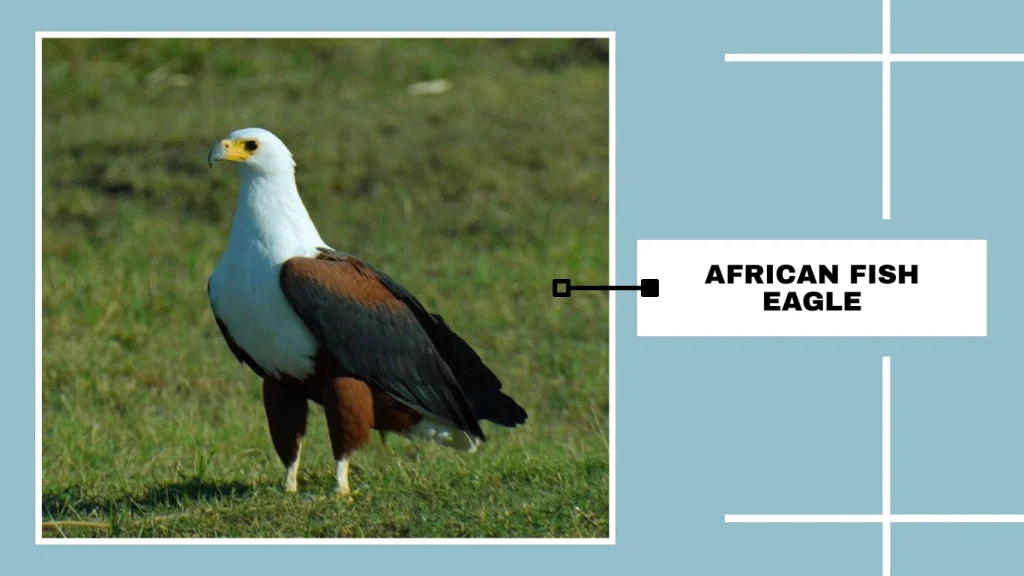
The African Fish Eagle (Haliaeetus vocifer) is one of Africa’s most recognizable birds, famous for its loud, echoing call and majestic presence near lakes and rivers.
Identification
- Size: 25 to 29 inches long; wingspan up to 7.9 feet
- Plumage: White head, chest, and tail; chestnut belly and black wings
- Beak: Powerful, yellow with a dark tip
- Eyes: Dark brown
- Legs: Yellow, strong, and unfeathered
- Tail: Short and white
- Juveniles: Mottled brown and white with less contrast
Habitat and Range
Widely distributed across sub-Saharan Africa. Inhabits large lakes, rivers, and reservoirs where fish are abundant.
Behavior
Pairs often call in duet, a sound commonly heard in African wilderness documentaries. They are territorial and often return to the same perch or nest site.
Diet
Specialized in catching fish, which it snatches from water surfaces using powerful talons. Also eats waterbirds, small mammals, and carrion.
Conservation Status
Listed as Least Concern. Still, pollution and water level changes can impact local populations.
14. Grey-headed Fish Eagle
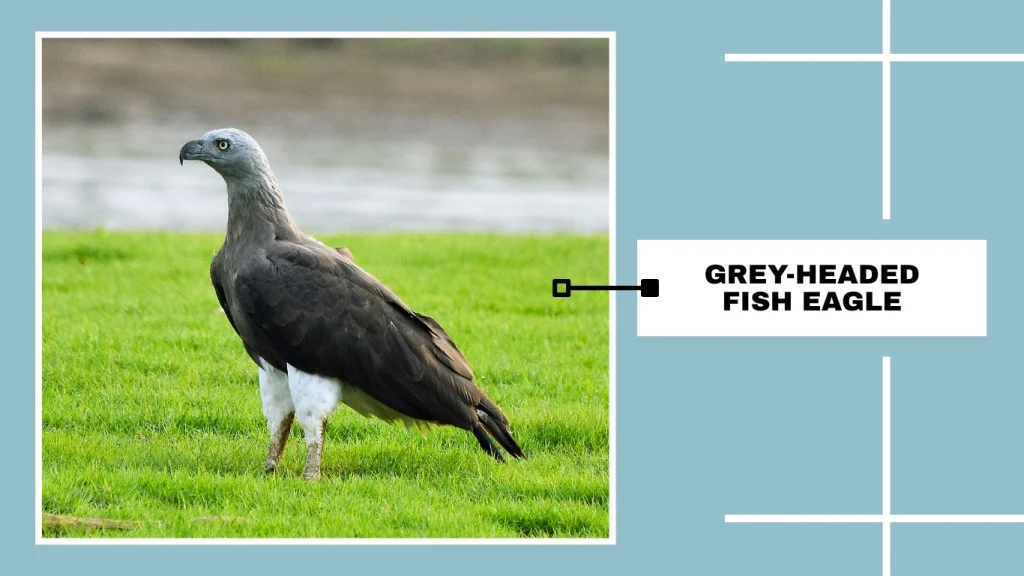
The Grey-headed Fish Eagle (Haliaeetus ichthyaetus) is a medium-sized fish eagle found in forested wetlands of South and Southeast Asia.
Identification
- Size: 24 to 28 inches long; wingspan up to 6 feet
- Plumage: Grey head, neck, and chest; brown body; white belly
- Beak: Hooked and dark with yellow cere
- Eyes: Pale yellow
- Legs: Yellow and unfeathered
- Tail: Short, white with dark terminal band
- Juveniles: Duller and more mottled in color
Habitat and Range
Ranges from India and Sri Lanka to Southeast Asia and the Philippines. Prefers wooded lakes, rivers, mangroves, and wetlands.
Behavior
Often perches quietly near water, waiting for an opportunity to strike. Pairs nest in large trees close to water.
Diet
Primarily eats fish but may also take amphibians, reptiles, and small birds. Hunts by swooping down from a perch rather than soaring.
Conservation Status
Near Threatened due to loss of wetland habitats and deforestation. Protected in several countries across its range.
15. Pallas’s Fish Eagle
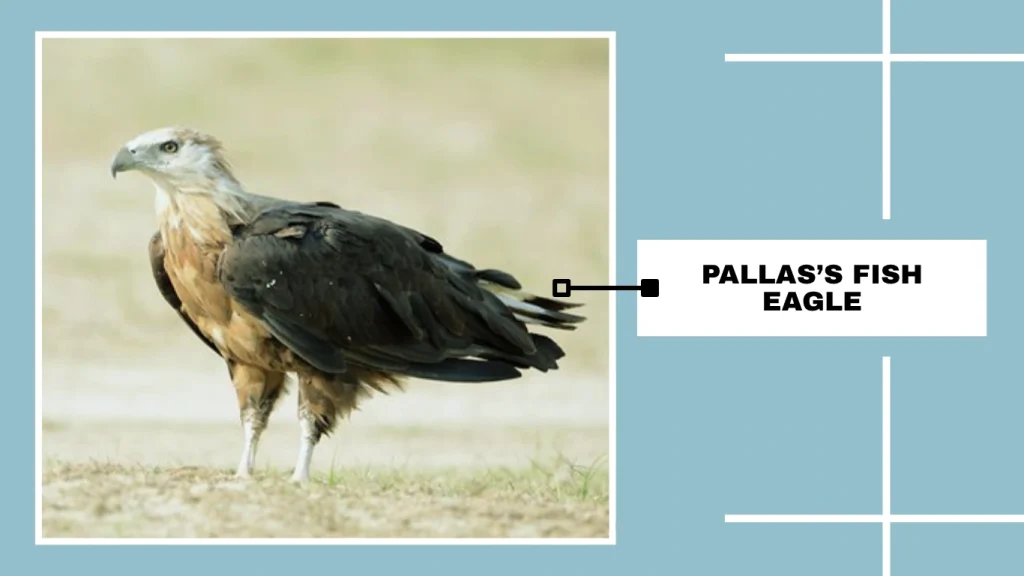
Pallas’s Fish Eagle (Haliaeetus leucoryphus), also known as the Band-Tailed Fish Eagle, is a large raptor with a distinctive appearance and strong preference for freshwater habitats.
Identification
- Size: 28 to 32 inches long; wingspan around 7.5 feet
- Plumage: Rich brown body with a contrasting pale buff or cream head and neck
- Beak: Strong and dark with a yellow cere
- Eyes: Pale yellow
- Legs: Yellow and unfeathered
- Tail: Broad and dark with a wide white band in the middle
- Juveniles: Darker and less contrasting overall with a faint tail band
Habitat and Range
Found near large rivers, lakes, and marshes in Central and South Asia—particularly around the Indian subcontinent, including Pakistan, India, Nepal, and Bangladesh.
Behavior
Often seen soaring or perched near water. Unlike many sea eagles, it is more elusive and less vocal. Breeds in tall trees or cliffs near water.
Diet
Feeds mainly on fish, but also eats water birds, turtles, and carrion. Hunts by gliding and swooping low over water.
Conservation Status
Listed as Vulnerable due to habitat loss, especially from wetland drainage, pollution, and human disturbance. Populations are declining across much of its range.
16. Bonelli’s Eagle

Bonelli’s Eagle (Aquila fasciata) is a medium-to-large eagle known for its agility and power. It favors mountainous and rocky terrain across the Mediterranean, the Middle East, and parts of Asia.
Identification
- Size: 22 to 30 inches long; wingspan up to 6 feet
- Plumage: Dark brown upperparts, pale underparts with dark streaks
- Beak: Strong and curved with a yellow cere
- Eyes: Golden to orange
- Legs: Feathered down to the toes
- Tail: Long with a dark terminal band
- Juveniles: Reddish-brown plumage with less contrast
Habitat and Range
Found in southern Europe, North Africa, the Middle East, and parts of South Asia. Prefers rugged hills, cliffs, and forested valleys.
Behavior
Often hunts in pairs and is known for aggressive, swift hunting tactics. Builds large nests on cliffs or tall trees.
Diet
Feeds on birds (like pigeons and partridges), reptiles, and mammals such as rabbits and hares.
Conservation Status
Near Threatened due to habitat degradation, disturbance, and reduced prey availability. Conservation efforts in Europe have stabilized some populations.
17. Booted Eagle
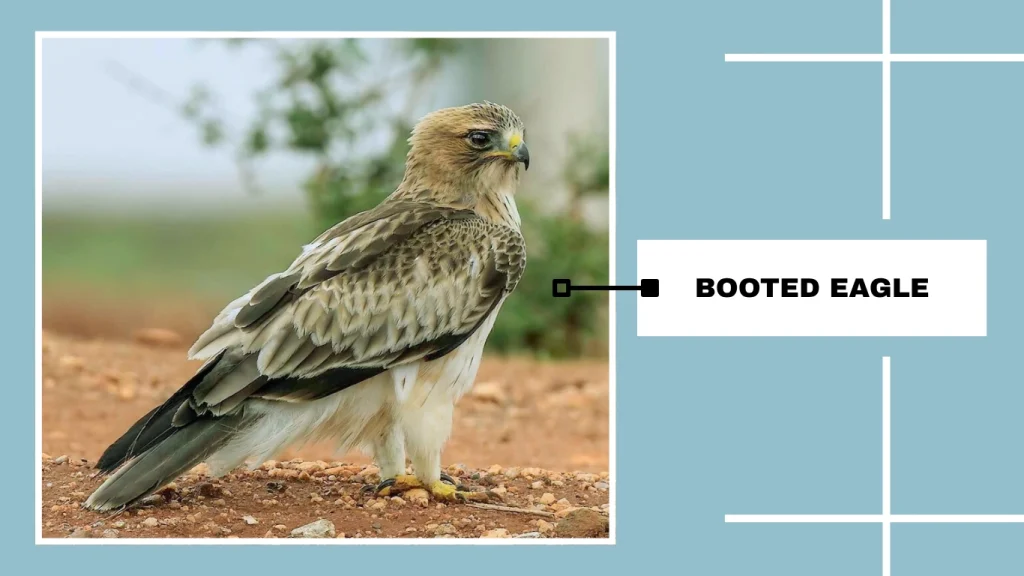
The Booted Eagle (Hieraaetus pennatus) is a small to medium-sized eagle named for its feathered legs (“booted”). It exists in two color morphs—light and dark—and is known for its wide migratory range.
Identification
- Size: 17 to 21 inches long; wingspan 3.9 to 5.1 feet
- Plumage (light morph): Pale head and underparts with dark flight feathers
- Plumage (dark morph): Overall dark brown with slightly lighter coverts
- Beak: Small, dark with a yellow cere
- Eyes: Bright yellow
- Legs: Fully feathered (booted) and yellow
- Tail: Pale with a dark terminal band
- Juveniles: Often resemble light morph adults but with buffier tones
Habitat and Range
Breeds across southern Europe, North Africa, and parts of Asia. Winters in sub-Saharan Africa and the Indian subcontinent. Prefers forested mountains and open woodland edges.
Behavior
Agile and fast in flight, often soaring or hovering while searching for prey. Nests in trees and is monogamous during breeding seasons.
Diet
Feeds on small birds, reptiles, and mammals. Capable of catching prey in midair or off the ground.
Conservation Status
Listed as Least Concern, but local declines have occurred due to deforestation and loss of nesting sites.
18. Wedge-tailed Eagle
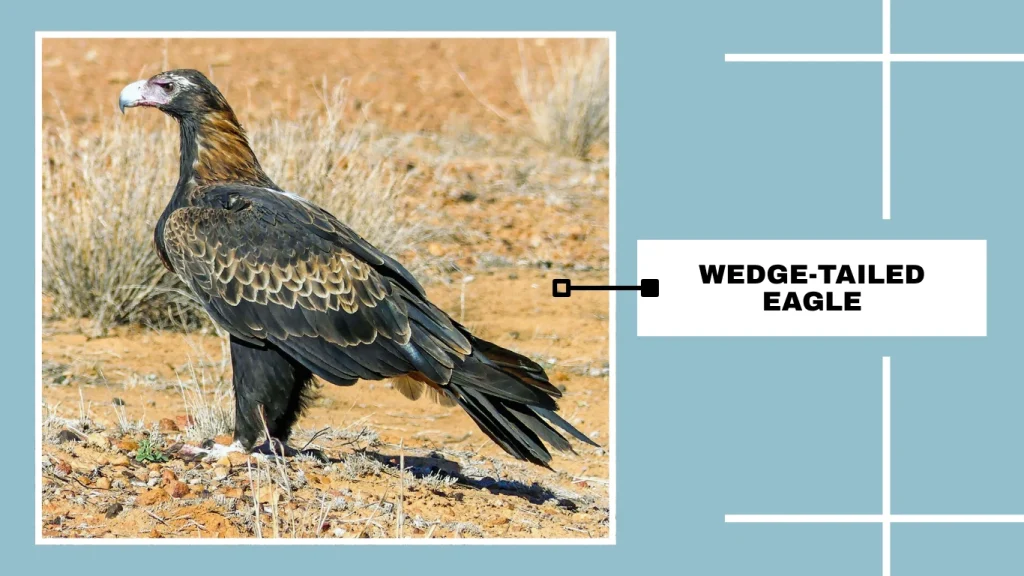
The Wedge-tailed Eagle (Aquila audax) is Australia’s largest bird of prey and one of the world’s largest eagles. It is easily recognized by its long, wedge-shaped tail.
Identification
- Size: 33 to 41 inches long; wingspan up to 9.2 feet
- Plumage: Dark brown to black overall with lighter feather bases
- Beak: Pale gray with dark tip
- Eyes: Brown to amber
- Legs: Feathered to the toes
- Tail: Long, narrow, and distinctly wedge-shaped
- Juveniles: Reddish-brown and become darker with age
Habitat and Range
Found throughout mainland Australia and parts of Tasmania and New Guinea. Occupies forests, open plains, deserts, and mountains.
Behavior
Highly aerial, they soar for hours over great distances. Pairs form lifelong bonds and use massive stick nests often reused year after year.
Diet
Feeds on rabbits, hares, wallabies, reptiles, and carrion. Known to scavenge roadkill and follow fires to catch fleeing prey.
Conservation Status
Listed as Least Concern. Once persecuted, it is now protected, though habitat destruction and poisoning still pose regional threats.
19. Verreaux’s Eagle

Verreaux’s Eagle (Aquila verreauxii), also called the Black Eagle, is a strikingly dark raptor best known for its adaptation to rocky and mountainous landscapes, especially in Africa.
Identification
- Size: 30 to 38 inches long; wingspan up to 7.5 feet
- Plumage: Entirely black with a bold white “V” across the back when wings are spread
- Beak: Powerful and dark with a yellow cere
- Eyes: Deep amber
- Legs: Feathered all the way down, black talons
- Tail: Broad and dark with faint barring
- Juveniles: Brownish with buff edges on feathers and less contrast
Habitat and Range
Native to eastern and southern Africa. Prefers mountainous, rocky, and cliff-dominated environments. Avoids dense forest and flat plains.
Behavior
Monogamous and highly territorial. Often seen soaring in pairs near cliffs. Nests are built on high rocky ledges and reused for decades.
Diet
Specializes in hunting rock hyraxes, but also eats birds, small mammals, and reptiles. Hunts with great speed and precision.
Conservation Status
Listed as Least Concern but threatened locally by habitat destruction and a decline in prey availability. Monitoring and cliff habitat protection are key.
20. Greater Spotted Eagle
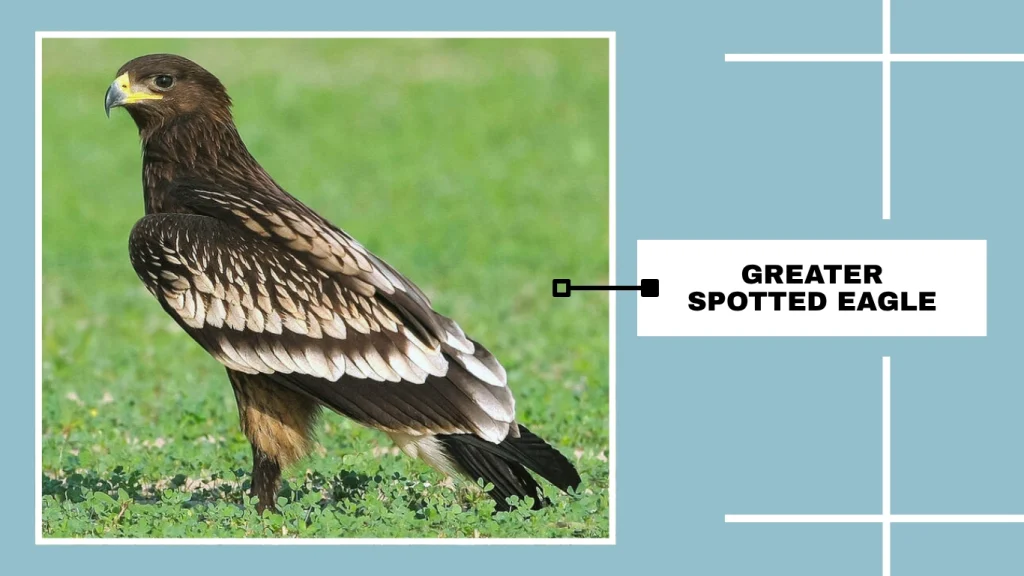
The Greater Spotted Eagle (Clanga clanga) is a large migratory eagle found across parts of Europe and Asia. It is often confused with the Lesser Spotted Eagle but is generally darker and more robust.
Identification
- Size: 23 to 28 inches long; wingspan up to 6.5 feet
- Plumage: Dark brown overall with faint lighter spotting on upper wings
- Beak: Strong and dark with a yellow cere
- Eyes: Yellow-brown
- Legs: Yellow and feathered halfway
- Tail: Short and rounded, lightly barred
- Juveniles: Paler with white wing covert spots and a lighter nape
Habitat and Range
Breeds in eastern Europe and western Asia in marshy forests and floodplains. Winters in South Asia, the Middle East, and northeastern Africa.
Behavior
Usually solitary or seen in small groups during migration. Less aggressive than other large eagles and often scavenges.
Diet
Feeds on small mammals, birds, amphibians, and carrion. Often hunts from a perch rather than soaring.
Conservation Status
Vulnerable due to habitat loss, drainage of wetlands, and hybridization with the Lesser Spotted Eagle. Conservation efforts include wetland protection and anti-poaching measures.
21. Lesser Spotted Eagle

The Lesser Spotted Eagle (Clanga pomarina) is a medium-sized migratory raptor that is often found in Eastern and Central Europe. Though similar to the Greater Spotted Eagle, it is smaller and paler.
Identification
- Size: 23 to 26 inches long; wingspan around 5.5 to 6 feet
- Plumage: Brown overall with slightly lighter underparts and faint white spots on upper wings
- Beak: Dark tip with yellow base
- Eyes: Pale yellow
- Legs: Yellow, partially feathered
- Tail: Rounded and faintly barred
- Juveniles: Buff-edged feathers and more distinct spotting
Habitat and Range
Breeds in mixed woodlands near open fields in Eastern and Central Europe. Migrates to sub-Saharan Africa during winter.
Behavior
Often seen soaring or perched on lone trees overlooking fields. Slightly less territorial than other eagles and may nest semi-colonially in rich habitats.
Diet
Feeds on small mammals, birds, reptiles, and amphibians. Also scavenges when necessary.
Conservation Status
Listed as Least Concern, though populations are decreasing due to deforestation and habitat fragmentation. Conservation involves protecting nesting forests and migration corridors.
22. Indian Spotted Eagle
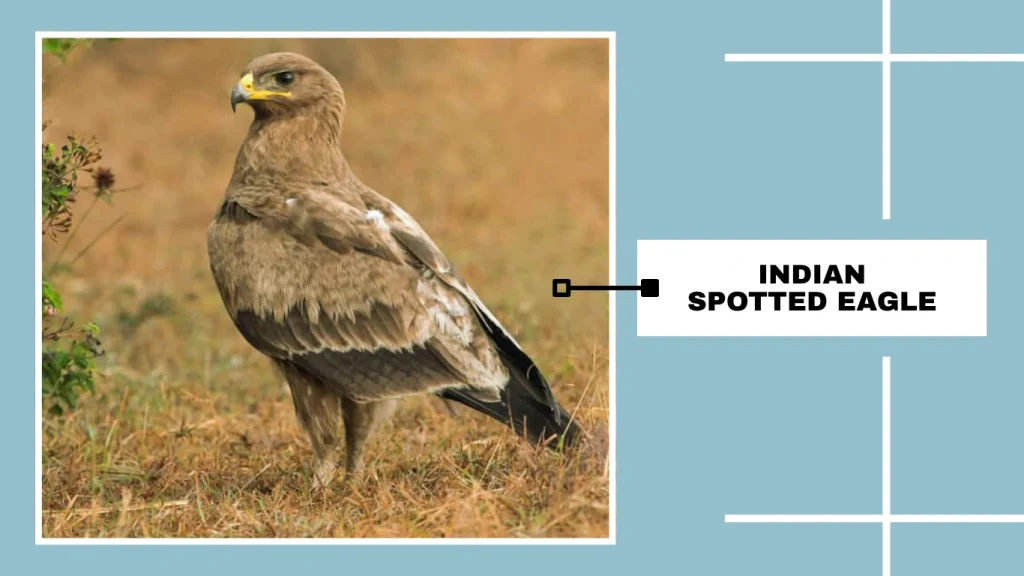
The Indian Spotted Eagle (Clanga hastata) is a medium-sized eagle native to the Indian subcontinent, closely related to the Lesser and Greater Spotted Eagles but more distinct in plumage and behavior.
Identification
- Size: 24 to 26 inches long; wingspan around 5.5 feet
- Plumage: Uniformly brown with less distinct spotting than its relatives
- Beak: Dark with yellow cere
- Eyes: Deep brown
- Legs: Yellow and unfeathered
- Tail: Rounded and unbarred
- Juveniles: Slightly paler with minimal spotting
Habitat and Range
Found primarily in India, Nepal, and parts of Bangladesh. Prefers lowland forests, dry plains, agricultural fields, and open countryside.
Behavior
Sedentary and non-migratory. Often seen gliding low over fields and roadsides or perched on trees and poles.
Diet
Feeds on small mammals, reptiles, amphibians, and large insects. Sometimes scavenges on roadkill.
Conservation Status
Vulnerable due to habitat degradation, especially in dry deciduous forests and grasslands. Protected in some regions through habitat preservation and awareness programs.
23. Long-crested Eagle
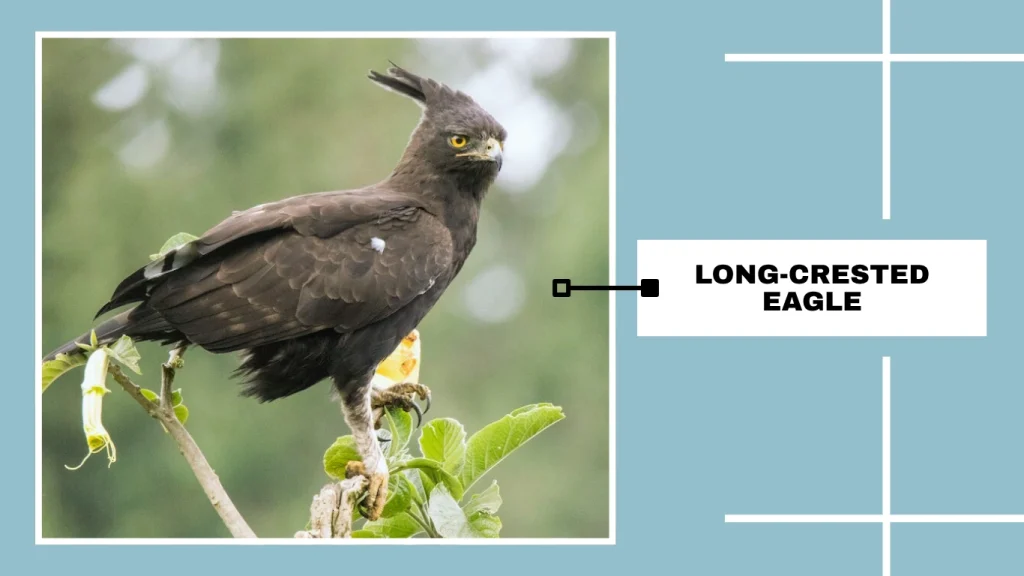
The Long-crested Eagle (Lophaetus occipitalis) is a small, striking African eagle best known for its long, shaggy black crest and piercing yellow eyes. It’s often seen perched alone along open roadsides and farmlands.
Identification
- Size: 20 to 24 inches long; wingspan around 4.5 feet
- Plumage: Dark brown to black with white patches on the wings
- Crest: Long and tufted, often raised
- Beak: Short and strongly hooked, yellow base with black tip
- Eyes: Bright yellow and intense
- Legs: Yellow and feathered to the base of the toes
- Tail: Broad and barred with black and white bands
- Juveniles: Paler with buff-colored mottling
Habitat and Range
Found throughout sub-Saharan Africa, especially in savannas, forest edges, plantations, and agricultural land. Prefers areas with scattered trees and access to open ground.
Behavior
Often remains motionless on perches for long periods. Uses a sit-and-wait strategy for hunting. Frequently raises its crest when alert or displaying.
Diet
Primarily feeds on rodents and other small mammals. Also eats birds, reptiles, and insects. Especially helpful to farmers for natural rodent control.
Conservation Status
Listed as Least Concern. Locally common and benefits from modified agricultural landscapes, though deforestation can reduce suitable habitats.
24. Rufous-bellied Eagle

The Rufous-bellied Eagle (Lophotriorchis kienerii) is a forest-dwelling eagle from South and Southeast Asia, noted for its beautiful reddish underparts and agile flight.
Identification
- Size: 20 to 25 inches long; wingspan up to 4.5 feet
- Plumage: Black upperparts, rich rufous (reddish-brown) underparts, and white throat
- Beak: Compact and sharply curved
- Eyes: Deep orange to brown
- Legs: Yellow and feathered halfway
- Tail: Grayish with narrow black bands
- Juveniles: Whitish below with dark streaking; lack the deep rufous tones
Habitat and Range
Inhabits dense forests and hilly woodlands in India, Sri Lanka, Indonesia, and the Malay Peninsula. Usually seen soaring above the canopy or perched high on forest edges.
Behavior
Territorial and solitary. Its soaring display flight with undulating glides is characteristic. Shy and elusive, it’s rarely observed at close range.
Diet
Feeds on small birds, reptiles, and squirrels. Known to snatch prey from tree canopies or mid-air.
Conservation Status
Near Threatened due to rapid deforestation and loss of primary forest habitat. Protection of forest corridors is essential for its survival.
25. Black-and-chestnut Eagle
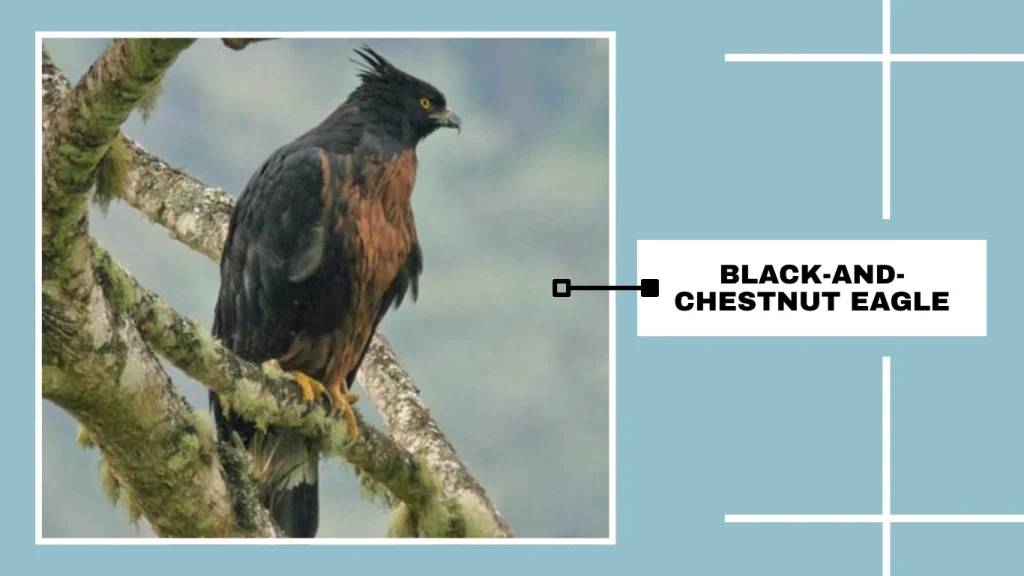
The Black-and-chestnut Eagle (Spizaetus isidori) is a rare and powerful forest eagle native to the Andean cloud forests. Known for its bold coloration and impressive size, it is one of South America’s most endangered raptors.
Identification
- Size: 26 to 30 inches long; wingspan up to 6.2 feet
- Plumage: Black head, back, and wings; deep chestnut underparts and thighs; white band on tail
- Crest: Short and black, often slightly raised
- Beak: Sturdy, black with a yellow cere
- Eyes: Bright yellow
- Legs: Strong, yellow, and feathered down to the toes
- Juveniles: Whitish or pale rufous with dark markings and less contrast
Habitat and Range
Found in the Andes Mountains, particularly in Colombia, Ecuador, Peru, and Bolivia. Prefers humid montane and cloud forests between 1,800 and 3,000 meters (5,900–9,800 feet) elevation.
Behavior
Solitary and elusive, this eagle is rarely seen due to its preference for dense forest canopies. Soars over ridges and valleys but also hunts within tree cover.
Diet
Feeds primarily on medium-sized mammals and birds, including monkeys, squirrels, and large arboreal birds. It hunts with powerful dives from high perches.
Conservation Status
Critically Endangered or Endangered depending on region. Threatened by deforestation, habitat fragmentation, and human persecution. Fewer than 1,000 individuals remain. Conservation programs are focusing on habitat protection and education in local communities.