



Thrushes are a diverse and melodious group of songbirds found across the globe. Known for their rich, fluting voices and often understated beauty, these birds thrive in a variety of habitats—from dense forests and mountain slopes to gardens and city parks. Many thrush species are skilled foragers, feeding on insects, worms, and berries, and some are long-distance migrants that travel thousands of miles between breeding and wintering grounds.
In this article, we explore 25 common thrush species from around the world. Each section highlights detailed identification, behavior, nesting habits, and their natural range—making it a helpful guide for birdwatchers, nature lovers, and wildlife educators. Let’s begin with the first species: the American Robin.
1. American Robin
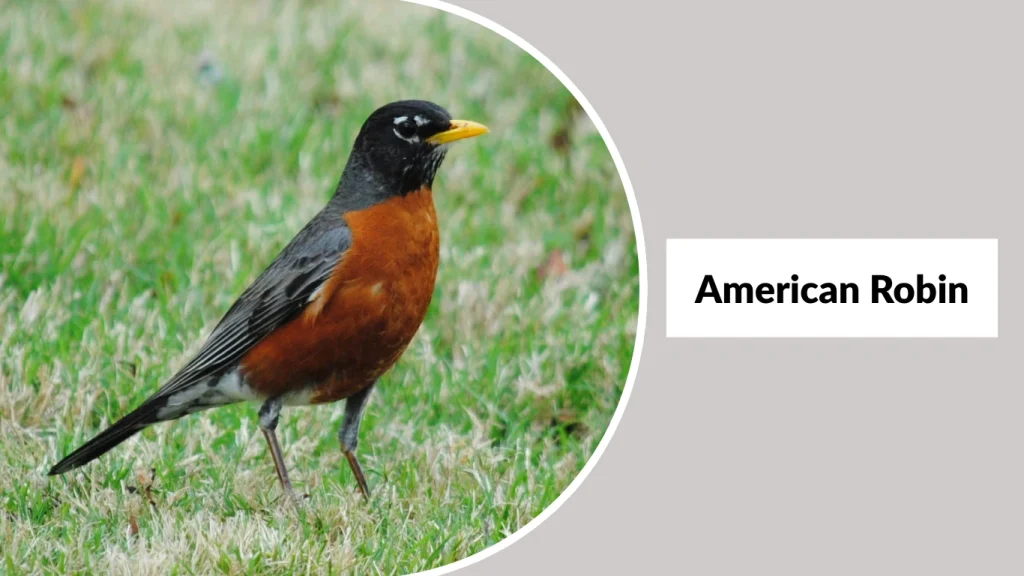
The American Robin is one of the most familiar and widespread songbirds in North America. Known for its bright orange belly, cheerful song, and early appearance in spring, it’s a beloved symbol of seasonal change. It thrives in a wide range of habitats, from city parks and gardens to forests and farmlands.
Identification
- Coloration: Grayish-brown back with a vibrant orange-red breast
- Head: Black in males, grayish in females
- Eye Ring: White, broken ring around each eye
- Bill: Yellow with a slightly darker tip
- Size: About 9–11 inches (23–28 cm) in length
- Wingspan: 12–16 inches (31–40 cm)
- Legs: Thin and dark
- Tail: Long and rounded with white corners
- Song: Cheerful, melodious phrases often repeated in patterns
- Habitat: Yards, woodlands, fields, and urban areas
Behavior and Diet
American Robins are ground foragers, hopping around lawns in search of earthworms, insects, and berries. They are known for their sharp eyesight, often seen tilting their head to locate prey beneath the soil. In winter, their diet shifts more toward fruits and berries.
Nesting and Reproduction
Females build cup-shaped nests using mud, grass, and twigs. Nests are often located in trees, shrubs, or even on ledges and building corners. The female lays 3 to 5 blue eggs per clutch and incubates them for about two weeks.
Range and Migration
Found year-round in much of the U.S., American Robins breed across Canada and Alaska and migrate to the southern U.S., Mexico, and Central America during colder months. Their migratory patterns are closely tied to food availability rather than temperature.
2. Wood Thrush

The Wood Thrush is a forest-dwelling songbird admired for its hauntingly beautiful, flute-like song that echoes through deciduous woodlands of eastern North America. Often heard more than seen, this thrush prefers shady, moist forests and plays a key role in forest ecosystems by dispersing seeds and consuming insects.
Identification
- Coloration: Warm reddish-brown upperparts with bright white underparts
- Spotting: Bold black spots scattered across the chest and flanks
- Head: Rich rufous crown contrasting with a white ring around the eye
- Bill: Straight, dark bill with a slightly lighter base
- Size: 7.5–8.5 inches (19–21.5 cm) in length
- Wingspan: Approximately 12 inches (30 cm)
- Legs: Pale pinkish to flesh-colored
- Tail: Rounded and slightly reddish
- Song: Ethereal and flutelike with layered phrases—often described as one of the most beautiful bird songs
- Habitat: Moist deciduous or mixed forests with dense understory
Behavior and Diet
Wood Thrushes are secretive birds that forage on the forest floor, flipping leaves and probing the soil. Their diet includes insects, spiders, snails, and earthworms, with fruits and berries supplementing in summer and fall.
Nesting and Reproduction
The female builds a well-formed nest using mud, grasses, and leaves, typically placed on a horizontal tree branch. She lays 3 to 4 pale blue eggs, which she incubates alone. Both parents help feed the chicks until they fledge.
Conservation and Threats
While still relatively common, the Wood Thrush population is in decline due to habitat fragmentation, which makes nests more vulnerable to predators and brood parasites like cowbirds. They are also affected by deforestation in their Central American wintering grounds.
3. Hermit Thrush

The Hermit Thrush is a shy and solitary bird known for its ethereal, flute-like song that’s often heard at dawn and dusk deep in wooded areas. Unlike other thrushes, it’s a hardy species that remains in much of the U.S. during winter, making it one of the earliest and latest thrushes seen in a given area.
Identification
- Coloration: Brown upperparts with a reddish tail (distinctive field mark)
- Underparts: Pale with fine, dark spotting on the chest
- Eye Ring: Noticeable pale eye ring giving a gentle expression
- Bill: Thin and dark with a yellowish base
- Size: 6.7–7.5 inches (17–19 cm) in length
- Wingspan: 11–12 inches (28–30 cm)
- Legs: Thin and pinkish
- Tail: Warmer reddish-brown, often lifted slightly when perched
- Song: Clear, slow, and flute-like, rising and falling in long phrases
- Habitat: Coniferous and mixed forests, especially in dense understory
Behavior and Diet
Hermit Thrushes forage close to the ground, hopping and pausing as they search for insects, beetles, and small fruits. During winter, they rely heavily on berries from shrubs like holly and dogwood.
Nesting and Reproduction
Their nests are built low in trees, shrubs, or sometimes on the ground. The cup-shaped nest is made from twigs, moss, leaves, and rootlets. Females lay 3 to 5 pale blue eggs and handle most of the incubation duties.
Range and Seasonal Movements
This thrush breeds in Canada and the northern U.S. and migrates to southern states and Mexico for the winter. However, some populations remain in the western U.S. year-round, especially in coastal or lowland areas.
4. Swainson’s Thrush
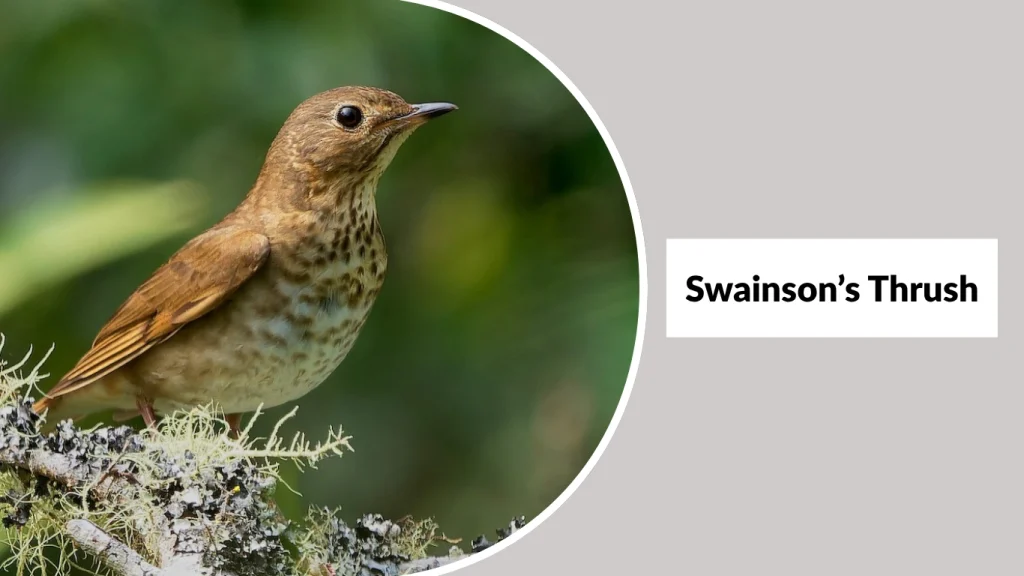
Swainson’s Thrush is a secretive bird most often identified by its upward-spiraling song that echoes softly through northern forests. Nicknamed the “olive-backed thrush,” it is a long-distance migrant that travels from North America to South America each year, covering thousands of miles between breeding and wintering grounds.
Identification
- Coloration: Olive-brown upperparts with pale, slightly yellowish underparts
- Spotting: Distinct buff-colored chest with subtle grayish-brown spots
- Eye Ring: Bold buff eye ring, giving a “spectacled” appearance
- Bill: Slim, dark with a pale base
- Size: 6.3–7.5 inches (16–19 cm) in length
- Wingspan: 11–12 inches (28–30 cm)
- Legs: Pale pinkish to flesh-colored
- Tail: Brown and fairly short
- Song: Ethereal, flute-like, and spiraling upward in pitch
- Habitat: Dense coniferous or mixed forests, often near streams or thickets
Behavior and Diet
This thrush forages low in the understory or on the forest floor. It feeds on insects, beetles, ants, and caterpillars, and also consumes berries during migration. Swainson’s Thrushes are shy and tend to stay hidden in foliage, making them easier to hear than to see.
Nesting and Reproduction
Females build well-camouflaged cup-shaped nests in shrubs or small trees, usually within six feet of the ground. Nests are constructed from twigs, bark, moss, and grass. The female lays 3 to 4 pale blue eggs and handles most of the incubation.
Migration and Range
They breed in boreal and montane forests of Canada, Alaska, and the northern U.S., then migrate to Central and South America for the winter. Their migration path includes long, nonstop flights over the Gulf of Mexico.
5. Veery

The Veery is a light-colored thrush known for its soft, spiraling song and gentle demeanor. Found in moist deciduous forests across eastern North America, it’s more often heard than seen. Its sweet, downward-spiraling song and buffy tones set it apart from its more heavily spotted relatives.
Identification
- Coloration: Warm cinnamon-brown upperparts
- Underparts: Light creamy white with faint, blurred spots on the chest
- Eye Ring: Pale and subtle, not as bold as in other thrushes
- Bill: Slender and dark, with a slightly paler lower mandible
- Size: 6.5–7 inches (16.5–18 cm) in length
- Wingspan: 10–11 inches (25–28 cm)
- Legs: Pale pinkish or gray
- Tail: Slightly rounded and cinnamon-colored like the back
- Song: Soft, descending, flute-like spirals with a hazy, echoing quality
- Habitat: Moist hardwood forests, especially near streams and thickets
Behavior and Diet
Veeries forage on the forest floor, feeding on ants, beetles, snails, caterpillars, and small fruits. They are active but elusive, usually staying low in dense underbrush. Their gentle nature and subdued color make them hard to spot.
Nesting and Reproduction
The female builds a shallow cup nest near or on the ground using dry leaves, twigs, and moss. She lays 3 to 5 light blue eggs and incubates them alone. Both parents help feed the young once hatched.
Range and Migration
Veeries breed in southern Canada and the northeastern U.S. and migrate to the Amazon basin in South America. Their migration is one of the longest among North American songbirds, sometimes exceeding 3,000 miles.
6. Song Thrush
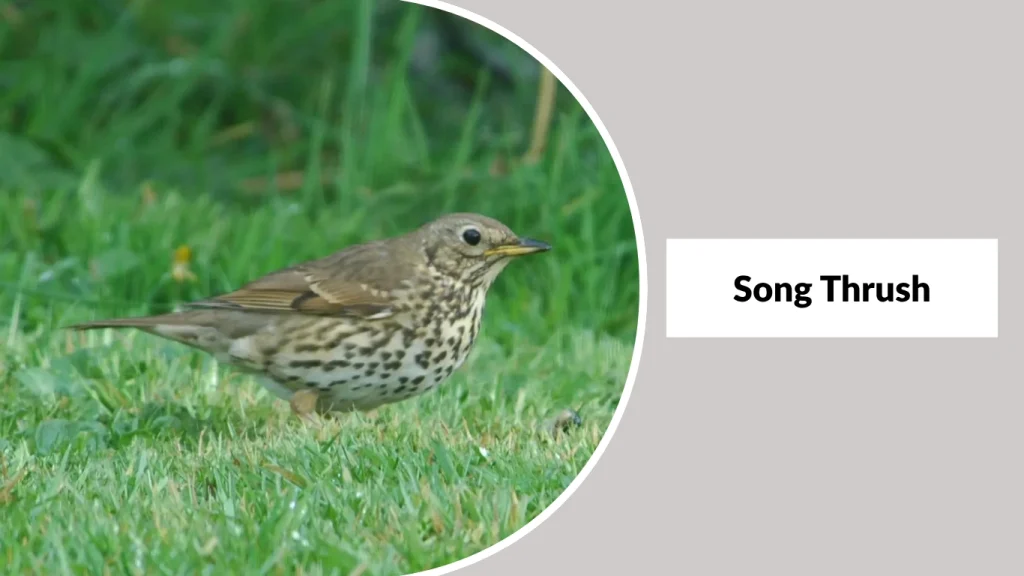
The Song Thrush is a familiar and beloved European songbird known for its loud, melodic voice and repeated musical phrases. It’s commonly seen in gardens, woodlands, and parks, often hopping on lawns and leaf litter in search of invertebrates. Its beautiful singing and spotted breast make it easy to recognize.
Identification
- Coloration: Warm brown upperparts
- Underparts: Creamy white with bold dark brown spots, shaped like arrowheads
- Eye Ring: Thin, pale ring around the eye
- Bill: Straight and dark, slightly paler at the base
- Size: 8.5–9.5 inches (21–24 cm) in length
- Wingspan: 13–15 inches (33–38 cm)
- Legs: Pale pink to buff-colored
- Tail: Short and rounded, same color as the back
- Song: Loud and musical with clear, repeated phrases—can mimic other birds
- Habitat: Gardens, woodlands, hedgerows, and urban green spaces
Behavior and Diet
Song Thrushes forage mainly on the ground, using their strong beaks to turn over leaves and dig for snails, worms, and insects. They are known for breaking snail shells against rocks, a behavior that makes them unique among thrushes. Berries and soft fruits are also consumed, especially in autumn and winter.
Nesting and Reproduction
They build neat cup-shaped nests in dense shrubs or trees using mud, grass, and moss. The female lays 3 to 5 glossy blue eggs with black or purple spots. She incubates the eggs and feeds the chicks with help from the male.
Range and Movement
The Song Thrush breeds throughout Europe and parts of western Asia. While some populations in milder regions are resident year-round, many northern birds migrate to southern Europe and North Africa during the winter months.
7. Mistle Thrush

The Mistle Thrush is the largest European thrush and is easily recognized by its upright posture, pale appearance, and rattling flight call. Named for its fondness for mistletoe berries, this bold bird is often seen guarding berry trees in winter from other foragers.
Identification
- Coloration: Grayish-brown upperparts
- Underparts: Whitish with bold black spots, less warm-toned than the Song Thrush
- Eye Ring: Pale but not strongly marked
- Bill: Slim and dark
- Size: 10–11 inches (27–28 cm) in length
- Wingspan: 16–18 inches (42–47 cm)
- Legs: Pale pinkish to gray
- Tail: Long, edged with white
- Song: Loud, fluty song delivered from treetops, especially in bad weather
- Habitat: Open woodlands, fields with scattered trees, parks, and orchards
Behavior and Diet
Mistle Thrushes forage boldly on open lawns, pastures, and roadsides. Their diet includes earthworms, insects, and a wide range of berries—especially rowan, holly, and mistletoe. In winter, they are known to defend fruiting trees vigorously against other birds.
Nesting and Reproduction
They build bulky nests in tree forks or on ledges using grass, roots, and moss, lined with mud. Clutches contain 3 to 5 pale blue eggs with fine speckling. Both parents assist in raising the young.
Range and Distribution
Found across most of Europe and into parts of Asia, Mistle Thrushes are partial migrants. Northern populations often move south for winter, while those in western and southern Europe may remain year-round. They are also expanding their range northward in some regions.
8. Eurasian Blackbird
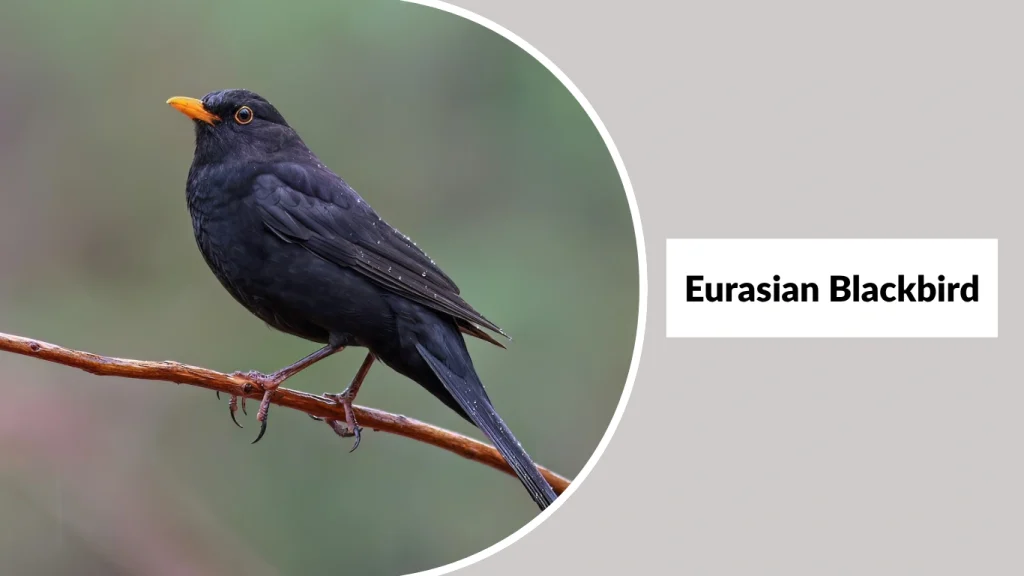
The Eurasian Blackbird, also simply called the Blackbird in Europe, is one of the most common and well-loved songbirds across the continent. Recognized for its rich melodious song and striking all-black plumage in males, it thrives in both natural forests and human-dominated landscapes like gardens and urban parks.
Identification
- Coloration:
- Male: All black with bright yellow eye ring and bill
- Female: Dark brown with streaked throat and a duller eye ring
- Male: All black with bright yellow eye ring and bill
- Size: 9–10.5 inches (23–27 cm) in length
- Wingspan: 13–15 inches (34–38 cm)
- Weight: Around 3.5–4 ounces (100–120 grams)
- Bill: Yellow in males, brownish in females
- Legs: Dark brown to black
- Tail: Medium length and straight
- Song: Flute-like, melodic, and musical, delivered from rooftops or treetops
- Habitat: Woodlands, gardens, parks, farmland edges, and towns
Behavior and Diet
Eurasian Blackbirds are ground feeders, commonly seen hopping and pulling earthworms or insects from lawns and leaf litter. Their diet also includes berries, fruits, and seeds. They are territorial during the breeding season, with males often singing early in the morning and at dusk to defend their space.
Nesting and Reproduction
Females construct neat cup-shaped nests out of grass, twigs, and mud, usually hidden in shrubs or hedges. They lay 3 to 5 greenish-blue eggs with reddish speckling. The female incubates while the male helps feed the chicks once they hatch.
Range and Distribution
The Eurasian Blackbird is found across Europe, parts of Asia, and North Africa. Many populations are resident year-round, especially in Western Europe, while northern birds may migrate to southern regions in winter. It has also been introduced to Australia and New Zealand, where it is now established.
9. Fieldfare
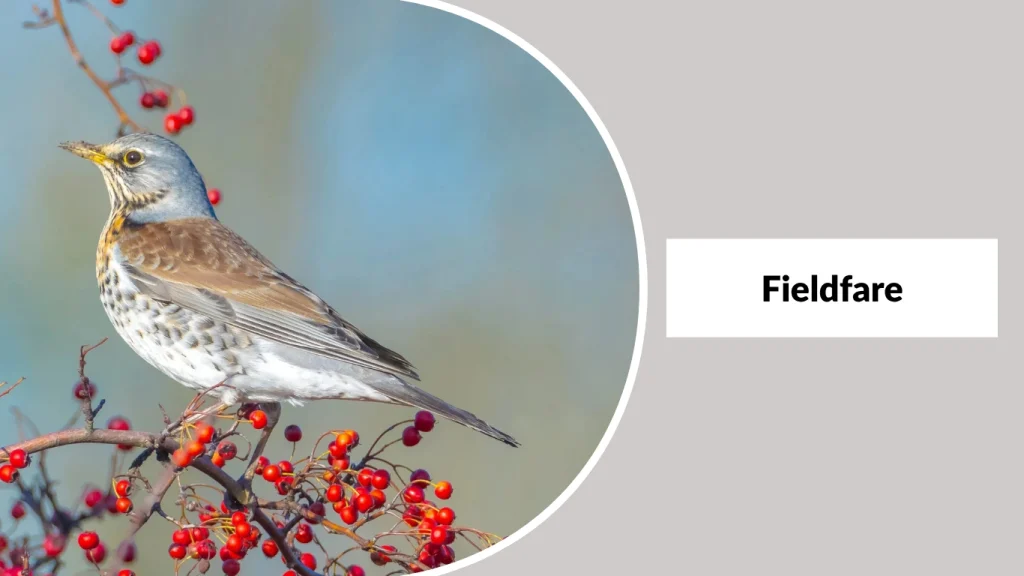
The Fieldfare is a large and handsome thrush species known for its colorful plumage and social behavior. Common across much of Europe during winter, it often gathers in large flocks in open countryside and orchards, where it feeds on fallen fruit, berries, and insects.
Identification
- Coloration:
- Head and nape: Slate gray
- Back and wings: Chestnut brown
- Underparts: Pale with bold black spotting on the breast and flanks
- Head and nape: Slate gray
- Size: 9.5–11 inches (24–27 cm) in length
- Wingspan: 16–17 inches (40–43 cm)
- Weight: 3.5–5 ounces (100–140 grams)
- Eye Ring: Faint and pale
- Bill: Yellow with dark tip
- Legs: Dark brown or black
- Tail: Dark with contrasting pale rump
- Song: Harsh “chack-chack-chack” call; less musical than other thrushes
- Habitat: Open fields, hedgerows, orchards, and woodland edges
Behavior and Diet
Fieldfares are highly social birds, often seen foraging in flocks, especially in winter. They feed on fallen apples, berries (especially hawthorn and rowan), and insects. When disturbed, they rise noisily into the air and settle again as a group.
Nesting and Reproduction
In breeding season, which occurs in northern Europe and Scandinavia, Fieldfares nest in colonies. Nests are built in trees or shrubs using grass, mud, and twigs. The female lays 4 to 6 blue-green eggs with dark speckles, and both parents share in raising the chicks.
Range and Migration
Fieldfares breed in northern and eastern Europe and migrate southwest in large numbers during autumn to winter in central and southern Europe. In milder winters, they may also be found in parts of the UK. Their gregarious behavior and large flocks make them easy to spot in open fields during the colder months.
10. Redwing

The Redwing is a small, elegant thrush species that migrates in large flocks from Scandinavia and Iceland to milder parts of Europe in winter. It is well-known for its subtle beauty, distinctive underwing markings, and soft, high-pitched call often heard during nocturnal migration.
Identification
- Coloration: Brown upperparts with creamy white underparts
- Markings: Bold dark streaks on the breast and flanks
- Distinctive Feature: Rusty-red patches on the underwings and flanks
- Supercilium: Prominent creamy-white eyebrow line (above each eye)
- Size: 8–9.5 inches (20–24 cm) in length
- Wingspan: 13–15 inches (33–38 cm)
- Weight: Around 2.5–3.5 ounces (65–100 grams)
- Bill: Slim and yellowish with a dark tip
- Legs: Pale to dark brown
- Tail: Medium length, same tone as the back
- Song: Thin “seep” call, especially at night; soft warbling during breeding
- Habitat: Fields, hedgerows, orchards, and forest edges
Behavior and Diet
Redwings are highly migratory and flocking birds, foraging on the ground for worms, insects, and berries. In winter, they often mix with Fieldfares and Starlings, feeding on hawthorn, holly, and rowan berries. Their alert posture and constant movement make them easy to distinguish in a mixed flock.
Nesting and Reproduction
They breed in northern Europe and Iceland, building nests in low shrubs, bushes, or small trees. Nests are made from grass, moss, and mud. The female typically lays 4 to 6 pale blue eggs with reddish speckles. Both parents help rear the young.
Range and Migration
Redwings migrate south from their breeding grounds in Scandinavia, Iceland, and northern Russia to winter across western and southern Europe. In the UK, they’re considered winter visitors, often arriving in October and leaving by March or April.
11. Varied Thrush

The Varied Thrush is a striking and colorful forest bird native to the Pacific Northwest of North America. With its bold plumage and eerie, whistling song, it’s often considered a bird of mystery and deep woods, especially during the quiet of the colder seasons.
Identification
- Coloration: Slate-blue upperparts in males; dark gray in females
- Breast: Bright orange with a contrasting dark breast band
- Supercilium: Strong orange eyebrow stripe
- Wings: Orange wing bars on blackish-gray feathers
- Size: 7.5–10 inches (19–25 cm) in length
- Wingspan: About 13–15 inches (33–38 cm)
- Weight: Around 2.5–3.5 ounces (70–100 grams)
- Bill: Thin and dark
- Legs: Pinkish to gray
- Tail: Medium-length and square-tipped
- Song: Long, haunting whistles on a single pitch, repeated slowly
- Habitat: Dense, moist coniferous forests, especially in mountainous areas
Behavior and Diet
Varied Thrushes forage low in the understory or on the forest floor, searching for insects, grubs, and berries. In winter, they often come into gardens and urban parks, especially in snow-covered regions where natural food is scarce.
Nesting and Reproduction
They build well-hidden cup-shaped nests in dense conifer branches, constructed from twigs, bark strips, moss, and lichen. The female lays 3 to 5 pale blue-green eggs, and both parents feed the chicks after hatching.
Range and Seasonal Movement
Breeding mainly in the Pacific Northwest, Alaska, and parts of western Canada, Varied Thrushes move south to coastal California and inland mountain forests during winter. They are occasional winter visitors to the western interior U.S., especially in irruption years when food is scarce in the north.
12. Bicknell’s Thrush

Bicknell’s Thrush is a rare and elusive songbird with a very limited breeding range in the high-altitude spruce-fir forests of northeastern North America. It is one of the most endangered songbirds on the continent, primarily threatened by habitat loss and climate change. Its subtle plumage and preference for remote habitats make it difficult to study.
Identification
- Coloration: Olive-brown upperparts with pale grayish-white underparts
- Spotting: Faint dusky spots on the throat and upper chest
- Eye Ring: Thin and indistinct
- Size: 6.7–7.1 inches (17–18 cm) in length
- Wingspan: Around 11 inches (28 cm)
- Weight: 0.9–1.2 ounces (25–34 grams)
- Bill: Thin and slightly downcurved, dark with pale base
- Legs: Pale pinkish to flesh-toned
- Tail: Medium length, matching the back
- Song: Clear, fluted phrases with rising and falling notes
- Habitat: Remote, high-elevation spruce-fir forests
Behavior and Diet
Bicknell’s Thrushes are insectivores, feeding on beetles, ants, flies, and caterpillars. They also consume berries during the late summer and on migration. Shy and secretive, they forage mostly in dense understory and low tree branches.
Nesting and Reproduction
The female builds a nest low in coniferous shrubs using twigs, moss, and grass. She lays 3 to 4 pale blue eggs. Males are known to mate with multiple females, which is uncommon among North American thrushes. Both parents feed the chicks.
Range and Conservation
This species breeds only in isolated mountain ranges of the northeastern U.S. and southeastern Canada. It winters in the Caribbean, especially on Hispaniola. Due to its small population and specific habitat needs, Bicknell’s Thrush is listed as vulnerable and is a focus of ongoing conservation efforts.
13. Grey-cheeked Thrush

The Grey-cheeked Thrush is a shy and strongly migratory thrush that breeds in the boreal forests of North America and migrates as far as South America for winter. It is one of the more elusive and difficult thrushes to observe due to its remote habitat and quiet behavior.
Identification
- Coloration: Plain olive-brown back with grayish face and cheeks
- Underparts: Off-white with dusky spotting on the throat and breast
- Eye Ring: Very faint or absent (distinguishes it from Swainson’s Thrush)
- Size: 6.3–7 inches (16–18 cm) in length
- Wingspan: About 11 inches (28 cm)
- Weight: 0.9–1.4 ounces (26–40 grams)
- Bill: Thin, dark with a paler base
- Legs: Pale pink
- Tail: Same tone as back, slightly notched
- Song: A descending, flute-like series of soft whistles, less melodic than others
- Habitat: Boreal forests, dense willow thickets, and brushy clearings
Behavior and Diet
Grey-cheeked Thrushes forage on the ground and in low shrubs, feeding on insects, spiders, and berries. They are particularly secretive during migration and often remain hidden in thick vegetation.
Nesting and Reproduction
They build cup-shaped nests low in shrubs or small conifers using grasses, moss, and bark. The female lays 3 to 5 pale blue eggs with little to no markings. Breeding occurs in remote and rugged areas, making nests hard to find.
Range and Migration
This species breeds in Alaska and across the northern boreal belt of Canada. During migration, it travels through eastern North America and winters in the upper Amazon Basin of South America. Its migration journey can exceed 3,000 miles.
14. White-throated Thrush

The White-throated Thrush is a striking and vocal thrush native to Mexico and Central America. Though rarely seen in the U.S., occasional individuals wander into Texas and the Southwest, exciting birders with their bold markings and melodic songs. It prefers humid forests and forest edges, especially at middle elevations.
Identification
- Coloration: Dark olive-brown upperparts with white underparts
- Throat: Bright white with bold black borders on the sides
- Eye Ring: Yellow and clearly defined
- Bill: Bright yellow and slightly curved
- Size: 8–9 inches (20–23 cm) in length
- Wingspan: About 13 inches (33 cm)
- Weight: Around 2.5–3 ounces (70–85 grams)
- Tail: Rounded and medium-length, same color as back
- Legs: Pale pink or gray
- Song: Rich, fluting notes with whistles and trills, often heard at dawn
- Habitat: Tropical and subtropical forests, forest edges, coffee plantations
Behavior and Diet
White-throated Thrushes forage in low vegetation and on the ground, searching for insects, earthworms, and fruit. They are quick and alert, often disappearing into thick foliage when disturbed.
Nesting and Reproduction
Nests are typically placed in shrubs or low trees and made of twigs, grass, and moss. The female lays 2–4 pale bluish or greenish eggs. Though not well-studied in the wild, their nesting behavior is believed to be similar to other forest thrushes.
Range and Occasional Sightings
They are found throughout Mexico, Central America, and parts of northern South America. Rare vagrants have been documented in the southern U.S., especially in winter. Their occasional appearances in Texas or Arizona are often featured in birding reports.
15. Dusky Thrush

The Dusky Thrush is a scarce but beautiful visitor from Asia, known for its crisp black-and-white face pattern and warm, dusky plumage. It breeds in Siberia and migrates to East and Southeast Asia in winter, though a few vagrants occasionally appear in Alaska and western North America.
Identification
- Coloration: Dark brown upperparts with warm rusty flanks
- Underparts: White with dark, scalloped spotting
- Face: Bold white supercilium and malar stripe framed by dusky cheeks
- Bill: Dark with a yellowish base
- Size: 8–9 inches (21–23 cm) in length
- Wingspan: 13–14.5 inches (33–37 cm)
- Weight: About 2.8–3.5 ounces (80–100 grams)
- Legs: Pale brown
- Tail: Dark brown, squared
- Song: High-pitched, warbling phrases interspersed with harsher calls
- Habitat: Open forests, scrub, farmland edges, and urban parks
Behavior and Diet
They feed mostly on the ground, picking through leaf litter for beetles, ants, and larvae. In winter, they switch to fruits and berries, particularly in orchards and hedgerows.
Nesting and Breeding
During breeding season, Dusky Thrushes nest in shrubs or small trees, using dry grass and moss. The female lays 3 to 5 eggs. Due to the remote breeding range, detailed nesting behavior is not well documented.
Range and Vagrancy
The main breeding range lies in Siberia and northeastern Asia. They migrate to China, Japan, and Southeast Asia for winter. Rarely, Dusky Thrushes appear in western Alaska and occasionally as far as the western U.S. and Europe, drawing attention from birders worldwide.
16. Eyebrowed Thrush

The Eyebrowed Thrush is a medium-sized, elegant thrush species native to Asia, admired for its sharp facial pattern and soft-toned plumage. Though it typically breeds in Siberia and migrates to Southeast Asia, it’s occasionally spotted in Alaska and has even reached Europe as a rare vagrant.
Identification
- Coloration: Grayish-brown upperparts with pale orange-washed flanks
- Breast and Belly: White to buff with some faint mottling
- Supercilium: Prominent white “eyebrow” stretching from the bill to behind the eye
- Head: Gray crown with contrasting dark eye-line
- Bill: Dark with a yellowish lower mandible
- Size: 8.5–9 inches (22–23 cm) in length
- Wingspan: 13–14 inches (33–36 cm)
- Weight: Around 2.5–3.5 ounces (70–100 grams)
- Legs: Pale yellowish or gray
- Tail: Brown, medium-length
- Song: Soft warbled song mixed with short whistles and clicks
- Habitat: Mixed forests, wooded valleys, and parks, especially in wintering range
Behavior and Diet
Eyebrowed Thrushes forage both in trees and on the ground, feeding on insects, earthworms, and a variety of berries and fruits. They often join mixed-species flocks during migration and winter, staying active and alert in the mid-canopy.
Nesting and Reproduction
They nest in the taiga and mixed woodlands of Siberia. Nests are built in trees and made of twigs, moss, and grass. The female lays 3–5 blue-green eggs. Nesting behavior is largely undocumented due to the remoteness of breeding areas.
Range and Movement
Breeds in Russia and migrates through China to winter in Southeast Asia. Vagrants have been recorded in Western Europe and western Alaska. Rare appearances in the U.K. and continental Europe generate much interest among birdwatchers.
17. Pale Thrush
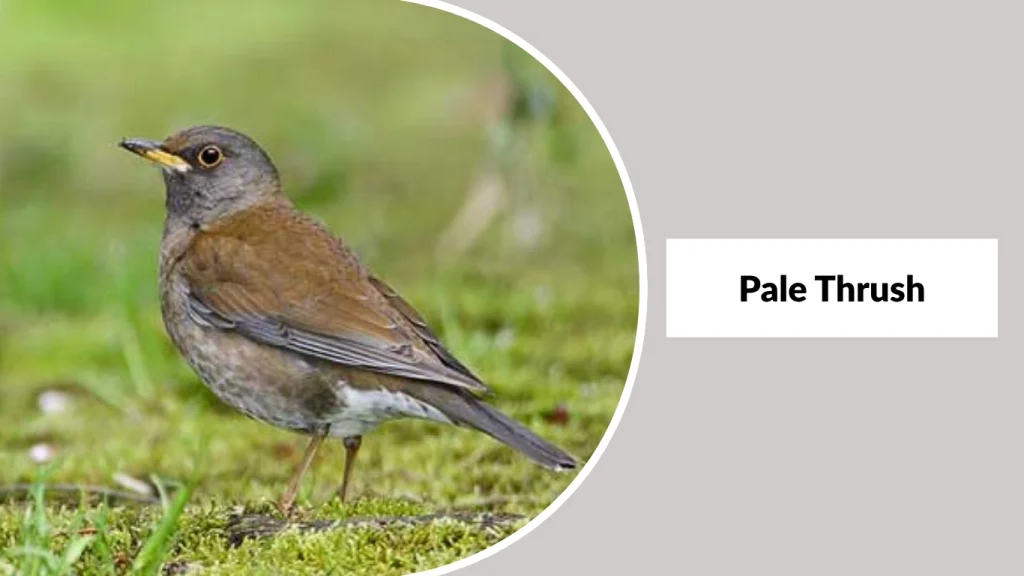
The Pale Thrush is a subtle yet beautiful thrush found in East Asia. Its soft coloration, gentle behavior, and melodic call make it a cherished species in its native range. Although not flashy, its overall smooth appearance and pale tones give it a graceful presence in woodland settings.
Identification
- Coloration: Ashy brown upperparts with lighter buff underparts
- Throat: Whitish with faint streaking
- Supercilium: Pale but less prominent than in similar species
- Bill: Slender, dark brown with yellow at the base
- Size: 8–9 inches (20–23 cm) in length
- Wingspan: About 13 inches (33 cm)
- Weight: 2.5–3 ounces (70–85 grams)
- Legs: Pale brown or gray
- Tail: Medium-length, same tone as back
- Song: Soft, rich warbling with occasional high notes
- Habitat: Deciduous and mixed forests, thickets, urban parks, and gardens
Behavior and Diet
Feeds mainly on the ground or in low bushes, searching for insects, snails, and fruits. They are often shy and stay low in vegetation, making them more frequently heard than seen.
Nesting and Reproduction
Breeding takes place in East Asian forests, particularly in Korea and Japan. Nests are built in trees using plant materials and lined with mud. The female typically lays 3 to 5 pale blue or greenish eggs.
Range and Migration
Breeds in temperate forests of East Asia, including Korea, Japan, and eastern China. Winters farther south in Southeast Asia, Taiwan, and parts of southern China. They are not known for long-distance vagrancy but are common winter residents in lowland forested areas.
18. Naumann’s Thrush

Naumann’s Thrush is a distinctive and beautifully patterned thrush species native to East Asia. Known for its chestnut-colored plumage and crisp markings, it breeds in northeastern Asia and migrates to China and Southeast Asia for the winter. Occasionally, it is spotted as a vagrant in Europe and western Alaska.
Identification
- Coloration: Warm brown upperparts with rufous-red flanks and rump
- Underparts: Pale with streaked chest and dark scaling on the sides
- Supercilium: White, bold, and well-defined
- Face: Strong contrast between cheek and eyebrow area
- Bill: Slim, dark with yellowish lower mandible
- Size: 8.5–9.5 inches (22–24 cm) in length
- Wingspan: 13–15 inches (33–38 cm)
- Weight: Around 2.5–3.5 ounces (70–100 grams)
- Legs: Pinkish or light gray
- Tail: Reddish-brown, slightly fanned when startled
- Song: Short whistles and warbles; more musical in breeding season
- Habitat: Forest edges, riverine woods, and open groves
Behavior and Diet
Naumann’s Thrush forages on the ground and in low shrubs, eating insects, earthworms, and berries. During migration and winter, it often joins mixed flocks and visits orchards and berry-laden trees in rural or suburban areas.
Nesting and Reproduction
Breeding mainly in southeastern Siberia and northern China, this thrush nests in conifers or shrubs. Nests are cup-shaped and made from moss, bark, and grass. The female typically lays 3–5 eggs. Nesting behavior resembles that of other forest thrushes.
Range and Migration
Breeds in northeast Asia, especially southeastern Russia and northeastern China. Migrates to central and southern China, Korea, and northern Southeast Asia in winter. Vagrants have been spotted in Japan, Taiwan, and occasionally Europe.
19. Scaly Thrush (also known as White’s Thrush)
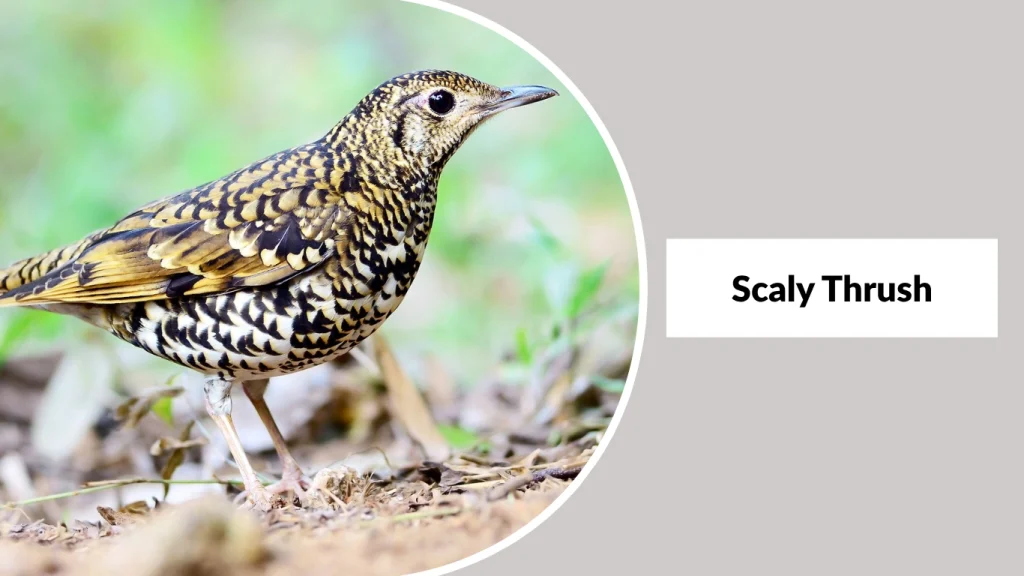
The Scaly Thrush is a secretive and visually stunning thrush found in dense forests of Asia. Its golden-scaled plumage provides excellent camouflage on the forest floor. It’s primarily crepuscular, moving quietly among shadows and fallen leaves.
Identification
- Coloration: Rich golden-brown upperparts with bold black-edged “scales”
- Underparts: Creamy white with heavy black scaling throughout
- Face: Complex pattern with pale eyebrow and mottled cheeks
- Bill: Slender and slightly decurved, dark with yellowish base
- Size: 10–11 inches (26–28 cm) in length
- Wingspan: 16 inches (41 cm) or more
- Weight: 4.5–6 ounces (130–170 grams)
- Legs: Pinkish or pale gray
- Tail: Broad and rounded, matching the scaled back
- Song: Soft whistles, more vocal at dusk and dawn
- Habitat: Moist forests, thick woodlands, ravines, and bamboo groves
Behavior and Diet
This solitary bird feeds by flipping leaves and probing the soil for insects, snails, and worms. It’s usually very quiet, relying on camouflage and stillness rather than flight to avoid detection. It may remain motionless when threatened.
Nesting and Reproduction
Nesting takes place in trees or dense understory, often hidden from view. The nest is constructed with moss, twigs, and mud. Females lay 3–4 eggs, but little is known about chick rearing due to the species’ secretive nature.
Range and Distribution
The Scaly Thrush is widespread across temperate and subtropical Asia—from the Himalayas and China to Southeast Asia and Japan. Northern populations are migratory, while southern and insular populations may be resident. Rare sightings occur in western Alaska and occasionally Europe.
20. Siberian Thrush

The Siberian Thrush is a shy and elusive forest thrush, often called the “shadow bird” due to its preference for dense, dark undergrowth. Males are striking with their dark plumage and white eyebrow, while females are more cryptic. This species breeds in remote Siberian forests and migrates long distances to Southeast Asia.
Identification
- Coloration:
- Male: Dark slate-blue to blackish upperparts with a bold white eyebrow and white underwing coverts
- Female: Brown with subtle streaking and a paler eyebrow
- Male: Dark slate-blue to blackish upperparts with a bold white eyebrow and white underwing coverts
- Underparts: Grayish to dark in males, buff with mottling in females
- Size: 8–9 inches (20–23 cm) in length
- Wingspan: About 13 inches (33 cm)
- Weight: 2.5–3.2 ounces (70–90 grams)
- Bill: Slim and dark
- Legs: Pinkish-gray
- Tail: Medium length, often flicked downward when alarmed
- Song: A quiet, whistled warble with some mimicry; males sing from high perches during breeding
- Habitat: Dense, damp coniferous or mixed forests with heavy underbrush
Behavior and Diet
Siberian Thrushes forage discreetly on the forest floor, flipping leaf litter to uncover insects, spiders, and worms. They also consume berries during migration. Males may sing from hidden perches during dawn and dusk.
Nesting and Reproduction
This thrush nests low in bushes or on the ground in well-concealed locations. The cup-shaped nest is made of twigs, moss, and grass. Females lay 3 to 5 pale green or bluish eggs. The breeding behavior remains poorly studied due to their remote habitat.
Range and Migration
They breed across Siberia and the Russian Far East, then migrate through eastern China and Southeast Asia to wintering grounds in Myanmar, Thailand, and Indonesia. Occasionally, vagrants are reported in Japan and, rarely, Europe or Alaska.
21. Clay-colored Thrush

The Clay-colored Thrush is a common and widely recognized bird across Central America. As Costa Rica’s national bird, it is celebrated for its rich, melodious voice and unassuming appearance. It thrives in both wild and urban environments, adapting well to human presence.
Identification
- Coloration: Uniform clay-brown or olive-brown throughout body
- Underparts: Slightly lighter, grayish or buffy
- Bill: Yellowish or dull horn-colored
- Eye Ring: Narrow, pale or yellowish
- Size: 8–9.5 inches (21–24 cm) in length
- Wingspan: 13–14 inches (33–36 cm)
- Weight: About 2.5–3.5 ounces (70–100 grams)
- Legs: Pale pinkish or gray
- Tail: Medium-length, same tone as back
- Song: Loud, beautiful fluting phrases sung year-round, especially at dawn
- Habitat: Forest edges, plantations, parks, gardens, and towns
Behavior and Diet
Clay-colored Thrushes forage both on the ground and in trees. They eat insects, snails, and a wide range of fruits and berries. Bold and curious, they are often seen hopping across lawns or calling from rooftops and telephone wires.
Nesting and Reproduction
Their nest is a mud-lined cup placed in trees, shrubs, or on man-made structures. The female lays 2 to 3 pale blue eggs, sometimes with light speckling. Both parents care for the chicks, and multiple broods may be raised each year.
Range and Human Interaction
Found from Mexico to northern Colombia, this thrush is very common in Costa Rica, Panama, and Nicaragua. It is often associated with rural and suburban homes, where it is known for its early-morning serenades and tameness around people.
22. Rufous-backed Robin
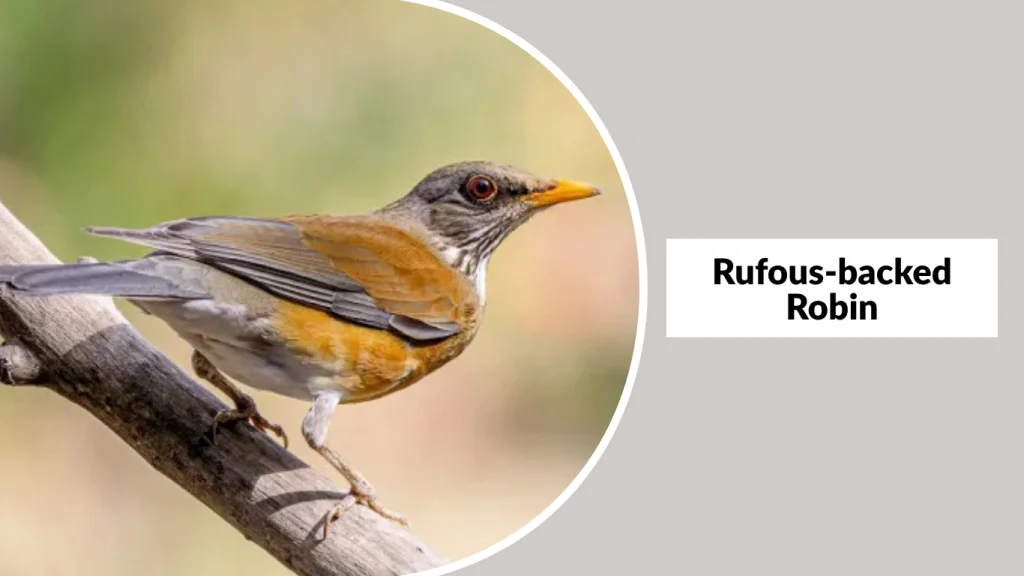
The Rufous-backed Robin is a colorful and active thrush native to western Mexico and Central America. Known for its bold rufous coloration and musical calls, it frequents forest edges, gardens, and dry woodlands. Occasionally, it is spotted as a rare vagrant in the southwestern United States, particularly in Arizona and Texas.
Identification
- Coloration: Gray head and upper chest with a rich rufous (reddish-orange) back and wings
- Underparts: Whitish belly and undertail
- Eye Ring: Pale yellow or cream, fairly prominent
- Bill: Bright yellow with a slightly curved shape
- Size: 8–9 inches (20–23 cm) in length
- Wingspan: 12–13 inches (30–33 cm)
- Weight: Around 2.5–3.2 ounces (70–90 grams)
- Legs: Pale gray or pinkish
- Tail: Long, dark with reddish highlights
- Song: A liquid, rolling melody with musical whistles, similar to the American Robin but slightly rougher
- Habitat: Thorn forests, dry tropical woodlands, orchards, and urban gardens
Behavior and Diet
This robin forages mainly on the ground, feeding on insects, earthworms, and fruit. In urban areas, it may visit feeders or forage on lawns and patios. It is bolder than many other thrushes and often seen in pairs or small groups.
Nesting and Reproduction
Nests are typically built in trees, shrubs, or vines and made from twigs, grass, and mud. The female lays 2 to 4 pale blue eggs, which may be speckled. Breeding occurs during the dry season, with both parents contributing to chick care.
Range and Sightings
Native to Mexico and Central America, the Rufous-backed Robin’s range has been gradually expanding northward. It is a regular resident in western Mexico and increasingly found near the U.S. border. Rare vagrant records exist from southern Arizona and Texas, particularly in winter.
23. Island Thrush
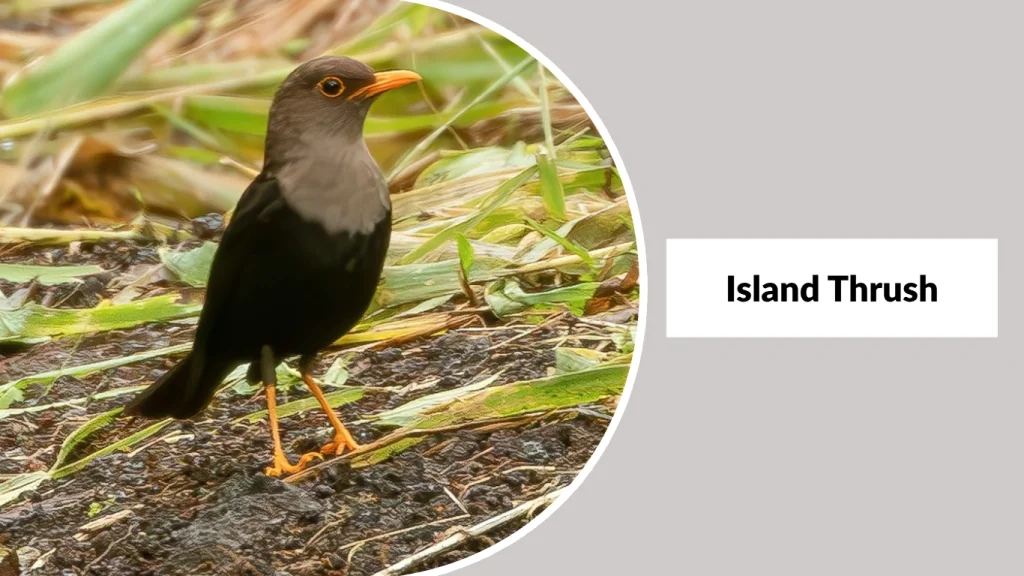
The Island Thrush is one of the most widespread and variable thrush species in the world, with dozens of subspecies found on islands throughout Southeast Asia and the western Pacific. Plumage varies greatly between populations, ranging from deep black to gray or even pale brown forms.
Identification
- Coloration: Highly variable; can be black, slate-gray, olive-brown, or pale, often with contrasting underparts
- Underparts: May be white, buff, or dark depending on subspecies
- Eye Ring: Usually pale and well-defined
- Bill: Yellowish or horn-colored, slim
- Size: 8–9 inches (21–23 cm) in length
- Wingspan: Around 12–13 inches (30–33 cm)
- Weight: 2.8–3.5 ounces (80–100 grams)
- Legs: Pale yellow, pinkish, or gray
- Tail: Medium-length, rounded
- Song: Variable by location; typically a sweet, whistled melody
- Habitat: Montane forests, scrublands, gardens, and edge habitats
Behavior and Diet
Island Thrushes feed on the forest floor, eating insects, grubs, snails, and fruit. They are generally tame and curious, especially on islands where predators are scarce. Some island forms live at high elevations and are adapted to montane climates.
Nesting and Reproduction
They nest in shrubs or low trees, using moss, leaves, and twigs to form a deep cup. The female lays 2 to 3 eggs. Due to the wide range and number of subspecies, nesting timing and behavior can vary by island.
Range and Subspecies
The Island Thrush ranges from the Himalayas to the Philippines, Indonesia, New Guinea, and across numerous Pacific islands including the Solomons and Samoa. Subspecies differ so much that many are candidates for future species splits. It is one of the most geographically diverse bird species globally.
24. Black-throated Thrush
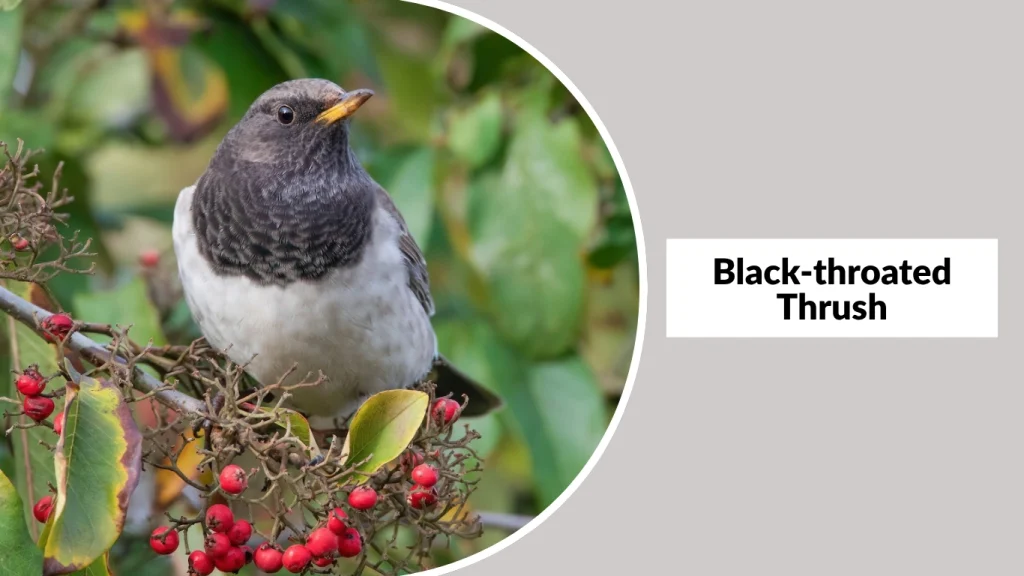
The Black-throated Thrush is a striking migratory thrush native to Central Asia, admired for its clean markings and elegant appearance. Males are especially distinctive with their black throats and pale bodies. Though primarily an Asian species, it is a rare winter visitor to parts of Europe and the Middle East, and vagrants have been recorded in western Alaska.
Identification
- Coloration:
- Male: Ash-gray upperparts with a bold black throat, upper breast, and face
- Female: Similar shape but with gray-brown tones and a less distinct dark throat
- Male: Ash-gray upperparts with a bold black throat, upper breast, and face
- Underparts: White to light gray, clean and unmarked in males
- Eye Ring: Pale and narrow
- Bill: Yellowish with a dark tip
- Size: 9–10 inches (23–25 cm) in length
- Wingspan: 14–15 inches (35–38 cm)
- Weight: 3–4 ounces (85–110 grams)
- Legs: Pale pink or gray
- Tail: Long and dark with a squared end
- Song: A low, mellow warble with chirps and short fluted notes
- Habitat: Forest edges, riverine groves, parks, and open woodland
Behavior and Diet
Black-throated Thrushes feed both in trees and on the ground. Their diet includes insects, earthworms, and a variety of berries such as elderberry and hawthorn. In winter, they often forage in orchards and berry thickets.
Nesting and Reproduction
They breed in southern Siberia and Central Asia. Nests are built in small trees or shrubs and constructed from grass, twigs, and moss. Females lay 3 to 5 blue or greenish eggs. Both parents assist in feeding the chicks.
Range and Migration
Breeding across the steppe and southern taiga zones of Siberia, they migrate south to northern India, the Middle East, and occasionally southeastern Europe during winter. Rare vagrants have been recorded as far west as the United Kingdom and as far east as Alaska.
25. African Thrush

The African Thrush is a widespread and adaptable songbird found across sub-Saharan Africa. It resembles the Eurasian Blackbird in shape but is lighter and has more spotting. This thrush is common in both wild and urban environments, often singing from rooftops, trees, or garden walls at dawn and dusk.
Identification
- Coloration: Gray-brown upperparts with a warmer orange wash on the breast and flanks
- Underparts: Light buff with faint brown spots on the upper breast
- Bill: Yellow-orange, often with a dark culmen
- Eye Ring: Narrow, yellow
- Size: 8–9 inches (20–23 cm) in length
- Wingspan: 12–14 inches (30–35 cm)
- Weight: 2.8–3.5 ounces (80–100 grams)
- Legs: Yellow to pinkish
- Tail: Medium-length, brownish-gray
- Song: Sweet, fluting whistles delivered from perches, often repeated in short sequences
- Habitat: Forest edges, savannah, gardens, plantations, and towns
Behavior and Diet
African Thrushes forage in leaf litter and lawns for insects, snails, and fruit. They are often confident around people and can be seen hopping through gardens or calling from fences. Their melodious song is often one of the first heard at sunrise.
Nesting and Reproduction
The nest is a deep cup made of twigs, leaves, and mud, usually placed in trees, vines, or even man-made structures. The female lays 2 to 3 speckled pale blue eggs. Both parents feed the young, and multiple broods are common.
Range and Distribution
This species is widespread from Senegal and Ethiopia to South Africa. It is found in a wide range of habitats, from lowland forests to upland scrub, and is well adapted to human-altered environments. Its broad range and adaptability make it one of Africa’s most successful thrushes.