



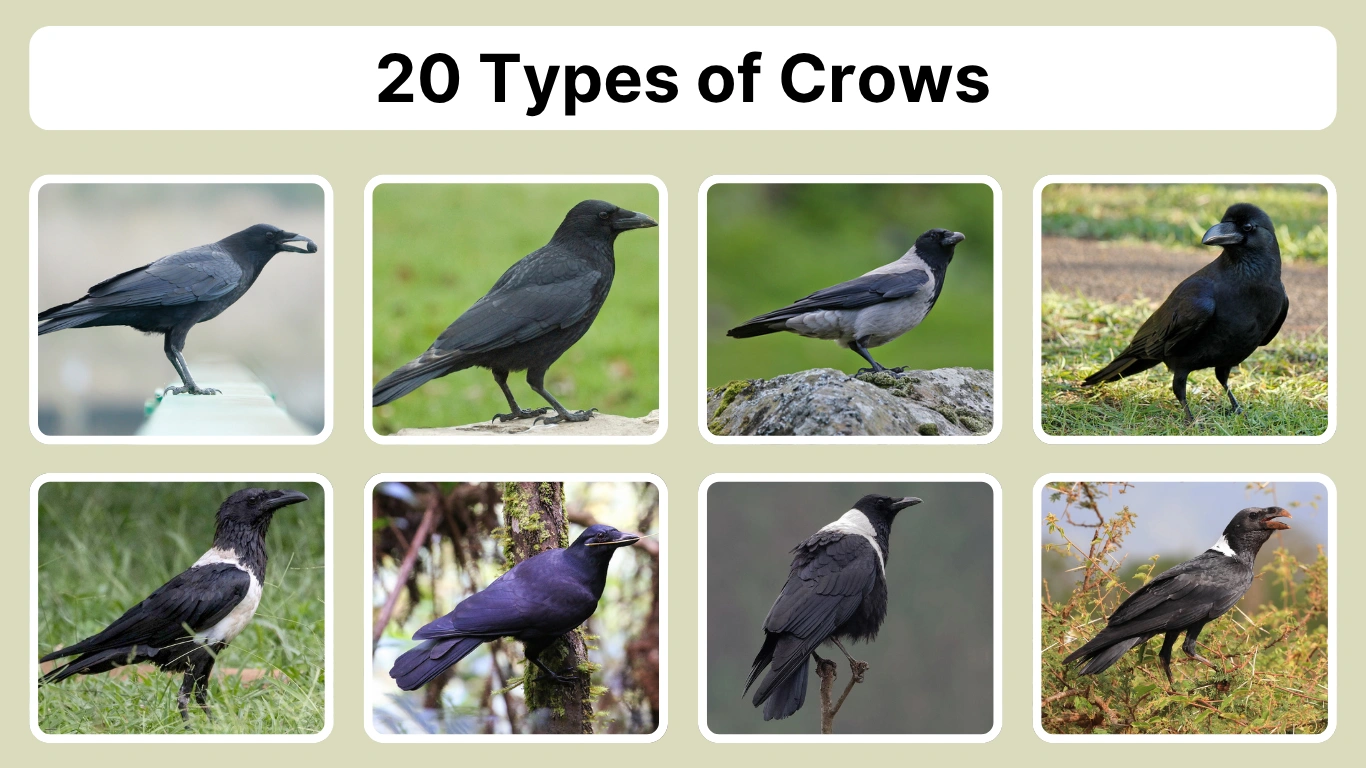
Crows are among the most intelligent and adaptable birds on Earth. Found across nearly every continent, these birds belong to the genus Corvus and display a remarkable variety in size, plumage, behavior, and vocalizations. From the familiar American Crow of North America to the tool-using New Caledonian Crow of the South Pacific, each species has evolved to thrive in its unique environment.
In this guide, we’ll explore 20 fascinating types of crows from around the world. For each crow, we’ll include a short overview, detailed identification traits, behavior, diet, nesting habits, and the regions where they live. Whether you’re a bird enthusiast, a wildlife researcher, or just curious about the diversity of crows, this resource offers an in-depth look into their remarkable world.
1. American Crow

The American Crow is one of the most widespread and intelligent bird species in North America. Recognized for its glossy black feathers and loud cawing calls, it thrives in a variety of environments—from rural farmlands to bustling cities. These birds are social, adaptable, and known for their problem-solving skills and complex communication.
Identification
- Color: Entirely black, including feathers, legs, and beak
- Size: About 17–21 inches (43–53 cm) in length
- Wingspan: Ranges from 33 to 39 inches (84–99 cm)
- Weight: Approximately 11 to 21 ounces (300–600 grams)
- Bill: Thick, strong, and slightly curved
- Eyes: Dark brown to black
- Voice: Loud and repetitive “caw-caw”
- Habitat: Woodlands, agricultural fields, urban parks, and suburban areas
Behavior and Diet
American Crows are omnivorous and opportunistic feeders. Their diet includes insects, small animals, fruits, seeds, carrion, and human garbage. They are known to use tools and work together in family groups for protection and food gathering.
Nesting and Reproduction
They build nests high in trees using twigs, bark, and grass. Both sexes help construct the nest. The female lays 3–9 eggs and incubates them while the male brings food. Juveniles often stay with the family to help raise subsequent broods.
Range and Distribution
Found across most of the United States, southern Canada, and parts of northern Mexico. They are year-round residents and adapt well to different ecosystems, including urban environments.
2. Carrion Crow

The Carrion Crow is a solitary and highly intelligent species commonly found across much of Europe and parts of Asia. With its deep black plumage and scavenging habits, it’s often mistaken for similar-looking crows but is distinct in behavior and voice. Unlike its more social relatives, the Carrion Crow is often seen alone or in pairs and plays an important role in cleaning up carrion and waste in natural and urban settings.
Identification
- Color: Uniform glossy black feathers across body, legs, and beak
- Size: 17–19 inches (44–50 cm) in length
- Wingspan: Approximately 33–39 inches (84–100 cm)
- Weight: Around 16–22 ounces (450–620 grams)
- Bill: Thick, black, and slightly curved with a blunt tip
- Eyes: Dark brown
- Voice: Deep, throaty “kraah” sound, lower-pitched than other crow species
- Habitat: Open countryside, farmlands, woodlands, cities, and coastal areas
Behavior and Diet
Carrion Crows are highly adaptable and feed on a wide range of food sources. Their diet includes carrion, insects, grains, fruits, small mammals, and food waste. They often scavenge roadkill and are known to cache food for later consumption. While generally solitary, they may join communal roosts during winter.
Nesting and Reproduction
Breeding pairs are monogamous and often return to the same nesting area year after year. Nests are built high in trees or on tall structures using sticks and lined with softer materials. The female lays 3–6 eggs and incubates them for about 18–20 days, with the male assisting by feeding her.
Range and Distribution
The Carrion Crow is native to western and central Europe, parts of Scandinavia, and eastern Asia. In Britain and parts of Europe, it is often found in areas where its close relative, the Hooded Crow, does not occur. It has adapted well to agricultural and urban landscapes.
3. Hooded Crow

The Hooded Crow is closely related to the Carrion Crow but is visually distinct due to its contrasting gray and black plumage. Found mainly in northern, eastern, and southeastern Europe and parts of the Middle East, this species is highly adaptable and intelligent. It is culturally significant in many regions and thrives in both rural and urban environments.
Identification
- Color: Pale gray body with black head, wings, tail, and bib
- Size: 17–19 inches (44–50 cm) in length
- Wingspan: Around 35–39 inches (88–100 cm)
- Weight: Typically 16–22 ounces (450–620 grams)
- Bill: Strong, black, and slightly arched
- Eyes: Dark brown to black
- Voice: Harsh, guttural “kraa-kraa” calls
- Habitat: Coastal cliffs, farmlands, cities, parks, and river valleys
Behavior and Diet
Hooded Crows are omnivorous and feed on carrion, insects, seeds, human scraps, and small animals. They are known for their intelligence and problem-solving skills. In some areas, they are observed using tools or dropping nuts on roads for vehicles to crack.
Nesting and Reproduction
They typically nest in trees, cliffs, or on tall buildings. Nests are built with twigs and lined with fur, feathers, or other soft material. Females lay 3–6 eggs and incubate them for about 18–20 days. Both parents feed the chicks after hatching.
Range and Distribution
Hooded Crows are found across northern and eastern Europe, from Scandinavia to Turkey, and as far east as Iran. In some areas like the British Isles, they interbreed with Carrion Crows where their ranges overlap. They are permanent residents in most of their range and well-adapted to human-altered landscapes.
4. House Crow

The House Crow is a highly social and intelligent bird native to the Indian subcontinent but has spread to various parts of the world due to human activity. Known for its adaptability to urban environments, it thrives in towns and cities, often relying heavily on food waste and human settlements. Its distinct grey neck and relentless cawing make it easily recognizable in its range.
Identification
- Color: Glossy black on the head, wings, and tail; pale gray to whitish on the neck and breast
- Size: 15–17 inches (38–44 cm) in length
- Wingspan: About 32–36 inches (80–92 cm)
- Weight: 7–10 ounces (200–280 grams)
- Bill: Slim, slightly curved, and all black
- Eyes: Deep brown
- Voice: Loud and repetitive “ka-ka-ka” calls
- Habitat: Urban areas, markets, ports, towns, villages, and occasionally forests
Behavior and Diet
House Crows are omnivorous and opportunistic scavengers. They consume garbage, human leftovers, insects, small reptiles, and bird eggs. Their ability to adapt quickly to new environments has made them successful invaders in several regions, often outcompeting native birds.
Nesting and Reproduction
They build nests in dense trees or on man-made structures using sticks and soft lining materials. House Crows nest in colonies and are known to be aggressive in defending their nesting area. A typical clutch consists of 3–5 eggs, and both parents share incubation and feeding duties.
Range and Distribution
Originally from South Asia, House Crows have spread to parts of the Middle East, eastern Africa, Southeast Asia, and even Australia through ships and human transport. In many countries, they are considered invasive due to their negative impact on native wildlife and agriculture.
5. Jungle Crow

The Jungle Crow, also known as the Large-billed Crow, is a robust and noisy species found across much of Asia. It thrives in a wide variety of habitats, including forests, mountains, farmlands, and urban areas. With its deep croaking call and imposing size, this crow is both resourceful and dominant in its environment.
Identification
- Color: Entirely glossy black, including bill, legs, and feathers
- Size: 19–23 inches (48–59 cm) in length
- Wingspan: Up to 39 inches (99 cm)
- Weight: 14–22 ounces (400–620 grams)
- Bill: Large, thick, and arched with a powerful look
- Eyes: Dark brown
- Voice: Harsh croaks and deep caws, very loud
- Habitat: Forests, hillsides, coastal zones, farmland, cities, and suburbs
Behavior and Diet
Jungle Crows are omnivorous and will eat nearly anything, including carrion, insects, small animals, grains, fruits, and kitchen scraps. They are intelligent and often observe and imitate behaviors to access food. Their larger size allows them to dominate over smaller crow species.
Nesting and Reproduction
They build nests in tall trees, cliffs, or on man-made structures using twigs and lining them with softer materials. Females lay 3–5 eggs per season, and both parents participate in incubation and chick-rearing.
Range and Distribution
Widely distributed across the Indian subcontinent, Southeast Asia, southern China, and parts of Japan. It’s a highly adaptable species that often coexists with humans in both rural and urban settings. Its broad range and flexible diet contribute to its success across diverse ecosystems.
6. Large-billed Crow
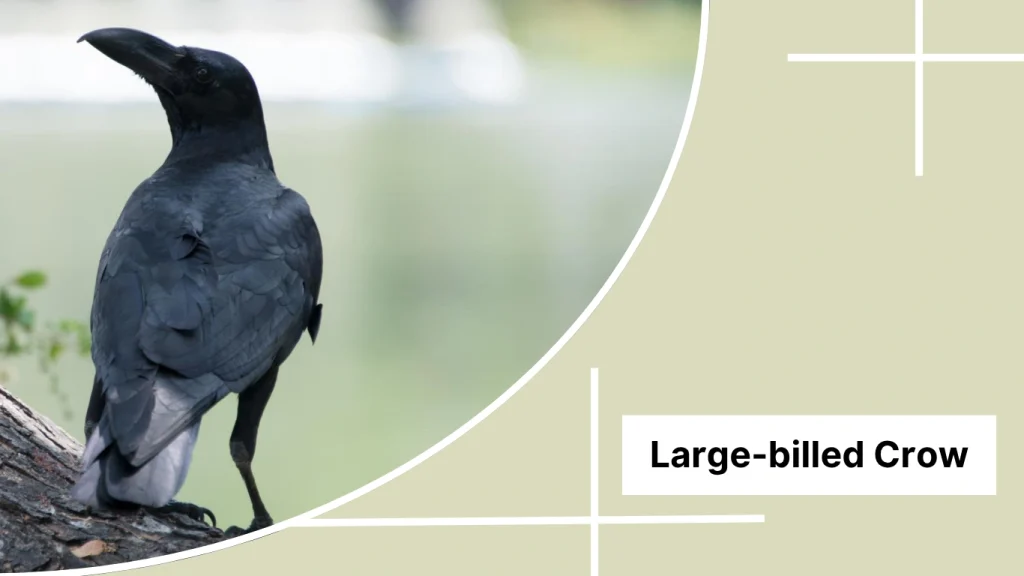
The Large-billed Crow, often considered a subspecies of the Jungle Crow in some regions, is a striking bird with a hefty bill and a strong presence. Found across East and Southeast Asia, this crow is adaptable, clever, and often thrives near human populations. It’s known for its deep, hoarse call and dominant behavior over smaller birds.
Identification
- Color: Entirely black with a greenish or bluish gloss in sunlight
- Size: 19–23 inches (48–59 cm) in length
- Wingspan: Up to 40 inches (100 cm)
- Weight: 15–22 ounces (430–620 grams)
- Bill: Very thick and long, with a noticeable arch; jet black
- Eyes: Dark brown to black
- Voice: Deep “garr-garr” or guttural “kraaa” sounds
- Habitat: Forests, rural farmlands, towns, garbage dumps, urban areas
Behavior and Diet
Large-billed Crows are assertive omnivores. They consume carrion, insects, fruits, seeds, eggs, small mammals, and a wide range of human food waste. Known for their curiosity and memory, they are capable of recognizing individuals and solving basic problems to obtain food.
Nesting and Reproduction
Their nests are bulky and built high in trees or occasionally on buildings. They use strong sticks and line the interior with grass, plastic, or cloth. The female typically lays 3–5 eggs, and both parents participate in raising the chicks.
Range and Distribution
Found throughout Japan, Korea, China, parts of India, and Southeast Asia. The species is very common in city parks and mountainous forests. It is one of the most dominant and visible crow species in its native range.
7. Northwestern Crow

The Northwestern Crow is a coastal bird native to the Pacific Northwest, particularly along the coasts of Alaska and British Columbia. It looks nearly identical to the American Crow but is slightly smaller and has subtle differences in voice and behavior. It is often found in intertidal zones, scavenging on marine life and human food.
Identification
- Color: Uniform black with a slight purple or green sheen
- Size: 15–17 inches (38–43 cm) in length
- Wingspan: 32–36 inches (81–91 cm)
- Weight: Around 12–16 ounces (340–450 grams)
- Bill: Slightly shorter and narrower than American Crow
- Eyes: Black
- Voice: More nasal and hoarse compared to American Crow
- Habitat: Coastal beaches, tidepools, harbors, towns, and coniferous forests
Behavior and Diet
This crow is a forager and scavenger. It feeds on shellfish, crabs, sea urchins, fish, carrion, insects, grains, and human garbage. It often drops shellfish from heights to crack them open. Northwestern Crows are social and often forage in small groups.
Nesting and Reproduction
Nesting occurs in trees or shrubs, often near the coast. The nest is made of twigs, lined with grass or fur. The female lays 3–6 eggs, and incubation is carried out mainly by the female while the male provides food.
Range and Distribution
Found along the Pacific Coast from southern Alaska down to Washington State. There is significant overlap with the American Crow, and interbreeding occurs in some regions. Recent genetic studies have led some ornithologists to classify it as a subspecies of the American Crow.
8. Fish Crow
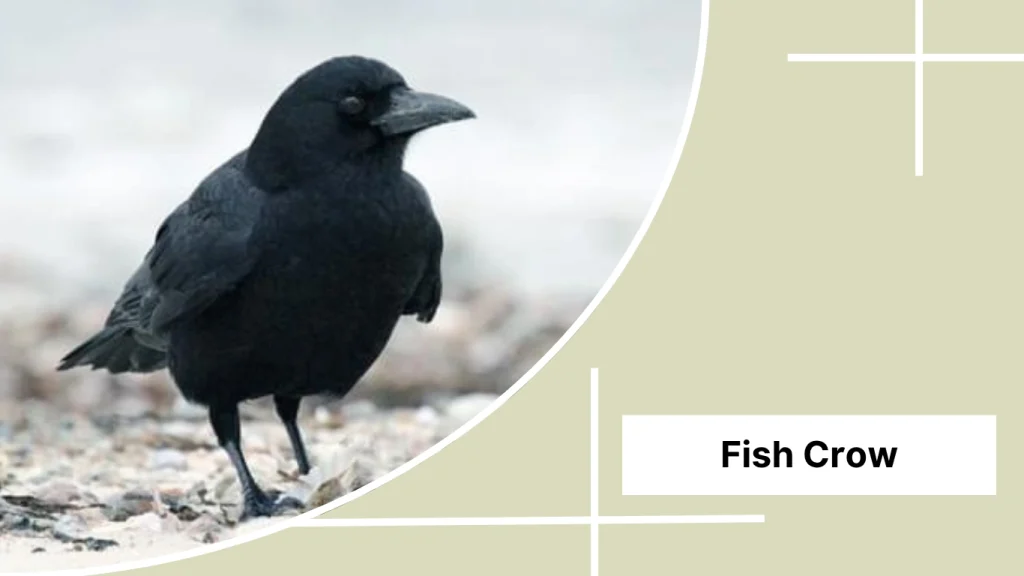
The Fish Crow is a smaller, sleeker cousin of the American Crow and is found mainly in the southeastern United States near coastlines, wetlands, and rivers. It’s easily distinguished by its nasal call and affinity for aquatic environments. Though similar in appearance to the American Crow, it is a separate species with unique habits.
Identification
- Color: All black with a subtle greenish gloss
- Size: 14–16 inches (36–41 cm) in length
- Wingspan: 32–34 inches (81–86 cm)
- Weight: 8–12 ounces (230–340 grams)
- Bill: Slimmer than American Crow
- Eyes: Dark brown to black
- Voice: Distinctive nasal “uh-uh” or “cah-ah”
- Habitat: Marshes, estuaries, beaches, riverbanks, urban coastal areas
Behavior and Diet
Fish Crows feed on crustaceans, fish, carrion, insects, bird eggs, seeds, and garbage. They are clever and resourceful, often seen in flocks scavenging around harbors or foraging in wetlands. They have been observed stealing food from other birds.
Nesting and Reproduction
They build nests in trees, especially near water. The nests are made from twigs and lined with softer materials. Fish Crows are early breeders, and females lay 3–6 eggs per clutch. Both parents tend to the young.
Range and Distribution
Found along the Atlantic and Gulf coasts of the United States, from New York to Florida and into Texas. The range is slowly expanding inland. Often found in mixed flocks with American Crows during non-breeding seasons.
9. Pied Crow

The Pied Crow is a striking, medium-sized crow native to Sub-Saharan Africa and parts of the Arabian Peninsula. It’s easily recognizable due to its contrasting black and white plumage and is one of the most commonly seen crows across African towns, villages, and open landscapes. This highly intelligent bird thrives in both natural and human-altered environments.
Identification
- Color: Black body, head, wings, and tail with a bright white collar across the chest and nape
- Size: 18–20 inches (46–50 cm) in length
- Wingspan: 33–39 inches (84–99 cm)
- Weight: 15–20 ounces (420–570 grams)
- Bill: Stout, black, and slightly curved
- Eyes: Dark brown
- Voice: Harsh, nasal cawing; deep “arrr” and “korrr” notes
- Habitat: Open woodlands, grasslands, coastal towns, garbage dumps, rooftops, and urban centers
Behavior and Diet
Pied Crows are opportunistic feeders. Their diet includes insects, reptiles, carrion, small mammals, bird eggs, fruits, seeds, and kitchen waste. They often follow roadsides and scavenge near human settlements. They are also known to engage in mobbing behavior against predators like eagles and owls.
Nesting and Reproduction
They construct large nests in trees, utility poles, or cliffs using sticks, wire, and twine, lined with grass or rags. The female lays 3–6 eggs, and both parents incubate and raise the chicks. They are known to fiercely defend their nesting sites.
Range and Distribution
Widespread across Africa south of the Sahara and found in some parts of the Middle East. Their adaptability to varied climates and their scavenging habits allow them to live in cities, farmlands, and even semi-desert areas.
10. Little Crow

The Little Crow is a smaller and more slender species found primarily in inland Australia. While it resembles the Torresian Crow, it can be distinguished by its higher-pitched call and smaller size. These crows often form large flocks and are well adapted to dry, open habitats.
Identification
- Color: Glossy black throughout, sometimes with a faint green or blue sheen
- Size: 15–17 inches (38–43 cm) in length
- Wingspan: Around 30–34 inches (76–86 cm)
- Weight: 10–14 ounces (280–400 grams)
- Bill: Small and neatly curved
- Eyes: White or pale bluish-white (a distinctive feature in adults)
- Voice: Higher-pitched, short “ark-ark” or “ah-ah” calls
- Habitat: Semi-arid scrublands, farmlands, grasslands, and occasionally towns
Behavior and Diet
Little Crows forage mainly on the ground and feed on insects, seeds, grains, carrion, and food scraps. They are commonly seen in large flocks, especially around agricultural areas, and may travel long distances in search of food and water.
Nesting and Reproduction
They typically build nests in tall eucalyptus trees using twigs and soft plant materials. The nest is compact and lined with wool or feathers. A clutch usually consists of 3–5 eggs. Both parents help in incubation and chick-rearing.
Range and Distribution
Endemic to inland and central Australia, especially in dry open country. They tend to avoid dense forests and coastal regions. Their numbers often increase in areas with intensive farming due to the availability of grain and water sources.
11. Torresian Crow

The Torresian Crow, also known as the Australian Crow, is a large, intelligent, and highly adaptable species native to northern and eastern Australia. It is often mistaken for other Australian crows and ravens but is distinguishable by its distinct vocalizations and white irises in adults. These crows are commonly found in both urban and rural environments.
Identification
- Color: Uniform glossy black with a bluish sheen
- Size: 18–20 inches (46–51 cm) in length
- Wingspan: Approximately 35–40 inches (90–102 cm)
- Weight: 16–22 ounces (450–620 grams)
- Bill: Large, deep, and slightly arched
- Eyes: Pale bluish-white in adults, dark in juveniles
- Voice: Harsh and varied; commonly a drawn-out “aaah-aah-aah”
- Habitat: Cities, farmlands, coastal regions, open forests, and bushlands
Behavior and Diet
Torresian Crows are omnivorous and opportunistic feeders. They eat a wide range of foods including insects, grains, fruits, carrion, small animals, and human refuse. In urban areas, they are known to scavenge from trash bins and outdoor eating areas. They often forage in flocks and are extremely wary and intelligent.
Nesting and Reproduction
They build nests in tall trees using sticks and line them with feathers, fur, or other soft materials. A typical clutch contains 3–5 pale greenish-blue eggs with brown markings. Both parents share incubation and chick-rearing duties.
Range and Distribution
Found throughout northern and eastern Australia, from Queensland to New South Wales, and in parts of Western Australia. They are also present in Papua New Guinea. This species is especially common in coastal cities and agricultural zones.
12. New Caledonian Crow

The New Caledonian Crow is world-renowned for its remarkable intelligence and use of tools. Native to the island of New Caledonia in the South Pacific, this species has become the focus of scientific research due to its advanced problem-solving abilities and ability to craft tools from natural materials.
Identification
- Color: Uniform black with slight gloss
- Size: 16–18 inches (40–45 cm) in length
- Wingspan: 30–35 inches (76–89 cm)
- Weight: 10–15 ounces (280–430 grams)
- Bill: Slender and slightly curved, ideal for manipulating objects
- Eyes: Dark brown
- Voice: Quiet, varied vocalizations and soft calls
- Habitat: Tropical forests, woodland edges, coconut groves, and rural gardens
Behavior and Diet
This crow is an expert forager and tool user. It crafts hooks and leaf stems to extract insects and grubs from tree bark and crevices. Their diet also includes small vertebrates, fruits, and seeds. They are often seen individually or in small family groups.
Nesting and Reproduction
Little is known about their breeding habits in the wild due to their elusive behavior, but nests are typically built high in trees. Pairs are monogamous and raise their young cooperatively. Their young stay with the parents longer than many other crow species, possibly to learn tool use.
Range and Distribution
Endemic to New Caledonia and nearby islands. They prefer native forests and areas with dense vegetation. Their restricted range makes them vulnerable to habitat loss, though they are currently listed as Least Concern due to stable populations.
13. Slender-billed Crow

The Slender-billed Crow is a sleek, forest-dwelling species native to parts of Southeast Asia and the Indonesian archipelago. True to its name, this crow is recognized for its long, narrow bill and lean appearance. It is typically found in humid tropical forests, where it is more elusive than its urban counterparts.
Identification
- Color: Uniform glossy black across body, legs, and bill
- Size: 16–18 inches (40–46 cm) in length
- Wingspan: Around 32–36 inches (81–91 cm)
- Weight: Approximately 10–15 ounces (280–430 grams)
- Bill: Long, narrow, slightly curved—adapted for forest foraging
- Eyes: Dark brown to black
- Voice: Harsh, rasping calls with some variation in pitch
- Habitat: Tropical and subtropical forests, lowland jungles, and dense inland woodlands
Behavior and Diet
Slender-billed Crows are highly adaptable forest scavengers and foragers. They feed on insects, small reptiles, fruits, seeds, carrion, and eggs. They are often seen in small groups or pairs, flying through the canopy or gliding between trees. These birds are cautious and shy around humans.
Nesting and Reproduction
Nesting behavior is not well-documented, but they are presumed to build typical crow nests of twigs and vegetation, often placed high in the forest canopy. Like most crow species, both parents are involved in raising the young.
Range and Distribution
Found in the Philippines, Indonesia (including Sulawesi and Borneo), and parts of Malaysia. Because of their forest-dependent nature, habitat destruction poses a risk to their population in some regions.
14. Cape Crow

The Cape Crow, also known as the Black Crow, is a long-legged, elegant crow native to southern Africa. Unlike other crows, it has a slightly longer neck and bill, which gives it a more upright posture. This species is commonly found in open grasslands and savannas, often walking or running rather than hopping.
Identification
- Color: Entirely black with a purplish or greenish sheen in sunlight
- Size: 18–20 inches (46–51 cm) in length
- Wingspan: Up to 40 inches (102 cm)
- Weight: 16–23 ounces (460–650 grams)
- Bill: Long, narrow, and slightly down-curved
- Legs: Longer than average for a crow, giving it a unique silhouette
- Eyes: Dark brown to black
- Voice: Deep croaking or grating “graak-graak” and gurgling calls
- Habitat: Grasslands, farmlands, open bush, and near wetlands
Behavior and Diet
Cape Crows forage mainly on the ground, feeding on insects, seeds, small mammals, lizards, amphibians, and carrion. They also probe the soil with their long bills, searching for insects and grubs. They are social and sometimes forage in family groups or small flocks.
Nesting and Reproduction
Nests are typically built in trees using sticks, roots, and plant matter. The female lays 3–5 eggs and performs most of the incubation, while the male provides food. Both parents care for the chicks after hatching.
Range and Distribution
Found throughout southern and eastern Africa, including South Africa, Namibia, Botswana, Zimbabwe, and parts of East Africa. Their preference for open habitats distinguishes them from more forest-oriented crow species.
15. Collared Crow

The Collared Crow is a distinctive and regionally confined species found primarily in China and parts of northern Southeast Asia. Its bold black-and-white plumage and preference for open countryside make it easily distinguishable from other Asian crows. Though once more common, its numbers have declined in recent years, making it a species of concern.
Identification
- Color: Black head, wings, tail, and upper chest with a clear white “collar” around the neck and white belly
- Size: 19–20 inches (48–51 cm) in length
- Wingspan: About 36–39 inches (91–99 cm)
- Weight: Approximately 16–22 ounces (450–620 grams)
- Bill: Large, strong, and slightly arched
- Eyes: Dark brown to black
- Voice: Deep, hoarse “krak-krak” calls
- Habitat: Rice paddies, agricultural fields, rural villages, and river valleys
Behavior and Diet
Collared Crows forage in open fields, usually in pairs or small groups. Their diet consists of insects, grains, fish, amphibians, and refuse. They are often seen following plows or exploring wetlands for food. Less aggressive than some crows, they are shy around human activity.
Nesting and Reproduction
They build large nests in tall trees or on utility poles using sticks, lined with finer plant material. A clutch typically contains 3–5 eggs. Breeding behavior resembles that of other Corvus species, with strong pair bonds and shared parental duties.
Range and Distribution
Once widespread across central and eastern China, the Collared Crow is now mainly found in the southern and central provinces, with small populations in Vietnam. It is considered Near Threatened due to habitat loss, pesticide use, and changes in land use practices.
16. Brown-headed Crow
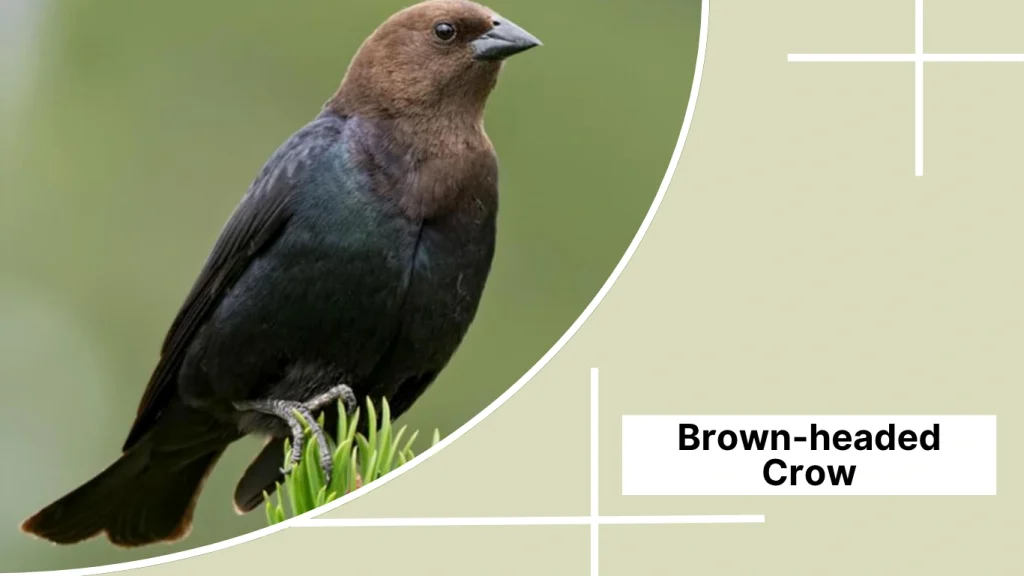
The Brown-headed Crow is a rare and little-studied species endemic to Indonesia, particularly the islands of Sulawesi and its offshore neighbors. Its distinctive coloration and limited range make it a unique member of the crow family and of great interest to conservationists.
Identification
- Color: Chocolate-brown head and neck contrasting with black body, wings, and tail
- Size: 17–18 inches (43–46 cm) in length
- Wingspan: Approximately 33–36 inches (84–91 cm)
- Weight: Estimated at 14–18 ounces (400–510 grams)
- Bill: Stout and black with a slight curve
- Eyes: Dark brown
- Voice: Low, croaking or rasping calls, not well documented
- Habitat: Lowland and coastal forests, swamp forests, and mangroves
Behavior and Diet
Not much is known about this crow’s behavior, but it is presumed to feed on fruits, insects, and small vertebrates. It is typically seen alone or in pairs, foraging in dense tropical vegetation. The species is believed to be shy and difficult to observe in the wild.
Nesting and Reproduction
Breeding behavior is largely undocumented, but it is expected to follow the typical crow pattern of tree nesting and biparental care. Due to its secretive nature, nest sightings are rare.
Range and Distribution
Endemic to Sulawesi and the nearby islands of Indonesia. Habitat loss and logging have significantly reduced its population, making it a species of conservation concern. It is currently listed as Vulnerable on the IUCN Red List.
17. Bismarck Crow

The Bismarck Crow, formerly grouped with the Torresian Crow, is now recognized as a distinct species native to the Bismarck Archipelago of Papua New Guinea. With its robust build and isolated island distribution, this species exhibits unique behaviors adapted to tropical island life.
Identification
- Color: Entirely glossy black with a subtle purplish sheen in good lighting
- Size: 18–20 inches (46–51 cm) in length
- Wingspan: Estimated at 35–38 inches (89–96 cm)
- Weight: Approximately 16–22 ounces (450–620 grams)
- Bill: Thick, slightly curved, and deep at the base
- Eyes: Dark brown to black
- Voice: Harsh, croaking calls—slightly more guttural than Torresian Crow
- Habitat: Tropical rainforests, coconut plantations, rural villages, and coastal woodlands
Behavior and Diet
The Bismarck Crow is an omnivorous forager. It feeds on insects, fruits, small reptiles, and food scraps. It is frequently seen in small groups or pairs, often foraging near human settlements or on beaches. It may also scavenge fish and marine debris in coastal zones.
Nesting and Reproduction
Nests are built in tall trees using twigs and lined with softer materials. The species likely lays 3–5 eggs per clutch, with both parents involved in incubation and chick rearing, similar to closely related crows.
Range and Distribution
Endemic to the Bismarck Archipelago, including New Britain and New Ireland. It is relatively common within its limited range but may face habitat pressures from logging and expanding agriculture.
18. White-necked Crow

The White-necked Crow is the largest Caribbean crow and is notable for its striking appearance and loud, varied calls. Endemic to Hispaniola (Dominican Republic and Haiti), this forest-dwelling crow has declined significantly in population due to habitat destruction and hunting.
Identification
- Color: Mostly black with a bluish gloss, and a faintly whitish to gray neck patch (not always visible)
- Size: 19–22 inches (48–56 cm) in length
- Wingspan: About 36–40 inches (91–102 cm)
- Weight: Up to 24 ounces (680 grams)
- Bill: Large, slightly arched, and prominently thick
- Eyes: Deep reddish-brown (a rare trait among crows)
- Voice: Extremely varied and expressive; includes coos, squawks, and rattling sounds
- Habitat: Tropical and subtropical moist forests, wooded hillsides, and cultivated areas
Behavior and Diet
Feeds on a wide range of food including fruits, seeds, insects, and small animals. It also scavenges and has been observed raiding crops, which has led to persecution by farmers. These crows are intelligent and often gather in small groups.
Nesting and Reproduction
Nesting is generally high in forest trees. The nest is built from sticks and lined with natural soft material. The species lays 3–5 eggs per clutch. Both adults contribute to raising the young.
Range and Distribution
Restricted to the island of Hispaniola in the Caribbean. Its population has declined due to deforestation, hunting, and competition with the introduced House Crow. It is currently listed as Vulnerable on the IUCN Red List.
19. Mariana Crow
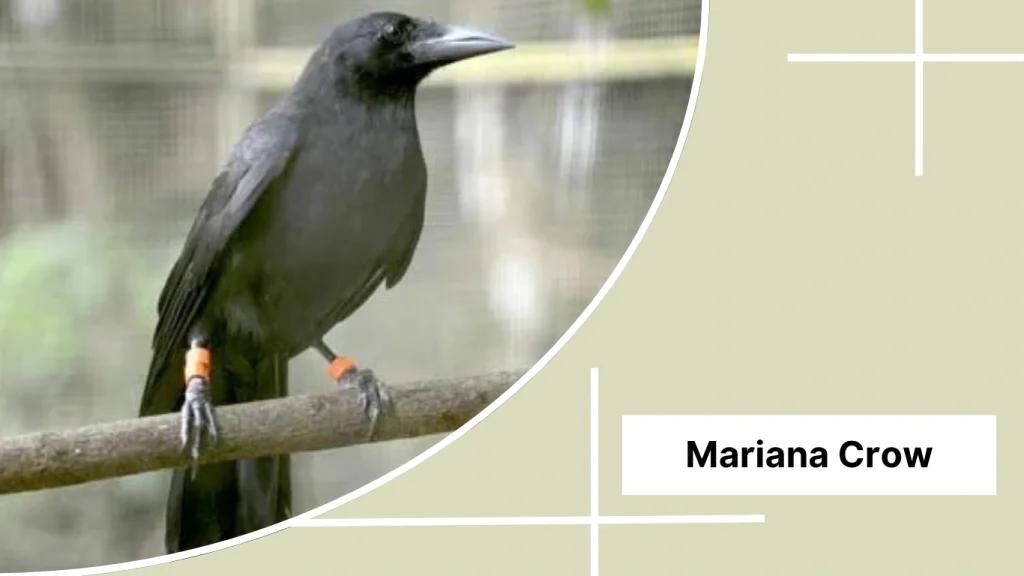
The Mariana Crow, also called Aga (its Chamorro name), is a critically endangered species found only in the Mariana Islands. This forest crow has a compact build and is culturally significant to the indigenous Chamorro people. Its population has been devastated by invasive predators like the brown tree snake.
Identification
- Color: Uniform black with slight greenish gloss
- Size: 15–16 inches (38–41 cm) in length
- Wingspan: About 30–34 inches (76–86 cm)
- Weight: 10–13 ounces (280–370 grams)
- Bill: Short, strong, and slightly curved
- Eyes: Dark brown
- Voice: High-pitched nasal calls, chattering, and sharp squawks
- Habitat: Limestone forests, coconut groves, and coastal woodlands
Behavior and Diet
Mariana Crows feed on insects, small animals, fruits, seeds, and lizards. They are territorial and form monogamous breeding pairs. Their shy behavior and small numbers make them difficult to observe in the wild.
Nesting and Reproduction
They nest in trees, often choosing sites well hidden by foliage. Females usually lay 1–4 eggs. Parental care is long-term, with juveniles remaining near the parents for months. Nest success is low due to predation by snakes and rats.
Range and Distribution
Once found on Guam and Rota, the species is now nearly extinct on Guam and survives in limited numbers on Rota. Conservation efforts include predator control, habitat protection, and captive breeding programs.
20. Fan-tailed Crow

The Fan-tailed Crow is a lesser-known forest crow native to parts of Indonesia and Papua New Guinea. It is recognized for its unique tail shape and secretive nature. Very little is known about this crow due to its remote habitat and elusive habits.
Identification
- Color: Glossy black plumage with a slight bluish sheen
- Size: Approximately 17–18 inches (43–46 cm) in length
- Wingspan: Estimated at 32–35 inches (81–89 cm)
- Weight: Unknown; likely similar to related species (around 400–500 grams)
- Bill: Medium-length and slightly curved
- Eyes: Dark
- Tail: Broad and fan-shaped when spread (distinct feature)
- Voice: Harsh caws and rasping calls, poorly studied
- Habitat: Mountain forests, remote lowland forests, and tropical woodland margins
Behavior and Diet
Presumed to be omnivorous, feeding on insects, fruits, and possibly small vertebrates. Typically seen alone or in pairs in the forest canopy. Because of its remote habitat, detailed studies of its diet and social structure are lacking.
Nesting and Reproduction
No detailed data available, but nesting behavior likely mirrors that of other forest-dwelling crows—building stick nests high in trees and exhibiting strong pair bonds.
Range and Distribution
Occurs in New Guinea and surrounding islands. It occupies dense, remote forests that are difficult to access, making population assessments and conservation studies challenging. It is currently not considered threatened but may be vulnerable to future habitat loss.