



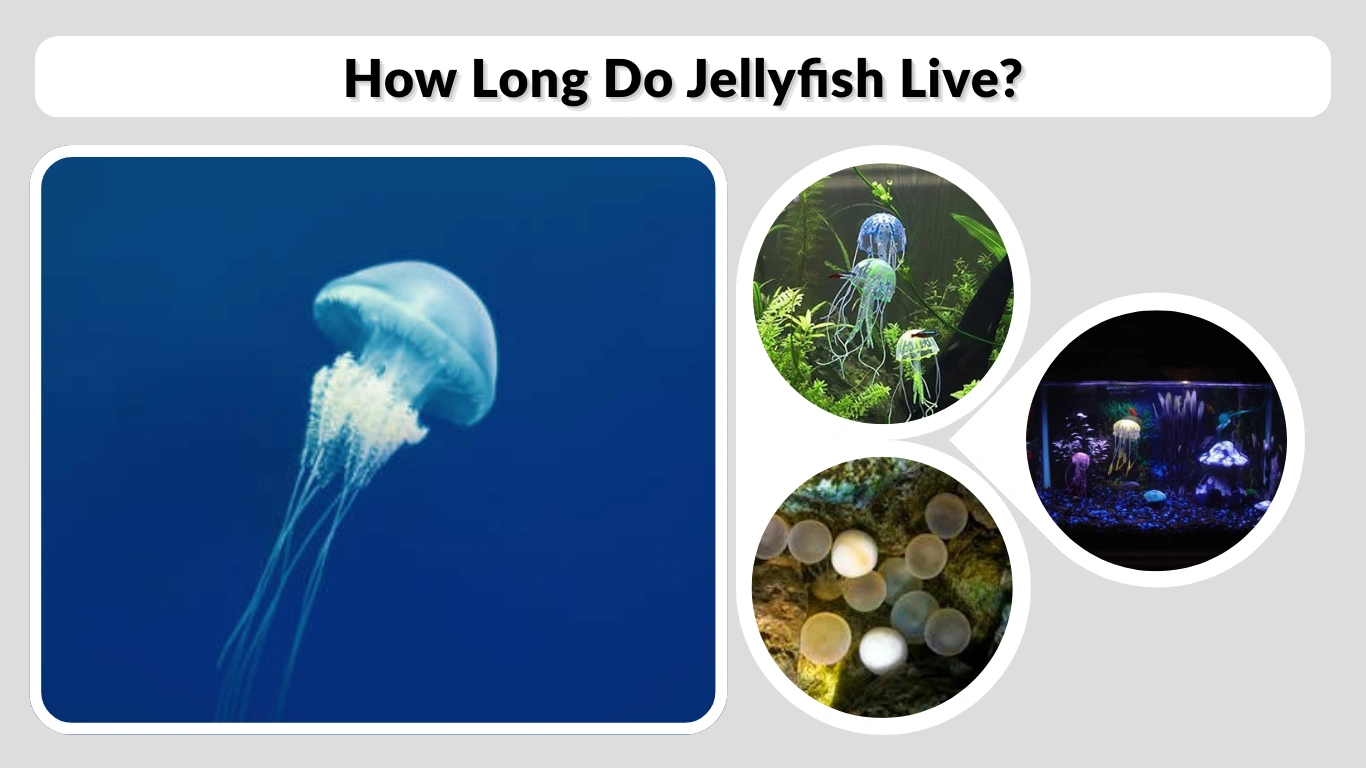
Jellyfish are among the oldest and most mysterious animals in the ocean, drifting through marine environments for over 500 million years. One of the most common questions people ask about them is surprisingly simple: how long do jellyfish live? The answer depends heavily on species, environment, and life stage. Some jellyfish survive only a few months, while others can live for several years. A rare few can even restart their life cycle. Understanding jellyfish lifespan requires looking closely at their unique life cycle and the many factors that influence survival.
How Long Do Jellyfish Live on Average?
There is no single lifespan that applies to all jellyfish. Most common coastal jellyfish species live between six months and two years. In many cases, the adult jellyfish seen floating near beaches survive only a few months after reaching maturity. Their lives are short but intense, focused almost entirely on feeding and reproduction.
Some species, particularly those living in colder or deeper waters, may survive longer. Their slower metabolism and reduced predation pressure can extend lifespan beyond two years. However, even in these cases, jellyfish rarely live as long as many fish, turtles, or marine mammals.
It is also important to distinguish between the jellyfish’s visible stage and its hidden stage. The free-swimming jellyfish, called the medusa, is only one part of a much longer life process. Many jellyfish spend far more time in an attached, microscopic form than as the floating animals people recognize.
Jellyfish Life Cycle and Its Link to Lifespan

Jellyfish lifespan cannot be understood without examining their life cycle. Most species pass through several dramatically different stages, each with its own survival challenges and time span.
Egg and Planula Stage
The life of a jellyfish begins when adult males and females release sperm and eggs into the water. Fertilized eggs quickly develop into tiny larvae called planulae. These microscopic organisms drift with plankton for several days or weeks. During this stage, mortality is extremely high. Many are eaten or fail to find a suitable surface to attach to.
Polyp Stage
If a planula survives, it settles onto a hard surface such as rock, shell, dock piling, or coral. It then transforms into a polyp. This stage looks nothing like a jellyfish. It resembles a tiny tube with tentacles and can remain attached for months or even years.
In many species, the polyp is actually the longest-living stage. Polyps can reproduce asexually, forming small colonies and producing new juvenile jellyfish. Because polyps are hidden and well-protected, they can survive unfavorable seasons, temperature changes, and food shortages. This hidden longevity is a major reason jellyfish populations can suddenly explode when conditions improve.
Medusa Stage (Adult Jellyfish)
The medusa is the familiar bell-shaped jellyfish seen in oceans. Juvenile medusae detach from the polyp and grow into adults. This stage is usually the shortest part of the life cycle. Most adult jellyfish live only a few months. Their main biological purpose is to feed, grow rapidly, and reproduce.
After reproduction, many species naturally weaken and die. Environmental stress, storms, predators, and lack of food often shorten this phase even further.
Identification and Growth Features

Jellyfish have soft, gelatinous bodies composed of more than 90 percent water. Their growth rate is closely tied to temperature and food supply. In warm, nutrient-rich waters, jellyfish can grow from tiny juveniles into full adults in a matter of weeks.
- Soft, umbrella-shaped bell
- Tentacles lined with stinging cells
- Rapid growth in favorable conditions
- Juvenile forms much smaller and less developed
- Seasonal size variation common
Because jellyfish grow quickly and lack hard skeletons, their bodies are easily damaged. This vulnerability is one reason their adult lifespan tends to be short.
Lifespan of Different Jellyfish Species (Overview)
Not all jellyfish live the same length of time. Moon jellyfish often live around one year. Many box jellyfish survive less than a year. Larger species like lion’s mane jellyfish may reach several years under good conditions. One exceptional species, the immortal jellyfish, can reverse its life cycle and potentially avoid biological aging altogether.
How Long Do Jellyfish Live in the Wild vs in Captivity?
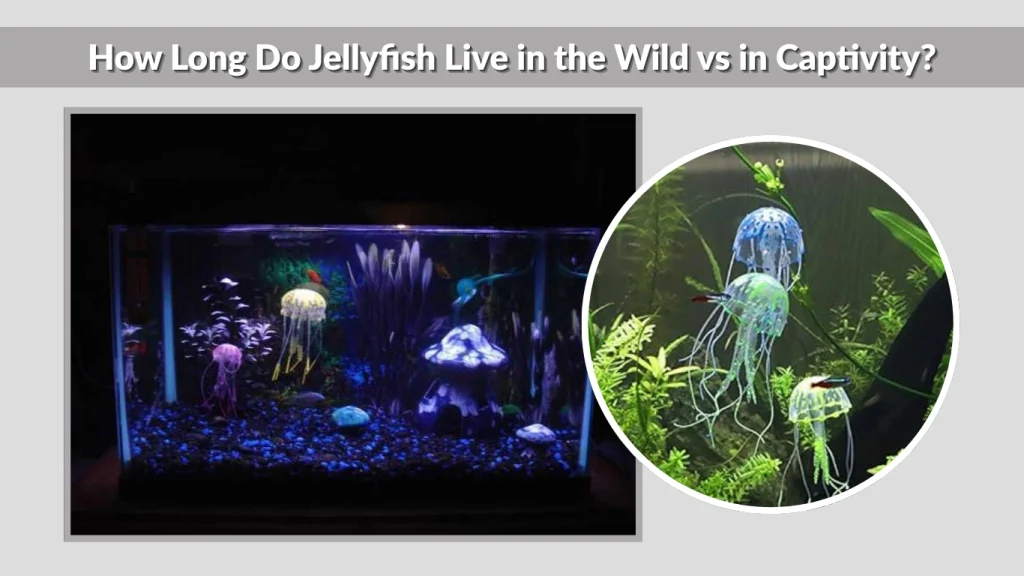
In the wild, jellyfish face constant threats that significantly shorten their lives. Predators such as sea turtles, large fish, sunfish, and other jellyfish feed on them. Storms can strand them on beaches, while changing currents may carry them into unsuitable environments. Pollution, temperature shifts, and food shortages further reduce survival. Because of these factors, many jellyfish never reach full maturity, and those that do often survive only a few months as adults.
In captivity, jellyfish can live longer under stable conditions. Aquariums carefully control water temperature, salinity, lighting, and food supply. Without predators and with regular feeding, some jellyfish species can survive significantly longer than in the wild. Moon jellyfish, for example, often live over a year in well-maintained tanks. However, even in captivity, most species still have naturally short lifespans compared to many marine animals.
Factors That Affect Jellyfish Lifespan
Many biological and environmental factors determine how long a jellyfish can live. Species is the most important factor, as genetic programming sets basic life expectancy. Environmental conditions then influence whether a jellyfish reaches that potential.
- Species and genetics determine natural lifespan limits.
- Water temperature affects metabolism and growth speed.
- Food availability influences growth, strength, and reproduction.
- Predators and disease are major causes of early death.
- Human impact such as pollution and overfishing alters survival rates.
Warmer water usually speeds up growth but shortens lifespan, while cooler water can slow development and sometimes extend it. Areas with abundant plankton often support longer survival and larger individuals.
Shortest-Living vs Longest-Living Jellyfish
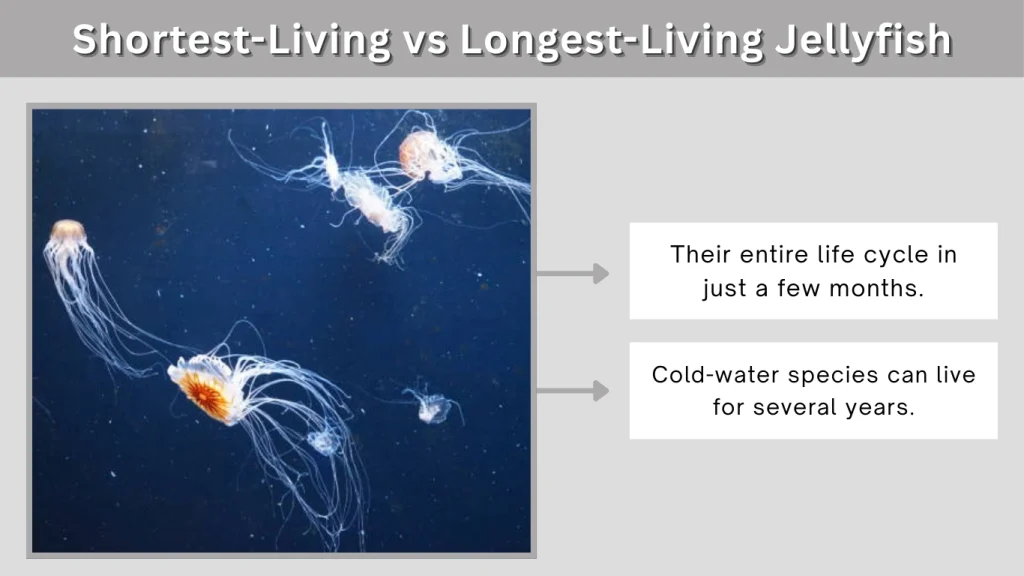
Some jellyfish complete their entire life cycle in just a few months. Small coastal species often bloom in spring or summer, reproduce rapidly, and disappear before the next season. These short-lived jellyfish invest energy in fast growth and reproduction rather than long-term survival.
On the opposite end, certain deep-sea or cold-water species can live for several years. Their slow metabolism and reduced predation pressure allow them to survive longer. The most extraordinary example is the immortal jellyfish (Turritopsis dohrnii). Instead of dying after reproduction, it can revert to its polyp stage and begin life again, making it biologically capable of repeated life cycles if not killed by external factors.
Do Jellyfish Age Like Other Animals?
Most jellyfish do experience biological aging. Their tissues weaken after reproduction, their swimming ability declines, and they become more vulnerable to disease and predation. This process, known as senescence, leads to natural death in most species.
However, some jellyfish challenge this pattern. The immortal jellyfish can reverse cellular development and escape normal aging. While it can still die from injury or environmental harm, it does not have a fixed biological lifespan in the same way other animals do. This has made jellyfish an important subject in aging and regeneration research.
Role of Jellyfish Lifespan in Marine Ecosystems
Jellyfish lifespan strongly influences ocean ecosystems. Short-lived species often appear in massive seasonal blooms, consuming large amounts of plankton and fish larvae. These blooms can temporarily reshape food webs and compete with fish populations.
Longer-living species provide a more stable food source for predators such as sea turtles and sunfish. The long-lived polyp stage also allows jellyfish populations to persist quietly on the seafloor, ready to produce new medusae when conditions become favorable.
Interesting Jellyfish Lifespan Facts
- Many jellyfish adults live less than one year.
- Polyp stages can survive for several years.
- Temperature strongly affects jellyfish longevity.
- Some jellyfish disappear completely after seasonal blooms.
- One species can restart its life cycle repeatedly.
FAQs
How long do jellyfish usually live?
Most jellyfish species live between a few months and two years. The visible adult stage often lasts only a few months, while the hidden polyp stage can survive much longer. Lifespan varies widely depending on species, environment, and food availability.
What jellyfish lives the longest?
The immortal jellyfish (Turritopsis dohrnii) is considered the longest-living jellyfish because it can revert to its juvenile form after adulthood and repeat its life cycle. Other deep-sea jellyfish may live several years under natural conditions.
Do jellyfish die after they sting?
No, jellyfish do not die after stinging. Their stinging cells can fire many times, and stinging is part of normal feeding and defense. Jellyfish usually die from predation, environmental stress, or natural aging rather than from stinging.
How long do jellyfish live out of water?
Out of water, most jellyfish survive only a few hours at most. Their bodies dry out quickly, their cells are damaged, and they cannot absorb oxygen properly. Exposure to sun and heat dramatically shortens survival time.
Are jellyfish immortal?
Most jellyfish are not immortal and age normally. Only the immortal jellyfish can biologically reset its life cycle. Even it can still die from predators, disease, or harsh environmental conditions.