




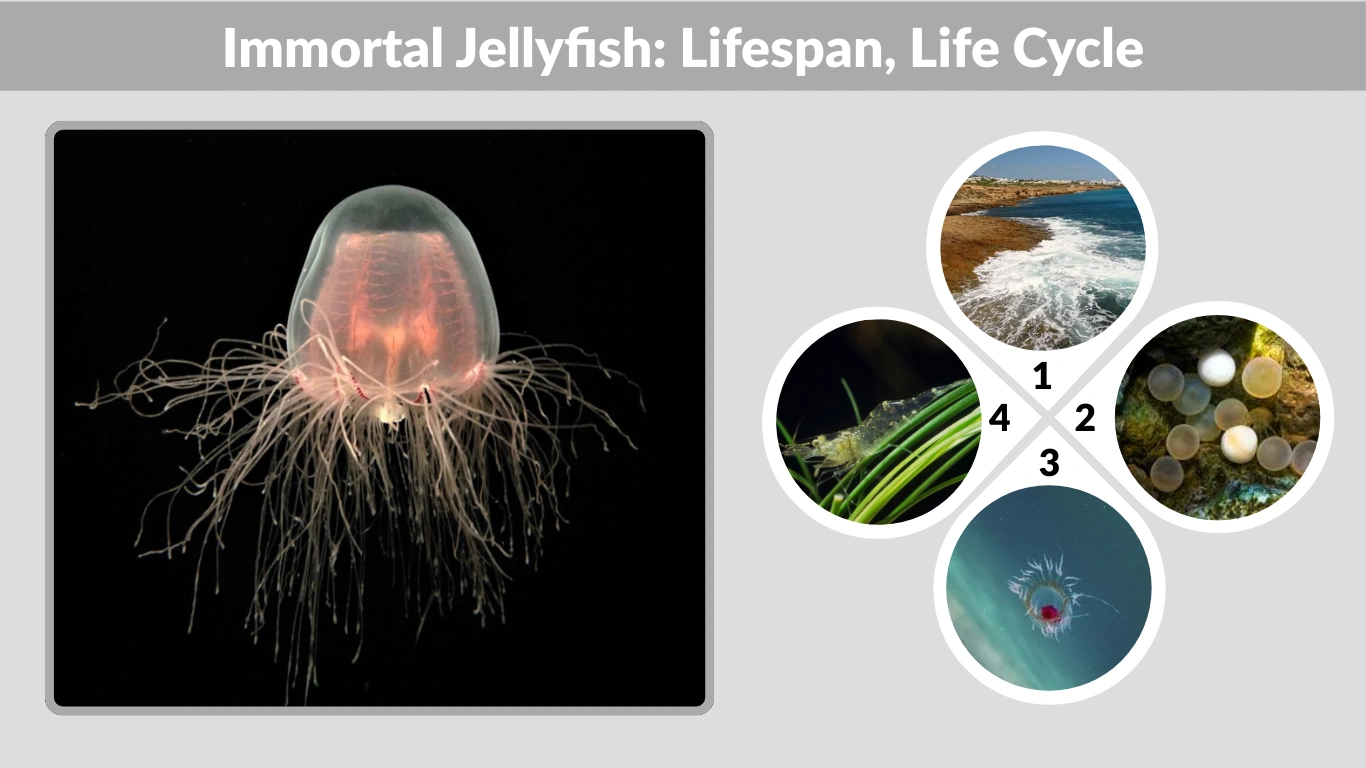
The immortal jellyfish is one of the most extraordinary creatures in the ocean, famous for its unique ability to reverse its life cycle. Unlike most animals that age and die, this tiny jellyfish can return to a juvenile stage after reaching adulthood, allowing it to begin life again. Because of this rare biological process, it is often described as “biologically immortal.” Understanding its scientific name, size, habitat, and early life stages helps explain why this species is so important to marine science and aging research.
What Is the Immortal Jellyfish?
The immortal jellyfish is a small hydrozoan species best known for its ability to escape death under the right conditions. When injured, stressed, or facing starvation, it can transform its adult body back into an immature polyp stage instead of dying. From this polyp, a new jellyfish can grow, genetically identical to the original.
This process does not make the immortal jellyfish invincible. It can still be eaten by predators, killed by disease, or destroyed by environmental changes. However, if it avoids these threats, it can repeat its life cycle indefinitely. This remarkable ability has made it a major subject of scientific research, especially in studies of cellular regeneration, aging, and DNA repair.
Scientific Name and Classification
Scientific Name of the Immortal Jellyfish
The scientific name of the immortal jellyfish is Turritopsis dohrnii. It belongs to the genus Turritopsis, a group of very small jellyfish found in oceans around the world. The species was first described in the late 19th century, but its life-cycle-reversing ability was not fully understood until much later.
Taxonomic Position
The immortal jellyfish is classified as follows:
Kingdom Animalia, Phylum Cnidaria, Class Hydrozoa, Order Anthoathecata, Family Oceaniidae. Unlike large box jellyfish or moon jellyfish, hydrozoans are typically small, delicate, and often overlooked due to their transparent bodies and planktonic lifestyle.
Identification and Physical Features

The immortal jellyfish is extremely small and delicate, which makes it difficult to notice in open water. Its simple structure is typical of hydrozoans, yet its cellular abilities are anything but simple.
- Tiny, transparent bell-shaped body
- Usually less than 5 millimeters wide
- Thin, threadlike tentacles around the bell
- Visible reddish stomach at the center
- Soft, nearly invisible appearance in water
The bell is dome-shaped and almost glass-clear. The most noticeable feature is the bright red stomach, which can often be seen through the transparent body. Fine tentacles extend from the edge of the bell and are used to capture microscopic prey.
Size and Weight of Immortal Jellyfish

The immortal jellyfish is among the smallest jellyfish species known. Its bell typically measures about 4 to 5 millimeters in diameter, roughly the size of a pencil eraser. Because its body is composed almost entirely of water, it weighs virtually nothing and moves easily with ocean currents.
Despite its tiny size, its biological impact is enormous. Most jellyfish live for only a few months to a few years. In contrast, Turritopsis dohrnii can potentially repeat its life cycle endlessly. Its small body allows rapid cellular reorganization, which may be one reason it can perform complete biological resets that larger animals cannot.
Color and Appearance
The immortal jellyfish is mostly transparent, with a faint whitish or glass-like appearance. This transparency makes it extremely difficult to detect in natural waters. The only strong coloration is its internal stomach, which appears bright red or reddish-orange through the clear bell.
Lighting plays a major role in its visibility. In direct sunlight, the bell may shimmer faintly, while in deeper or darker waters, it can become almost invisible. This near-invisibility helps protect it from predators and allows it to drift unnoticed among plankton.
Habitat and Global Distribution
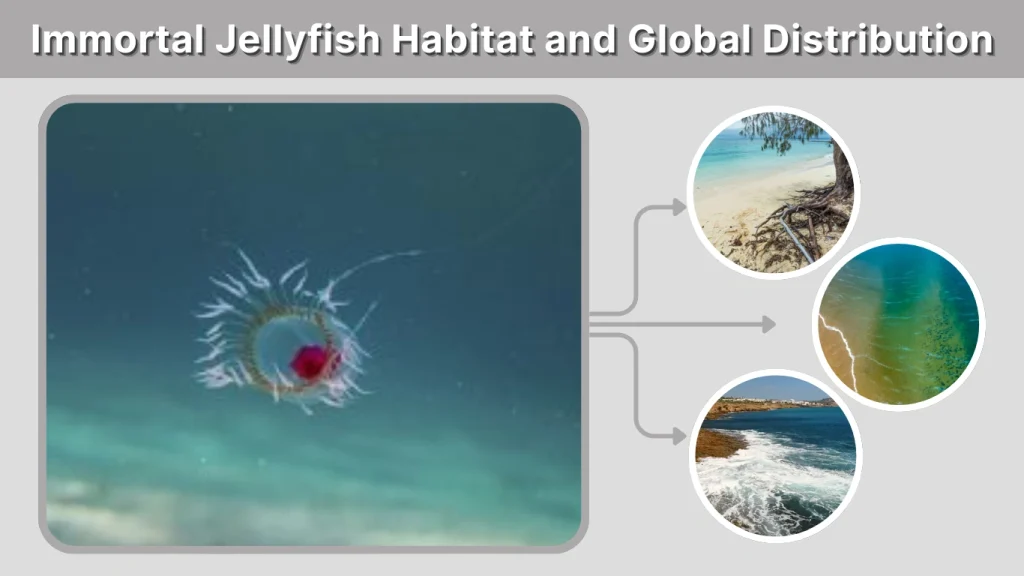
Originally, the immortal jellyfish was native to warm and temperate waters of the Mediterranean Sea and parts of the Atlantic Ocean. Today, it is considered a cosmopolitan species, meaning it is now found in oceans around the world.
- Warm and temperate marine environments
- Coastal and offshore plankton zones
- Mediterranean Sea and Atlantic Ocean origins
- Spread to the Pacific and Indian Oceans
- Commonly transported in ship ballast water
Its global spread is largely due to human shipping activity. Tiny polyps and medusae can survive in ballast water tanks and be released into new environments, where they establish new populations. Immortal jellyfish prefer calm, plankton-rich waters where microscopic prey is abundant.
Life Cycle of the Immortal Jellyfish (Overview)
Like most jellyfish, the immortal jellyfish begins life as a fertilized egg that develops into a free-swimming larva. This larva eventually settles onto a hard surface and becomes a polyp. The polyp stage can produce small medusae that detach and grow into adult jellyfish.
What makes this species unique is what happens after adulthood. When most jellyfish reproduce, they soon weaken and die. The immortal jellyfish, however, can reverse this process. Instead of dying, its adult cells reorganize and transform back into a polyp state. From that polyp, new jellyfish can bud and grow, restarting the entire life cycle.
This ability to move backward through its own development is known as transdifferentiation. It involves adult cells changing directly into different types of cells, essentially reprogramming the body from mature form back into a juvenile one.
Life Cycle of the Immortal Jellyfish (Detailed Stages)
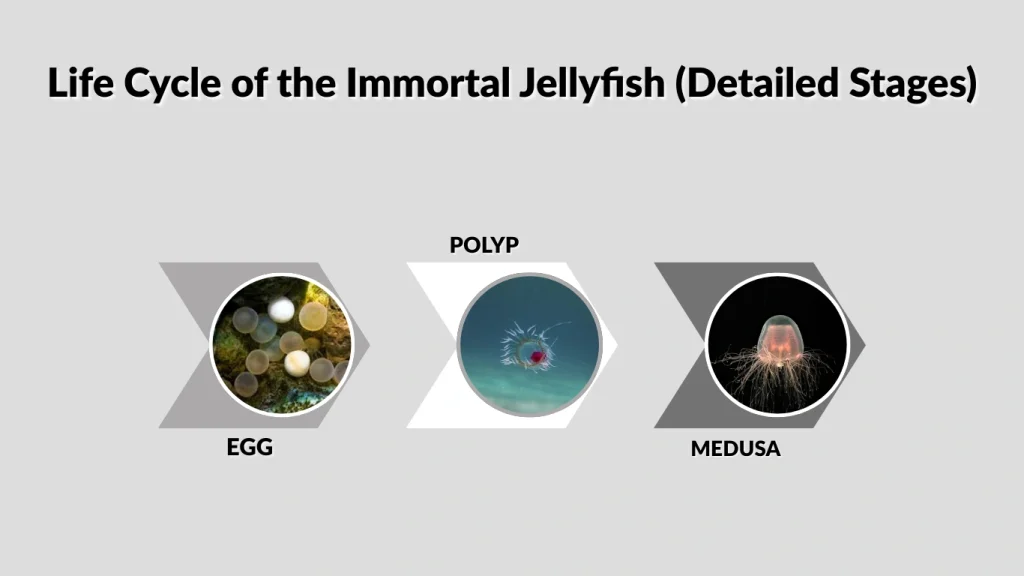
The immortal jellyfish follows the same basic life cycle pattern as many hydrozoans, but with one extraordinary difference: it can reverse the process. This allows it to escape biological aging under suitable conditions.
Egg and Planula Stage
Reproduction begins when adult medusae release eggs and sperm into the water. After fertilization, the egg develops into a microscopic, free-swimming larva called a planula. The planula drifts among plankton for several days before attaching itself to a hard surface such as rock, shell, or coral.
Polyp Stage
Once attached, the larva becomes a polyp. This small, tube-shaped form anchors to the surface and feeds on tiny planktonic organisms. The polyp can form a small colony and reproduce asexually by budding. Under normal circumstances, the polyp produces juvenile medusae that detach and enter open water.
Medusa Stage (Adult Form)
The juvenile medusae grow into adult immortal jellyfish. In this stage, they swim freely, feed, and reproduce sexually. In most jellyfish species, this phase marks the final chapter of life. For Turritopsis dohrnii, however, it is only a temporary condition.
Transdifferentiation and Rejuvenation
When faced with injury, starvation, physical damage, or sudden environmental stress, the adult jellyfish can sink to the seafloor and transform into a cyst-like mass. Its cells then undergo transdifferentiation, directly changing from adult cell types into juvenile ones. This mass develops into a new polyp, which can once again produce medusae. The life cycle is effectively reset.
Immortal Jellyfish Lifespan Explained
The immortal jellyfish does not have a fixed lifespan in the traditional sense. Because it can revert to the polyp stage after sexual maturity, it avoids the irreversible aging process that limits most animals. Biologically, this means it has the potential to live indefinitely.
However, this does not make the immortal jellyfish truly invincible. In the wild, most individuals are eaten by predators, succumb to disease, or are destroyed by environmental changes before they can reset their life cycle many times. The term “immortal” refers specifically to its ability to escape biological aging, not to immunity from death.
Diet and Feeding Behavior
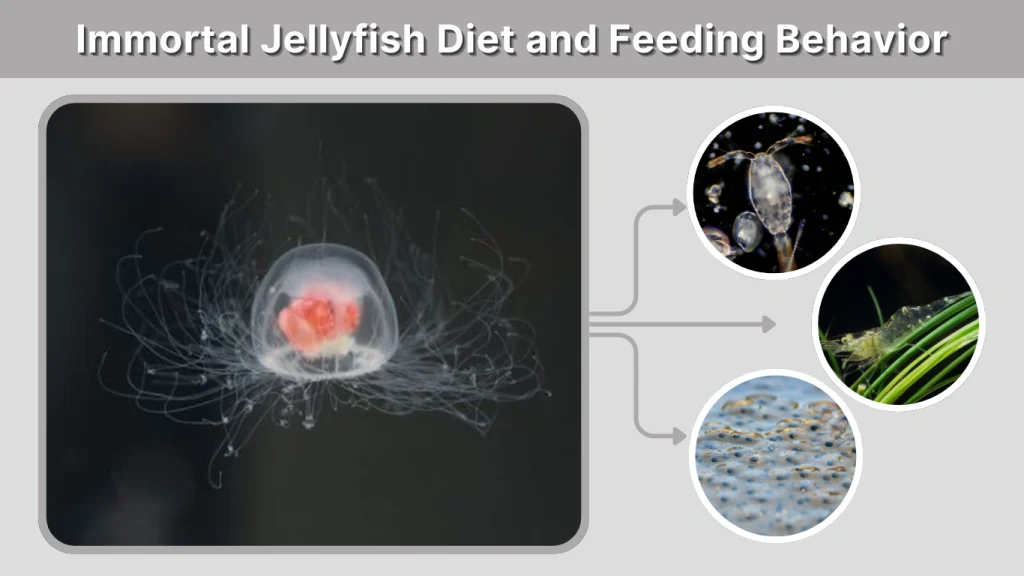
Immortal jellyfish feed primarily on microscopic marine organisms. Their diet includes zooplankton, tiny crustaceans, fish eggs, and larvae. Using their fine tentacles, they capture prey and deliver mild venom through specialized stinging cells called nematocysts.
Food is transferred to the mouth located at the center of the bell, where digestion begins. Nutrients absorbed from prey support growth, reproduction, and the intense cellular activity required for regeneration. A steady food supply increases survival chances and may influence how often individuals successfully revert to the polyp stage.
Predators and Natural Threats
Despite their remarkable abilities, immortal jellyfish are a common food source in marine ecosystems. They are eaten by larger jellyfish, sea anemones, small fish, and plankton-feeding animals. Their transparency offers limited protection, but their tiny size makes them easy to consume.
Environmental threats also pose serious risks. Pollution, changes in water temperature, ocean acidification, and habitat disruption can reduce survival rates. Although the immortal jellyfish can biologically reset itself, it cannot survive conditions that destroy its cells entirely.
Why Is the Immortal Jellyfish “Immortal”?
The secret of the immortal jellyfish lies in its cellular flexibility. Most animals have specialized cells that can no longer change once adulthood is reached. Turritopsis dohrnii can reverse this specialization. Its cells can transform directly into different cell types, similar to stem cells.
- Adult cells convert back into juvenile cells
- Entire body reorganizes into a new polyp
- Aging process is biologically bypassed
- DNA damage can be repaired through regeneration
- Life cycle can restart repeatedly
Because aging is effectively undone, the immortal jellyfish avoids natural death caused by senescence. This process has attracted scientists studying aging, cancer resistance, and regenerative medicine.
Role in Marine Ecosystems
Immortal jellyfish are part of the planktonic food web. They help control populations of microscopic organisms and serve as prey for many marine animals. Although individually small, their global spread means they may influence plankton dynamics in some regions.
Their increasing distribution also makes them important indicators of ecological change. The expansion of immortal jellyfish populations may reflect warming oceans, shipping activity, and altered marine environments.
Immortal Jellyfish Facts
- Can restart its life cycle after adulthood
- Smaller than a fingernail
- First discovered in the 1880s
- Now found in oceans worldwide
- Studied for aging and medical research
FAQs
What is the scientific name of the immortal jellyfish?
The scientific name of the immortal jellyfish is Turritopsis dohrnii. It belongs to the hydrozoan class and is known for its ability to revert from its adult medusa form back into a juvenile polyp stage, effectively restarting its life cycle.
How long does the immortal jellyfish live?
The immortal jellyfish does not have a natural lifespan limit. It can repeatedly reverse its life cycle and avoid biological aging. However, in the wild, most individuals die from predation, disease, or environmental stress before resetting many times.
Where does the immortal jellyfish live?
It is found in warm and temperate oceans worldwide. Originally native to the Mediterranean Sea, it has spread globally through ship ballast water and now lives in coastal and open-ocean plankton zones.
How does the immortal jellyfish reproduce?
It reproduces sexually as an adult medusa, producing eggs and sperm that form larvae. It also reproduces asexually in the polyp stage. Unique to this species, adults can transform back into polyps through transdifferentiation.
Why is the immortal jellyfish important to science?
Scientists study the immortal jellyfish to understand aging, cellular reprogramming, and regeneration. Its ability to revert adult cells into juvenile forms may provide insights into stem cell research, tissue repair, and age-related diseases.