




The eastern screech owl (Megascops asio) is a small but powerful owl commonly found across North America. Despite its name, it rarely “screeches” and is better known for its soft whinny and trill calls heard at night. This adaptable owl thrives in forests, suburbs, and even city parks. With excellent camouflage and sharp hunting skills, the eastern screech owl plays an important role in controlling pests and maintaining ecological balance.
What is an Eastern Screech Owl?
The eastern screech owl is a small owl species belonging to the Strigidae family. Its scientific name, Megascops asio, reflects its classification among typical owls. Unlike larger owls, this species is compact but highly efficient as a predator.
It is widely distributed across eastern North America and is one of the most common owls in its range. Its ability to live close to humans makes it more frequently encountered than many other owl species, though it often goes unnoticed due to its excellent camouflage.
Eastern Screech Owl Identification
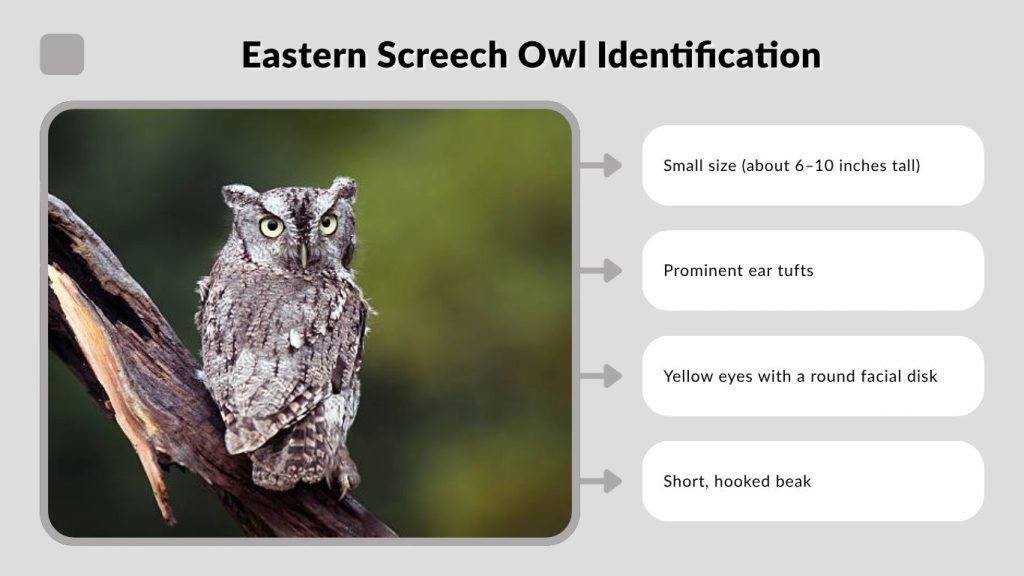
The eastern screech owl is a small, well-camouflaged owl that can be difficult to spot despite being common across its range. Its compact size, ear tufts, and bark-like feather patterns help it blend seamlessly into trees. Learning a few key features makes identification much easier, especially at dusk or night when they are most active.
Key identification features:
- Small size (about 6–10 inches tall)
- Prominent ear tufts (often mistaken for horns)
- Yellow eyes with a round facial disk
- Short, hooked beak
- Camouflage plumage resembling tree bark
- Two main color morphs: gray and red
- Compact body with broad, rounded wings
- Distinctive calls (whinny and soft trill instead of a hoot)
These features help distinguish the eastern screech owl from other owl species, especially in wooded or suburban environments.
Eastern Screech Owl Habitat & Range
Natural Habitat
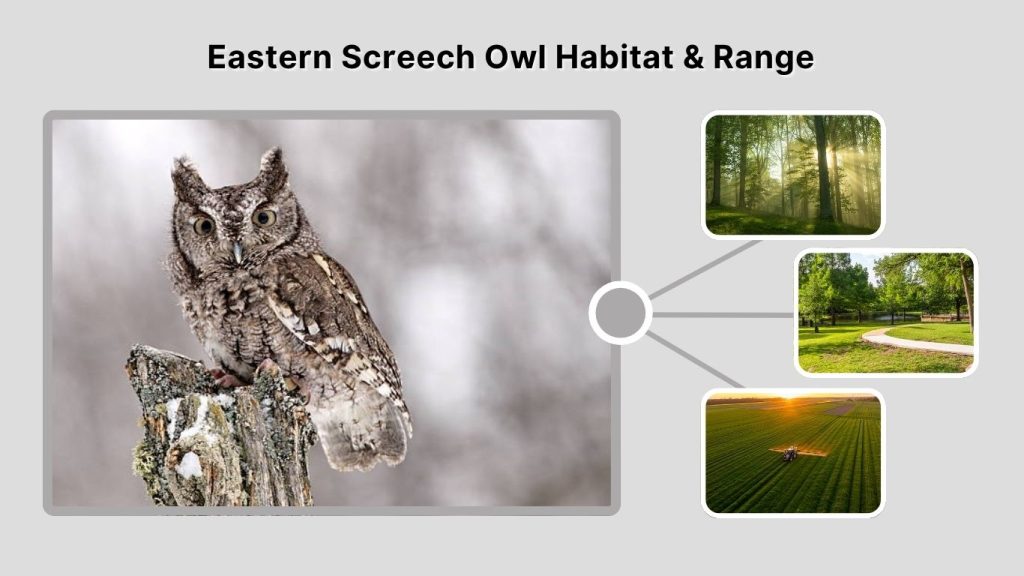
Eastern screech owls are highly adaptable and can live in a wide range of habitats. They are commonly found in woodlands, forests, and areas with scattered trees. They prefer locations with tree cavities, which they use for nesting and shelter.
Unlike some owl species, they are comfortable living near humans and are often found in suburban neighborhoods, parks, and farmlands.
Geographic Range
This species is widespread across eastern North America. It can be found in regions such as Florida, Texas, Michigan, and many other states.
Their broad range and adaptability have made them one of the most successful owl species in the region.
Adaptability
Eastern screech owls are known for their ability to thrive in human-altered environments. They often use nest boxes or birdhouses provided by people, which helps support their populations.
Their ability to adapt to different conditions, including urban areas, has allowed them to maintain stable populations over time.
Nesting & Reproduction
Nesting Habits
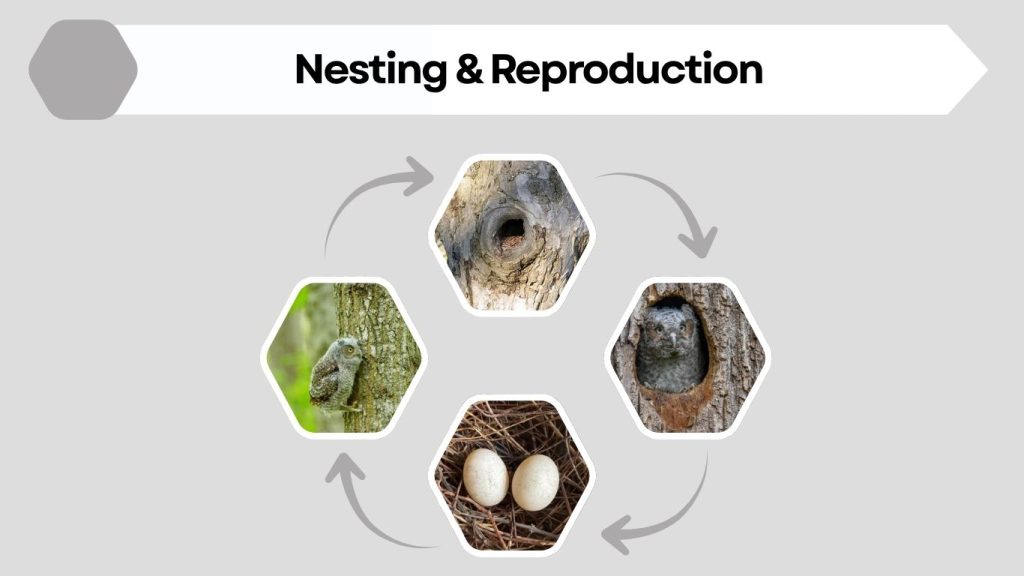
Eastern screech owls do not build their own nests. Instead, they rely on natural tree cavities or abandoned holes created by woodpeckers. They also readily use nest boxes designed specifically for them.
These owls prefer nesting sites that are well-hidden and provide protection from predators.
Nest Box Placement
Nest boxes are commonly used to attract eastern screech owls. Ideal placement is usually several meters above the ground in a quiet area with nearby trees.
Proper placement and design of nest boxes can significantly increase the chances of attracting these owls.
Breeding Season
The breeding season typically begins in late winter to early spring. During this time, pairs become more vocal and communicate frequently through calls.
Females lay a small clutch of eggs, usually between 2 and 5, depending on environmental conditions.
Eggs & Raising Young
The female incubates the eggs while the male provides food. Once the chicks hatch, both parents are involved in feeding and protecting them.
Fledglings leave the nest after a few weeks but continue to rely on their parents as they learn to hunt and survive on their own.
Eastern Screech Owl Sounds & Calls
Main Calls
Despite their name, eastern screech owls do not typically screech. Instead, they produce two main types of calls:
- A whinny-like call that sounds similar to a horse
- A soft trill that is calm and rhythmic
These sounds are commonly heard at night and are often mistaken for other animals.
Types of Sounds
Eastern screech owls use a variety of vocalizations, including mating calls, territorial calls, and communication sounds between mates and offspring.
Their calls are not harsh but rather soft and haunting, adding to the nighttime atmosphere of forests and neighborhoods.
What Do Their Sounds Mean?
These vocalizations serve important purposes. Owls use them to establish territory, attract mates, and communicate with their partners or young.
During breeding season, pairs may call back and forth, strengthening their bond and warning other owls to stay away.
Diet & Hunting Behavior
What Do Eastern Screech Owls Eat?
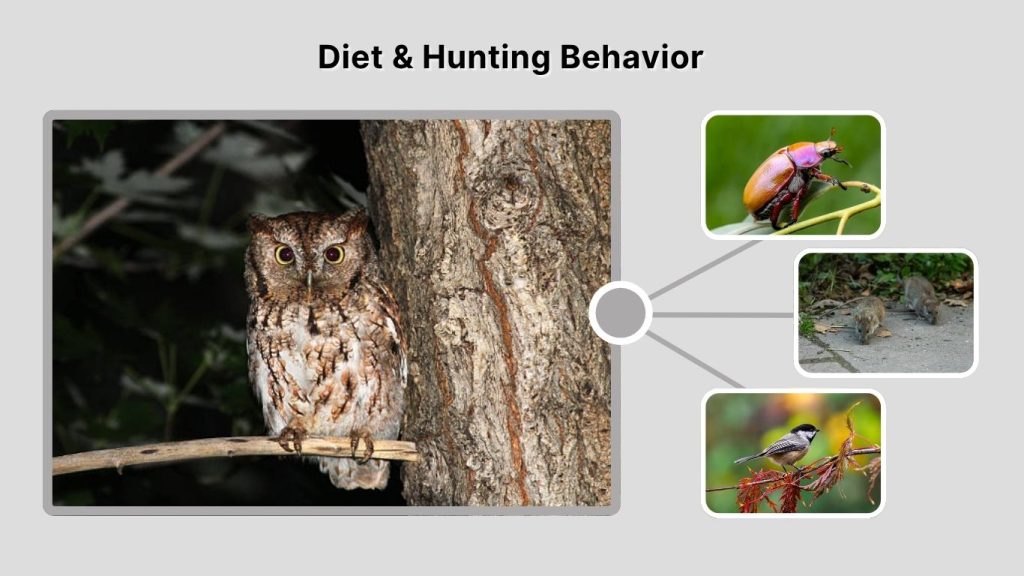
Eastern screech owls have a varied diet, making them highly adaptable hunters. They feed on:
- Insects such as beetles, moths, and crickets
- Small mammals like mice and shrews
- Birds and small reptiles
- Amphibians such as frogs
Their diet often changes depending on the season and availability of prey.
Hunting Style
These owls are primarily nocturnal and hunt at night. They rely on their sharp vision and excellent hearing to locate prey in darkness. Like other owls, they have specialized feathers that allow for silent flight, helping them catch prey without being detected.
They often hunt by perching quietly and then swooping down on unsuspecting prey.
Predators & Threats
Despite being skilled hunters, eastern screech owls face threats from larger predators such as great horned owls, hawks, and snakes. Habitat loss and human activity can also impact their survival.
Behavior & Lifestyle
Eastern screech owls are solitary and territorial birds. They are most active at night but may occasionally be seen during the day, especially when disturbed.
One of their most impressive traits is their camouflage. They can remain perfectly still against tree bark, making them nearly invisible. This helps them avoid predators and surprise prey.
They are also known for their adaptability and can live in both rural and urban environments. Many people may unknowingly live near these owls due to their quiet and secretive nature.
Eastern Screech Owl Flight & Feathers
The feathers of the eastern screech owl are specially designed for silent flight. Soft edges reduce sound, allowing them to glide quietly through the air.
In flight, they appear compact with rounded wings. Their movements are smooth and controlled, enabling them to navigate through dense trees with ease.
Their feathers also play a key role in identification, with patterns that provide excellent camouflage and protection.
Eastern vs Western Screech Owl
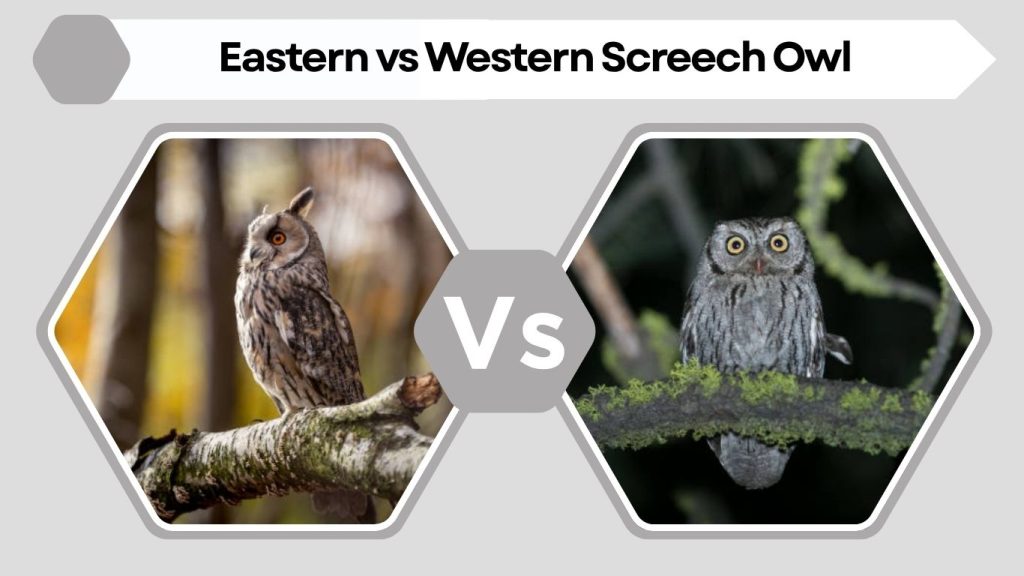
The eastern screech owl and western screech owl are closely related but differ in several ways.
The eastern species is found across the eastern United States, while the western screech owl lives in the western regions. They also differ slightly in size, coloration, and vocalizations.
Understanding these differences helps bird watchers correctly identify each species in the wild.
Lifespan, Migration & Conservation
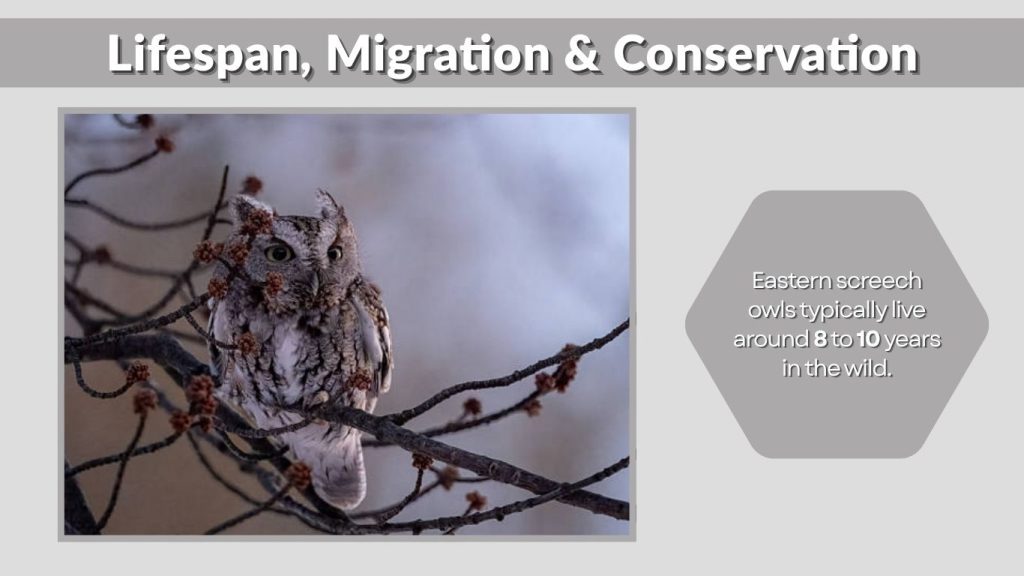
Eastern screech owls typically live around 8 to 10 years in the wild, though some may live longer in safe conditions.
Unlike many birds, they do not migrate and remain in the same area year-round. This makes them a permanent part of their local ecosystem.
Their population is generally stable, and they are not considered endangered. However, habitat loss and environmental changes can still pose risks in certain areas.
Symbolism & Cultural Meaning
Owls have long been symbols of wisdom and mystery in many cultures. The eastern screech owl, with its nighttime calls and hidden nature, is often associated with secrecy and insight.
In some traditions, owls are believed to be messengers or guardians of the night. Interpretations vary widely depending on cultural beliefs.
Interesting Facts About Eastern Screech Owls
- They can rotate their heads up to 270 degrees.
- Their camouflage makes them almost invisible against tree bark.
- They do not actually “screech” despite their name.
- They can live comfortably in urban environments.
- Their calls include a whinny and a soft trill rather than loud hoots.
Conclusion
The eastern screech owl is a remarkable bird known for its adaptability, camouflage, and unique vocalizations. Despite its small size, it plays a big role in controlling insect and rodent populations. Its ability to live near humans while remaining hidden makes it both common and mysterious. By understanding and protecting its habitat, we can ensure that this fascinating owl continues to thrive in both wild and urban environments.
FAQs
What does an eastern screech owl sound like?
Eastern screech owls produce a soft whinny and a gentle trill rather than a loud screech. These calls are commonly heard at night.
Where do eastern screech owls live?
They live in forests, woodlands, suburban areas, and parks across eastern North America, often nesting in tree cavities.
What do eastern screech owls eat?
Their diet includes insects, small mammals, birds, reptiles, and amphibians, depending on availability.
Are eastern screech owls nocturnal?
Yes, they are mainly active at night and use their excellent vision and hearing to hunt in the dark.
Do eastern screech owls migrate?
No, eastern screech owls are non-migratory and stay in the same area throughout the year.