



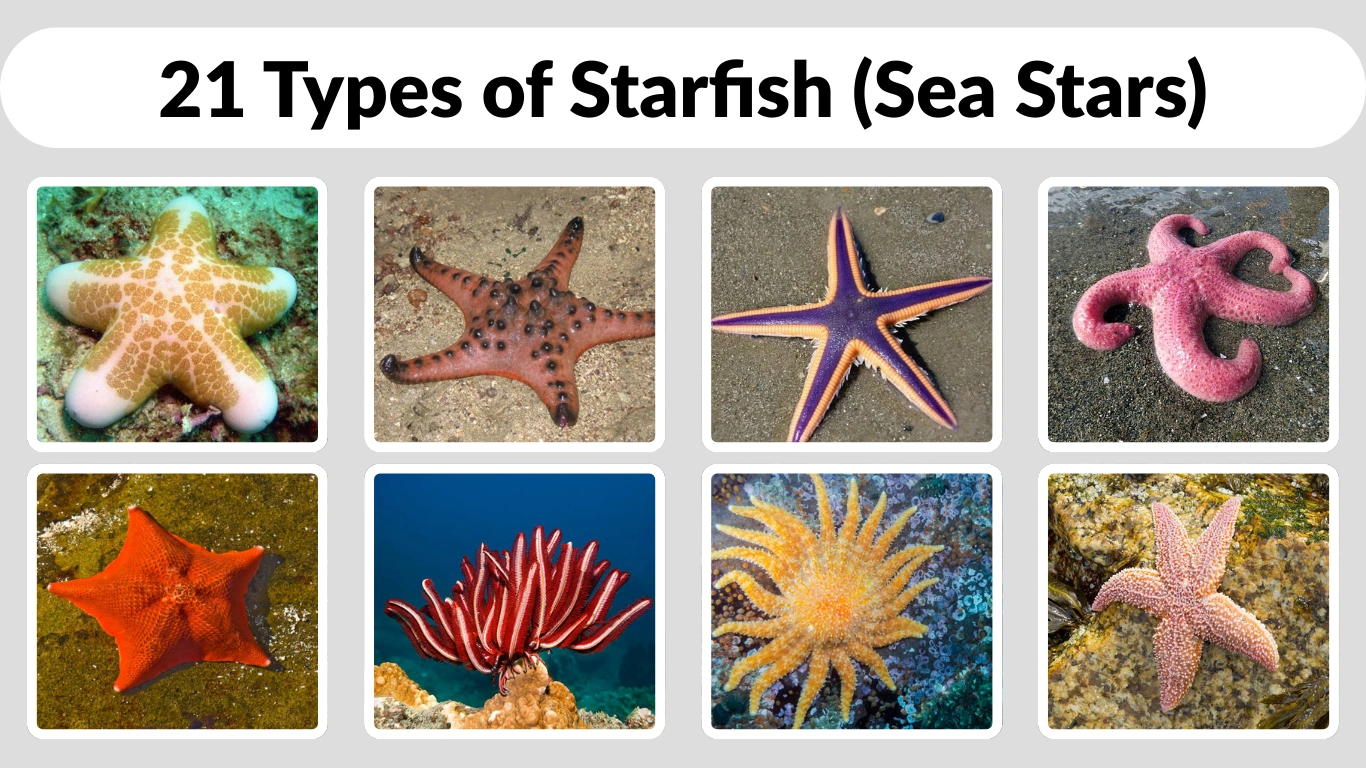
Starfish, also known as sea stars, are fascinating marine animals found in oceans all over the world. With their unique shapes, varied colors, and incredible abilities like regeneration, they play an important role in maintaining healthy marine ecosystems. From shallow coral reefs to deep ocean floors, different types of starfish have adapted to a wide range of environments. This guide introduces various starfish species, focusing on their identification, where they are found, what they eat, and how they behave in the wild.
1. Common Starfish
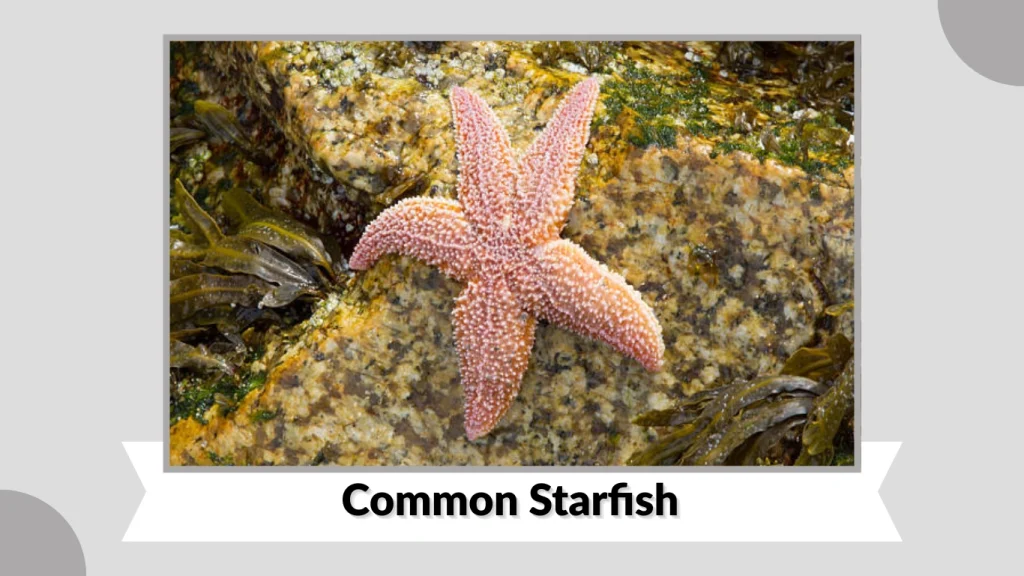
The common starfish, also known as the common sea star, is one of the most familiar and widely recognized starfish species. It is often found along rocky shorelines and shallow coastal waters, where it plays an important role in maintaining marine ecosystem balance.
Identification
- Typically has five arms radiating from a central disc
- Color ranges from orange, brown, purple, to reddish tones
- Rough, slightly spiny upper surface
- Strong tube feet on the underside for movement and feeding
Where It Is Found
The common starfish is found along the coasts of the Atlantic Ocean, especially in Europe and the northeastern Atlantic. It is commonly seen in tide pools, rocky shores, and shallow seabeds.
Diet
This starfish mainly feeds on mollusks such as mussels and clams. It uses its tube feet to pry open shells and then extends its stomach outside its body to digest prey externally.
Habitat
The common starfish prefers rocky and sandy seabeds, tide pools, and shallow coastal waters. It can live from the intertidal zone down to deeper waters, as long as food is available.
Behaviors
Common starfish are slow-moving but efficient predators. They can regenerate lost arms and are highly adaptable to changing environments. During low tide, they often hide under rocks to avoid drying out.
2. Sunflower Starfish
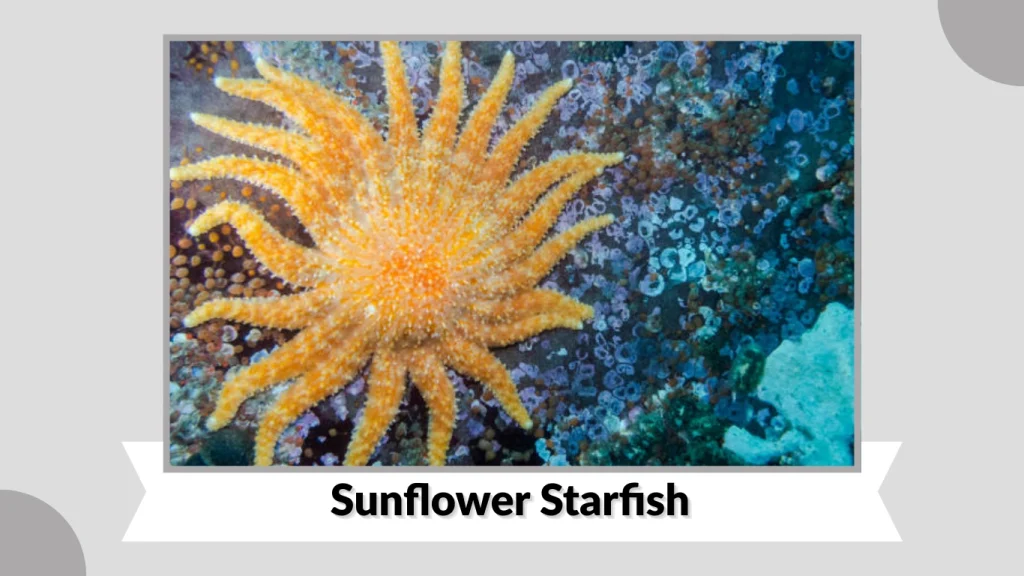
The sunflower starfish is one of the largest and fastest-moving sea stars in the world. It is well known for its many arms and important role as a top predator in marine ecosystems.
Identification
- Has 16–24 arms, sometimes more
- Large size, can grow over 1 meter (3 feet) across
- Colors include purple, orange, red, brown, or yellow
- Soft body with a thick central disc
Where It Is Found
Sunflower starfish are found along the Pacific coast of North America, from Alaska to California. They usually live in colder waters.
Diet
They feed on sea urchins, clams, snails, crabs, and other starfish. Their appetite helps control sea urchin populations.
Habitat
This species lives on rocky reefs, sandy bottoms, and kelp forests, from shallow waters to deeper ocean zones.
Behaviors
Sunflower starfish are unusually fast for starfish, moving quickly using hundreds of tube feet. They can regenerate arms and are active hunters rather than passive feeders.
3. Crown-of-Thorns Starfish

The crown-of-thorns starfish is a highly venomous species known for its impact on coral reefs. It is easily recognized by its sharp, thorn-like spines.
Identification
- Has up to 21 arms
- Covered with long, sharp, venomous spines
- Colors include purple, green, red, or gray
- Large and rigid body structure
Where It Is Found
This starfish is commonly found in the Indo-Pacific region, including the Red Sea, Indian Ocean, and Great Barrier Reef.
Diet
It feeds primarily on coral polyps, especially hard corals, making it a major threat to coral reef health during population outbreaks.
Habitat
Crown-of-thorns starfish live on coral reefs and lagoon areas, usually hiding during the day and feeding at night.
Behaviors
They are mostly nocturnal and can cause large-scale coral damage when populations increase. When threatened, they use their venomous spines as defense.
4. Chocolate Chip Starfish

The chocolate chip starfish is a popular and easily recognized sea star, often seen in aquariums due to its attractive appearance and hardy nature.
Identification
- Usually has five short, thick arms
- Cream or yellow body with dark brown, chip-like spines
- Firm, rough upper surface
- Grows up to 15–20 cm (6–8 inches)
Where It Is Found
This starfish is found in the Indo-Pacific region, including shallow waters around islands and coral reefs.
Diet
It feeds on algae, sponges, detritus, and small invertebrates. In captivity, it may eat coral, so it is not reef-safe.
Habitat
Chocolate chip starfish live on sandy bottoms, coral reefs, and shallow lagoons, usually in warm tropical waters.
Behaviors
They are slow-moving and mostly nocturnal. When threatened, they can regenerate lost arms and tolerate a wide range of conditions.
5. Blue Starfish

The blue starfish is admired for its striking blue coloration and is commonly found in tropical marine environments.
Identification
- Typically has five long, pointed arms
- Bright blue or bluish-purple color
- Smooth or slightly textured surface
- Medium-sized body
Where It Is Found
Blue starfish are found in the Indo-Pacific Ocean, especially around coral reefs in shallow coastal waters.
Diet
They mainly feed on algae, biofilm, and small organisms found on rocks and reef surfaces.
Habitat
This species prefers coral reefs, rocky areas, and sandy seabeds in warm, clear waters.
Behaviors
Blue starfish are generally peaceful and slow-moving. They spend much of their time grazing and hiding in reef crevices during strong currents.
6. Red Cushion Starfish

The red cushion starfish is known for its rounded, pillow-like shape rather than long arms. It is a slow-moving species that spends most of its life grazing on reef surfaces and playing a quiet but important ecological role.
Identification
- Short, barely visible arms forming a cushion shape
- Bright red, orange, or pink coloration
- Hard, bumpy surface with small spines
- Can grow up to 30 cm (12 inches) wide
Where It Is Found
This starfish is found throughout the Indo-Pacific region, including East Africa, the Red Sea, and the Pacific Islands.
Diet
It feeds mainly on algae, detritus, sponges, and microorganisms found on rocks and coral surfaces.
Habitat
Red cushion starfish live on coral reefs, rocky shores, and shallow lagoons, usually in warm, shallow waters.
Behaviors
They are slow and non-aggressive, often remaining still for long periods. They can regenerate damaged body parts and are active both day and night.
7. Leather Star

The leather star is named for its thick, smooth, leathery skin. It is a hardy species that can tolerate a wide range of environmental conditions.
Identification
- Five short, broad arms with a soft, leathery texture
- Colors range from brown and orange to purple
- Flexible body compared to spiny starfish
- Can reach 25 cm (10 inches) in diameter
Where It Is Found
Leather stars are found along the Pacific coast of North America, from Alaska to California.
Diet
They are omnivorous, feeding on algae, mussels, barnacles, small invertebrates, and organic debris.
Habitat
This species inhabits rocky shorelines, tide pools, and shallow coastal waters, often exposed during low tide.
Behaviors
Leather stars are highly adaptable and resistant to temperature and salinity changes. They can regenerate arms and often hide under rocks to avoid predators and drying out.
8. Sand Sifting Starfish

The sand sifting starfish is a specialized sea star best known for its role in cleaning and aerating sandy seabeds. Unlike colorful reef starfish, it is usually pale in color and spends most of its life buried beneath the sand, emerging mainly to feed or move to new areas.
Identification
- Typically has five long, triangular arms
- Body color is white, gray, or light beige
- Smooth upper surface with fine spines underneath
- Can grow up to 30 cm (12 inches) across
Where It Is Found
Sand sifting starfish are found in the Indo-Pacific region, including coastal areas of Southeast Asia, Australia, and island reefs. They are common in shallow tropical waters.
Diet
This species feeds primarily on detritus, organic waste, microalgae, and tiny organisms found within sand. It swallows sand, digests edible material, and expels clean sand, helping maintain sediment health.
Habitat
Sand sifting starfish live on sandy ocean floors, lagoons, and shallow reef flats. They prefer calm waters with fine sand where food particles are abundant.
Behaviors
They spend much of their time burrowed under sand, with only arm tips sometimes visible. This behavior protects them from predators and strong sunlight. They are slow-moving but constantly active beneath the surface. Although beneficial to sandy environments, they can starve in captivity if food resources are limited.
9. Brittle Star
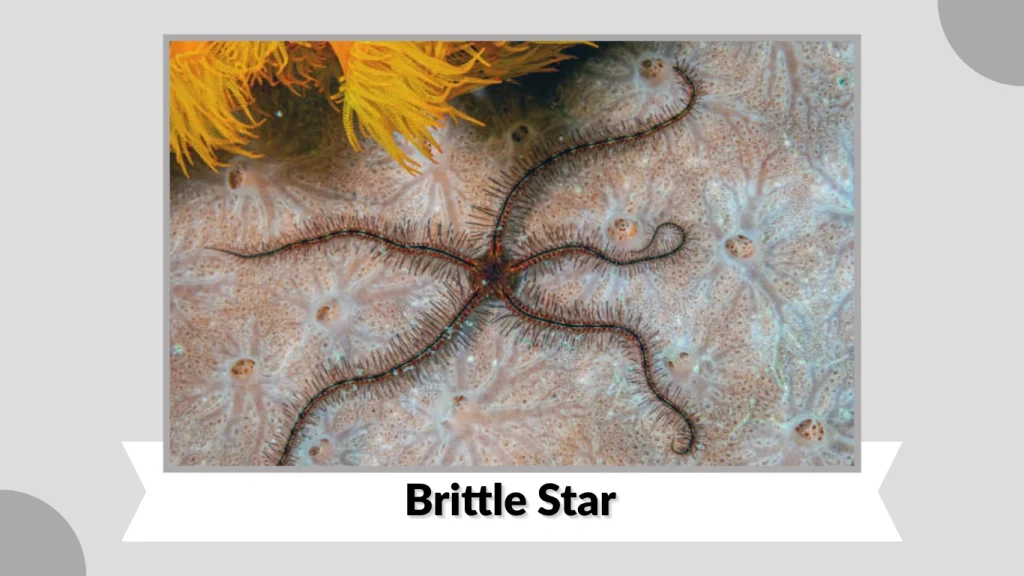
Brittle stars are closely related to starfish but are easily distinguished by their thin, flexible arms and rapid movements. They are among the most agile echinoderms and play a major role in marine nutrient recycling.
Identification
- Small central disc with five long, whip-like arms
- Arms are clearly separated from the disc
- Colors range from brown and gray to banded or spotted
- Fragile arms that break easily for defense
Where It Is Found
Brittle stars are found in oceans worldwide, from shallow coral reefs to deep-sea environments. They are one of the most widespread echinoderms.
Diet
They are scavengers and filter feeders, feeding on plankton, detritus, algae, and small organisms. Some species raise their arms into the water to catch food particles.
Habitat
Brittle stars live under rocks, coral rubble, sandy bottoms, and reef crevices. Deep-sea species may inhabit cold, dark ocean floors.
Behaviors
Unlike most starfish, brittle stars move quickly by rowing their arms, making them highly mobile. When threatened, they can intentionally drop arms to escape predators, later regenerating them. They are mostly nocturnal and avoid open spaces during the day.
10. Basket Star

The basket star is a highly distinctive sea star known for its complex, branching arms that resemble a woven basket. It is mainly nocturnal and uses a unique feeding strategy that sets it apart from most other starfish species.
Identification
- Has five main arms that branch repeatedly into many smaller arms
- Arms form a basket-like, tangled structure when curled
- Colors range from brown and yellow to orange or reddish tones
- Central disc is relatively small compared to arm span
Where It Is Found
Basket stars are found in tropical and temperate oceans worldwide, including the Indo-Pacific, Atlantic, and Mediterranean regions. They are often spotted at night.
Diet
They are suspension feeders, capturing plankton, tiny crustaceans, and organic particles from the water. The branched arms trap food, which is then passed toward the mouth.
Habitat
Basket stars live on coral reefs, rocky ledges, and deep-sea slopes. Many species anchor themselves to sponges, corals, or rocks during feeding.
Behaviors
Basket stars are mostly nocturnal. At night, they climb to elevated positions and spread their arms wide to catch drifting food. During the day, they tightly coil their arms and hide in crevices. Their arms are fragile and can regenerate if damaged.
11. Feather Star

Feather stars are visually striking echinoderms with feather-like arms that give them a graceful, flower-like appearance. Unlike most starfish, many feather stars can actively swim.
Identification
- Usually has 10 or more feathery arms
- Arms have numerous side branches (pinnules)
- Colors include yellow, red, black, white, or patterned
- Mouth faces upward, unlike true starfish
Where It Is Found
Feather stars are commonly found in the Indo-Pacific region, especially around coral reefs, but some species live in deeper waters worldwide.
Diet
They are filter feeders, consuming plankton, microscopic algae, and organic particles suspended in the water. Their arms capture food and move it toward the mouth.
Habitat
Feather stars live on reefs, rocky outcrops, and underwater cliffs. Some species attach temporarily using grasping appendages, while others remain mobile.
Behaviors
Feather stars are often nocturnal, hiding during the day and feeding at night. When threatened, they can swim by rhythmically waving their arms. Like other echinoderms, they can regenerate lost arms and are sensitive to water movement and light.
12. Bat Star

The bat star is a distinctive, webbed sea star named for the bat-like shape formed by the membrane between its arms. It is a common and important species in coastal ecosystems and is often studied because of its adaptability and feeding behavior.
Identification
- Usually five arms connected by noticeable webbing
- Flat body with a smooth to slightly rough surface
- Color varies widely: brown, orange, red, purple, or green
- Can grow up to 50 cm (20 inches) across
Where It Is Found
Bat stars are found along the Pacific coast of North America, ranging from Alaska to Baja California.
Diet
They are opportunistic omnivores, feeding on algae, barnacles, mussels, dead animals, and organic debris. This flexible diet helps them survive in changing conditions.
Habitat
Bat stars inhabit rocky shores, kelp forests, sandy bottoms, and pier pilings. They are commonly seen in shallow coastal waters.
Behaviors
Bat stars are slow-moving but highly adaptable. They can tolerate changes in temperature, salinity, and oxygen levels. They often gather in groups and can regenerate lost arms, making them resilient survivors in dynamic environments.
13. Giant Pink Starfish

The giant pink starfish is one of the largest and most striking sea stars, known for its bright color and impressive size. It plays a key role as a predator in cold-water marine ecosystems.
Identification
- Has five thick, broad arms
- Bright pink to reddish-pink coloration
- Covered with small, rough spines
- Can reach 60 cm (24 inches) in diameter
Where It Is Found
This species is found along the Pacific coast of North America, from Alaska to California, mostly in colder waters.
Diet
Giant pink starfish feed mainly on sea urchins, clams, snails, and other invertebrates. Their feeding helps control prey populations.
Habitat
They live on rocky reefs, kelp forests, and sandy ocean floors, from shallow waters to deeper coastal zones.
Behaviors
Giant pink starfish are strong predators that use their tube feet to pry open shells. They move slowly but steadily and can regenerate arms if injured. They are usually solitary and active both day and night.
14. Royal Starfish

The royal starfish is admired for its bold colors and striking patterns, making it one of the most visually impressive sea stars. It is an active predator and an important member of reef ecosystems.
Identification
- Usually has five long, pointed arms
- Bright coloration with contrasting patterns or markings
- Firm body with short spines on the upper surface
- Medium to large size compared to other starfish
Where It Is Found
Royal starfish are found mainly in the Atlantic Ocean and Caribbean Sea, including coastal areas of North America and tropical islands.
Diet
They feed on mollusks, small invertebrates, and organic matter. Like many starfish, they use their tube feet to open shells.
Habitat
This species inhabits coral reefs, rocky bottoms, and sandy seabeds, usually in warm, shallow waters.
Behaviors
Royal starfish are active hunters and move more frequently than many other sea stars. They can regenerate arms and often seek shelter under rocks during strong currents or daylight.
15. Horned Starfish

The horned starfish is named for the distinct horn-like projections on its arms. It is a robust and well-armored species that relies on its tough body for protection.
Identification
- Five arms with raised, horn-like spines
- Thick, rigid body structure
- Colors range from brown and gray to reddish tones
- Rough, heavily armored surface
Where It Is Found
Horned starfish are found in the Indo-Pacific region, especially around rocky and coral reef areas.
Diet
They feed on sponges, algae, and small invertebrates, scraping food from hard surfaces.
Habitat
This species prefers rocky reefs and coral outcrops, often in shallow to moderately deep waters.
Behaviors
Horned starfish are slow-moving and well-defended. Their hard armor and spines discourage predators. They are mostly active at night and can regenerate damaged arms over time.
16. Knobby Starfish

The knobby starfish is named for the raised, rounded knobs covering its upper surface. These knobs give it a rugged appearance and provide extra protection from predators. It is commonly seen on tropical reefs and shallow coastal waters.
Identification
- Usually five thick arms
- Upper surface covered with large, rounded knobs
- Colors include brown, gray, orange, or mottled patterns
- Strong, rigid body structure
Where It Is Found
Knobby starfish are found in the Indo-Pacific region, including coral reefs and coastal areas of Southeast Asia and nearby islands.
Diet
They feed on algae, sponges, detritus, and small invertebrates found on reef surfaces.
Habitat
This species lives on coral reefs, rocky bottoms, and sandy areas near reefs, mostly in warm, shallow waters.
Behaviors
Knobby starfish are slow-moving and solitary. They rely on their tough body and camouflage to avoid predators. Like other sea stars, they can regenerate lost or damaged arms.
17. Marble Sea Star

The marble sea star is recognized for its beautiful marbled color patterns, which help it blend into rocky environments. It is a common sight along temperate coastlines.
Identification
- Five slender arms with a marbled or mottled pattern
- Colors include white, gray, brown, and purple
- Slightly rough texture with small spines
- Medium-sized body
Where It Is Found
Marble sea stars are found along the Pacific coast of North America, particularly from California to Alaska.
Diet
They feed on barnacles, mussels, small snails, and organic debris, playing a role in controlling prey populations.
Habitat
This species inhabits rocky shores, tide pools, and shallow subtidal zones, often clinging to rocks exposed during low tide.
Behaviors
Marble sea stars are resilient and adaptable. They can tolerate wave action and changing water conditions. When threatened, they cling tightly to surfaces using their tube feet and can regenerate arms if injured.
18. Serpent Star

The serpent star is closely related to brittle stars and is known for its long, snake-like arms and swift movements. It is more active and flexible than most true starfish.
Identification
- Small central disc with five very long, slender arms
- Arms are smooth and highly flexible
- Colors range from brown and gray to banded patterns
- Arms clearly distinct from the central body
Where It Is Found
Serpent stars are found in tropical and temperate oceans worldwide, from shallow coastal waters to deeper marine zones.
Diet
They are scavengers and predators, feeding on detritus, plankton, small crustaceans, and dead organic matter.
Habitat
Serpent stars live on sandy bottoms, coral rubble, and rocky reefs, often hiding under stones or within crevices.
Behaviors
They are fast-moving and mostly nocturnal. When threatened, serpent stars can drop an arm to escape predators. Lost arms are later regenerated, allowing survival in high-risk environments.
19. Bloody Henry Starfish

The bloody Henry starfish is named for its deep red coloration and striking appearance. It is a well-known species along rocky European coastlines.
Identification
- Five thick arms with a rough, spiny surface
- Deep red to dark crimson color
- Strong, muscular body
- Medium to large size
Where It Is Found
This starfish is found in the northeastern Atlantic Ocean, particularly around the coasts of the United Kingdom and northern Europe.
Diet
Bloody Henry starfish feed on mussels, clams, barnacles, and other shellfish, using their tube feet to open shells.
Habitat
They inhabit rocky shores, tide pools, and shallow seabeds, often exposed during low tide.
Behaviors
They are active predators and can survive in cold waters. Bloody Henry starfish can regenerate arms and often hide in crevices to avoid strong waves and predators.
20. Northern Pacific Sea Star

The northern Pacific sea star is a robust and aggressive predator known for its wide distribution and adaptability. It has had a major ecological impact in some regions due to its feeding habits and rapid spread.
Identification
- Usually five arms, sometimes more
- Colors vary widely: purple, orange, red, brown, or mottled
- Rough upper surface with small spines
- Strong tube feet for gripping prey
Where It Is Found
Native to the northwestern Pacific Ocean, this sea star has spread to other regions, including parts of North America and Europe.
Diet
It feeds on mussels, clams, oysters, barnacles, and other invertebrates, often outcompeting native species.
Habitat
The northern Pacific sea star lives on rocky shores, mudflats, piers, and shallow coastal waters.
Behaviors
It is highly aggressive and adaptable, capable of surviving in a range of temperatures and salinities. It reproduces quickly and can significantly alter local ecosystems.
21. Granulated Sea Star

The granulated sea star is named for its grainy, textured surface, which gives it a distinctive appearance. It is an important predator in coastal marine habitats.
Identification
- Five broad arms with a granulated, rough texture
- Colors include gray, brown, yellow, or orange
- Thick, sturdy body shape
- Medium-sized sea star
Where It Is Found
Granulated sea stars are found mainly in the Atlantic Ocean, including coastal waters of Europe and North America.
Diet
They feed on mollusks, small crustaceans, and organic matter, using their tube feet to handle prey.
Habitat
This species inhabits rocky and sandy seabeds, from shallow waters to deeper coastal zones.
Behaviors
Granulated sea stars are slow-moving but persistent feeders. They are tolerant of changing conditions and can regenerate lost arms, helping them survive in dynamic marine environments.