
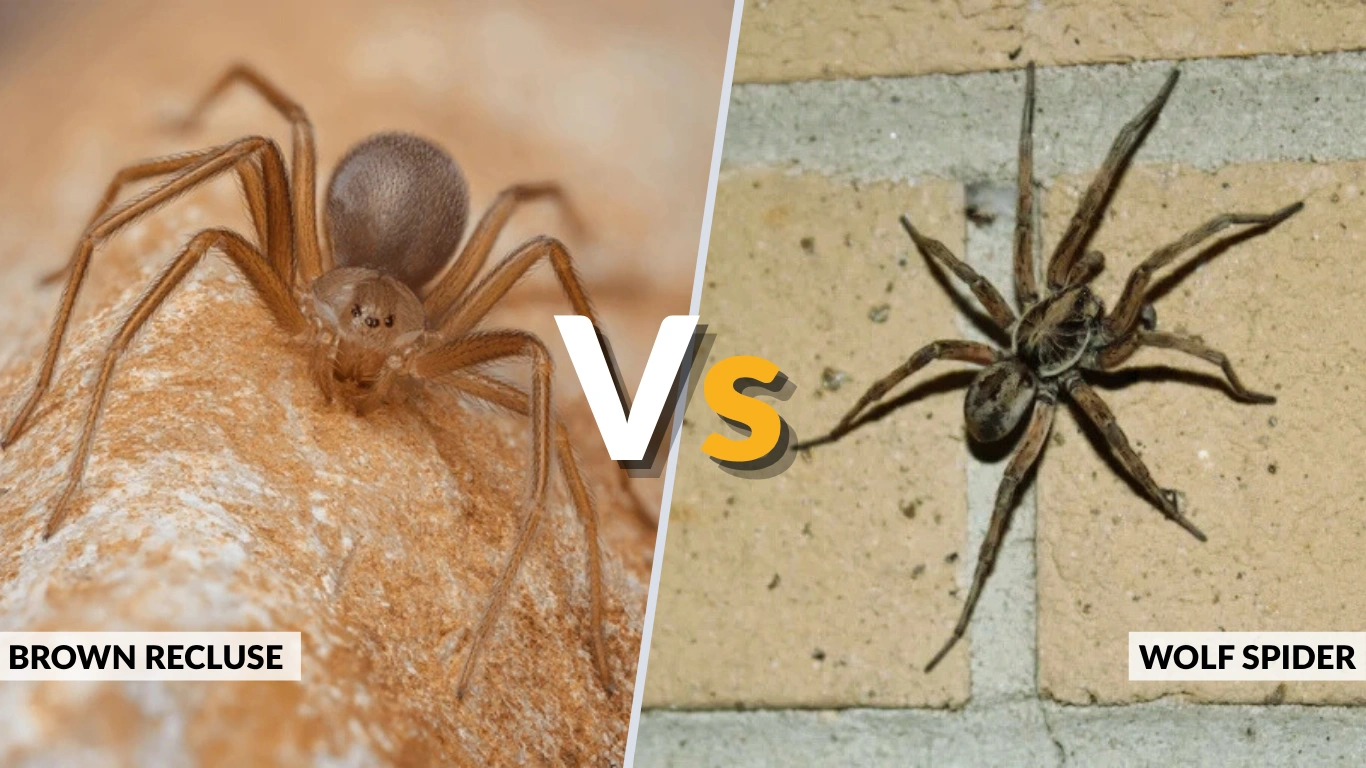
Brown recluse spiders and wolf spiders are often confused because both appear in homes, share similar brown tones, and move quickly. Yet they differ sharply in anatomy, behavior, venom strength, and danger to humans. Understanding these distinctions helps homeowners accurately identify what they’re seeing and prevents unnecessary fear. This guide explores their appearance, size, bite symptoms, habits, and common misidentifications to help you confidently tell them apart.
Overview of Both Spiders

Brown Recluse at a Glance
The brown recluse (Loxosceles reclusa) is a small, shy spider known for its violin-shaped marking and medically significant venom. It prefers dark, undisturbed indoor spaces such as closets, basements, storage rooms, and behind furniture. Unlike many other spiders, it has only six eyes arranged in three pairs — a key identification feature. Despite its reputation, it is not aggressive and bites primarily when pressed against skin.
Wolf Spider at a Glance
Wolf spiders belong to the Lycosidae family, which includes hundreds of species found across North America. They are fast, strong hunters that chase prey rather than relying on webs. Their bulky, hairy bodies, eight-eye arrangement, and reflective eyeshine make them easy to recognize. Though intimidating, their bites are rarely dangerous and usually cause only mild irritation. Wolf spiders commonly wander indoors while searching for insects or mates.
Key Differences Between Brown Recluse and Wolf Spider
Physical Appearance
Brown recluses are slender, smooth-bodied spiders with a uniform tan or light brown color. In contrast, wolf spiders are much bulkier and covered in dense hairs, giving them a rugged appearance. Brown recluses have very thin legs with little visible hair, while wolf spiders have thicker, visibly hairy legs that contribute to their intimidating look.
Markings and Visual ID
One of the most reliable ways to identify a brown recluse is its violin-shaped marking, with the “neck” pointing toward the abdomen. However, lighting, age, or dust can make this marking hard to see. Wolf spiders do not have this violin pattern; instead, they display bold stripes and mottled patterns across the cephalothorax and abdomen. These markings can vary by species but are almost always more complex than the recluse’s simple coloration.
Behavior and Movement
Brown recluses move quietly and slowly, often retreating when disturbed. They prefer stillness over confrontation and usually remain hidden. Wolf spiders, however, are fast movers that sprint across floors and walls. Their quick, darting behavior contributes to their reputation for being aggressive, even though they are not. Wolf spiders actively roam at night to hunt, whereas brown recluses tend to stay close to their hiding spots.
Identification Guide (With Look-Alike Variants)

Brown Recluse Identification Checklist
- Uniform tan or light brown body
- Smooth legs with no bands
- Distinct violin marking (when visible)
- Six eyes arranged in pairs
- Prefers dark, dry indoor spaces
- Small size, generally ¼–½ inch body length
These features distinguish the recluse from many house spiders. Because recluses are limited to specific regions, sightings outside these areas are often misidentifications.
Wolf Spider Identification Checklist
- Strong, robust body shape
- Noticeably hairy legs and abdomen
- Eight eyes arranged in three rows
- Prominent eye shine in low light
- Fast, active hunters that roam at night
- Size varies greatly depending on species
These traits make wolf spiders among the easiest to identify once you’re familiar with their body structure and behavior.
Other Spiders Often Confused
Many spiders resemble either the recluse or the wolf spider, leading to frequent misidentifications. Grass spiders, for example, have similar body markings to wolf spiders but build funnel webs and have long, delicate legs. Hobo spiders and dotted wolf spiders also cause confusion due to their earthy colors and quick movement. The rabid wolf spider, a common southeastern species, is often mistaken for a recluse because of its darker patterns and rapid running behavior. Understanding these differences helps reduce unnecessary fear and ensures safer handling of indoor encounters.
Size Comparison

Brown Recluse Size Range
Brown recluses remain relatively small throughout their lifespan. Adults typically measure between 6–12 mm (¼–½ inch) in body length, with a modest leg span that rarely exceeds the diameter of a quarter. Their slender build and smooth legs make them appear even smaller than their true measurements. Juveniles look almost identical to adults but are significantly lighter in color.
Wolf Spider Size Range
Wolf spiders show extreme size variation depending on species. Smaller varieties measure around ½ inch in body length, while larger species like the Carolina wolf spider can reach over an inch. Their broad bodies and thick, hairy legs give them a more formidable presence than recluses. Female wolf spiders, especially those carrying egg sacs or spiderlings, appear noticeably larger.
Side-by-Side Size Comparison Table
| Feature | Brown Recluse | Wolf Spider |
| Body Length | ¼–½ inch | ½–1+ inch |
| Leg Span | Up to a quarter-sized diameter | Wider, bulkier leg spread |
| Build | Slender, smooth | Thick, hairy |
| Visual Impact | Small, subtle | Large, intimidating |
Wolf spiders almost always appear larger, even when measurements overlap, due to their mass and hair-covered bodies.
Bite Comparison and Medical Concerns

Brown Recluse Bite Effects
Brown recluse bites can be serious because their venom contains enzymes capable of damaging soft tissue. Symptoms typically begin with mild irritation, followed by increasing pain over several hours. In some cases, the bite site may blister or develop necrosis. However, severe reactions are less common than often portrayed. Most bites heal without extensive damage when treated promptly, and many suspected recluse bites are actually caused by infections or other insects.
Wolf Spider Bite Effects
Wolf spider bites are medically mild. Their venom is not necrotic, and symptoms usually include swelling, itching, and localized redness. Pain is comparable to a bee sting and fades within minutes to hours. Wolf spiders rarely bite unless trapped against the skin, and even then, the reaction is generally minimal. Misdiagnosed wolf spider bites are far more common than confirmed ones.
Wolf Spider Bite vs Brown Recluse Bite
The most significant difference lies in the venom’s effect. Brown recluse bites may cause necrotic tissue damage, while wolf spider bites do not. Recluse bites may worsen over time, developing a dark center and open sore. Wolf spider bites improve quickly and do not cause tissue death. Because many insect bites look similar early on, professional diagnosis is recommended when symptoms escalate.
Brown Recluse Bite vs Wolf Spider Bite Pictures
Online bite photos can be misleading because many “recluse bite” images show unrelated infections, abscesses, or MRSA. Wolf spider bite photos often exaggerate reactions for dramatic effect. Real brown recluse bites typically start small and develop symptoms slowly over 24–72 hours. Genuine wolf spider bites rarely produce dramatic wounds. Relying solely on photos can lead to inaccurate conclusions.
Habitat and Regional Differences

Regions Where Brown Recluses Are Common
Brown recluses primarily inhabit the central and southern United States. States such as Missouri, Kansas, Oklahoma, Arkansas, and Tennessee fall within their natural range. They are rare in states like Florida, California, and Michigan, despite frequent claims. Most “brown recluse sightings” in these regions turn out to be harmless look-alikes. Indoors, recluses favor dry, dark, and undisturbed areas.
Regions Where Wolf Spiders Are Abundant
Wolf spiders are widespread across North America. They thrive in forests, grasslands, deserts, and suburban yards. Variants such as the Florida wolf spider, Texas wolf spider, and Michigan wolf spider reflect local species adapted to each region. These spiders regularly wander into homes and garages while hunting, making them among the most commonly encountered large spiders.
Misidentifications by Region
In Florida, wolf spiders are frequently mistaken for recluses even though true recluses are extremely rare there. In Oregon, hobo spiders and house spiders are often mislabeled as brown recluses. Missouri and Kansas, where both spiders can appear, produce the most legitimate comparisons. Because geography plays a major role in identification, understanding regional species helps prevent false alarms.
Behavior, Hunting & Threat Level

Wolf Spider Behavior
Wolf spiders are active hunters that chase down insects using speed and agility. Their tendency to run rapidly across floors makes them look aggressive, but they prefer to escape rather than confront threats. Female wolf spiders carry their egg sacs under their abdomen and may carry hundreds of spiderlings on their back, leading to surprising indoor encounters.
Brown Recluse Behavior
Brown recluses are true to their name — they avoid confrontation and prefer isolation. They rarely wander and spend much of their time hidden in clutter, boxes, cabinets, or dark corners. Recluses do not chase prey; instead, they rely on stillness and quick lunges to catch insects. Their shy nature means bites usually occur only when they are accidentally pressed against skin.
Danger Assessment: Which Is More Harmful?
The brown recluse poses the greater medical risk due to its venom’s potential tissue effects. Wolf spiders, while intimidating, are overwhelmingly harmless and deliver only mild, non-serious bites. In terms of likelihood, wolf spiders are more visible and active, but brown recluse bites are more consequential. Neither species is aggressive toward humans.
Multi-Spider Comparisons
Hobo Spider vs Wolf Spider vs Brown Recluse
Hobo spiders share earthy colors and similar speed with wolf spiders but have different eye arrangements and web-building habits. Brown recluses differ from both through their smooth legs, uniform color, and six-eye pattern. Wolf spiders stand out with their size and hairy texture.
Wolf Spider vs Grass Spider vs Brown Recluse
Grass spiders resemble wolf spiders but build funnel webs and have long, thin legs. Brown recluses differ sharply with their violin marking and smooth legs. Wolf spiders remain the largest and most robust of the three.
Wolf Spider vs Hobo vs Brown Recluse
Hobo spiders are often blamed for bites they rarely cause. Brown recluses possess more medically significant venom, while wolf spiders are generally harmless. Each can be misidentified depending on regional species overlaps.
Photo, Image & Video Search Intent
Brown Recluse vs Wolf Spider Photos & Images
Searchers often use visual cues to compare these spiders. Photos can help but should be interpreted cautiously, as lighting, angles, and species variation can create misleading impressions. Clear images of the eyes, body shape, and leg texture offer the most reliable identification clues.
Wolf Spider vs Brown Recluse Pictures
Wolf spider photos often highlight their large size and hairiness, while recluse photos emphasize the violin marking. However, many images online incorrectly label harmless spiders as recluses. Always verify with known anatomical features rather than relying on coloration alone.
Video Keywords & YouTube Searches
Comparison videos are popular online, showcasing wolf spiders running across floors or recluses hiding in corners. “Fight” videos or “who would win” clips tend to be sensationalized and not representative of natural spider behavior. These spiders rarely meet in the wild and almost never engage in combat.
“Who Would Win?” Comparisons
Wolf Spider vs Brown Recluse Fight
In hypothetical encounters, the outcome depends on size, speed, and context. Wolf spiders are larger and faster, giving them an advantage in physical strength. Brown recluses rely on quick strikes rather than brute force. In reality, neither seeks confrontation, and natural encounters are rare.
Why Spiders Rarely Fight in Nature
Spiders occupy different habitats and hunting styles, reducing the chance of direct conflict. Wolf spiders roam outdoors, while recluses prefer sheltered indoor areas. Most spiders avoid unnecessary fights because injuries could be fatal in the wild.
FAQs
What is the easiest way to tell a brown recluse from a wolf spider?
The simplest distinctions involve the eyes, body shape, and markings. Brown recluses have six eyes in pairs and a smooth, tan body with a violin marking. Wolf spiders have eight eyes in three rows, a bulkier, hairy body, and patterned markings. Observing leg hair and body thickness also helps differentiate them.
Are brown recluse bites more dangerous than wolf spider bites?
Yes. Brown recluse venom can occasionally cause necrotic tissue damage, leading to slow-healing sores. However, severe reactions are less common than many assume. Wolf spider bites, in contrast, are medically mild and rarely cause more than redness or swelling. Most wolf spider bites heal quickly with simple home care.
Do wolf spiders and brown recluses live in the same regions?
Their ranges overlap in parts of the central and southern United States, especially in states like Missouri, Kansas, and Arkansas. Brown recluses have a more limited range and are rare in northern or coastal states. Wolf spiders, however, live across the entire country and may appear almost anywhere indoors or outdoors.
Can wolf spiders or brown recluses infest a home?
Wolf spiders do not form true infestations; they wander indoors individually while hunting. Brown recluses can establish hidden indoor populations, but they typically remain out of sight and avoid human contact. Infestations occur mainly in cluttered or undisturbed spaces where recluses can hide, reproduce, and find insects.
What should I do if I find one of these spiders inside my house?
If the spider appears large, hairy, and fast-moving, it’s likely a wolf spider and can be safely relocated outdoors. If you suspect a brown recluse—smooth body, violin marking, small size—avoid handling it directly. Use a container to trap it, and consider contacting pest control if sightings become frequent.