
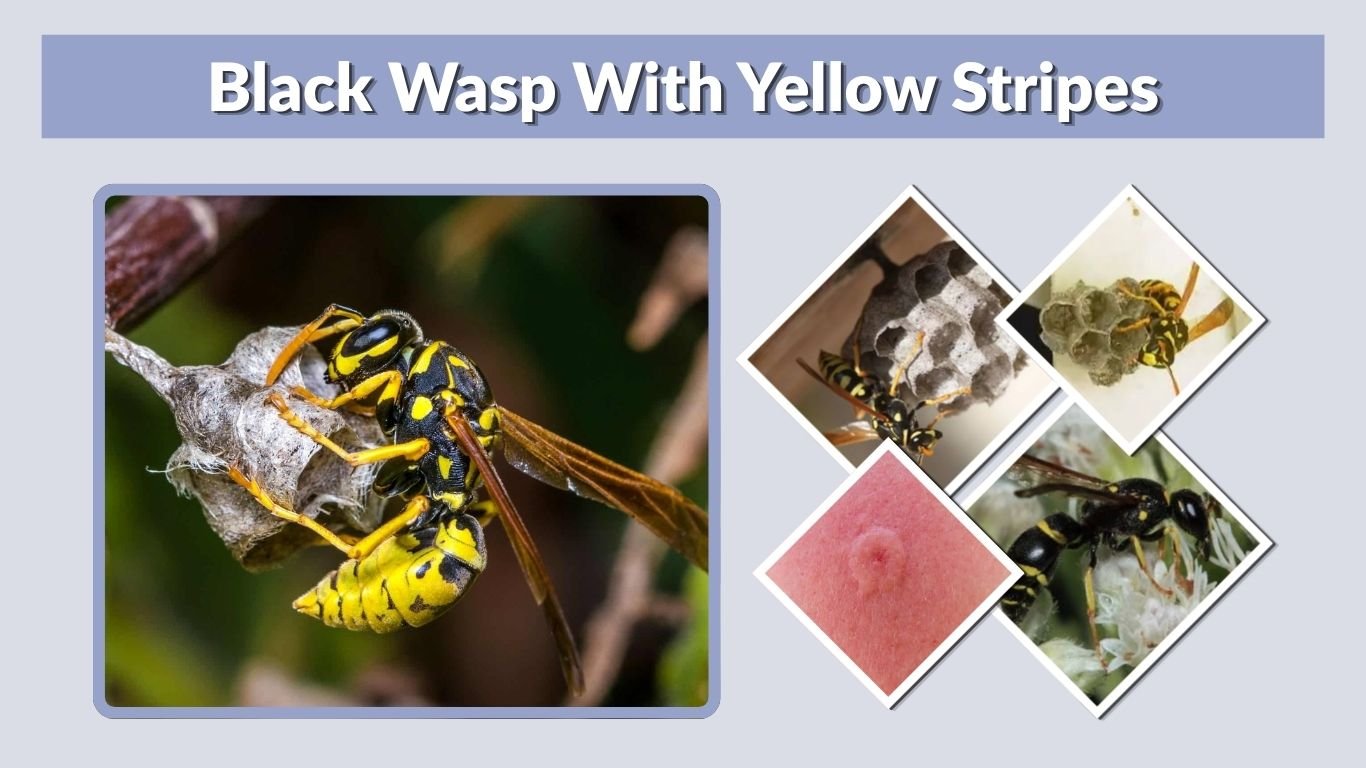
A black wasp with yellow stripes may be a yellowjacket, paper wasp, potter wasp, mason wasp, mud dauber, or another solitary hunting wasp. Color alone is rarely enough for an exact identification because numerous species share similar warning patterns. Body size, waist shape, leg position, wings, nesting location, behavior, and the number of abdominal bands provide stronger clues. This guide explains the most likely species and whether the insect poses a threat.
What Is a Black Wasp With Yellow Stripes?
The name “black wasp with yellow stripes” does not refer to a single species. It is a general description covering numerous social and solitary wasps.
Common possibilities include:
- Yellowjackets
- European paper wasps
- Potter and mason wasps
- Black-and-yellow mud daubers
- Sand and digger wasps
- Scoliid and tiphiid wasps
Yellowjackets are typically compact, smooth-bodied insects with bright black-and-yellow abdominal markings. European paper wasps have similar colors but usually possess slimmer bodies, narrower waists, and longer legs. Potter and mason wasps are often mostly black with one or several thinner yellow bands.
How to Identify a Black and Yellow Wasp
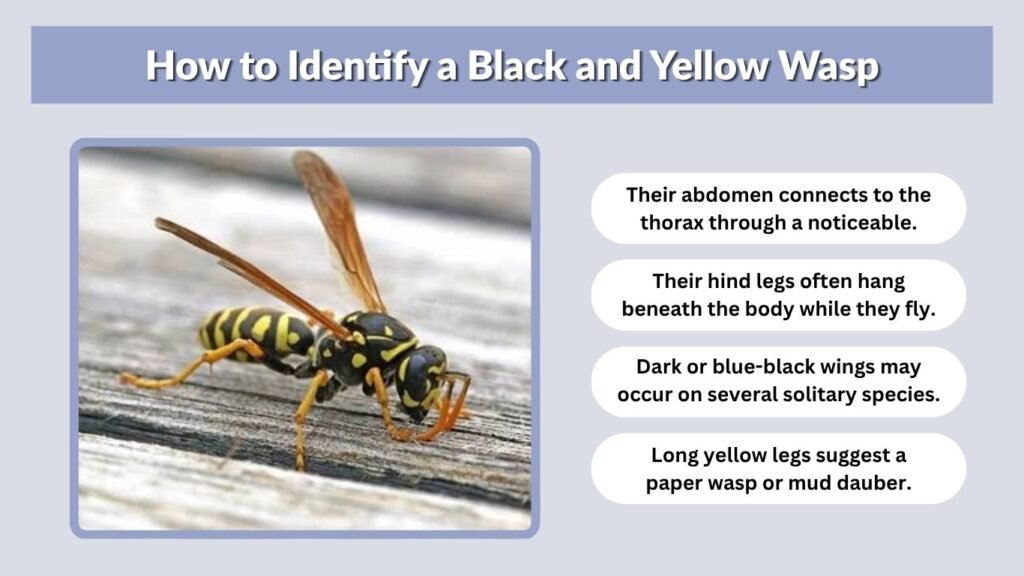
Look beyond the color pattern before attempting to identify the insect. Several physical and behavioral details can narrow the possibilities.
Examine the Body Shape
Yellowjackets have thick, compact bodies and relatively short legs. Their abdomen connects to the thorax through a noticeable but not extremely long waist.
Paper wasps appear more slender and elongated. Their hind legs often hang beneath the body while they fly. Potter and mason wasps may have compact abdomens but a more distinct, pinched waist.
Mud daubers generally have an exceptionally thin, thread-like connection between the thorax and abdomen. This shape makes them look longer and more delicate than yellowjackets.
Count the Yellow Stripes
The number of stripes can provide a clue, but it cannot confirm the species by itself. Markings may vary between species, sexes and individual insects.
| Yellow markings | Possible identification |
|---|---|
| One broad yellow stripe | Potter wasp, mason wasp or solitary hunting wasp |
| Two yellow stripes | Potter wasp, mason wasp or scoliid-type wasp |
| Three thin yellow stripes | Potter wasp, sand wasp or another solitary wasp |
| Numerous bold bands | Yellowjacket or European paper wasp |
| Yellow legs and thin body | Paper wasp or black-and-yellow mud dauber |
Observe the Wings and Legs
Dark or blue-black wings may occur on several solitary species. A black wasp with yellow stripes and blue wings could be a potter, mason, scoliid, or other hunting wasp rather than a yellowjacket.
Long yellow legs suggest a paper wasp or mud dauber. Yellowjackets usually have shorter legs that remain closer to the body during flight.
Notice Its Behavior
Behavior is often more useful than stripe count.
A wasp repeatedly entering a hole in the ground may be a yellowjacket or solitary ground-nesting species. One flying beneath roof edges could be a paper wasp. A wasp carrying mud toward a wall opening is probably a mud dauber or mason wasp.
Wasps gathering around garbage, sugary drinks, meat, outdoor meals, or fallen fruit are frequently yellowjackets. Solitary wasps are more commonly observed visiting flowers, searching vegetation for prey, or inspecting small nesting cavities.
Common Black Wasps With Yellow Stripes
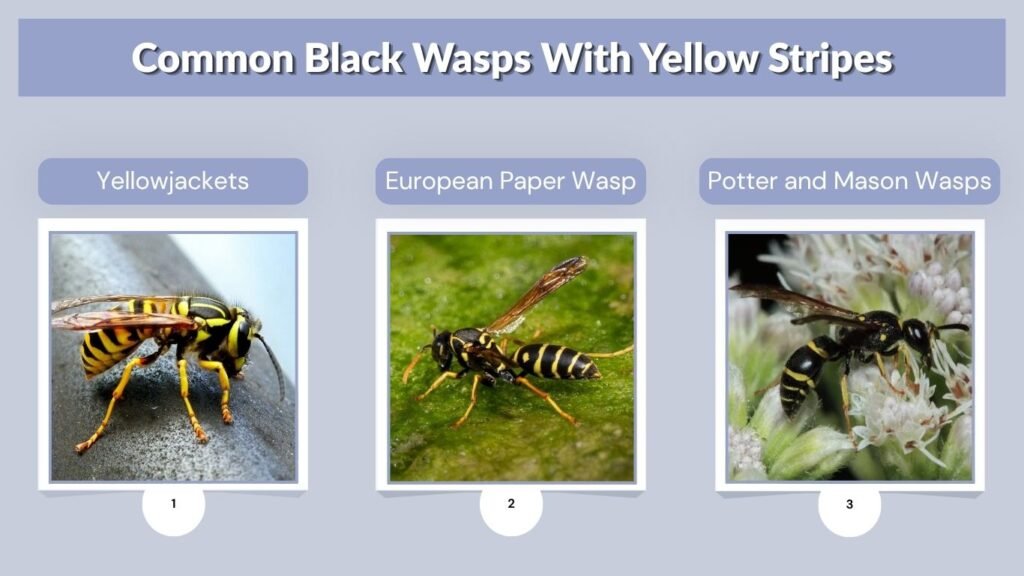
Several groups are regularly described using this search phrase.
Yellowjackets
Yellowjackets measure approximately 3/8 to 5/8 inch long and generally have hard, shiny bodies with little hair. Their yellow markings may form lines, spots, triangles or diamond-shaped patterns, depending on the species.
They live in social colonies containing workers and a queen. Nests may be underground, inside wall cavities, beneath structures, or attached to trees and buildings. Their defensive behavior makes them one of the more concerning possibilities.
A yellowjacket is especially likely when the insect is:
- Compact and smooth
- Boldly marked with several black-and-yellow bands
- Flying in and out of one entrance with other wasps
- Attracted to food, garbage or sweet drinks
- Aggressive near a nest
European Paper Wasp
The European paper wasp is predominantly black with prominent bright-yellow markings. It is frequently confused with a yellowjacket, but its body is generally slimmer and more elongated.
Paper wasps construct uncovered, umbrella-shaped paper combs. These nests may appear beneath eaves, railings, porch ceilings, outdoor furniture, sheds and other protected surfaces.
They usually ignore people while foraging. However, workers may defend a nest when someone approaches too closely or disturbs the supporting structure.
Potter and Mason Wasps
A mostly black wasp with one, two or three thin yellow stripes is often a potter or mason wasp. These solitary insects belong to the same broader family as yellowjackets and paper wasps but do not form large worker colonies.
Some build small mud pots, while others use existing holes in wood, stems, walls or masonry. Females provision their nest cells with paralyzed caterpillars that serve as food for developing larvae.
They may appear intimidating, but they are generally less defensive than social wasps. A single individual exploring flowers, walls or hollow openings is more likely to avoid confrontation.
Black-and-Yellow Mud Dauber
The black-and-yellow mud dauber has a narrow, elongated body, long legs and a thread-like waist. Its abdomen may appear mostly black with yellow sections or stripes.
Females collect mud and construct tubular cells on protected walls, ceilings, bridges, sheds and similar surfaces. They capture spiders and place them inside the cells as food for their young.
Mud daubers are solitary hunting wasps and are not normally aggressive. Their mud nests may later be occupied by other insects, so an active nest should be identified before it is handled.
Sand and Digger Wasps
A small black wasp with yellow stripes may belong to one of several ground-nesting solitary groups. These insects dig individual burrows in loose soil, sand, lawns, pathways or garden beds.
Some hunt flies, caterpillars, crickets or other insects. Multiple females may nest close together when an area provides suitable soil, giving the appearance of a colony. However, each female commonly maintains her own nest.
Large Black Wasp With Yellow Stripes
A large or giant black wasp with yellow bands is less likely to be an ordinary yellowjacket. Large specimens may be paper wasps, potter wasps, scoliid wasps, cicada-killing wasps or other solitary hunters.
Size can be difficult to judge when an insect is flying. Compare it with a nearby object and examine the abdomen, wings and waist from a safe distance.
The great black wasp is sometimes suggested, but a true great black wasp is predominantly violet-black with smoky wings and normally lacks bright yellow abdominal stripes. It can reach approximately 1 to 1¼ inches long.
Small or Tiny Black Wasp With Yellow Stripes
Tiny black-and-yellow wasps are often solitary species rather than miniature yellowjackets. Possibilities include small potter wasps, mason wasps, sand wasps and parasitoid wasps.
Many parasitoid wasps lay eggs in or on other insects and help control garden pests. They rarely interact with people and may be unable or unlikely to sting humans.
A small, compact insect repeatedly entering a social nest should still be treated cautiously. Juvenile wasps do not fly outside the nest, so a small flying individual is an adult species rather than a “baby wasp.”
Are Black Wasps With Yellow Stripes Dangerous?
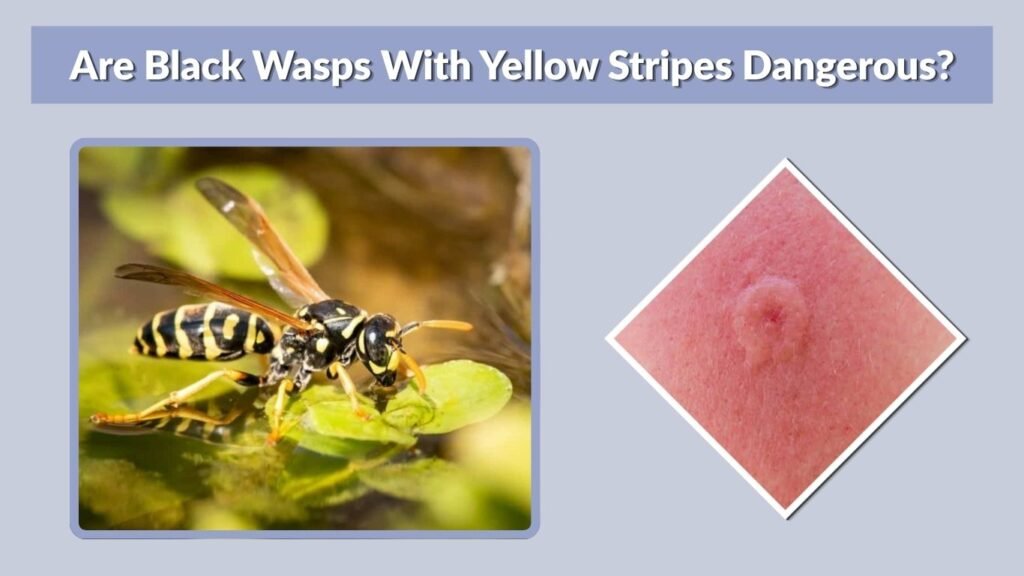
Their danger level depends primarily on whether they are social or solitary.
Yellowjackets and paper wasps can sting repeatedly because their stingers do not normally remain embedded in human skin. They are most likely to attack when their nest is disturbed. Yellowjackets may be particularly defensive when people walk near an underground entrance or operate lawn equipment nearby.
Solitary wasps can also sting, but they usually reserve their venom for capturing prey. Most avoid humans unless they are trapped, squeezed, stepped on or handled.
The insect is not “poisonous” in the usual sense. Venom is injected through a sting, while poison causes harm when touched or consumed.
What Does the Sting Feel Like?
A sting commonly causes:
- Immediate sharp or burning pain
- Redness around the puncture
- Local swelling
- Itching or tenderness
- Warmth around the affected area
Wash the site with soap and water, apply a cold pack wrapped in cloth, and avoid scratching it. Seek emergency medical help for difficulty breathing, swelling of the face or throat, faintness, widespread hives, or another sign of a severe allergic reaction.
Multiple stings, stings inside the mouth, or reactions involving a young child may also require prompt medical advice.
Black Wasp With Yellow Stripes in the House
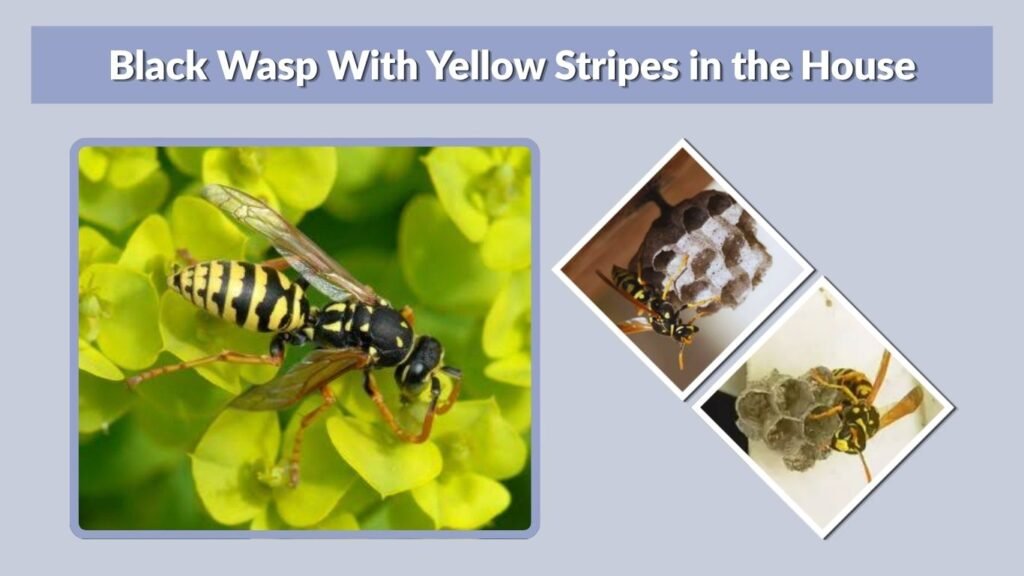
A single wasp indoors may have entered through an open door, window, vent, chimney or damaged screen. It may also have emerged from firewood or an overwintering site.
Repeated sightings suggest a possible nest in:
- An attic
- A wall void
- A chimney
- A roof opening
- A window frame
- An exterior vent
- A nearby shed or porch
Do not seal an active entrance immediately. Trapped social wasps may search for another exit and move farther into the building. Observe their flight path from a safe location and contact a pest-control professional when activity appears to originate inside a structure.
Black and Yellow Wasp Look-Alikes
Not every black insect with yellow stripes is a true wasp.
Hoverflies
Hoverflies imitate wasp coloration but have only one functional pair of wings. They have large fly-like eyes, short antennae and no stinger. Many can remain nearly motionless in the air.
Wasp Moths
Some moths possess black wings and yellow-banded abdomens. They may fly during the day and resemble wasps, but their scaled wings, moth-like antennae and lack of a narrow wasp waist provide identification clues. The yellow-banded wasp moth is one example of this mimicry.
Sawflies
Sawflies are related to wasps but have broad connections between the thorax and abdomen instead of narrow waists. Some females display black bodies with cream or yellow bands. Most cannot sting people.
FAQs
What kind of wasp is black with yellow stripes?
The most likely possibilities are a yellowjacket, European paper wasp, potter wasp, mason wasp or black-and-yellow mud dauber. Identification depends on its size, body shape, number of stripes, leg length, nesting behavior and geographical location.
What is a black wasp with one yellow stripe?
A black wasp with a single yellow abdominal stripe may be a potter wasp, mason wasp or another solitary hunting species. Some have incomplete bands that appear as one stripe from certain angles. A clear photograph is usually necessary for a reliable species-level identification.
What is a black wasp with two yellow stripes?
Two bold yellow stripes commonly occur in certain potter, mason and scoliid wasps. Many are solitary and relatively non-aggressive. However, markings vary, so examine the waist, legs, wings, size and nesting location before deciding what it is.
Will a black-and-yellow wasp sting?
Yes, female wasps may be capable of stinging. Social species such as yellowjackets and paper wasps are more likely to sting while defending a nest. Solitary species generally avoid people and usually sting only when trapped, pressed against the skin or handled.
How can I identify a black wasp with yellow stripes?
Photograph the insect without approaching a nest. Record its approximate size, stripe number, wing color, waist shape, leg color, behavior and nesting site. Also include the location and month observed, because regional distribution and seasonal activity can narrow the possible species.
