

Boll weevils may be small, but their impact on agriculture—especially cotton farming—has been enormous. These tiny beetles, scientifically known as Anthonomus grandis, originated in Mexico and made their way into the southern United States in the late 19th century, bringing billions of dollars in crop destruction. In this article, we’ll explore the meaning of a boll weevil, how it damages cotton, its life cycle, whether it still exists today, and what farmers have done to fight back. We’ll also address popular questions like “Are boll weevils dangerous?”, highlight their characteristics, and explain how they’ve shaped agricultural history.
What Is a Boll Weevil?
The boll weevil is a beetle that became infamous for its devastating impact on cotton crops in the southern United States. It primarily feeds on cotton buds and bolls, destroying the plant’s ability to produce usable fibers. Despite its small size, the boll weevil played a major role in reshaping agriculture and economy in affected areas.
Scientific Classification and Name
- Scientific Name: Anthonomus grandis
- Family: Curculionidae (true weevils or snout beetles)
- Order: Coleoptera (beetles)
Common Regions Found
- Native to Central Mexico
- Spread throughout southern U.S. in the early 1900s
- Still found near parts of Texas and Mexico
Boll Weevil Meaning and Origin
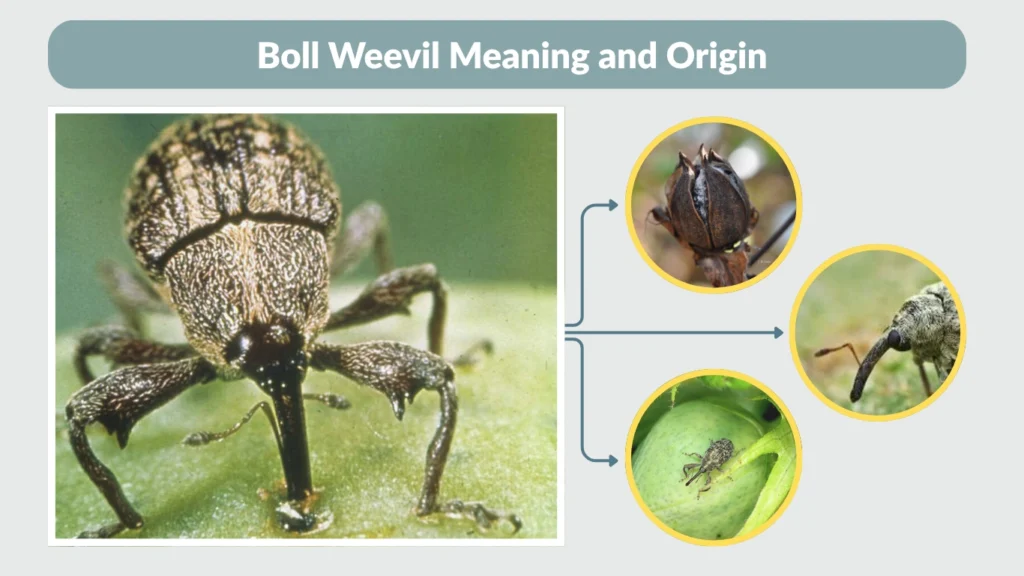
The term “boll weevil” refers specifically to this cotton-feeding insect, but it has also come to symbolize economic disruption and resilience in Southern communities. Understanding its origin is key to grasping the scope of its agricultural influence.
Meaning of Boll Weevil
- “Boll” refers to the rounded seed capsule of the cotton plant.
- “Weevil” is a type of beetle with a long snout that bores into plant material.
- Together, “boll weevil” describes a beetle that attacks cotton bolls.
Origin and Historical Entry into the U.S.
- Native to Central and Southern Mexico, where it fed on wild cotton species.
- First appeared in Texas in the 1890s.
- Spread rapidly across cotton-growing regions of the southern U.S. by the 1920s, aided by the expansion of cotton farming.
Boll Weevil Characteristics

Boll weevils are small, grayish-brown beetles with distinct physical features that help them burrow into cotton plants. Despite their size, their body is adapted to cause significant damage to cotton crops.
Key Identification Traits
- Size: About 6 mm (¼ inch) long
- Color: Gray to brown, with a rough, scale-like texture
- Snout: Long, curved snout used for boring into cotton bolls
- Antennae: Elbowed and clubbed, located on the snout
- Wings: Can fly short distances, helping them spread rapidly
Behavior and Habits
- Primarily active during warm months
- Adults feed and reproduce in cotton fields
- Can survive winter in plant debris or soil by entering diapause (dormancy)
Do Boll Weevils Still Exist?
Many people wonder if boll weevils are still around after the massive eradication programs in the U.S. The answer is yes, but their numbers have greatly declined thanks to aggressive control measures.
Current Presence in the U.S.
- Largely eradicated from most cotton-producing states
- Still present in limited areas of southern Texas near the Mexican border
- Continual monitoring and trapping programs are maintained in risk zones
Global Status and Risk
- Still exist in parts of Mexico, Central America, and South America
- Risk of reintroduction exists if vigilance decreases
- Climate change may influence future distribution patterns
Are Boll Weevils Dangerous?

Boll weevils are not dangerous to humans, but they are extremely harmful to agriculture—particularly cotton. Their destructive feeding habits have historically caused billions of dollars in crop losses across the southern United States.
Human Safety
- Boll weevils do not bite, sting, or carry diseases.
- They pose no direct health risk to humans or pets.
Agricultural Threat
- Considered one of the most damaging cotton pests in U.S. history.
- Infestations can lead to significant yield loss and crop failure.
Life Cycle and Reproduction
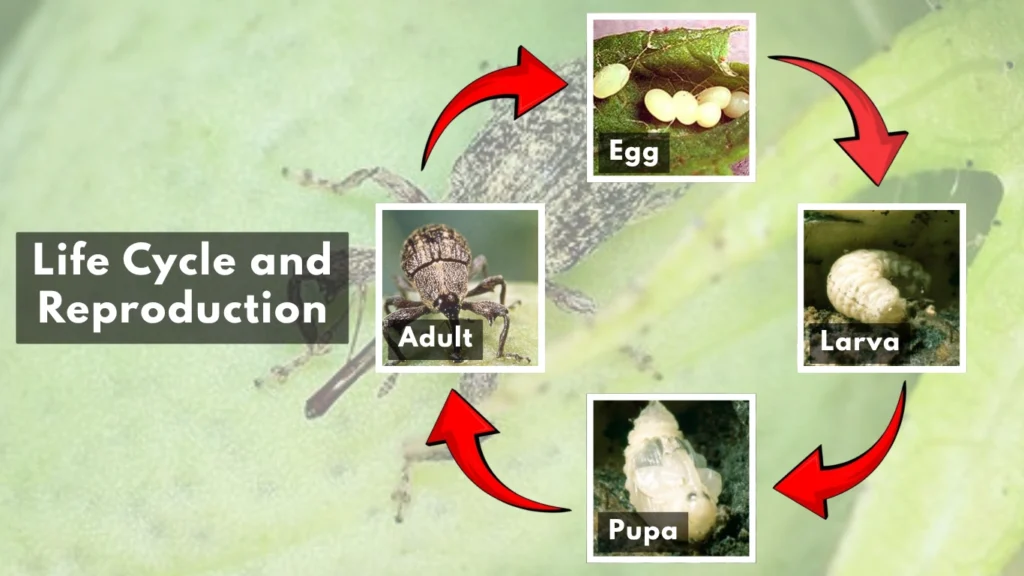
Understanding the boll weevil’s life cycle is crucial to controlling its population. These beetles are fast breeders, capable of producing multiple generations in a single season.
Key Life Stages
- Egg: Laid inside cotton squares or bolls by the female using her snout.
- Larva: Hatches inside the boll, feeding on seeds and destroying fibers.
- Pupa: Transforms within the damaged boll into an adult.
- Adult: Emerges to feed, mate, and lay more eggs.
Reproductive Cycle
- Up to 6–10 generations per year in warm climates.
- Life cycle completes in about 3 weeks during peak growing season.
- Adults can enter diapause (a dormant state) to survive winter.
How Boll Weevils Damage Cotton
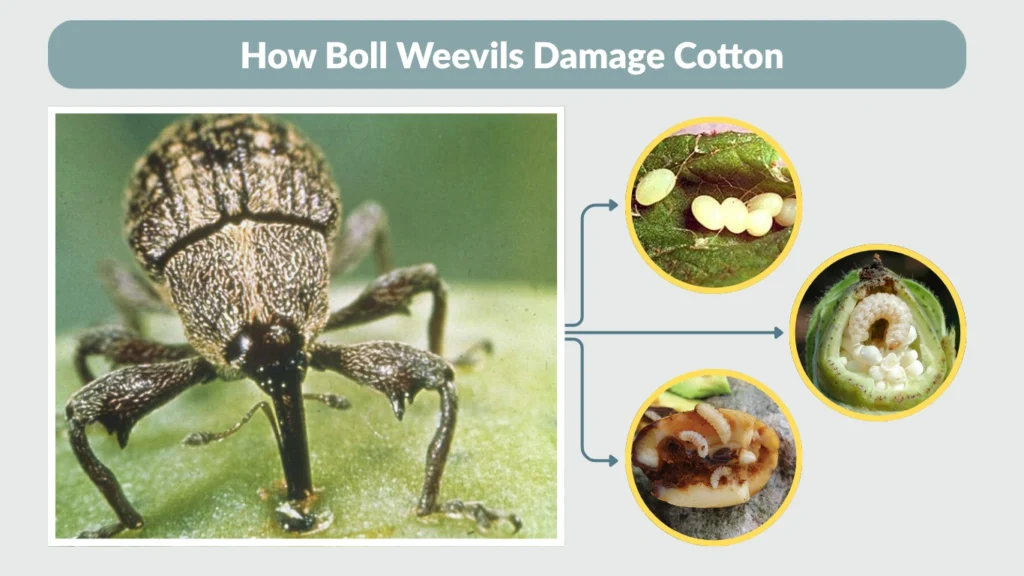
Boll weevils target the most vulnerable parts of the cotton plant—the flower buds and bolls. The damage they cause not only reduces yields but also affects fiber quality.
Feeding Behavior
- Adult weevils chew into young cotton squares and lay eggs inside.
- Larvae feed internally, causing the boll to turn yellow, drop, or rot.
- Damage becomes visible as holes, brown spots, or shedding fruit.
Signs of Infestation
- Premature fruit drop
- Small holes in bolls or squares
- Discolored or rotten cotton
- Increased presence of adult beetles on buds and stems
Boll Weevil Control Methods
Controlling boll weevils requires a mix of strategies tailored to their life cycle and behavior. Historically, heavy use of chemical insecticides like malathion and DDT was common, but this led to environmental concerns and resistance. Today, integrated pest management (IPM) is the preferred approach.
This includes field sanitation (removing old cotton stalks), early planting, and destroying infested bolls. Monitoring with pheromone traps helps detect weevil presence and time treatments effectively. In some regions, biological control agents like parasitoid wasps have also been introduced to target weevil larvae naturally.
The key to success is consistent, region-wide management—not just action from individual farmers.
Boll Weevil Eradication Program
Launched in the late 1970s, the Boll Weevil Eradication Program (BWEP) was one of the most successful pest control efforts in U.S. agricultural history. It combined scientific research, farmer cooperation, and government support to reduce and in many areas eliminate boll weevil populations.
The program used coordinated strategies like widespread pheromone trapping, GPS-based mapping, and targeted spraying. Farmers were also required to follow cultural practices like post-harvest field cleanup and timely planting.
As a result, cotton yields improved, pesticide use dropped by up to 70%, and most of the U.S. became boll weevil-free. Only a few border areas in southern Texas continue to monitor and manage low-level infestations.
Boll Weevil Pesticide Resistance
Pesticide resistance in boll weevils became a serious issue during the mid-20th century. Prolonged use of chemicals such as DDT and malathion led to the development of resistant populations, especially in heavily sprayed cotton fields.
This resistance forced farmers to apply higher doses or mix chemicals, which increased production costs and environmental risks. It also accelerated the need for alternative strategies, such as crop rotation and biological control.
Modern eradication efforts now emphasize minimal chemical use, relying instead on precise detection and timed, localized applications to reduce resistance buildup. As of today, resistance is still monitored closely in areas where eradication isn’t yet complete.
Natural Predators of Boll Weevils
In natural ecosystems, boll weevils face threats from a variety of predators and parasites that help keep their populations in check. These natural enemies can be effective allies in reducing weevil numbers, especially in areas where chemical use is limited.
Birds, ants, and spiders are among the common predators that feed on adult weevils. However, one of the most notable biological control agents is the parasitoid wasp Catolaccus grandis, which targets boll weevil larvae. These wasps lay their eggs inside weevil-infested cotton bolls, and their larvae consume the weevil larvae from within.
While natural predators alone may not eliminate weevils, they play a valuable role in an integrated pest management plan, especially when combined with cultural and chemical controls.
FAQs
To wrap up, here are some of the most common questions people ask about boll weevils—along with fast, clear answers based on entomological and historical facts.
Are boll weevils extinct?
No, boll weevils are not extinct. While largely eradicated in most U.S. cotton-producing areas, small populations still persist near the Texas-Mexico border and in parts of Central and South America.
What do boll weevils eat?
Their primary food source is cotton. Adult boll weevils feed on cotton buds and squares, while larvae develop inside the cotton bolls, feeding on the seeds and destroying the fiber.
Can boll weevils harm other plants?
Boll weevils are highly specialized and mainly target cotton plants. However, they can occasionally be found feeding on wild cotton or hibiscus species, but these cases are rare and typically not agriculturally significant.
Why is there a Boll Weevil Monument?
The Boll Weevil Monument in Enterprise, Alabama, honors the insect for pushing local farmers to diversify their crops, ultimately strengthening the region’s agricultural economy. It’s one of the only monuments in the world dedicated to a pest.
How do farmers detect boll weevil presence today?
Farmers use pheromone traps that attract adult weevils. These traps allow for precise monitoring and help guide targeted spraying or other control measures.
