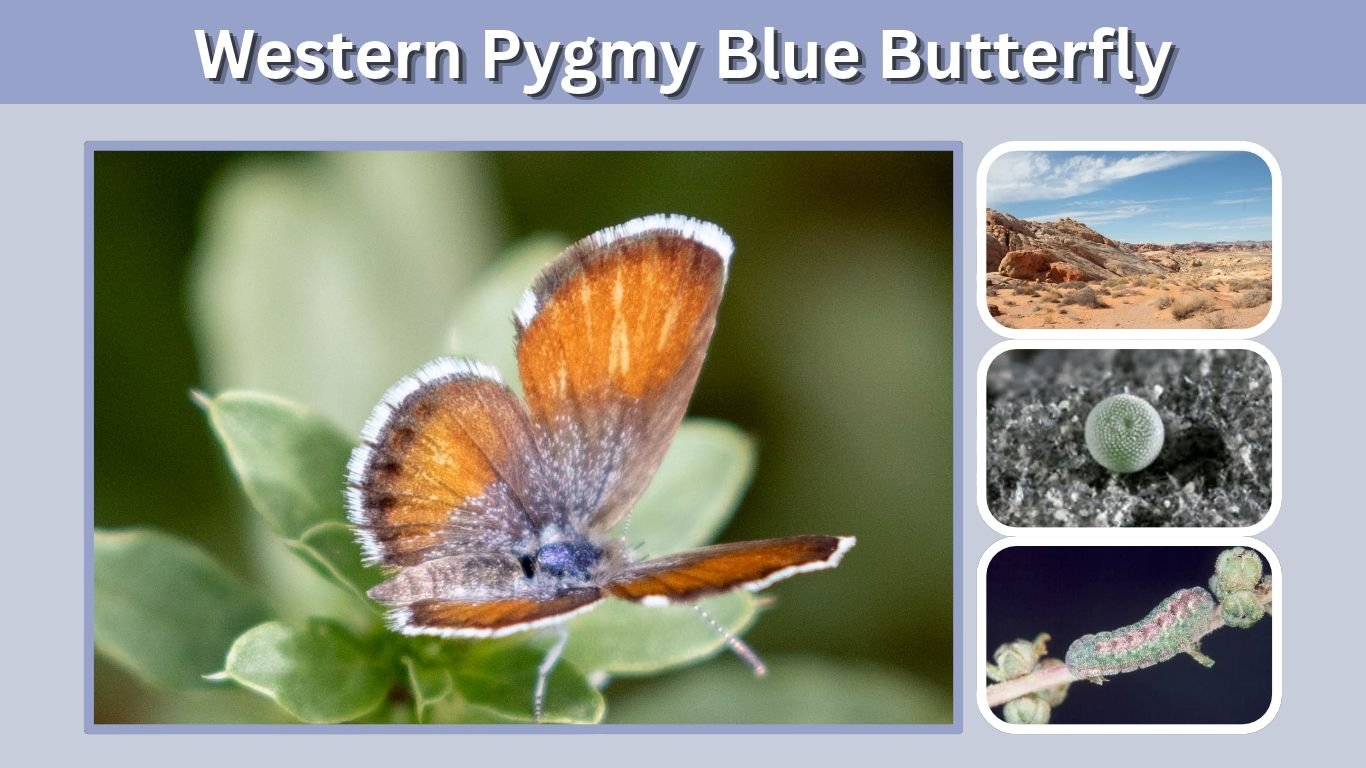
The western pygmy-blue butterfly (Brephidium exilis) is one of the smallest butterfly species in North America. Despite its tiny size, it has beautiful copper-brown wings with subtle blue markings near the body and delicate black spots along the edges. It is commonly found in dry landscapes, salt marshes, and alkaline habitats across the southwestern United States and Mexico. Its unusual appearance, short lifespan, and ability to survive in challenging environments make it an interesting species to explore.
What Is a Western Pygmy Blue Butterfly?
The western pygmy-blue butterfly is a tiny member of the family Lycaenidae, which includes blues, coppers, and hairstreaks. Its scientific name is Brephidium exilis, and it is particularly famous for being one of the smallest butterflies in North America. Although its common name suggests bright blue wings, its upper surface is mainly copper-brown with subtle blue coloring near the body. It spends much of its time flying close to low-growing vegetation.
Scientific Classification
The western pygmy-blue butterfly belongs to the following taxonomic groups:
- Scientific name: Brephidium exilis
- Common name: Western pygmy-blue butterfly
- Family: Lycaenidae
- Subfamily: Polyommatinae
- Genus: Brephidium
- Order: Lepidoptera
- Class: Insecta
Why Is It Called the Western Pygmy Blue?
The name describes its small body size, blue wing markings, and geographical distribution. The word pygmy refers to its unusually tiny dimensions, while blue describes the subtle blue scales near the bases of its wings. The term western distinguishes it from other small blue butterflies, including the eastern pygmy blue.
Western Pygmy Blue Butterfly Identification and Size
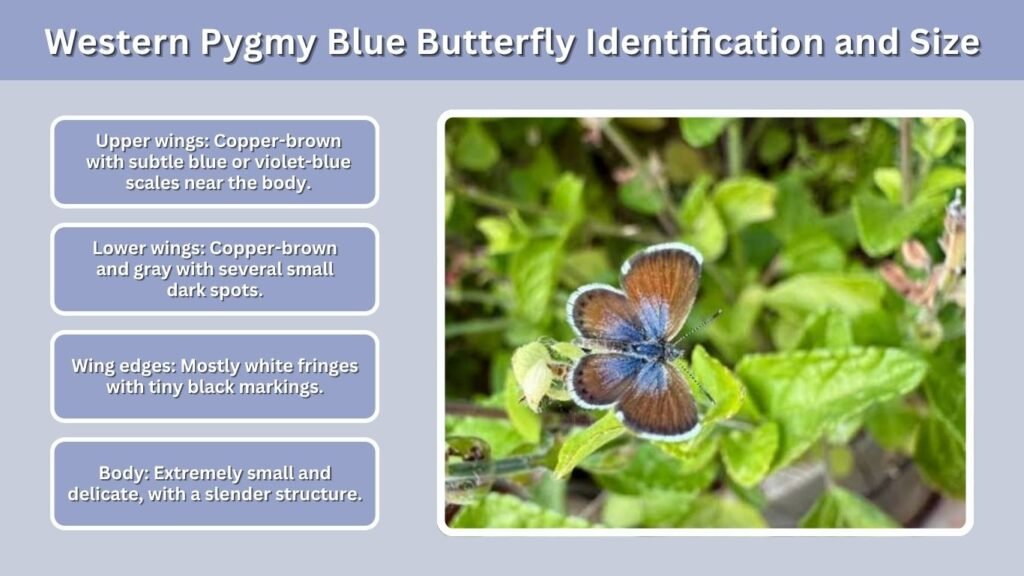
Identifying the western pygmy-blue butterfly can be challenging because it is extremely small and often flies close to the ground. Its wings have a combination of copper-brown, gray, white, and blue coloring. When viewed from above, the blue markings may be difficult to notice, but closer observation reveals its distinctive wing patterns and tiny dark spots.
How Big Is the Western Pygmy Blue Butterfly?
The western pygmy-blue butterfly has a wingspan of approximately 12–20 mm (0.5–0.75 inches). Its tiny body and delicate wings make it difficult to notice among low-growing plants. Females are generally larger than males, while males often display slightly more noticeable blue coloring on their upper wings.
Distinctive Physical Features
Several physical characteristics help identify this miniature butterfly:
- Upper wings: Copper-brown with subtle blue or violet-blue scales near the body.
- Lower wings: Copper-brown and gray with several small dark spots.
- Wing edges: Mostly white fringes with tiny black markings.
- Body: Extremely small and delicate, with a slender structure.
- Antennae: Short, club-shaped antennae typical of butterflies in the blue family.
- Caterpillar: Usually green or yellowish-green with small pale markings.
Male vs. Female Western Pygmy Blue
Male and female western pygmy-blue butterflies look similar, but their wing coloration can differ slightly. Males generally have more noticeable blue or violet-blue scales near the wing bases. Females tend to have less blue and a more copper-brown appearance. Females are also usually larger, which can provide another useful identification clue.
Western Pygmy Blue Butterfly Habitat and Distribution
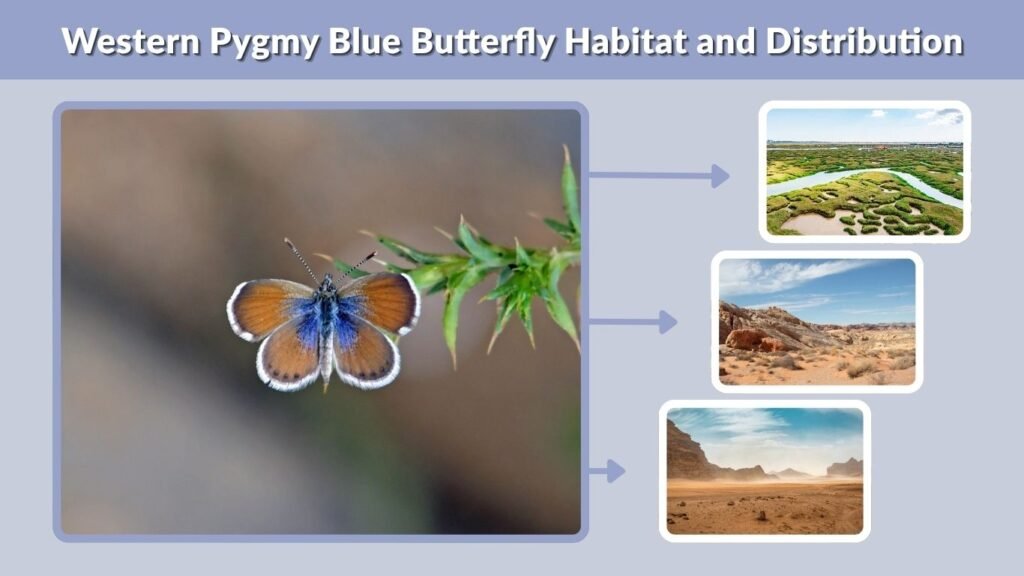
The western pygmy-blue butterfly is adapted to dry and alkaline environments where suitable host plants grow. It commonly inhabits salt marshes, desert lowlands, sandy areas, and disturbed landscapes. Although it is strongly associated with the southwestern United States, its distribution extends into Mexico and parts of Central America. Its ability to use several low-growing host plants helps it survive in different habitats.
Where Do Western Pygmy Blue Butterflies Live?
The species occurs across several regions of North America and beyond.
- California: Found in central and southern California, including dry valleys and alkaline habitats.
- Arizona: Occurs in desert landscapes and areas with suitable host plants.
- Nevada: Found in southern and central parts of the state.
- New Mexico: Occurs in dry lowland environments and surrounding regions.
- Texas: Common in western and southern Texas, with populations capable of flying throughout the year in warmer areas.
- Mexico: Found in Baja California and other parts of the country, with its broader range extending into Central America.
Its distribution can expand seasonally, and individuals may appear outside their usual core range.
Preferred Habitat Conditions
Western pygmy-blue butterflies prefer open environments with low-growing vegetation. They are especially associated with alkaline soils, salt flats, and areas containing salt-tolerant plants. They often fly close to the ground rather than moving high above trees or shrubs.
Their small size allows them to move easily through short vegetation. Warm weather and suitable host plants are important for breeding, while flowering plants provide nectar for adults.
Western Pygmy Blue Butterfly Diet and Host Plants
Food availability is important throughout the western pygmy-blue butterfly’s life cycle. Caterpillars depend on specific host plants for development, while adults obtain energy from flower nectar. Many of their host plants grow in dry, salty, or disturbed environments. This relationship helps explain why the species is frequently found around saltbushes, pigweeds, and other low-growing vegetation.
Common Western Pygmy Blue Butterfly Host Plants
The caterpillars feed on several plants, particularly members of the goosefoot and related plant groups.
- Saltbush (Atriplex): One of the most important host plant groups for this butterfly.
- Lambsquarters (Chenopodium album): Provides foliage for developing caterpillars.
- Russian thistle (Salsola): A common plant used by some populations, particularly in disturbed landscapes.
- Seepweed (Suaeda): An important host plant in certain alkaline and coastal habitats.
- Pigweed (Amaranthus): Some species can provide suitable food for developing larvae.
What Do Adult Western Pygmy Blue Butterflies Eat?
Adult western pygmy-blue butterflies primarily feed on flower nectar. Because of their small size, they often visit tiny flowers growing close to the ground. They use their long proboscis to reach nectar and obtain the energy needed for flying, mating, and reproduction.
Unlike adult butterflies, caterpillars feed directly on plant material. They may consume leaves, flowers, and other parts of their host plants as they grow.
Western Pygmy Blue Butterfly Life Cycle
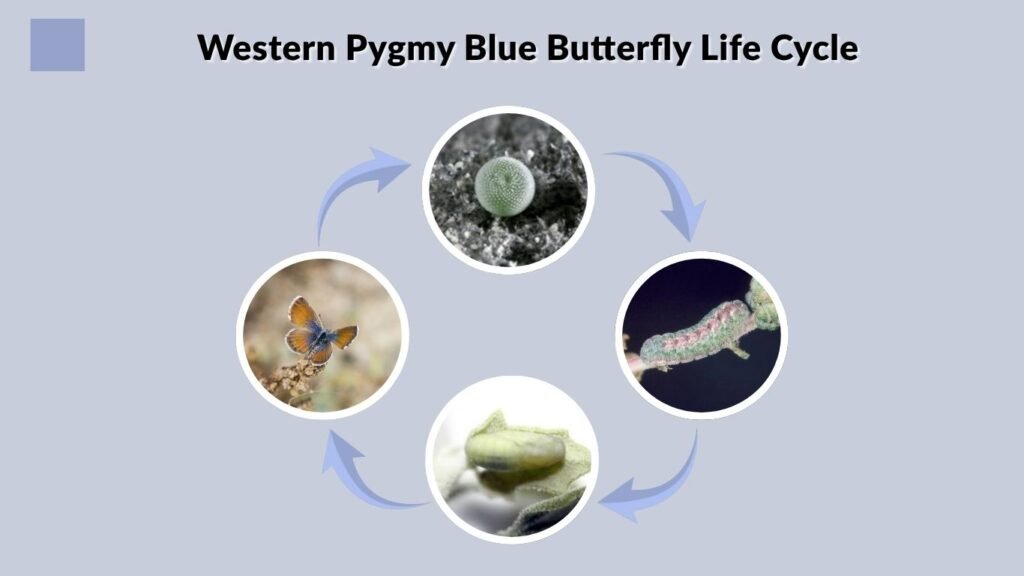
The western pygmy-blue butterfly undergoes complete metamorphosis, developing through four stages: egg, caterpillar, chrysalis, and adult. Each stage has a different appearance and function. Its development depends on temperature, food availability, and local environmental conditions. In colder regions, the chrysalis can survive winter before the adult butterfly emerges during more favorable weather.
1. Egg Stage
Female western pygmy-blue butterflies lay tiny, pale green or whitish eggs on suitable host plants. The eggs are usually deposited individually on leaves or other plant surfaces. Their small size makes them difficult to notice without close inspection.
After the eggs hatch, tiny caterpillars emerge and begin feeding on nearby plant material.
2. Caterpillar Stage
The caterpillar is small, green, and somewhat rough in appearance. Its body may have pale markings, small whitish structures, or darker stripes depending on its development and food source. It feeds on suitable host plants and gradually increases in size through several growth stages.
Unlike the colorful adult, the caterpillar is adapted to blend into the vegetation around it. This camouflage can make it difficult for predators to detect.
3. Chrysalis Stage
After completing its growth, the caterpillar prepares to pupate. It forms a smooth, oval-shaped chrysalis that is generally pale green and somewhat translucent. The chrysalis is usually attached to or located near a suitable host plant.
During this stage, the caterpillar undergoes the transformation into an adult butterfly. In many populations, the chrysalis can overwinter, allowing the species to survive colder seasonal conditions.
4. Adult Butterfly Stage
The adult western pygmy-blue butterfly emerges from the chrysalis with soft, folded wings. It gradually expands and dries its wings before beginning to fly.
Once fully developed, it searches for nectar, mates, and suitable locations for reproduction. Males often patrol around host plants looking for females, while females lay eggs on appropriate vegetation to begin another generation.
Western Pygmy Blue Butterfly Facts and Lifespan
The western pygmy-blue butterfly has several interesting characteristics beyond its miniature size. It is adapted to habitats that many other butterfly species may avoid, and its small wings allow it to move through low vegetation. Its seasonal activity also varies depending on geographical location and temperature.
How Long Does a Western Pygmy Blue Butterfly Live?
The adult western pygmy-blue butterfly has a relatively short lifespan. Some regional educational references report an adult lifespan of approximately 7–12 days, although actual survival can vary with weather, predators, and food availability. Its entire development takes longer because it includes the egg, caterpillar, and chrysalis stages.
Interesting Facts About Western Pygmy Blue Butterflies
- It is recognized as one of the smallest butterflies in North America.
- Its wingspan is generally between 12 and 20 mm.
- Its upper wings are mainly copper-brown rather than bright blue.
- Males patrol around host plants to locate potential mates.
- Its caterpillars feed on saltbushes and other suitable low-growing plants.
- Adults obtain energy from flower nectar.
- Its chrysalis can overwinter in colder parts of its range.
- It often flies very close to the ground, making it difficult to spot.
FAQs
1. Is the Western Pygmy Blue Butterfly the Smallest Butterfly in North America?
Yes. The western pygmy-blue butterfly is widely recognized as the smallest butterfly species in North America. Its wingspan measures approximately 12–20 mm, making it considerably smaller than most familiar butterfly species.
2. How Big Is a Western Pygmy Blue Butterfly?
An adult western pygmy-blue butterfly generally has a wingspan of 0.5–0.75 inches (12–20 mm). Its body is also very small, and its copper-brown wings have subtle blue markings near the center.
3. Where Can You Find Western Pygmy Blue Butterflies?
They are commonly found in the southwestern United States, including California, Arizona, Nevada, New Mexico, and Texas. Their distribution also extends through Mexico and into Central America. They prefer dry, alkaline environments and salt marshes.
4. What Do Western Pygmy Blue Butterfly Caterpillars Eat?
The caterpillars feed on plants such as saltbush (Atriplex), lambsquarters (Chenopodium album), Russian thistle (Salsola), and other suitable vegetation. Their diet depends on which host plants are available in their habitat.
5. How Long Does a Western Pygmy Blue Butterfly Live?
The adult stage may last approximately 7–12 days, although lifespan varies with environmental conditions. Before becoming an adult, the butterfly develops through egg, caterpillar, and chrysalis stages, which extend its overall life cycle.