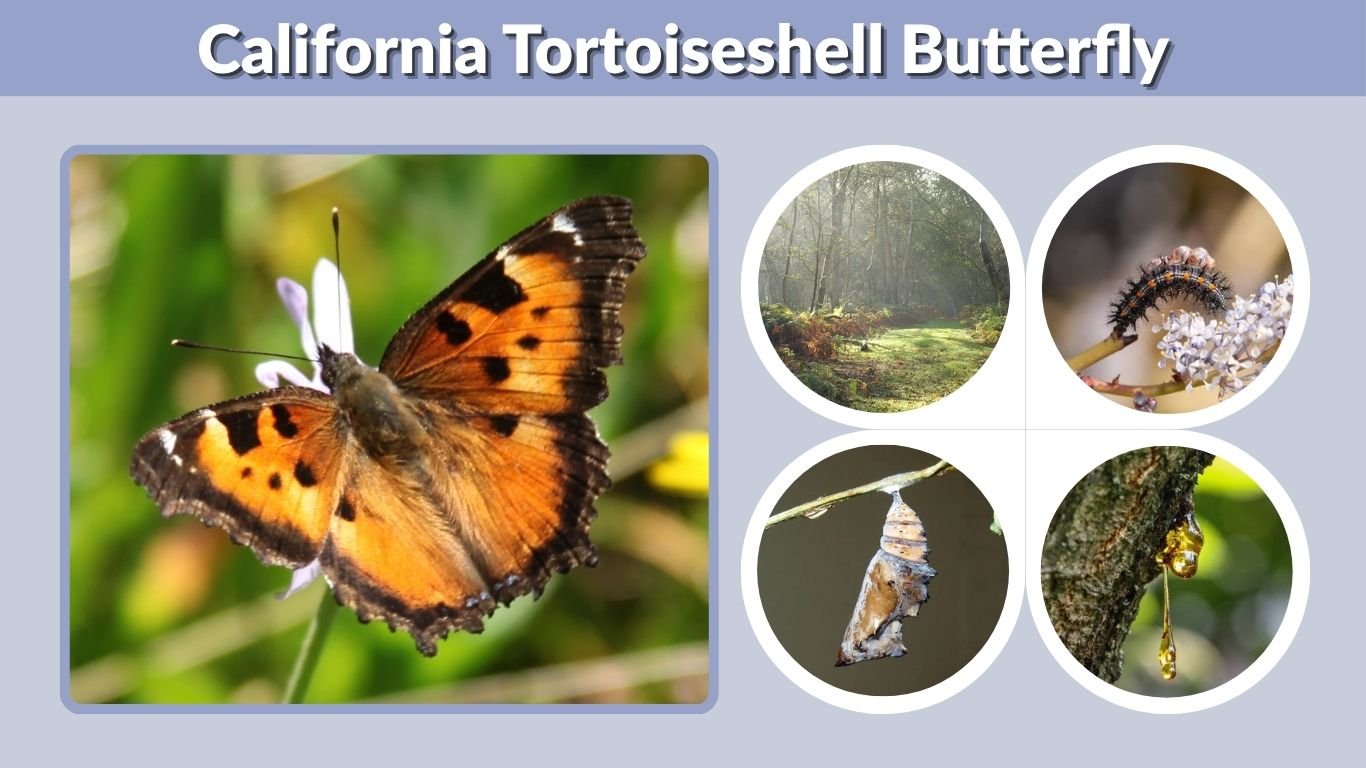
The California tortoiseshell butterfly (Nymphalis californica) is a beautiful orange-and-black butterfly native to western North America. Known for its remarkable seasonal migrations, this species sometimes appears in enormous numbers across California, Oregon, and the Sierra Nevada mountains. Its leaf-like wing undersides, unusual life cycle, and dependence on wild lilac plants make it particularly fascinating. Understanding the California tortoiseshell butterfly’s appearance, habitat, diet, caterpillar development, and migration patterns can help nature enthusiasts identify and appreciate this distinctive butterfly.
What Does a California Tortoiseshell Butterfly Look Like?
The California tortoiseshell is a medium-sized butterfly belonging to the Nymphalidae family, commonly known as brush-footed butterflies. It has distinctive orange-brown wings decorated with black markings. Its appearance provides both visibility during flight and effective camouflage when resting.
Physical Appearance and Identification
The most recognizable features of a California tortoiseshell butterfly include:
- Wingspan: Approximately 1.25–2.75 inches (3.2–7 cm).
- Wing color: Bright orange to rusty brown with prominent black spots.
- Wing borders: Dark, irregular edges with small bluish markings.
- Underside: Mottled brown and gray, resembling a dried leaf.
- Body: Dark brown with fine hairs and short front legs.
When its wings are open, the butterfly displays its colorful upper surface. When closed, its darker underside helps it blend into tree bark, rocks, and other natural surroundings.
California Tortoiseshell vs. Painted Lady
The California tortoiseshell is sometimes confused with the painted lady butterfly because both display orange-and-black wings.
However, painted ladies have conspicuous white spots on black forewing tips and a different pattern underneath. California tortoiseshells have more irregular wing edges and a dark, leaf-like underside.
These differences are especially useful when identifying butterflies during large seasonal migrations.
California Tortoiseshell Butterfly Habitat and Range
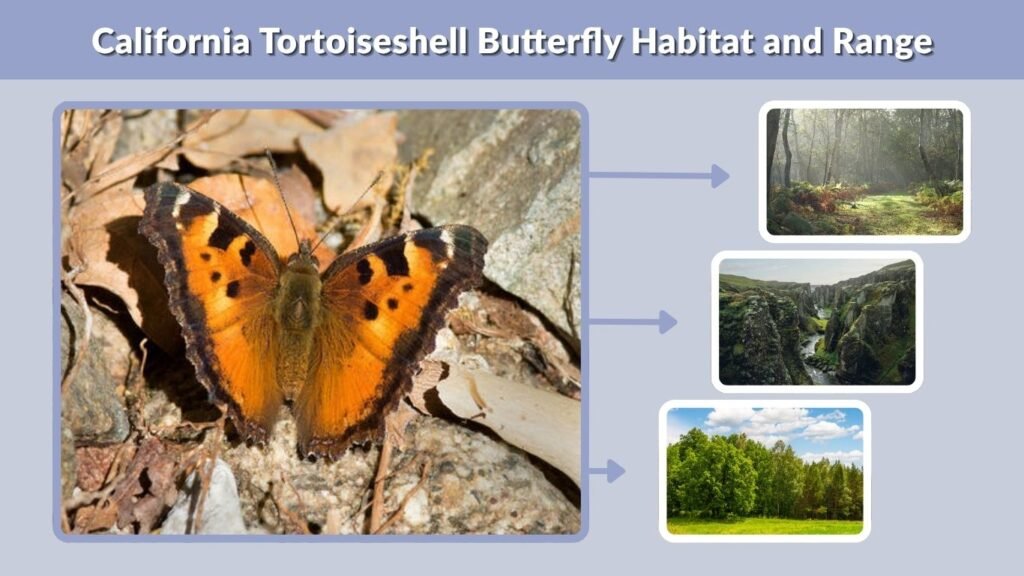
California tortoiseshell butterflies inhabit various environments across western North America. They are particularly associated with mountainous landscapes where their caterpillar host plants grow naturally. Their distribution changes throughout the year as adults move between breeding, feeding, and overwintering locations.
Where Do California Tortoiseshell Butterflies Live?
Their natural range extends from British Columbia through the western United States into northern Baja California. They also occur eastward into parts of the Rocky Mountain region.
Common habitats include woodland clearings, chaparral, mountain canyons, forest edges, and brush-covered hillsides.
In California, they inhabit the Sierra Nevada, Coast Ranges, and other mountainous regions. They are also found throughout Oregon, although their abundance varies considerably between years.
During major population increases, migrating individuals may appear far outside their usual habitats.
California Tortoiseshell Butterfly Life Cycle

The California tortoiseshell butterfly undergoes complete metamorphosis, developing through four stages: egg, caterpillar, chrysalis, and adult. Its reproduction closely follows seasonal plant growth, particularly the availability of fresh wild lilac leaves. Depending on the region, populations may produce additional broods during summer.
Egg Stage
Female butterflies lay clusters of small eggs on young leaves or stems of wild lilac plants belonging to the genus Ceanothus.
These plants provide food for newly hatched caterpillars. Egg development depends on environmental conditions, including temperature, and the larvae emerge when ready to begin feeding.
California Tortoiseshell Butterfly Caterpillar
California tortoiseshell caterpillars are dark, spiny larvae with yellow markings and a pale stripe along the back.
Young caterpillars often feed together in groups, consuming leaves from their host plants. When populations become extremely large, they may strip substantial amounts of foliage from wild lilac shrubs.
Unlike some other butterfly larvae, they do not construct large communal silk webs around their feeding areas.
As the caterpillars mature, they shed their skin repeatedly before entering the pupal stage.
Chrysalis and Adult Butterfly
After completing its larval development, the caterpillar attaches itself to a suitable surface and forms a hanging chrysalis.
The chrysalis is usually grayish or brownish, helping it blend into nearby vegetation.
Inside, the insect transforms into an adult butterfly. Once the adult emerges, its wings expand and harden before it begins flying.
In California’s foothills, many new adults emerge during late spring or early summer.
What Do California Tortoiseshell Butterflies Eat?
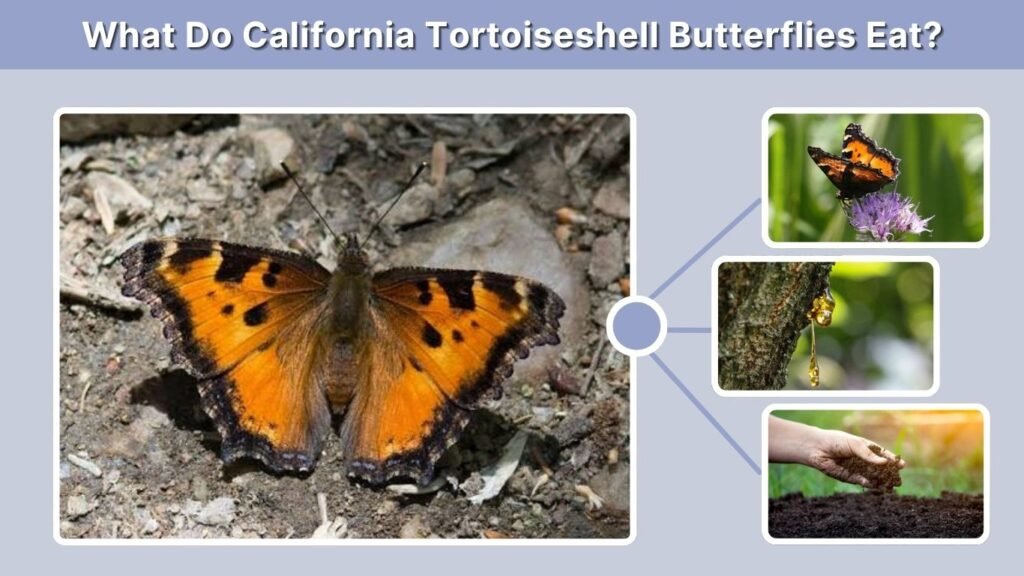
The diet of a California tortoiseshell changes as it develops. Caterpillars primarily consume leaves, while adults obtain liquid nourishment from flowers and other natural sources. Their food preferences influence where these butterflies breed, gather, and migrate.
Caterpillar Food and Host Plants
California tortoiseshell caterpillars depend on native wild lilac species. Important host plants include snowbrush (Ceanothus velutinus) and deerbrush (Ceanothus integerrimus).
These shrubs are particularly important because females lay their eggs on them, allowing developing caterpillars immediate access to food.
Adult Butterfly Diet
Adult California tortoiseshell butterflies consume several natural food sources:
- Flower nectar from native flowering plants.
- Tree sap and other sugary plant secretions.
- Juices from damaged or overripe fruit.
- Honeydew produced by sap-feeding insects.
- Moisture and dissolved minerals from damp soil.
Large gatherings sometimes occur around muddy patches, where butterflies obtain moisture and minerals through a behavior called mud-puddling.
California Tortoiseshell Butterfly Migration
Migration is one of the most remarkable behaviors of the California tortoiseshell butterfly. Unlike monarch butterflies, which are famous for their extensive seasonal journeys, California tortoiseshells generally move between foothill habitats and higher mountain elevations. However, their migrations can involve enormous numbers of individuals.
California Tortoiseshell Butterfly Migration in Tahoe
The Lake Tahoe region is well known for occasional mass movements of California tortoiseshell butterflies.
During spring and early summer, adults move toward higher elevations, where fresh host plants become available as mountain temperatures rise.
In 2019, large numbers of California tortoiseshell butterflies appeared throughout the Lake Tahoe Basin and surrounding Sierra Nevada.
Their abundance attracted considerable attention from residents, visitors, and butterfly researchers.
Mass migrations are not equally impressive every year. Population size, environmental conditions, and host plant availability influence the number of migrating butterflies.
California Tortoiseshell Butterfly Migration in Oregon
Oregon is another important part of this butterfly’s distribution.
California tortoiseshell butterflies occur in mountain canyons, forest openings, meadows, and other suitable habitats throughout the state.
During population outbreaks, considerable numbers may travel northward into Oregon, including areas associated with the Cascade Range.
For example, unusually abundant California tortoiseshells were reported in parts of northern California and Oregon during 2019.
These movements demonstrate how the butterfly can rapidly expand its visible presence across western landscapes.
How Long Do California Tortoiseshell Butterflies Live?
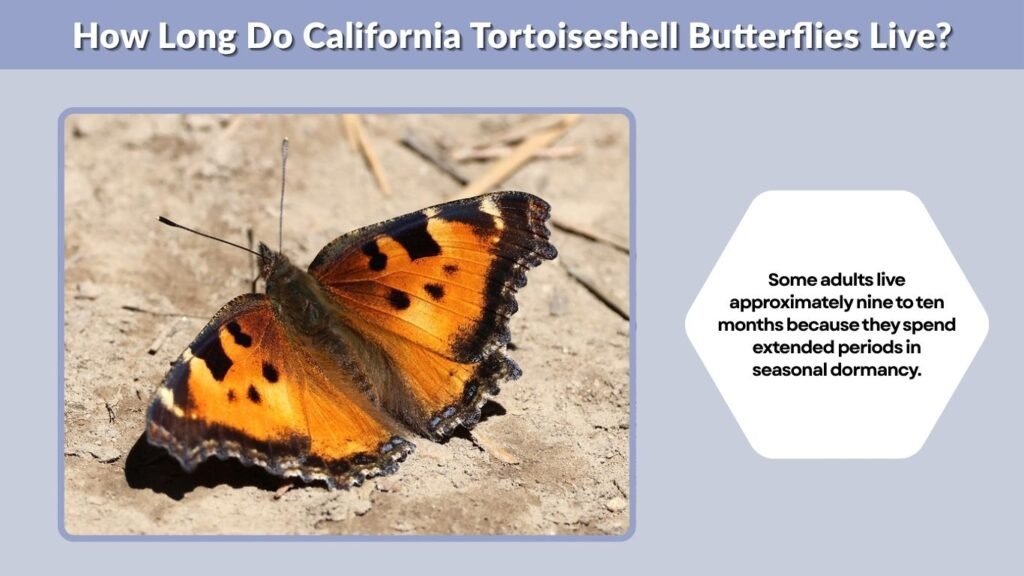
California tortoiseshell butterflies can survive considerably longer than many other butterfly species. Some adults live approximately nine to ten months because they spend extended periods in seasonal dormancy.
They may enter estivation, a period of reduced activity during hot summer conditions, particularly at higher elevations.
Later, adults descend toward suitable overwintering habitats and enter winter dormancy.
When temperatures become favorable, surviving adults become active again, mate, and reproduce.
This combination of summer and winter dormancy allows some individuals to survive across multiple seasons.
Are California Tortoiseshell Butterflies Rare?
California tortoiseshell butterflies are not considered globally threatened, but their populations fluctuate dramatically.
In some years, they appear relatively uncommon. In others, favorable breeding conditions produce enormous numbers of caterpillars and migrating adults.
Because their larvae depend on wild lilac, protecting native shrubland and woodland habitats helps support their populations.
These butterflies also contribute to local ecosystems by visiting flowers and serving as food for birds and other wildlife.
FAQs
1. Are California tortoiseshell butterflies poisonous?
California tortoiseshell butterflies are not known to be poisonous or dangerous to humans. They do not sting, and their adults are harmless. Their spiny caterpillars should nevertheless be handled gently or left undisturbed.
2. Do California tortoiseshell butterflies hibernate?
Yes. California tortoiseshell butterflies overwinter as adults. They shelter in protected locations during colder months and become active again when temperatures rise. Some also enter summer dormancy at higher elevations.
3. What is the California tortoiseshell butterfly’s host plant?
Various species of wild lilac (Ceanothus) serve as the main host plants. Female butterflies lay eggs on these shrubs, and their caterpillars feed on the leaves.
4. Is the California tortoiseshell the same as the small tortoiseshell?
No. The California tortoiseshell (Nymphalis californica) is native to western North America, while the small tortoiseshell (Aglais urticae) is a different species found across Europe and parts of Asia.
5. Why do California tortoiseshell butterflies migrate in large groups?
Large migrations often follow periods of successful reproduction and increased butterfly populations. Seasonal changes in temperature, host plant growth, and habitat conditions influence when and where these butterflies move.