
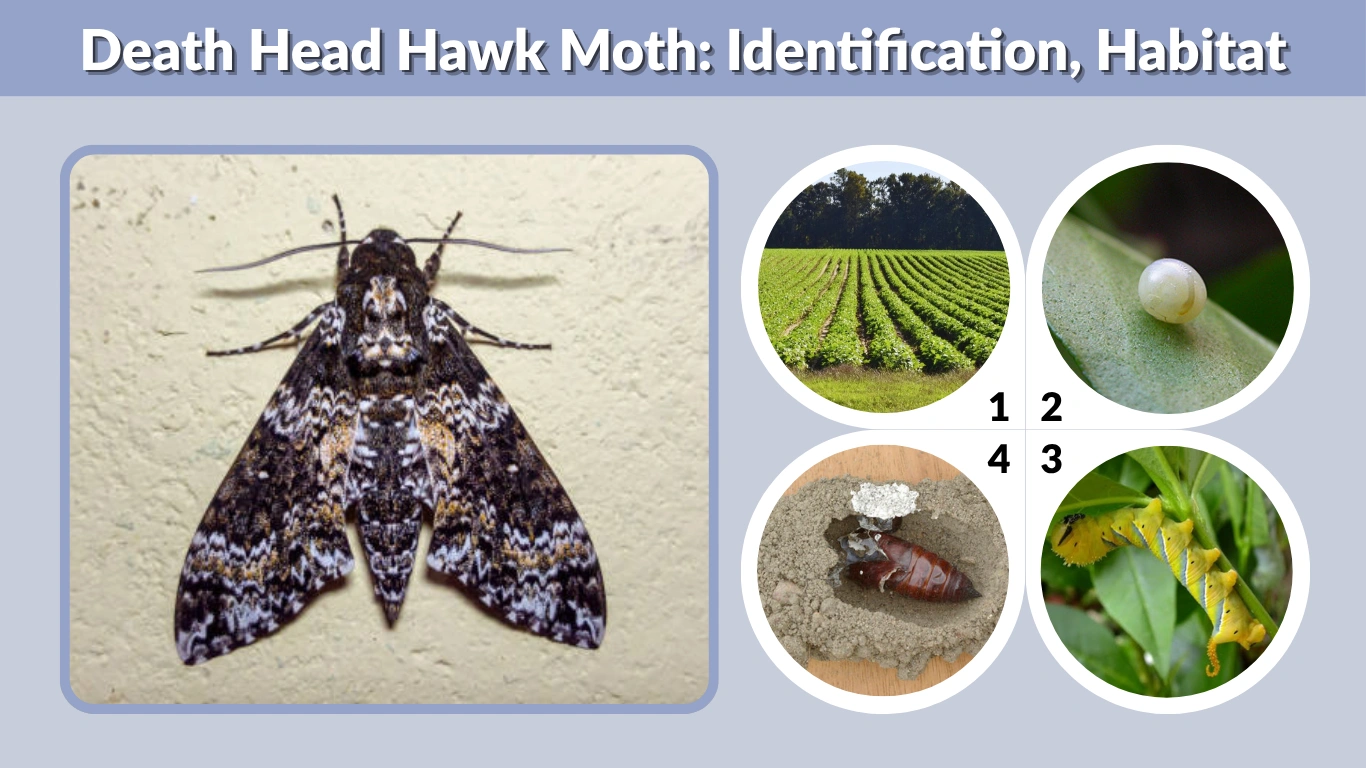
The death’s-head hawk moth is one of the most mysterious and fascinating moth species in the world. Known for the skull-like marking on its thorax, this large moth has captured human imagination for centuries. It belongs to the genus Acherontia and is often associated with folklore, superstition, and even popular culture.
Despite its somewhat eerie appearance, the death’s-head hawk moth is harmless to humans. Its unique features, including its ability to produce sound and its unusual behavior of entering beehives, make it stand out among other moths. In this guide, you’ll learn how to identify it, explore its caterpillar stage, understand its habitat, and discover some intriguing facts.
What is the Death’s-Head Hawk Moth?
The death’s-head hawk moth refers to a group of moths in the genus Acherontia, with the most well-known species being Acherontia atropos. These moths are part of the Sphingidae family, commonly known as hawk moths, which are recognized for their strong flying ability and large size.
The name “death’s-head” comes from the distinctive skull-like pattern found on the thorax of the adult moth. This marking, combined with its large size and dark coloration, has led to many myths and superstitions throughout history.
Key Characteristics
One of the most notable features of the death’s-head hawk moth is its skull-like marking, which gives it a unique and slightly intimidating appearance. However, this is purely a visual trait and has no harmful function.
These moths are relatively large and heavy-bodied, with strong wings that allow them to fly long distances. Another unusual trait is their ability to produce a squeaking or chirping sound when disturbed, which is rare among moth species.
They are primarily nocturnal and are most active during the night, when they feed and search for mates.
Death’s-Head Hawk Moth Identification
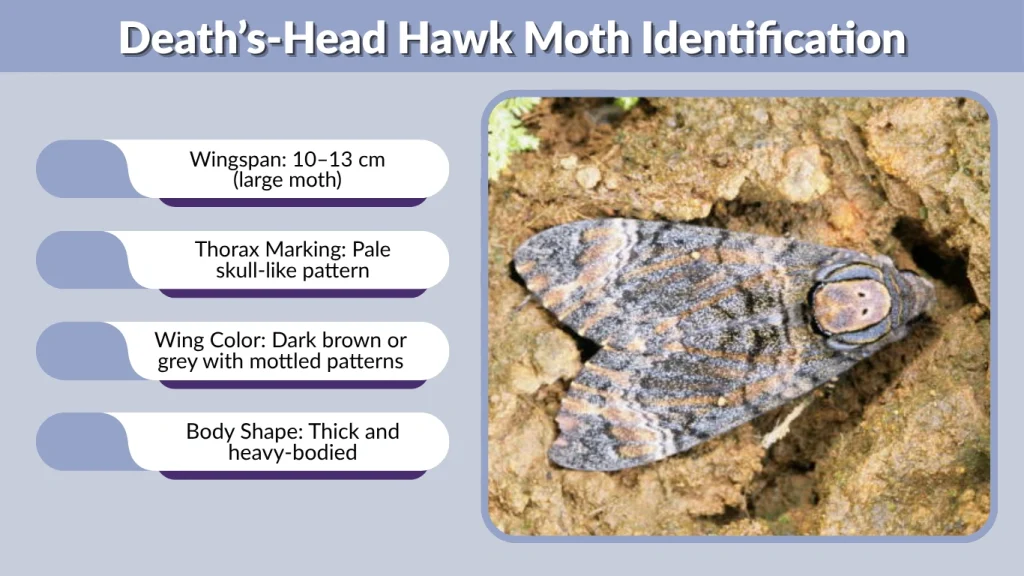
The death’s-head hawk moth is one of the easiest moths to recognize due to its large size and distinctive markings. Its most notable feature is the skull-like pattern on its thorax, which gives the species its name. Combined with its dark wings and bold body stripes, this moth has a unique and slightly intimidating appearance.
Quick Identification Features
- Wingspan: 10–13 cm (large moth)
- Thorax Marking: Pale skull-like pattern
- Wing Color: Dark brown or grey with mottled patterns
- Abdomen: Yellow and black striped (wasp-like appearance)
- Body Shape: Thick and heavy-bodied
- Flight Style: Strong, fast flyer
- Activity Time: Nocturnal (active at night)
- Sound: Produces a squeaking noise when disturbed
Identification Tips
- Look for the distinct skull marking on the thorax
- Notice the bold striped abdomen, unlike most moths
- Often found near farmland or gardens
- May be seen around beehives or flowers at night
These features make the death’s-head hawk moth one of the most recognizable and unusual moth species in the world.
Death’s-Head Hawk Moth Caterpillar
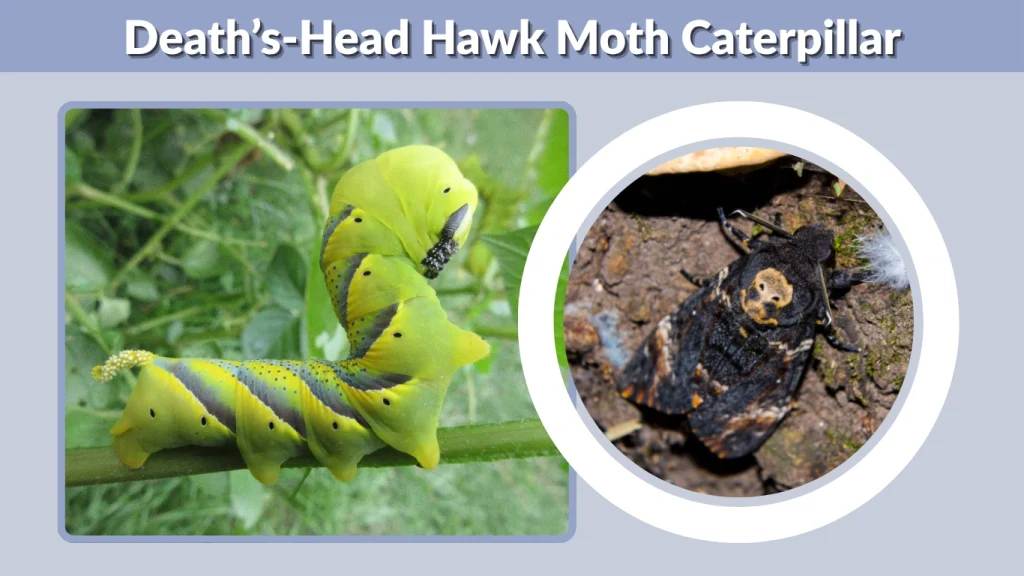
The caterpillar stage of the death’s-head hawk moth is large, colorful, and equally impressive.
Appearance
The caterpillars can vary in color, commonly appearing in bright green, yellow, or brown forms. They have diagonal stripes along their bodies and a curved horn at the rear, which is typical of hawk moth larvae.
As they grow, they can reach a considerable size, often becoming quite thick and noticeable.
Diet and Host Plants
Death’s-head hawk moth caterpillars feed on a variety of plants. Common host plants include potato, tomato, jasmine, and olive. Because they consume agricultural crops, they are sometimes considered pests in certain regions.
Their feeding activity is intense, as they need to store enough energy for the pupal stage.
Growth and Development
During the larval stage, the caterpillar goes through several molts, known as instars. With each stage, it grows larger and changes slightly in appearance.
This stage lasts for several weeks, after which the caterpillar prepares to pupate.
Death’s-Head Hawk Moth Habitat
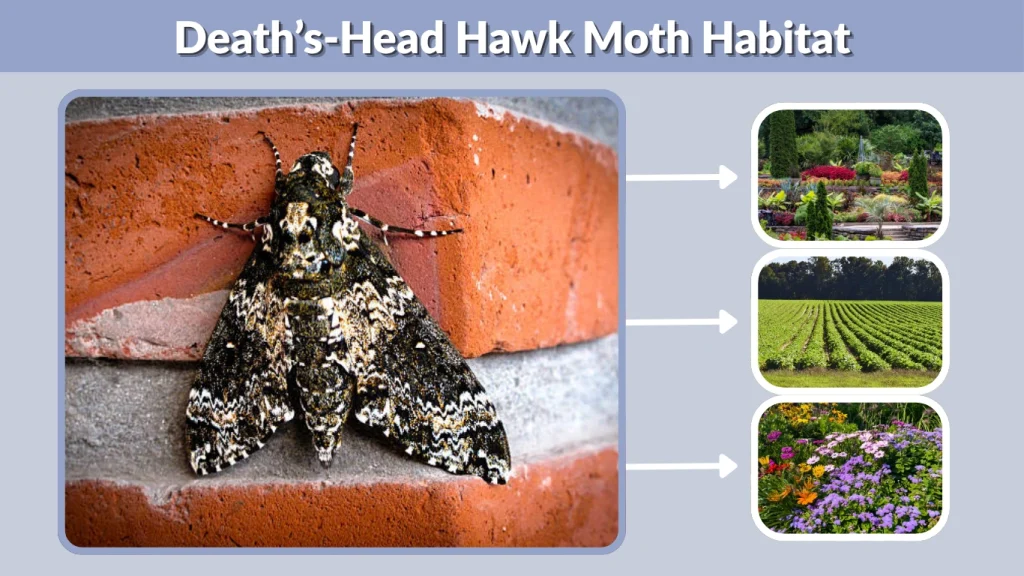
The death’s-head hawk moth is widely distributed across multiple continents and thrives in a variety of environments.
Geographic Distribution
This species is commonly found in Africa, parts of Asia, and southern Europe. It is also known to migrate into northern regions, including the UK, especially during warmer seasons.
Its wide distribution is partly due to its strong flying ability and adaptability.
Preferred Environments
Death’s-head hawk moths prefer habitats such as gardens, farmland, and open countryside where host plants are abundant. They are often found in areas where crops like potatoes and tomatoes are grown.
They are also attracted to places where they can find nectar sources and suitable breeding grounds.
Death’s-Head Hawk Moth Life Cycle
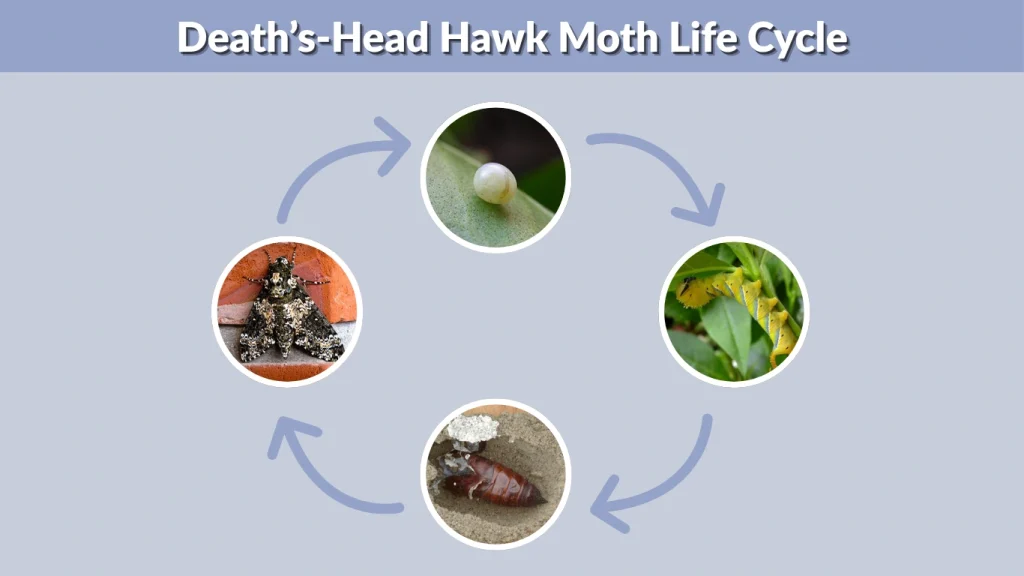
Like all moths, the death’s-head hawk moth undergoes complete metamorphosis, progressing through four distinct stages: egg, larva, pupa, and adult.
Egg Stage
The life cycle begins when the female lays eggs on suitable host plants such as potato or jasmine. These eggs are small, smooth, and typically laid on the underside of leaves to protect them from predators.
They usually hatch within a few days, depending on environmental conditions like temperature and humidity.
Larval Stage
Once the eggs hatch, the caterpillars begin feeding immediately. This stage is marked by rapid growth, with the caterpillar consuming large amounts of plant material.
Over several weeks, it goes through multiple molts (instars), growing larger and storing energy. The caterpillar’s bright colors and horn remain visible throughout this stage.
Pupal Stage
After reaching full size, the caterpillar burrows into the soil to pupate. Unlike some moths that form cocoons above ground, the death’s-head hawk moth develops underground.
Inside the pupa, the caterpillar transforms into an adult moth. This stage may last a few weeks, although it can be longer in cooler conditions.
Adult Stage
The adult moth emerges from the soil fully developed. It is nocturnal and spends its time feeding on nectar, mating, and laying eggs.
Adults are strong fliers and can travel long distances, contributing to their wide distribution.
Death’s-Head Hawk Moth Facts
The death’s-head hawk moth is surrounded by fascinating facts that make it one of the most unique moths in the world:
- It gets its name from the skull-like marking on its thorax
- It can produce a squeaking sound when disturbed
- It is one of the heaviest moth species
- It has been featured in films like The Silence of the Lambs
- It can enter beehives and steal honey without being attacked
These traits have contributed to its mysterious reputation and cultural significance.
Behavior and Adaptations
The death’s-head hawk moth has several unique behaviors and adaptations that help it survive.
It is primarily nocturnal, which reduces the risk of predation and allows it to feed when flowers are open at night. Its dark, mottled wings provide excellent camouflage during the day.
One of its most unusual adaptations is its ability to produce sound. When threatened, it emits a squeaking noise that may startle predators.
Perhaps the most remarkable behavior is its interaction with bees. The moth can mimic the scent of bees, allowing it to enter hives undetected. Once inside, it feeds on honey, a rare behavior among moths.
Its strong wings and large body enable it to migrate over long distances, making it a successful and adaptable species.
Is the Death’s-Head Hawk Moth Dangerous?
Despite its intimidating appearance, the death’s-head hawk moth is not dangerous to humans.
It does not bite or sting, and the squeaking sound it produces is harmless. However, its caterpillar may cause damage to crops, which is why it is sometimes considered an agricultural pest.
Overall, the moth plays a role in pollination and is an important part of the ecosystem.
FAQs
What is special about the death’s-head hawk moth?
It is famous for the skull-like marking on its thorax, its ability to make a squeaking sound, and its unusual behavior of entering beehives to steal honey.
Is the death’s-head hawk moth harmful to humans?
No, it is completely harmless. It does not bite or sting and poses no threat to people.
What does the death’s-head hawk moth caterpillar look like?
The caterpillar is large and colorful, often green, yellow, or brown, with diagonal stripes and a curved horn at the rear.
Where does the death’s-head hawk moth live?
It is commonly found in Africa, Asia, and southern Europe, and sometimes migrates to northern regions like the UK.
Why does the death’s-head hawk moth make a sound?
It produces a squeaking sound as a defense mechanism, which may help scare away predators when the moth feels threatened.
Conclusion
The death’s-head hawk moth is a truly remarkable species, known for its striking appearance and unusual behaviors. From its skull-like marking to its ability to produce sound and interact with beehives, it stands out as one of the most fascinating moths in the world.
Although it may appear intimidating, it is harmless to humans and plays an important role in nature. Understanding its life cycle, habitat, and behavior helps us appreciate the complexity and diversity of the natural world.
Whether you encounter it in the wild or learn about it through research, the death’s-head hawk moth is a species that continues to captivate and intrigue people around the globe.
