
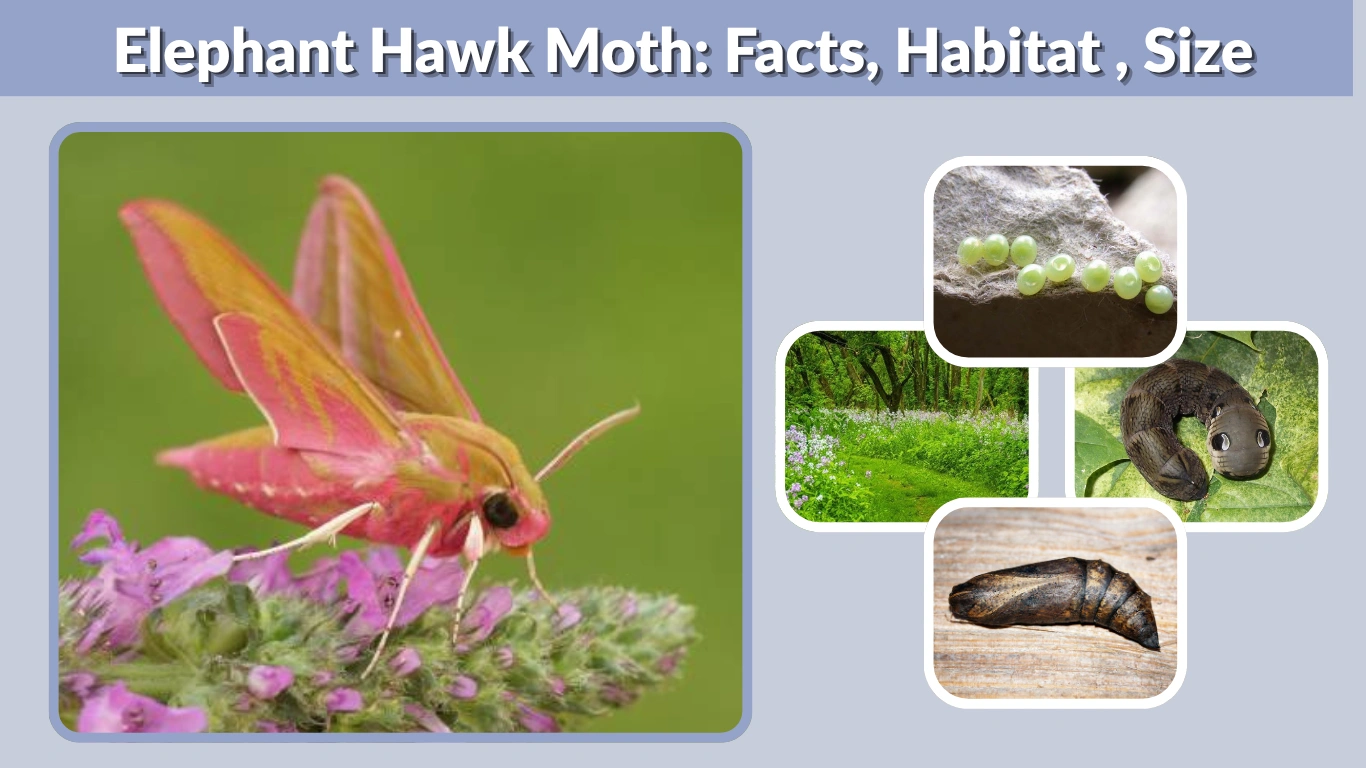
The elephant hawk moth (Deilephila elpenor) is one of the most colorful and easily recognizable moths in Europe. With its striking pink and olive-green wings, it stands out among other moth species that are often more muted in color. This beautiful insect is a favorite among gardeners and wildlife enthusiasts due to both its appearance and its fascinating life cycle.
Despite being a moth, it is often mistaken for a butterfly or even a hummingbird because of its hovering flight while feeding. The elephant hawk moth is also well known for its unusual caterpillar, which resembles an elephant’s trunk when extended. In this guide, you’ll learn how to identify it, explore its caterpillar stage, understand its habitat, and discover interesting facts about this remarkable species.
What is the Elephant Hawk Moth?
The elephant hawk moth belongs to the Sphingidae family, commonly known as hawk moths. These moths are known for their strong flying ability, streamlined bodies, and fast wing movements.
The name “elephant hawk moth” comes from its caterpillar, which has a long, trunk-like front section that resembles an elephant’s trunk. This unique feature, combined with its eye spots, gives it a distinctive and somewhat unusual appearance.
This species is widely distributed across Europe and parts of Asia and is commonly found in gardens and natural habitats where suitable host plants are available.
Key Characteristics
The adult moth is known for its vivid coloration, featuring bright pink and olive-green patterns on its wings. These colors are not only visually striking but also help the moth blend into flowers and vegetation.
It is a medium-sized hawk moth with a streamlined body, allowing it to fly quickly and efficiently. Like other hawk moths, it is primarily nocturnal, becoming active at dusk and during the night.
Elephant Hawk Moth Identification

Identifying the elephant hawk moth is relatively easy due to its bold colors and unique shape.
Adult Moth Identification
Adult elephant hawk moths typically have a wingspan of about 4.5 to 6 cm. Their wings display a distinctive combination of pink and olive-green shades, with pink stripes running across the forewings.
The body is slender and aerodynamic, which supports its fast and agile flight. When feeding, the moth hovers in front of flowers, using its long proboscis to extract nectar.
How to Recognize It Easily
There are several features that make this moth easy to identify:
- Bright pink and green coloration
- Smaller size compared to larger hawk moths
- Active at dusk and night
- Hovering flight similar to a hummingbird
These traits make the elephant hawk moth one of the most recognizable species in its family.
Elephant Hawk Moth Caterpillar

The caterpillar of the elephant hawk moth is just as fascinating as the adult and is often even more surprising in appearance.
Appearance
The caterpillar can be green or brown, depending on its stage of development. One of its most striking features is the pair of large eye spots near the head, which can make it look like a small snake.
Its elongated front section can be extended, giving it the appearance of an elephant’s trunk, which is how it gets its name. As it grows, the caterpillar can reach up to 7–8 cm in length.
Diet and Host Plants
Elephant hawk moth caterpillars feed on a variety of plants. Common host plants include willowherb, bedstraw, and fuchsia. These plants are often found in gardens, making it easy to spot the caterpillar in residential areas.
The caterpillar feeds heavily during this stage, storing energy for its transformation into a moth.
Defense Mechanisms
One of the caterpillar’s most interesting adaptations is its ability to mimic a snake. When threatened, it retracts its head and displays its eye spots, making it appear larger and more intimidating.
This defensive behavior helps protect it from predators such as birds.
Elephant Hawk Moth Habitat
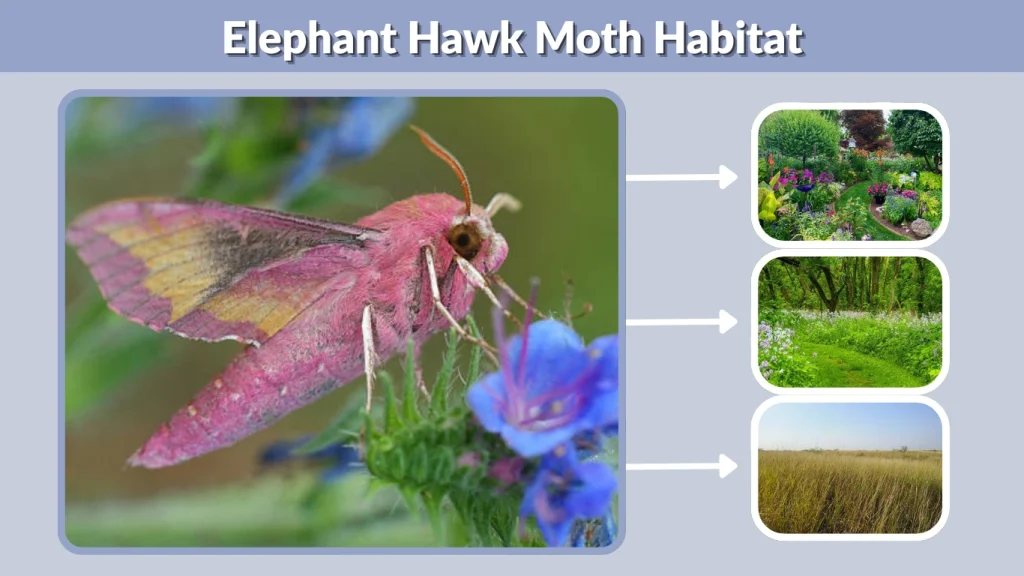
The elephant hawk moth is widely distributed and thrives in a variety of environments.
Geographic Distribution
This species is commonly found across the UK and much of Europe. It also occurs in parts of Asia, where similar environmental conditions exist.
Its widespread presence makes it one of the most familiar hawk moths in these regions.
Preferred Environments
Elephant hawk moths prefer habitats such as gardens, woodland edges, grasslands, and hedgerows. They are particularly attracted to areas where nectar-rich flowers and host plants are abundant.
Because of this, they are frequently seen in suburban gardens as well as in natural landscapes.
Elephant Hawk Moth Life Cycle

The elephant hawk moth undergoes complete metamorphosis, which includes four main stages: egg, larva, pupa, and adult. Each stage is essential for its development and survival.
Egg Stage
The life cycle begins when the female moth lays small, round eggs on the leaves of host plants such as willowherb or bedstraw. These eggs are usually laid individually to ensure that each caterpillar has enough food once it hatches.
Depending on temperature and environmental conditions, the eggs typically hatch within a few days.
Larval Stage
After hatching, the caterpillar begins feeding immediately. This stage is focused on growth, and the caterpillar consumes large amounts of plant material.
As it grows, it goes through several molts, known as instars. During this stage, its color may change from green to brown, helping it adapt to its surroundings. The caterpillar’s eye spots and trunk-like appearance remain its most distinctive features.
This stage lasts for several weeks.
Pupal Stage
Once fully grown, the caterpillar leaves the plant and moves to the ground to pupate. It forms a pupa in leaf litter or soil, where it remains protected during transformation.
Inside the pupa, the caterpillar undergoes a complete transformation into an adult moth. This stage can last several weeks or even longer if conditions are not ideal.
Adult Stage
The adult moth emerges from the pupa fully developed. It is mainly active at dusk and during the night, when it feeds on nectar and searches for a mate.
After mating, the female lays eggs, and the cycle begins again.
Elephant Hawk Moth Facts
The elephant hawk moth is known for several fascinating traits that make it a favorite among insect enthusiasts:
- It is one of the most colorful moths in Europe
- Its caterpillar resembles an elephant’s trunk
- It can hover while feeding, similar to a hummingbird
- It is commonly found in gardens and urban areas
- It plays an important role as a pollinator
These characteristics make it both visually appealing and ecologically important.
Elephant Hawk Moth Size
The elephant hawk moth is considered medium-sized compared to other hawk moths.
Adult Size
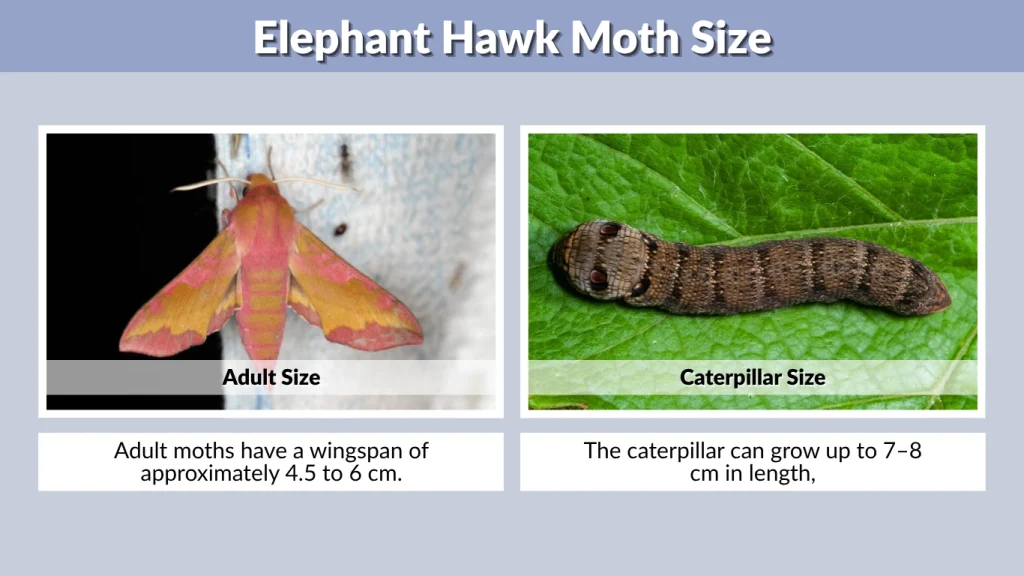
Adult moths have a wingspan of approximately 4.5 to 6 cm. Their relatively small size, combined with their bright coloration, makes them easy to recognize.
Caterpillar Size
The caterpillar can grow up to 7–8 cm in length, making it quite large compared to the adult moth’s body. This size increase is necessary to store energy for the pupal stage.
Behavior and Adaptations
The elephant hawk moth has several adaptations that help it survive in its environment.
It is primarily nocturnal, meaning it is active during the evening and night. This reduces the risk of predation and allows it to feed on flowers that bloom at night.
Its hovering flight is one of its most notable behaviors. Using its long proboscis, it can feed on nectar without landing, similar to a hummingbird.
The caterpillar’s snake-like appearance is another important adaptation. By mimicking a snake, it can deter predators and increase its chances of survival.
Additionally, its coloration helps it blend into flowers and vegetation, providing camouflage during rest.
Is the Elephant Hawk Moth Dangerous?
The elephant hawk moth is completely harmless to humans.
It does not bite or sting, and its caterpillar is safe to observe. While the caterpillar feeds on plants, it rarely causes significant damage and is not considered a serious pest.
In fact, the moth is beneficial because it helps pollinate flowers, contributing to the health of ecosystems.
FAQs
What does an elephant hawk moth look like?
It has bright pink and olive-green wings, a slender body, and a wingspan of about 4.5–6 cm, making it one of the most colorful moths.
What is special about the elephant hawk moth caterpillar?
The caterpillar has large eye spots and a trunk-like front section, which makes it resemble an elephant or even a small snake.
Where do elephant hawk moths live?
They are commonly found in the UK, Europe, and parts of Asia, especially in gardens, grasslands, and woodland edges.
When are elephant hawk moths active?
They are mostly active at dusk and during the night when they feed on nectar from flowers.
Are elephant hawk moths beneficial?
Yes, they are important pollinators and help maintain healthy ecosystems by aiding plant reproduction.
Conclusion
The elephant hawk moth is a remarkable species known for its vibrant colors, unique caterpillar, and fascinating behavior. From its trunk-like larva to its hovering flight as an adult, it offers a glimpse into the complexity of the natural world.
Its presence in gardens and natural habitats makes it an accessible and enjoyable species to observe. By understanding its life cycle, habitat, and role in the ecosystem, we can better appreciate the importance of conserving such beautiful and beneficial insects.
