

The Emperor Scorpion (Pandinus imperator) is one of the largest and most eye-catching scorpions in the world. Native to West Africa, it’s known for its glossy black body, powerful pincers, and calm nature. Despite its fierce appearance, it’s surprisingly gentle and easy to care for—making it a favorite among exotic pet lovers and curious nature enthusiasts alike.
Species Overview

Scientific Classification
The Emperor Scorpion belongs to the Scorpionidae family, which includes several large-bodied scorpions. Its scientific name, Pandinus imperator, reflects its size and status as one of the most dominant species in its group. Classified under the order Scorpiones, it shares common features with other arachnids, such as having eight legs, jointed limbs, and a segmented tail ending in a stinger.
Although often confused with the Asian Forest Scorpion due to similar size and color, the Emperor Scorpion is less aggressive and generally considered safer to observe or keep in captivity.
Physical Characteristics
An adult Emperor Scorpion typically measures between 6 to 8 inches in length, with a strong and glossy exoskeleton that ranges from deep black to dark brown. Its body is divided into three key parts: the prosoma (head), mesosoma (midsection), and metasoma (tail).
The pincers (also called pedipalps) are thick, textured, and powerful—more often used for defense or capturing prey than the stinger. The tail, equipped with a venomous stinger, is relatively thick and curved upward. Despite its fierce look, the Emperor Scorpion rarely uses its stinger unless provoked or in self-defense.
Natural Habitat and Range

Geographic Distribution
The Emperor Scorpion is native to West Africa, particularly found in:
- Ghana
- Nigeria
- Sierra Leone
- Togo
- Benin
- Ivory Coast
In the wild, they inhabit tropical rainforests and savanna regions, where they hide under logs, rocks, leaf litter, and inside burrows. Their natural range has become fragmented due to deforestation and human activity, which has made them more vulnerable in the wild, even though they remain common in captivity.
Environmental Preferences
Emperor Scorpions are adapted to humid and warm environments, thriving best in temperatures between 75°F and 90°F (24°C–32°C) with humidity levels above 75%. These conditions are essential to their survival, as they can quickly dehydrate in drier climates.
Their natural instinct is to stay hidden during the day, seeking shelter in tight crevices, tunnels, or under organic debris. At night, they emerge to hunt and explore, guided by their highly sensitive hairs and receptors that pick up vibrations from nearby prey or threats.
Their habitat plays a significant role in their behavior: a calm, dark, moist environment helps reduce stress, promote natural behavior, and increase longevity, whether in the wild or captivity.
Behavior and Adaptations

Nocturnal Lifestyle
Emperor Scorpions are strictly nocturnal creatures. During daylight, they remain buried in substrate or tucked beneath bark, leaves, or stones to avoid dehydration and predation. Once night falls, they become more active—hunting for food, digging, and occasionally interacting with others of their kind.
Because of their poor eyesight, they rely on sensory hairs on their legs and pincers to detect movement and vibration. These hairs act like radar, allowing them to sense prey or danger in complete darkness. Their nocturnal routine and stealthy movement make them efficient ambush predators.
Defense Mechanisms
Despite their fearsome appearance, Emperor Scorpions are not aggressive. They tend to rely on intimidation before using force. When threatened, they’ll often:
- Raise their claws in a defensive posture
- Arch their tail as a warning
- Attempt to retreat before striking
Interestingly, they rarely use their venomous stinger unless absolutely necessary. Instead, their massive pincers are their primary defense. These are powerful enough to crush insects and deter predators.
Another fascinating defense trait is their UV fluorescence. Like many scorpions, their exoskeleton glows a bright blue-green under ultraviolet light, a feature scientists believe may help with species recognition or act as a warning signal to other animals.
Social Behavior
Unlike many scorpion species that are highly territorial and solitary, Emperor Scorpions have shown limited tolerance for social living, especially in captivity. In the wild, multiple scorpions may be found sharing the same space or burrow, especially when conditions are ideal.
However, this social behavior comes with caution. They can become aggressive during molting or when food is scarce. In captivity, hobbyists sometimes keep them communally, but only under close supervision and with adequate space, hides, and food to prevent stress or cannibalism.
Burrowing and Shelter Use
A major part of the Emperor Scorpion’s behavior revolves around burrowing. In their natural habitat, they create small tunnels or take over abandoned burrows to escape predators and maintain moisture. The ability to flatten their bodies allows them to squeeze into tight, hidden spaces with ease.
Burrowing is not only a survival strategy—it also helps regulate temperature and humidity, making it essential for health and well-being in both the wild and captivity. In terrarium setups, they should always be provided with enough deep substrate (like coconut fiber or moist soil) to dig and hide comfortably..
Diet and Feeding Habits

What They Eat
Emperor Scorpions are carnivorous hunters that mainly eat small invertebrates. Their typical diet includes:
- Crickets
- Cockroaches
- Mealworms
- Waxworms
- Occasionally small vertebrates like pinky mice (though not required in captivity)
In the wild, they actively search for prey during the night, using their pincers to grab and crush it before consuming. Their venom is used sparingly, mostly for subduing resistant or larger prey.
Hunting Technique
They’re ambush predators—using stealth rather than speed. Instead of chasing prey, they stay hidden, detect vibrations, and strike when prey gets close. After catching the target with their claws, they may sting or simply crush it before feeding.
In captivity, feeding is straightforward. Offer live insects two to three times per week. Overfeeding should be avoided as it may lead to obesity or spoil the enclosure. Always remove uneaten prey within 24 hours to prevent stress or injury to the scorpion.
Life Cycle and Reproduction

Mating and Gestation
Emperor Scorpions have a unique and ritualistic mating process. A male begins by grasping the female’s pincers in a sort of “dance” known as the promenade à deux. He then guides her over a spermatophore (a sperm packet he deposits), which she takes into her genital opening.
Gestation is long—lasting 7 to 9 months, after which the female gives birth to live young (scorpions are viviparous). A single birth may produce 10 to 30 offspring, depending on the mother’s health and environment.
Growth and Development
After birth, the babies—white and soft-bodied—immediately climb onto their mother’s back for safety. They remain there until they complete their first molt, usually within a week or two. Once molted, they start fending for themselves, though they may linger nearby.
Young scorpions will go through multiple molts (usually 6 to 7) over a span of 2–3 years before reaching maturity. Each molt is a vulnerable period when the scorpion’s body is soft and defenseless.
The average lifespan of an Emperor Scorpion is 6 to 8 years, though some live longer in well-maintained enclosures.
Housing and Care

Enclosure Setup
Caring for an Emperor Scorpion in captivity requires a setup that mimics its natural environment:
- Tank size: Minimum of 10 gallons per adult
- Substrate: 4–6 inches of coconut fiber, peat moss, or a mix of soil and sand
- Hides: Bark, rocks, and artificial caves
- Water: Shallow dish with clean water at all times
The enclosure should be escape-proof and have minimal lighting, as scorpions are light-sensitive.
Temperature and Humidity
- Temperature: 75°F–90°F (24°C–32°C)
- Humidity: 75%–85%
- Use a heat mat on the side or bottom of the tank—not overhead—to avoid drying out the substrate.
- Mist the enclosure regularly and monitor with a hygrometer.
Handling and Safety
While Emperor Scorpions are among the calmest of their kind, handling should be limited. They can still sting or pinch when stressed. Their claws are stronger than their venom, but both can cause discomfort.
Instead, use soft tools like rubber-tipped tongs or a container to move them if needed. It’s always safer to observe than handle.
Comparison With Similar Species
Emperor Scorpion vs. Asian Forest Scorpion
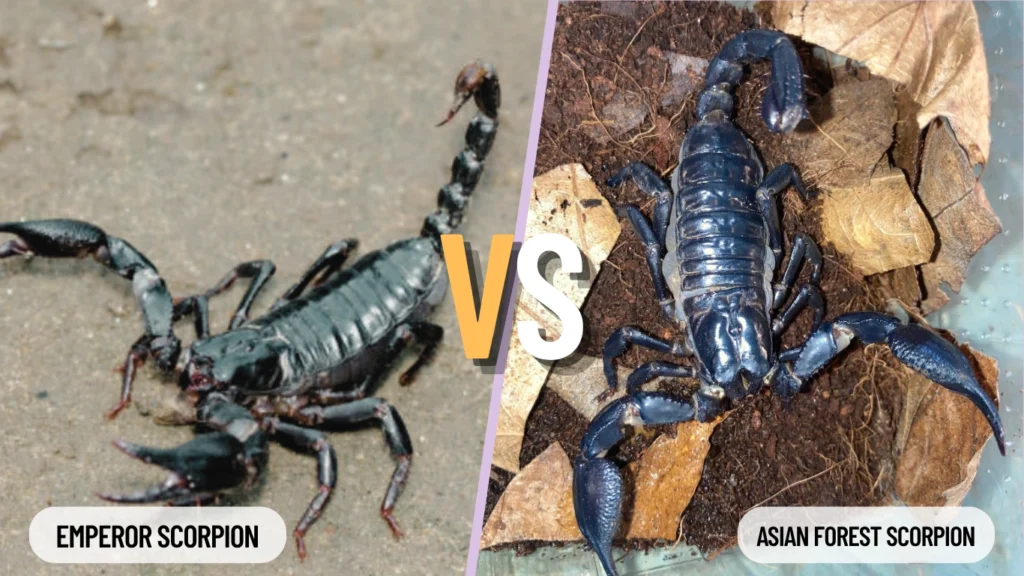
- Temperament: Emperor is calmer, less aggressive
- Color: Emperor is shinier black; Asian Forest is matte
- Pincers: Emperor has thicker, more powerful claws
- Care: Both need similar humidity and substrate depth, but Asian Forest Scorpions are more defensive
Emperor Scorpion vs. Giant Forest Scorpion

These species are often mistaken for each other, but the Emperor has a larger body, more robust pincers, and is easier to manage in captivity. The Giant Forest Scorpion tends to have a slightly narrower body and is less commonly kept as a pet.
Interesting Facts
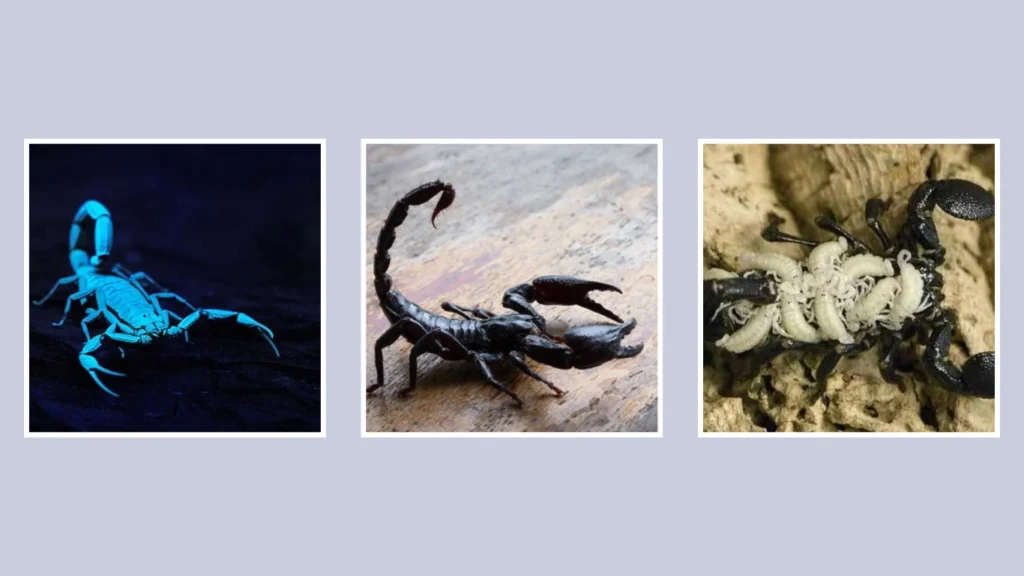
- UV Glow: Their entire body glows neon green or blue under black light due to compounds in their exoskeleton.
- Communal Living: Unlike many scorpions, they sometimes tolerate small groups in captivity when conditions are ideal.
- Minimal Venom Use: They rarely sting—pincers do most of the work.
- Low-Risk to Humans: Their venom is milder than a bee sting for most people.
- Ecosystem Role: In the wild, they help control insect populations.
- Survival Adaptation: They can survive weeks without food or water by slowing their metabolism.
- Silent Walkers: Their soft, padded feet allow them to move almost silently—great for stealth hunting.
FAQs
How big does an Emperor Scorpion get?
Adults reach lengths of 6 to 8 inches, making them one of the world’s largest scorpions.
Is the Emperor Scorpion venomous?
Yes, but their venom is mild and rarely causes more than localized pain or numbness in humans. For most people, the sting is less painful than a bee sting.
What do Emperor Scorpions eat?
Their diet includes crickets, roaches, mealworms, and other insects. Occasionally, they may eat small vertebrates, but this isn’t required in captivity.
How long do Emperor Scorpions live?
They typically live 6–8 years, though some can survive longer in stable, captive conditions.
Do Emperor Scorpions glow under UV light?
Yes. Like all scorpions, they fluoresce under UV light, appearing bright green or blue due to natural chemicals in their outer shell.
Conclusion
The Emperor Scorpion may look intimidating, but it’s a gentle giant in the scorpion world. With its unique appearance, mild venom, and fascinating behavior, it remains a favorite for exotic pet lovers and researchers alike. Whether in the wild or a terrarium, it’s a species that commands both respect and curiosity.
