
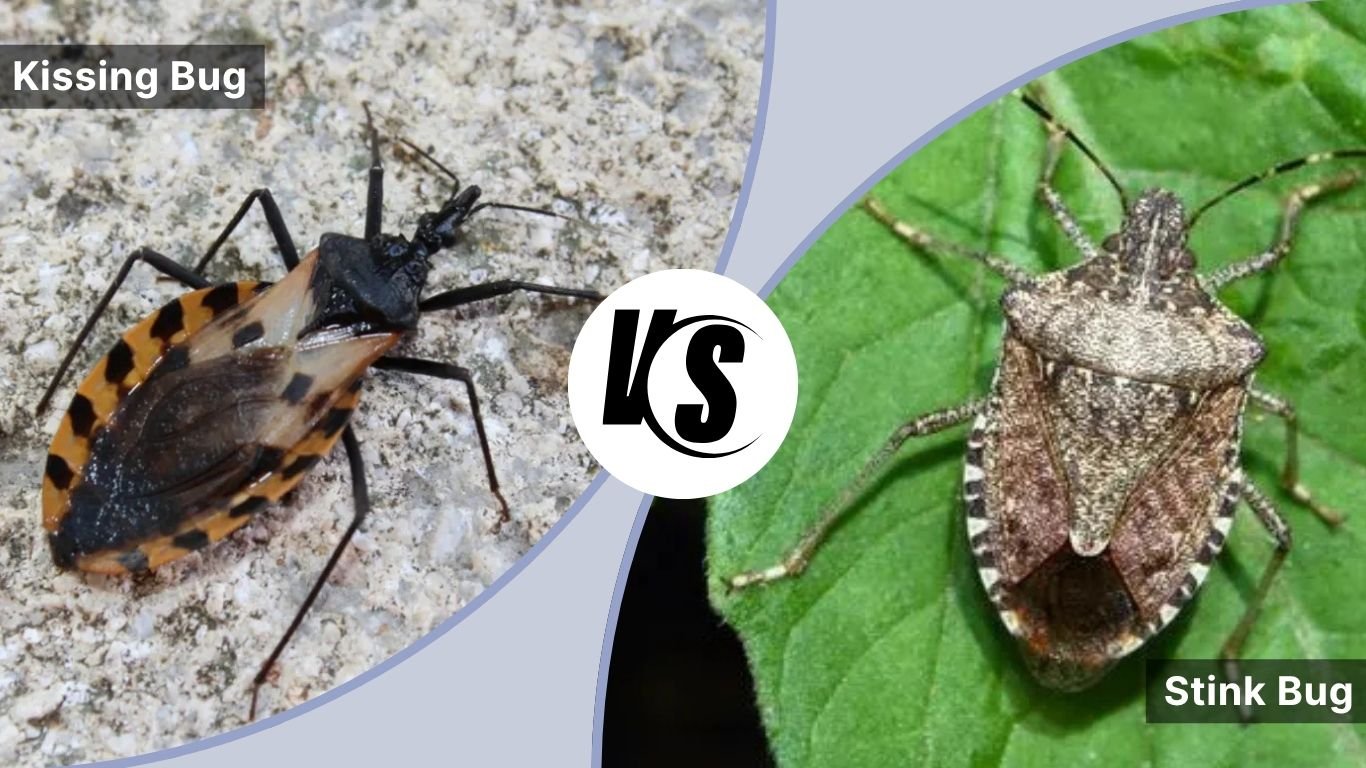
Kissing bugs and stink bugs are sometimes confused because both have flattened bodies, folded wings, and similar brown or dark coloring. However, they differ greatly in appearance, feeding behavior, and potential risk to humans. Kissing bugs are blood-feeding insects with long, narrow heads and may carry the parasite associated with Chagas disease. Stink bugs generally feed on plants and are best known for releasing a strong odor when disturbed. Identifying the insect correctly is important because an ordinary stink bug is usually a household nuisance, while a suspected kissing bug may require more careful handling and professional identification.
Kissing Bug vs. Stink Bug: Quick Comparison
Although both insects belong to the order Hemiptera, they are from different families and have different lifestyles. Kissing bugs belong to the assassin bug family, Reduviidae, while most insects commonly called stink bugs belong to the family Pentatomidae.
| Feature | Kissing bug | Stink bug |
|---|---|---|
| General body shape | Long, narrow, and somewhat oval | Broad, flattened, and shield-shaped |
| Head | Long and cone-shaped | Shorter and relatively small |
| Typical length | Often about ¾ to more than 1 inch | Common species are often around ½ to ¾ inch |
| Common colors | Black or dark brown with red, orange, or yellow edges | Green, brown, gray, or mottled |
| Main food | Blood from animals or people | Plant juices, fruits, seeds, or other insects |
| Odor | Not known for a strong defensive smell | Releases a noticeable odor when disturbed |
| Human biting | Can bite humans | Normally does not feed on humans |
| Main concern | Bite reactions and possible Chagas exposure | Crop damage and indoor nuisance |
1. Body Shape
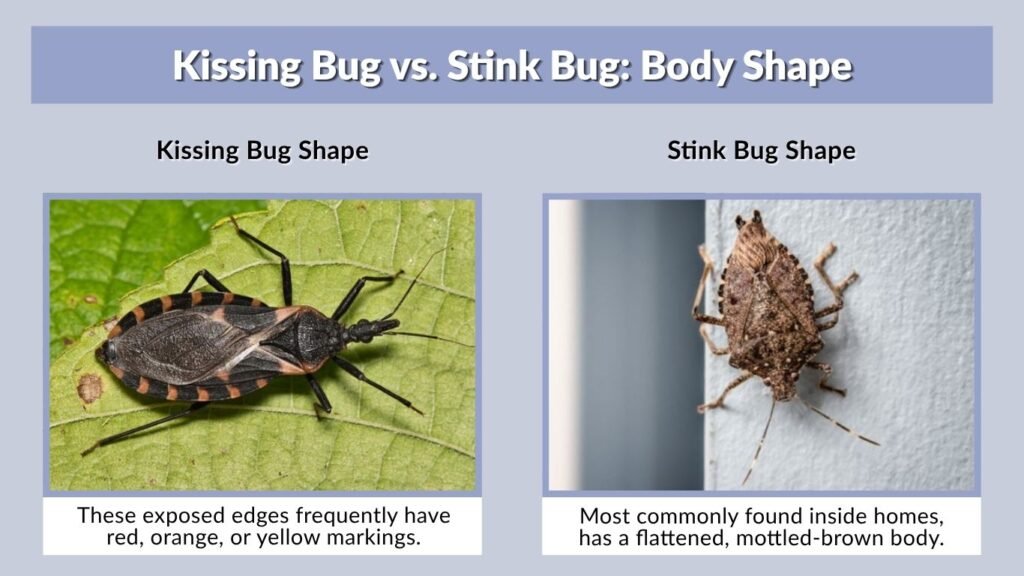
Body shape is one of the easiest ways to distinguish a kissing bug from a stink bug.
Kissing Bug Shape
A kissing bug generally has an elongated body. Its abdomen may appear wide in the center, but the insect is still noticeably longer and narrower than a typical stink bug.
The edges of the abdomen may extend beyond the folded wings. These exposed edges frequently have red, orange, or yellow markings that create a striped or spotted border.
The body does not have the strongly defined shield-like outline associated with most stink bugs.
Stink Bug Shape
A stink bug usually has a broad, shield-shaped body. Its shoulders are wide, while the body narrows toward the rear.
The brown marmorated stink bug, one of the species most commonly found inside homes, has a flattened, mottled-brown body. Adults measure approximately 14 to 17 millimeters long and have alternating pale and dark bands along parts of the antennae and abdomen.
When viewed from above, the insect’s back resembles a small shield or a five-sided shape.
2. Head and Mouthparts
The appearance of the head is another major identification feature.
Kissing bugs have a distinctly long, narrow head. It often looks cone-shaped, which explains why these insects are also called conenose bugs. The section between the eyes and mouthparts is much longer than it is on a stink bug.
CDC identification guidance describes U.S. kissing bugs as having a long head that appears flattened on top, along with slender legs and a narrow body.
Stink bugs have much shorter heads that seem small compared with their wide shoulders. Their antennae project outward, but the face does not have the elongated appearance of a kissing bug.
Both insects have piercing-sucking mouthparts. However, they use these mouthparts for very different purposes.
3. Color and Markings
Color alone should not be used to identify either insect because both groups include multiple species. Markings and body proportions are usually more reliable.
| Identification area | Kissing bug markings | Stink bug markings |
|---|---|---|
| Abdomen | Often has red, orange, or yellow markings along the outer edge | May have alternating pale and dark patches along the edge |
| Wings | Usually dark, with a narrow or elongated appearance | Broadly folded across the shield-shaped back |
| Antennae | Usually long and thin | Some species have obvious white or pale bands |
| Legs | Long and relatively slender | Usually shorter in proportion to the body |
| Overall pattern | Dark center with colored side markings | Green, solid brown, gray, or mottled brown |
Many kissing bugs have a black or dark-brown body with reddish or yellowish markings running along the sides of the abdomen. The exact color pattern depends on the species.
Brown marmorated stink bugs have mottled brown, gray, and cream coloring that helps them blend into bark and dried vegetation. Alternating light and dark bands on the antennae are particularly helpful for identifying this species.
Some native stink bugs are bright green, while others are solid brown. Therefore, a brown insect is not automatically a kissing bug.
4. Feeding Habits
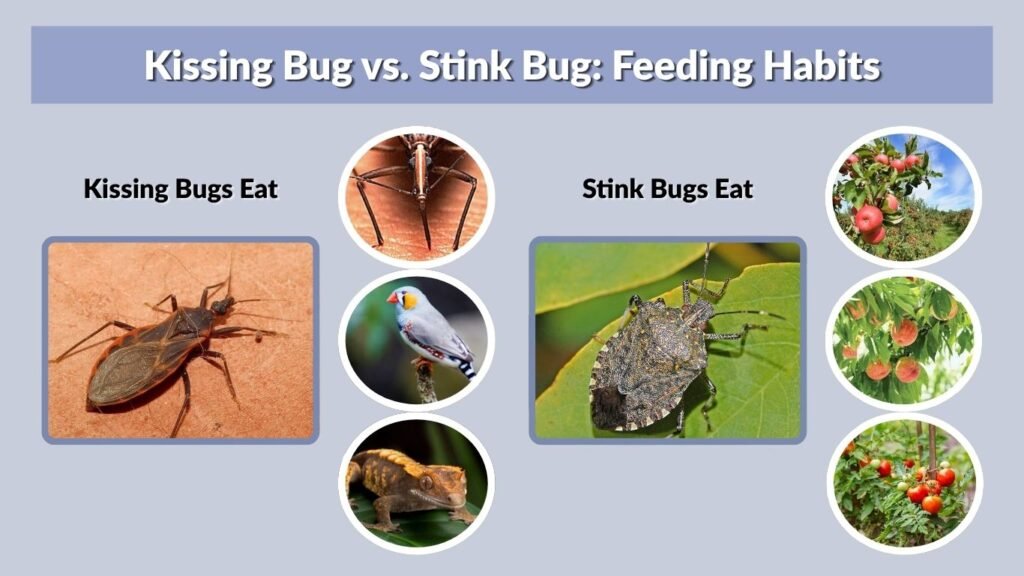
The most important biological difference between the two insects is what they eat.
What Kissing Bugs Eat
Kissing bugs feed on blood. They may obtain blood meals from mammals, birds, reptiles, and sometimes humans.
They commonly emerge at night and locate hosts while those animals or people are resting. A kissing bug inserts its mouthpart into the skin and feeds for several minutes.
These insects are sometimes associated with bites around the face because the face may remain uncovered during sleep. However, they can bite any exposed area, including the arms, hands, neck, and legs.
What Stink Bugs Eat
Most common stink bugs feed on plants. They insert their mouthparts into fruits, stems, leaves, seeds, or developing crops and remove plant fluids.
Their feeding may damage apples, peaches, tomatoes, peppers, corn, beans, and numerous ornamental plants. Damaged fruits may develop sunken areas, discoloration, or distorted growth.
Some stink bug species are predators that feed on caterpillars and other insects. However, common household invaders such as the brown marmorated stink bug primarily feed on plants.
5. Do They Bite Humans?
Kissing bugs are capable of biting humans, while ordinary plant-feeding stink bugs generally are not interested in people.
Kissing Bug Bites
A kissing bug bite may be painless at first. The affected person may later develop a small red mark, itching, swelling, or localized irritation.
The bite itself does not necessarily transmit Chagas disease. The parasite that causes Chagas disease, Trypanosoma cruzi, can be present in the feces of an infected kissing bug. Transmission may occur if contaminated material enters the bite wound, broken skin, eyes, or mouth.
Finding a kissing bug also does not mean the insect carries the parasite. Correct insect identification and appropriate medical guidance are necessary when a meaningful exposure may have occurred.
Do Stink Bugs Bite?
Common plant-feeding stink bugs do not seek human blood and generally do not bite people. They may crawl on skin, but they normally attempt to escape rather than feed.
A person handling one roughly could potentially experience a minor poke from its mouthparts, but this is unusual. Stink bugs do not transmit Chagas disease.
6. Odor and Defensive Behavior
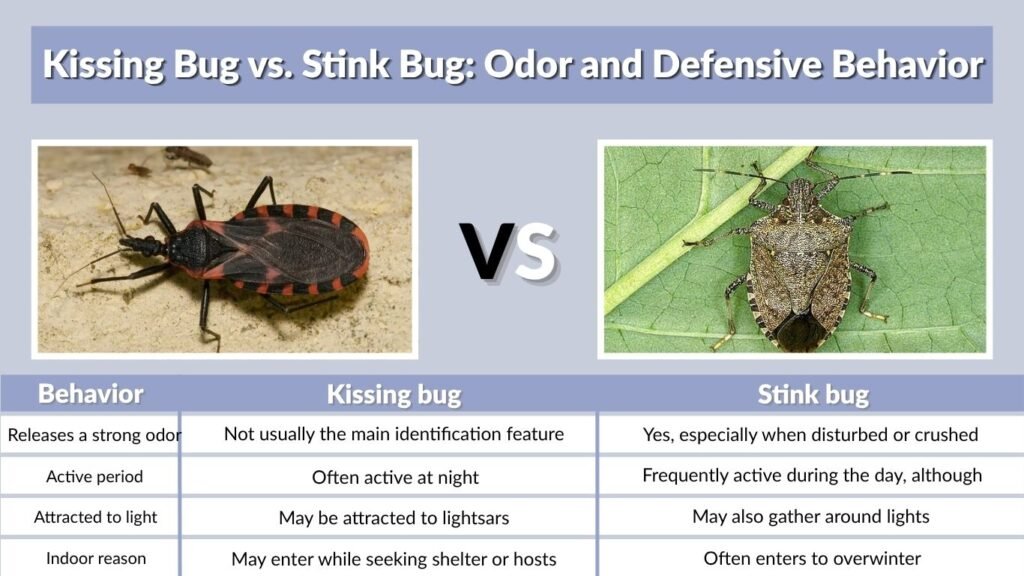
The strong odor is the feature that gives stink bugs their common name.
When threatened, handled, or crushed, a stink bug may release defensive chemicals from glands in its body. People describe the smell in different ways, sometimes comparing it to strong herbs, chemicals, or decaying vegetation.
Kissing bugs do not usually release the same familiar stink bug odor. They may attempt to hide, crawl away, or fly when disturbed.
| Behavior | Kissing bug | Stink bug |
|---|---|---|
| Releases a strong odor | Not usually the main identification feature | Yes, especially when disturbed or crushed |
| Active period | Often active at night | Frequently active during the day, although behavior varies |
| Attracted to light | May be attracted to lights | May also gather around lights |
| Indoor reason | May enter while seeking shelter or hosts | Often enters to overwinter |
| Defensive response | Hides, escapes, or may bite if mishandled | Releases odor and attempts to escape |
Because both insects may fly toward artificial lights, finding one near a porch or window does not provide enough information for identification.
7. Where They Are Found
Kissing bugs often live near the nests, dens, or sleeping areas of animals. They may be associated with rodents, opossums, raccoons, dogs, birds, and other potential blood hosts.
Outdoors, they may shelter beneath wood, rocks, bark, animal nesting material, or debris. They occasionally enter homes through cracks and gaps.
Stink bugs are more closely associated with vegetation, gardens, farms, orchards, and wooded areas. They may feed outdoors during warm weather and enter buildings when temperatures begin falling.
Brown marmorated stink bugs frequently gather on sunny exterior walls before entering gaps around windows, doors, roofs, vents, and siding. Indoors, they generally do not reproduce, damage furniture, or feed on people. They are primarily seeking a protected place to survive the colder season.
8. Which Bug Is More Dangerous?
A kissing bug is the more medically significant insect because some individuals can carry T. cruzi. Chagas disease may initially cause no symptoms or mild symptoms, but chronic infection can eventually affect the heart or digestive system in some people.
However, the presence of a kissing bug does not mean that infection has occurred. Transmission requires contact with infected fecal material, and not every kissing bug is infected.
A stink bug is usually not dangerous to humans. Its odor can be unpleasant, and sensitive individuals may experience minor irritation after handling one. Its main importance is as an agricultural pest and seasonal household nuisance.
What to Do If You Find a Suspected Kissing Bug
Do not crush the insect with your bare hands. Crushing it may bring you into contact with its body fluids or fecal material.
Place a container over the insect and slide a piece of stiff paper underneath it. Transfer it into a sealed container without directly touching it. Wash your hands thoroughly afterward.
Many insects resemble kissing bugs, so expert identification is valuable. Texas health authorities specifically note that numerous look-alike insects are incorrectly identified as kissing bugs.
Seek medical advice when a suspected kissing bug has bitten you, fecal material may have entered your eyes or mouth, or you develop unusual symptoms after a possible exposure. Difficulty breathing, severe facial swelling, faintness, or rapidly spreading hives requires urgent medical attention.
How to Keep Both Bugs Outside
Many of the same exclusion methods work for kissing bugs and stink bugs:
- Seal cracks around doors, windows, walls, and foundations.
- Repair torn window and door screens.
- Install weatherstripping around exterior doors.
- Seal spaces around pipes, cables, vents, and utility openings.
- Move firewood, debris, and animal nesting material away from the house.
- Reduce unnecessary exterior lighting near doors.
- Inspect pets’ outdoor sleeping areas regularly.
- Vacuum indoor stink bugs instead of crushing them.
Repeated kissing bug sightings should be taken more seriously than seasonal stink bug activity. A licensed pest-management professional can inspect the property, identify entry points, and determine whether targeted control is necessary.
FAQs
Are Kissing Bugs and Stink Bugs Related?
They are distantly related because both belong to the insect order Hemiptera, commonly called true bugs. However, kissing bugs belong to the assassin bug family, while typical stink bugs belong to the stink bug family. Their diets and behavior are very different.
Can a Stink Bug Carry Chagas Disease?
Common stink bugs are not recognized vectors of Chagas disease. The parasite is associated with infected triatomine insects, commonly called kissing bugs. A shield-shaped stink bug found inside a home should not automatically be treated as a Chagas disease risk.
Does a Kissing Bug Smell When Crushed?
A kissing bug may have an odor, but it is not known for the strong defensive smell characteristic of stink bugs. Odor alone is not a dependable identification method, and a suspected kissing bug should not be crushed with bare hands.
How Can I Tell a Kissing Bug From a Brown Stink Bug?
Look at the body and head. A kissing bug has a long, narrow body, an elongated cone-shaped head, and often orange, red, or yellow markings along its abdomen. A brown stink bug has a shorter head and a broad, shield-shaped body.
Should I Kill a Kissing Bug?
Avoid crushing a suspected kissing bug. Safely capture it in a sealed container so that an extension office, health department, or insect specialist can identify it. Wash your hands afterward and seek medical guidance when direct exposure or a bite may have occurred.
