
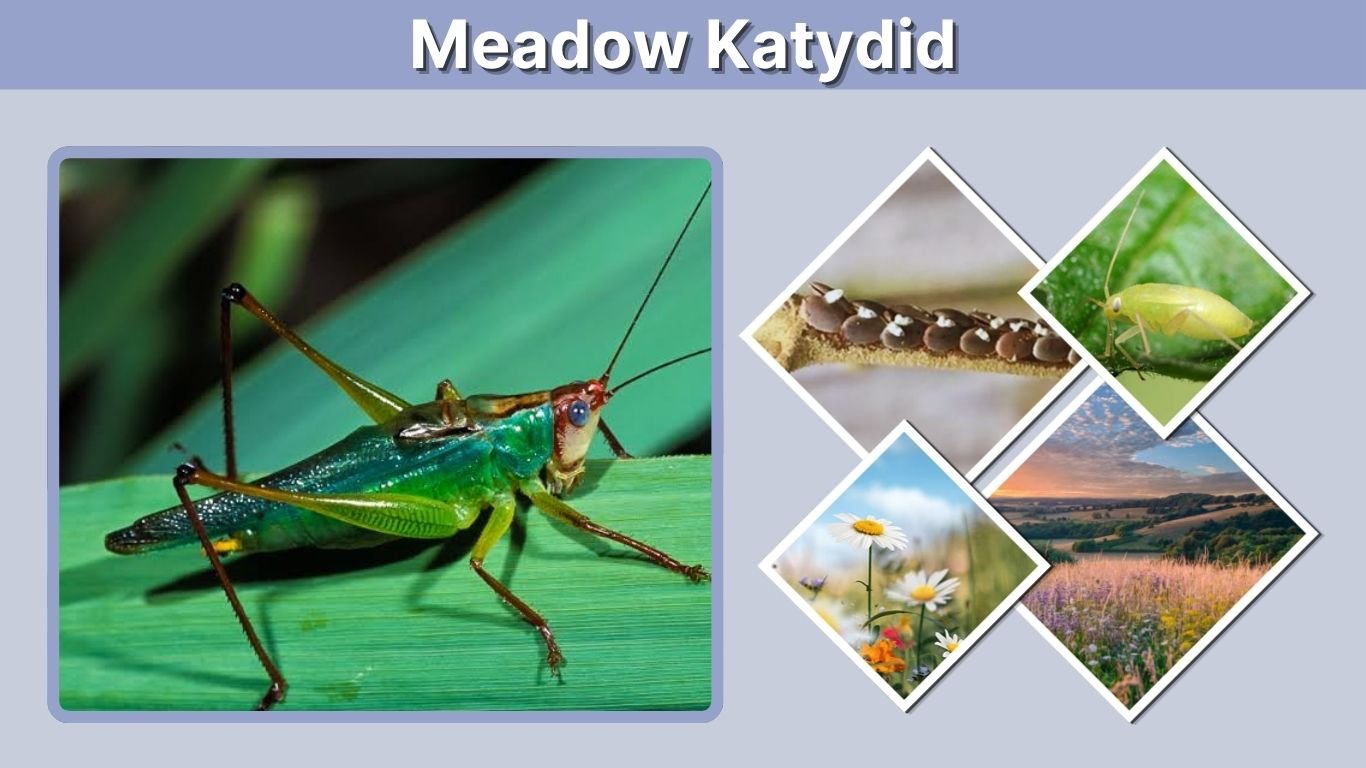
The meadow katydid is a slender, long-antennaed insect commonly found among grasses, sedges, shrubs, and other low vegetation. These katydids are best known for their green or brown camouflage and the distinctive songs males produce during warm weather. “Meadow katydid” refers to several related species rather than a single insect, including slender, common, short-winged, and black-legged meadow katydids. This guide explains their identification, habitat, diet, sound, nymph development, life cycle, bite behavior, and some of the most recognizable species.
What Is a Meadow Katydid?
Meadow katydids belong to the katydid family Tettigoniidae and are part of the order Orthoptera, which also contains crickets and grasshoppers. In North America, many familiar meadow katydids belong to the genera Conocephalus and Orchelimum. Conocephalus species are often called lesser meadow katydids, while Orchelimum includes many larger meadow katydids.
Meadow Katydid Identification
Typical characteristics include:
- Green, brown, or mixed green-and-brown coloration
- Extremely long, threadlike antennae
- Slender body
- Powerful hind legs for jumping
- Wings lying flat along the abdomen
- Chewing mouthparts
- Large compound eyes
- Female with a noticeable ovipositor
- Male with specialized structures near the abdomen
- Adults commonly found among grasses and low plants
Exact coloration and proportions vary considerably between species.
Meadow Katydid Scientific Name
There is no single scientific name for every meadow katydid. For example, the common meadow katydid is Orchelimum vulgare, while the slender meadow katydid is Conocephalus fasciatus. The short-winged meadow katydid is Conocephalus brevipennis.
Meadow Katydid vs. Grasshopper
A meadow katydid can look like a small green grasshopper, but the antennae provide an easy clue. Katydid antennae are usually extremely long and may exceed the body length considerably.
Grasshoppers generally have much shorter antennae. Meadow katydids also belong to the long-horned branch of Orthoptera and are more closely associated with crickets than with short-horned grasshoppers.
Common Types of Meadow Katydids
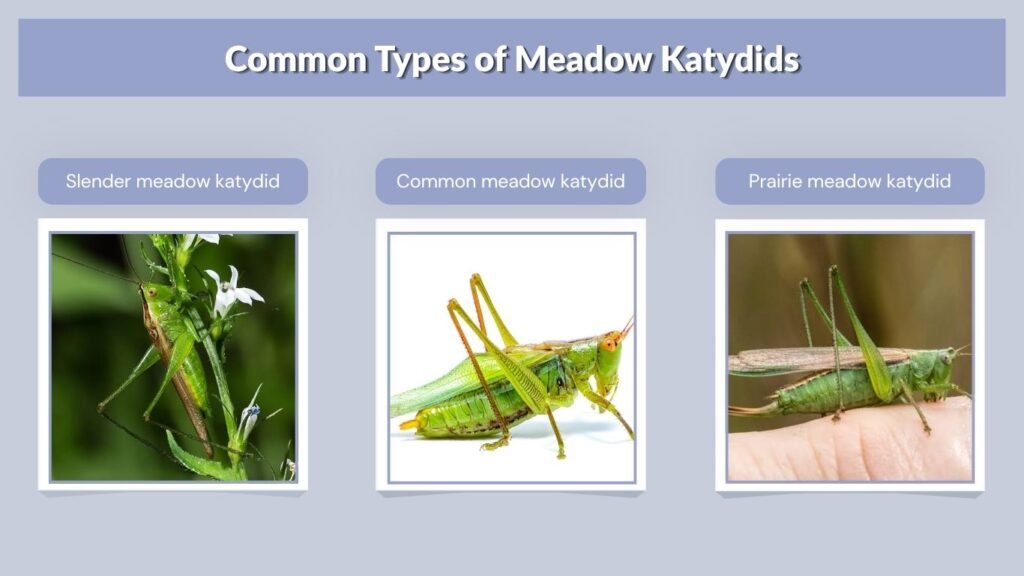
Numerous species carry the meadow katydid name, and identification can sometimes require close examination of the wings, face, legs, ovipositor, or male cerci. Habitat and song are also useful clues. Some species favor relatively dry grasslands, while others are strongly associated with marshes, damp meadows, or vegetation near streams.
Popular Meadow Katydid Species
Some well-known types include:
- Slender meadow katydid – Conocephalus fasciatus
- Common meadow katydid – Orchelimum vulgare
- Short-winged meadow katydid – Conocephalus brevipennis
- Black-legged meadow katydid – Orchelimum nigripes
- Handsome meadow katydid – Orchelimum pulchellum
- Long-tailed meadow katydid – Conocephalus attenuatus
- Prairie meadow katydid – Conocephalus saltans
- Dusky-faced meadow katydid – Orchelimum campestre
- Delicate meadow katydid – Orchelimum delicatum
- Gladiator meadow katydid – Orchelimum gladiator
The species can differ noticeably in size, markings, wing length, habitat, and song.
Slender Meadow Katydid
The slender meadow katydid, Conocephalus fasciatus, has a narrow body and relatively long wings. Adults measure roughly 18–26 mm, and the species occurs widely across North America.
It inhabits grassy areas, fields, meadows, and open woodland. Its slim appearance can make it look more delicate than many larger Orchelimum meadow katydids.
Common Meadow Katydid
The common meadow katydid, Orchelimum vulgare, occurs primarily across eastern and central North America. It is usually green with a relatively plain green face, reddish eyes, and dark lines around the upper body.
Adults are around 26 mm in body length, although their long legs, wings, and antennae make them appear larger.
Meadow Katydid Habitat
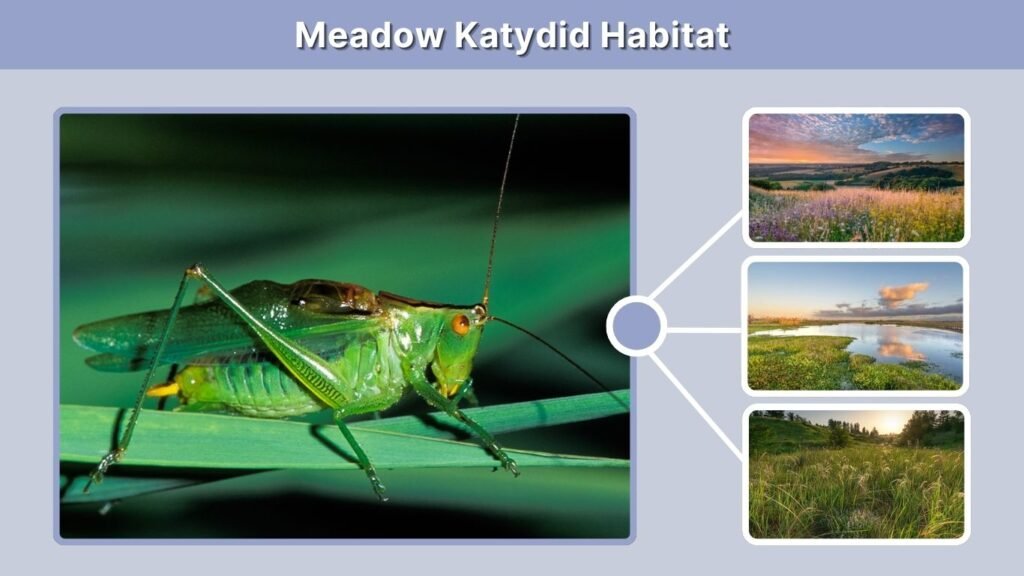
As their name suggests, meadow katydids are strongly associated with grassy and herbaceous habitats. However, habitat preferences differ by species. Some live in relatively dry fields, while others prefer moist meadows or marsh vegetation. Their coloration helps them disappear among stems and leaves, protecting them from birds, spiders, frogs, and other predators.
Where Do Meadow Katydids Live?
Common habitats include:
- Meadows
- Tall grasslands
- Marshes
- Wetlands
- Stream edges
- Forest margins
- Open woodlands
- Roadside vegetation
- Gardens
- Prairies
- Sedge-filled areas
The short-winged meadow katydid, for example, is associated with damp meadows, marshes, and stream edges, whereas the slender meadow katydid occupies grassy fields, meadows, and open woodland.
Meadow Katydids in North America
Many meadow katydid species occur in the United States and Canada. They can be encountered from Texas and the Midwest to Indiana, Wisconsin, Virginia, and northeastern regions.
Distribution differs significantly among species. The common meadow katydid occupies much of eastern and central North America, while some specialized species have considerably narrower ranges.
What Do Meadow Katydids Eat?
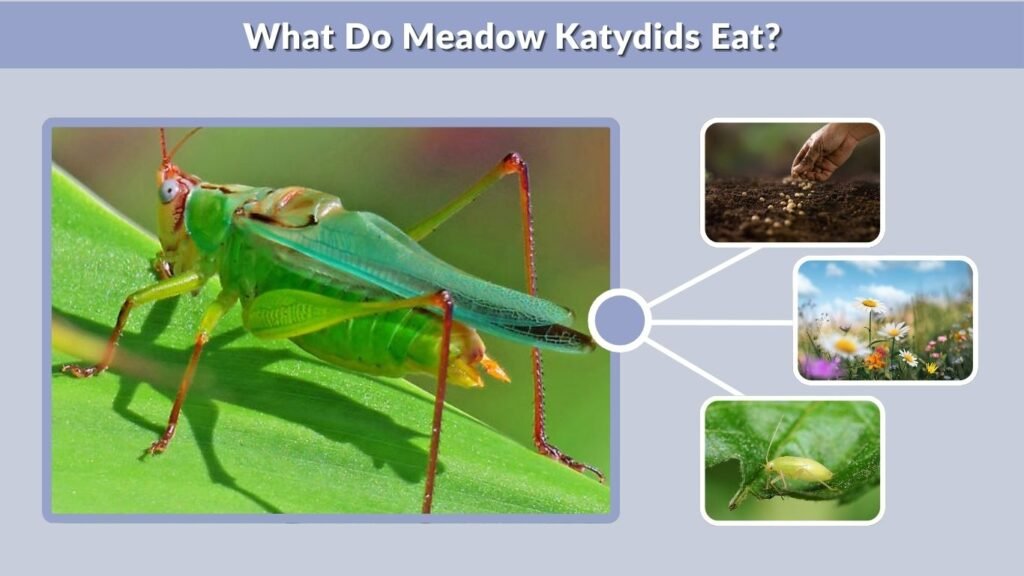
Meadow katydids have chewing mouthparts and feed directly on materials they find within vegetation. Diet varies among species, and many are opportunistic omnivores rather than strict plant eaters. Their feeding usually does not cause the kind of widespread crop damage associated with large populations of locusts or certain grasshoppers.
Meadow Katydid Diet
Foods may include:
- Grass blades
- Tender leaves
- Flowers
- Seeds
- Pollen
- Soft plant tissues
- Small insects
- Aphids
- Insect eggs
- Other tiny arthropods
Some meadow katydids consume more animal matter than others, so individual species may have noticeably different feeding habits.
Are Meadow Katydids Garden Pests?
Occasional feeding may leave small holes or chewed edges on plants, but meadow katydids usually occur in numbers too low to cause major garden damage.
Their role is more complex than that of a simple plant pest because species that consume small insects may also prey on other arthropods living among vegetation.
Meadow Katydid Sound and Song
Sound is one of the most useful ways to detect meadow katydids because they can be difficult to see within dense grass. Males produce species-specific songs that help attract females. Different meadow katydids produce combinations of buzzes, ticks, pulses, rasps, and trills, sometimes at frequencies that become difficult for some people to hear.
How Do Meadow Katydids Make Sound?
Male katydids produce sound by stridulation, rubbing specialized areas of their forewings together. A file-like section interacts with a scraper to create vibrations.
This mechanism allows a small insect to produce surprisingly noticeable calls. Song speed and rhythm can also change with temperature.
What Does a Meadow Katydid Sound Like?
There is no single meadow katydid sound because every species has its own calling pattern. Some produce continuous buzzing, while others alternate short ticks and buzzes.
For example, documented meadow katydid species differ in pulse rates, song length, and dominant frequencies, making acoustic identification particularly valuable.
Why Do Meadow Katydids Sing?
Male meadow katydids primarily sing to attract females. Their calls also help keep competing males separated.
Songs are commonly heard during the warmer part of the year when adults are reproductively active. Depending on species and local conditions, calling may occur during daylight, around dusk, or after dark.
Meadow Katydid Nymph and Life Cycle
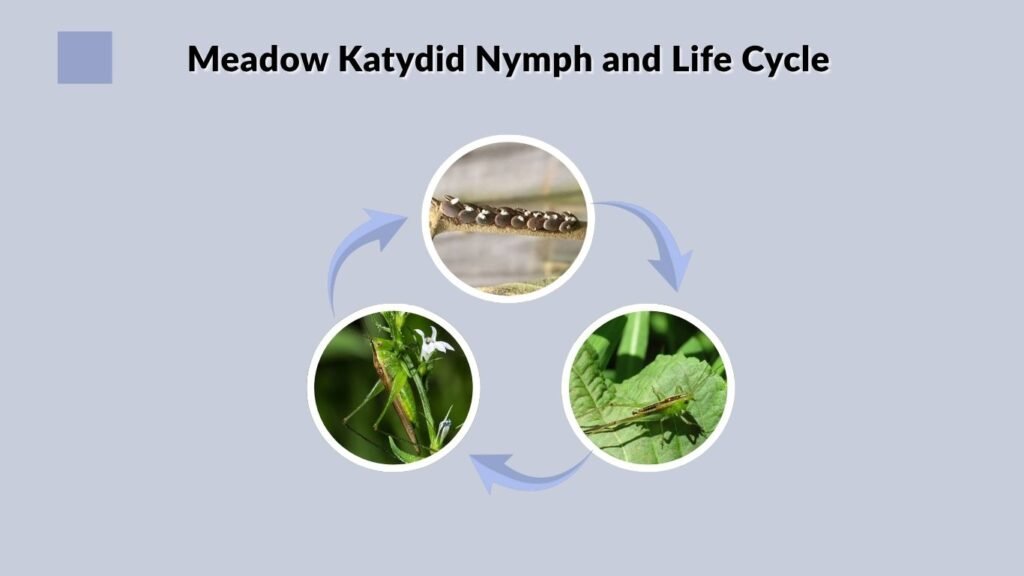
Meadow katydids undergo incomplete metamorphosis. This means they do not have a caterpillar-like larval stage or pupa. Instead, young insects hatch as nymphs that already resemble miniature adults. They gradually develop adult characteristics through successive molts until their wings and reproductive structures become fully formed.
Meadow Katydid Life Cycle
The main stages are:
- Egg: Female deposits eggs in suitable vegetation or plant tissue.
- Young nymph: Small and wingless but similar to an adult.
- Growing nymph: Enlarges through repeated molts.
- Late-stage nymph: Develops noticeable wing pads.
- Adult: Has complete wings and mature reproductive structures.
What Does a Meadow Katydid Nymph Look Like?
Nymphs have long antennae, strong hind legs, and a slender body. Their wings are absent or represented by small developing wing pads.
Young meadow katydids can sometimes look different in color from mature adults. Identification becomes easier later because adult wings, male cerci, and the female ovipositor provide additional clues.
Female Meadow Katydid
A female can often be recognized by her ovipositor, a long structure extending from the rear of the abdomen. Its exact length and curvature differ among species.
Despite its stinger-like appearance, the ovipositor is an egg-laying structure and is not used to inject venom.
Does a Meadow Katydid Bite?
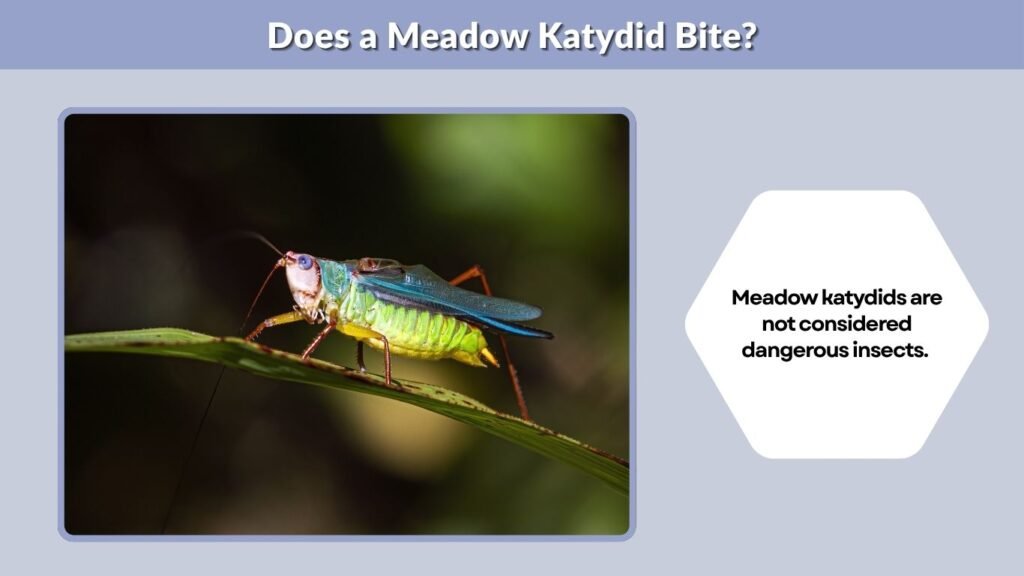
Meadow katydids are not considered dangerous insects. They usually rely on camouflage, jumping, or flight rather than confrontation. However, their chewing mouthparts are strong enough that a large individual could give a defensive nip when tightly held or squeezed.
Is a Meadow Katydid Bite Dangerous?
A bite would generally feel like a small pinch and may cause brief discomfort. Meadow katydids do not possess venomous fangs or a stinger.
Handling them gently—or simply observing them without handling—is the easiest way to avoid being bitten.
Are Meadow Katydids Harmful?
For people, meadow katydids are generally harmless. Their nighttime sounds may be noticeable, and individual insects may occasionally enter homes accidentally, but they are not household pests.
Outdoors, they form part of natural meadow and wetland food webs, serving as both consumers and prey for many other animals.
Interesting Meadow Katydid Facts
Despite their small size, meadow katydids have several remarkable adaptations that help them survive in dense vegetation.
Quick Facts
- Meadow katydids belong to the family Tettigoniidae.
- Many North American species belong to Conocephalus or Orchelimum.
- Their antennae may be much longer than their bodies.
- Males produce species-specific mating songs.
- Females have an ovipositor for laying eggs.
- Many species are green, but brown forms also occur.
- Some prefer dry grasslands while others live in wetlands.
- They develop through incomplete metamorphosis.
- Their camouflage makes them difficult to spot.
- Songs can help identify species that look very similar.
FAQs
1. What is the scientific name of a meadow katydid?
Meadow katydid refers to multiple species rather than one scientific species. Many belong to Conocephalus or Orchelimum. The common meadow katydid is Orchelimum vulgare, while the slender meadow katydid is Conocephalus fasciatus.
2. What do meadow katydids eat?
They consume various plant materials such as leaves, grasses, flowers, seeds, and tender tissues. Some species are also opportunistic omnivores and may eat aphids, insect eggs, and other small arthropods encountered among vegetation.
3. Do meadow katydids bite humans?
They do not normally bite people, but a large individual may nip defensively if it is grabbed or squeezed. Meadow katydids are not venomous and do not have a stinger, so they are generally harmless.
4. What does a meadow katydid sound like?
The sound depends on the species. Meadow katydid songs may include buzzing, ticking, raspy pulses, or short trills. Males create these sounds by rubbing specialized structures on their forewings together to attract females.
5. Where can you find meadow katydids?
They commonly live in meadows, grasslands, marshes, wetlands, forest edges, prairies, and tall roadside vegetation. Some species prefer dry grassy areas, while others are strongly associated with damp meadows, sedges, or streamside plants.
