
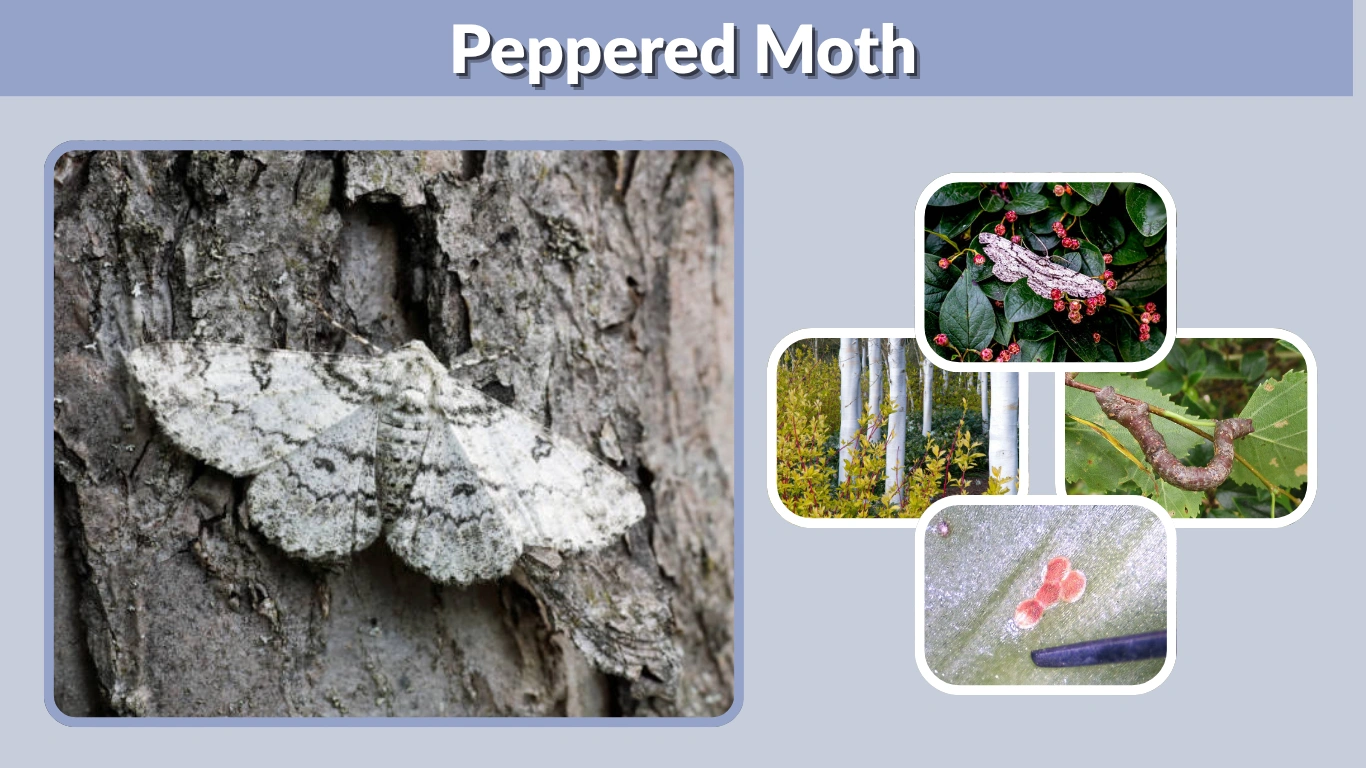
Peppered moths are among the most famous examples of natural selection in biology. These insects became widely studied during the Industrial Revolution because their populations changed color in response to environmental conditions. Scientists observed how light and dark moths survived differently depending on pollution levels and tree bark color. The peppered moth story helps explain adaptation, evolution, camouflage, and predator-prey relationships. Today, biology students continue to study peppered moths to better understand how species respond to environmental change over time.
What Is a Peppered Moth?
Peppered moths are medium-sized night moths known for their spotted wings and remarkable ability to camouflage themselves against tree bark. Their scientific name is Biston betularia, and they are commonly found in forests and wooded areas. The species became historically important because it demonstrated natural selection occurring in real time.
Why Are They Called Peppered Moths?
Peppered moths received their name from the pepper-like black speckles scattered across their pale wings. This pattern helps them blend into lichen-covered trees, making it difficult for predators to spot them during the daytime.
The species exists in multiple color forms, but the light-colored version was originally the most common. Over time, environmental conditions changed the survival rate of these different color variations.
Main Types of Peppered Moths
- Typica moths are light-colored with dark speckles
- Carbonaria moths are dark or nearly black
- Intermediate forms display mixed gray coloration
Where Do Peppered Moths Live?
Peppered moths mainly live in forests, woodlands, and areas with plenty of trees. They are widely distributed across England, Europe, North America, and parts of Asia. These moths prefer habitats where their wing colors match the surrounding environment.
During the Industrial Revolution, polluted cities created darker tree surfaces covered with soot. This environmental change greatly influenced which moth color survived more successfully.
Peppered Moth Life Cycle
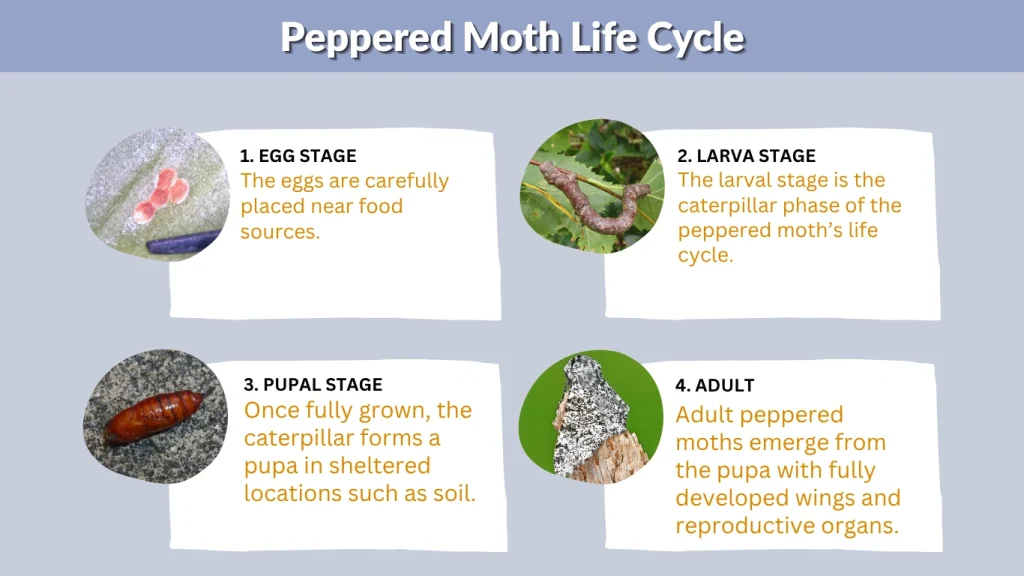
The peppered moth goes through a complete metamorphosis consisting of four stages: egg, larva, pupa, and adult moth. Each stage is important for growth, survival, and reproduction. Environmental conditions, food availability, and predator threats all influence how successfully the moth develops throughout its life cycle.
Egg Stage
Adult female peppered moths lay tiny eggs on tree branches and leaves during late spring and summer. The eggs are carefully placed near food sources so the young caterpillars can begin feeding immediately after hatching. After several days, the eggs hatch into larvae.
Larval Stage
The larval stage is the caterpillar phase of the peppered moth’s life cycle. These caterpillars are excellent at camouflage because their bodies closely resemble small twigs. This disguise protects them from birds and other predators while they feed on leaves.
Peppered moth caterpillars commonly eat leaves from:
- Birch trees
- Oak trees
- Willow trees
As the caterpillars grow, they shed their outer skin several times before reaching full size.
Pupal Stage
Once fully grown, the caterpillar forms a pupa in sheltered locations such as soil, bark crevices, or leaf litter. During this stage, the insect undergoes major internal changes and transforms into an adult moth.
Peppered moths often spend the winter in the pupal stage because the protective casing helps them survive cold temperatures and harsh weather conditions.
Adult Moth Stage
Adult peppered moths emerge from the pupa with fully developed wings and reproductive organs. Their primary purpose during this stage is mating and laying eggs to begin the next generation.
Adult moths are mostly active at night and spend the daytime resting on tree bark where their wing patterns provide camouflage from predators. Depending on environmental conditions, adult peppered moths typically live for only a few weeks.
Peppered Moths and Natural Selection

Peppered moths became famous because they clearly demonstrated natural selection. Natural selection occurs when organisms with beneficial traits survive and reproduce more successfully than others. In the case of peppered moths, camouflage played a major role in survival.
The Industrial Revolution and Peppered Moths
Before industrial pollution increased, most trees in England were covered with pale lichens. Light-colored moths blended into these surfaces and were difficult for birds to detect. Dark moths, however, stood out and were eaten more often.
As factories released smoke and soot into the environment, tree bark became darker and lichens disappeared. Suddenly, dark moths gained a survival advantage because they blended into the darker trees more effectively.
How Did the Population Become Mostly Dark Colored?
Over time, birds consumed more visible light moths while dark moths survived and reproduced. Because dark moths passed their genes to future generations, the population gradually became dominated by dark-colored individuals.
This process became one of the strongest real-world examples of evolution through natural selection.
Why Peppered Moths Matter in Biology
Scientists continue studying peppered moths because they demonstrate how environmental changes can influence species survival. Their story helps researchers understand adaptation, camouflage, genetics, and ecological balance.
Peppered moths also show that evolution is not simply a theory from the distant past. Instead, it is an observable biological process that continues to occur whenever environments change and organisms must adapt to survive.
Industrial Melanism in Peppered Moths
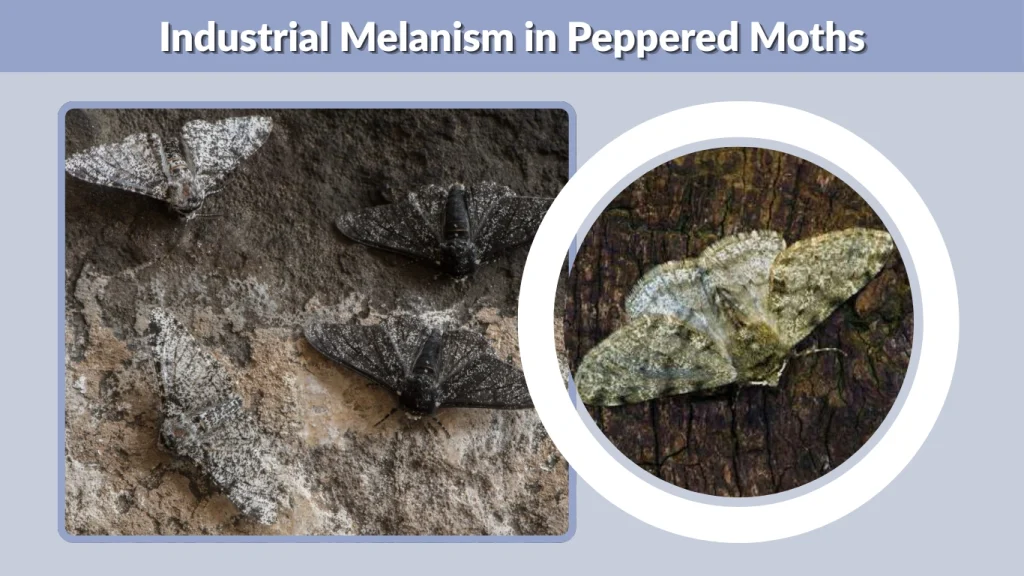
Industrial melanism refers to the process in which darker-colored organisms become more common because environmental pollution gives them a survival advantage. Peppered moths became the most famous example of this phenomenon during the Industrial Revolution in England. Their changing population patterns showed scientists how quickly environmental pressures can affect evolution within a species.
What Is Industrial Melanism?
Industrial melanism occurs when pollution darkens natural environments, allowing darker animals to camouflage more effectively. In peppered moths, dark-winged forms became harder for predators to detect on soot-covered trees.
This adaptation increased the survival rate of dark moths in industrial areas. As a result, the dark-colored carbonaria form spread rapidly through polluted regions.
The Role of Predators in Natural Selection
Birds are the primary predators of peppered moths. These predators hunt visually during daylight hours while moths rest on tree trunks. Moths that stand out against their surroundings are easier targets for hungry birds.
The survival of peppered moths depends heavily on camouflage. Environmental conditions determine which color form remains hidden more effectively from predators.
How Peppered Moths Avoid Predators
Peppered moths use several survival strategies to avoid being eaten:
- Camouflage against tree bark
- Remaining motionless during the day
- Resting on surfaces matching their wing color
These behaviors increase their chances of surviving long enough to reproduce.
Peppered Moth Adaptation and Evolution
Peppered moths are often used in biology classes because they provide clear evidence of adaptation and evolution. Their population changes were not random. Instead, environmental pressures selected the moths best suited to survive in specific habitats.
Peppered Moth Evolution Explained
Evolution in peppered moths occurred through inherited traits passed from parents to offspring. Dark moths survived more successfully in polluted areas, while light moths survived better in cleaner forests.
As environmental conditions changed, the dominant moth color changed as well. This shift demonstrated how populations evolve across generations.
The Return of Light-Colored Peppered Moths
During the twentieth century, pollution levels in many industrial regions began to decrease. Cleaner air allowed lichens to return to tree bark, making trees lighter once again.
This environmental improvement gave light-colored moths a camouflage advantage. Over time, the typica form increased in population while dark moth numbers declined in many locations.
Why Peppered Moths Are Important to Science
Peppered moths remain scientifically important because they provide measurable evidence of natural selection. Researchers can directly observe how environmental pressures influence survival rates within a population.
The species also demonstrates the relationship between predators, camouflage, and habitat conditions. These observations continue helping scientists understand ecological and evolutionary processes.
Peppered Moth Habitat and Behavior
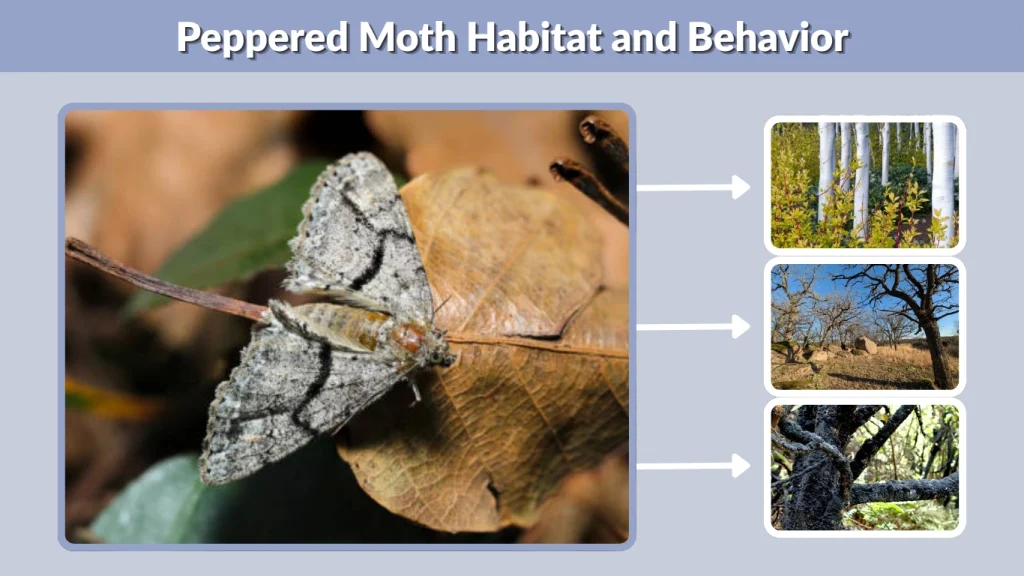
Peppered moths spend most of their lives hidden within wooded environments. Their behaviors are strongly connected to survival and protection from predators. Both caterpillars and adult moths rely heavily on camouflage throughout their life cycle.
Trees Used by Peppered Moths
Peppered moths commonly rest on trees that help conceal their wing coloration. Common resting surfaces include:
- Birch trees with pale bark
- Oak trees with rough surfaces
- Trees covered in lichens or soot
The appearance of these surfaces determines how effectively different moth colors remain hidden.
How Long Do Peppered Moths Live?
Adult peppered moths usually live only a few weeks. Their primary purpose during adulthood is reproduction. Most feeding and growth occur during the caterpillar stage before metamorphosis.
Although adult lifespans are short, the complete life cycle from egg to adult may take several months depending on seasonal conditions.
Investigating Phenomena Through Peppered Moths
The peppered moth remains one of the clearest examples of environmental influence on evolution. Scientists, teachers, and students continue studying this species because it demonstrates how organisms adapt when habitats change over time.
Evidence of Evolution in Real Time
Unlike many evolutionary examples based only on fossils, peppered moth changes were directly observed by scientists. Researchers recorded shifts in moth populations as pollution levels changed across industrial regions.
This evidence helped strengthen scientific understanding of natural selection and adaptation.
Why Peppered Moths Still Matter Today
Peppered moths continue to be relevant in modern environmental science. Their story highlights how human activities can influence ecosystems and alter species survival patterns.
The species also reminds scientists that environmental recovery can reverse some evolutionary pressures. As habitats improve, populations may once again favor traits that were previously less successful.
FAQs
What Is a Peppered Moth?
A peppered moth is a species of night moth scientifically known as Biston betularia. It is famous for demonstrating natural selection during the Industrial Revolution. The moth exists in both light and dark color forms, which helped scientists study evolution and environmental adaptation in real-world conditions.
Why Are Peppered Moths Important in Biology?
Peppered moths are important because they provide one of the clearest examples of natural selection and evolution. Their changing populations showed how environmental conditions can affect survival rates, reproduction, and inherited traits within a species over multiple generations.
What Do Peppered Moths Eat?
Peppered moth caterpillars feed mainly on leaves from deciduous trees such as birch, willow, and oak. Adult moths feed very little and focus primarily on reproduction. Most growth and nutrient intake occur during the larval stage before transformation into adult moths.
What Animals Eat Peppered Moths?
Birds are the primary predators of peppered moths because they hunt visually during the daytime. Other insect-eating predators may also consume them. Camouflage is the moth’s main defense, helping it blend into tree bark and avoid detection from predators.
How Do Peppered Moths Demonstrate Natural Selection?
Peppered moths demonstrate natural selection through changes in their population colors during the Industrial Revolution. Dark moths survived better on soot-covered trees, while light moths survived better in cleaner environments. These survival advantages changed the dominant population over time through reproduction.
