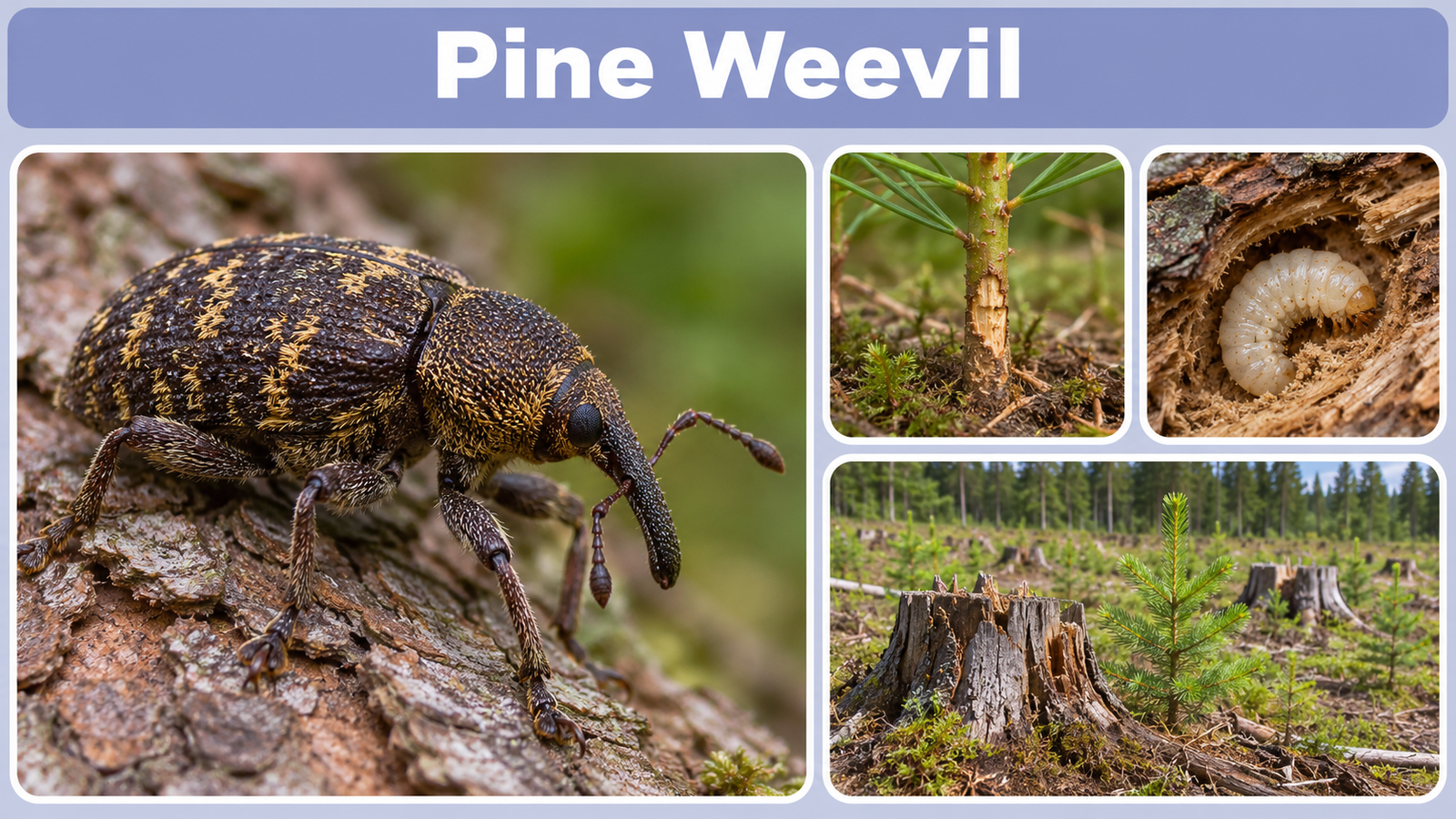
If the bark near the base of a newly planted pine looks scraped away, the large pine weevil may be responsible. This dark, long-snouted beetle is a major concern on recently felled conifer sites, where old stumps provide breeding material and young seedlings offer fresh bark for adults to eat. Severe feeding can strip a ring around the stem and kill the tree. The name can also cause confusion because the North American white pine weevil damages a different part of the tree. Here’s how to identify the large pine weevil, recognize its feeding scars, and protect vulnerable seedlings.
What Is a Pine Weevil?
The large pine weevil (Hylobius abietis) is a snout beetle in the family Curculionidae. It occurs across much of Europe and is a significant forestry pest in the United Kingdom, especially where young conifers are planted after timber harvesting. Adults use living plants for food, while their larvae develop in the stumps and roots of dead or felled conifers. This combination makes newly replanted sites particularly vulnerable. The name “pine weevil” can refer to other beetles in different regions, so check which part of the tree has been damaged before deciding which species is involved.
How to Identify a Pine Weevil
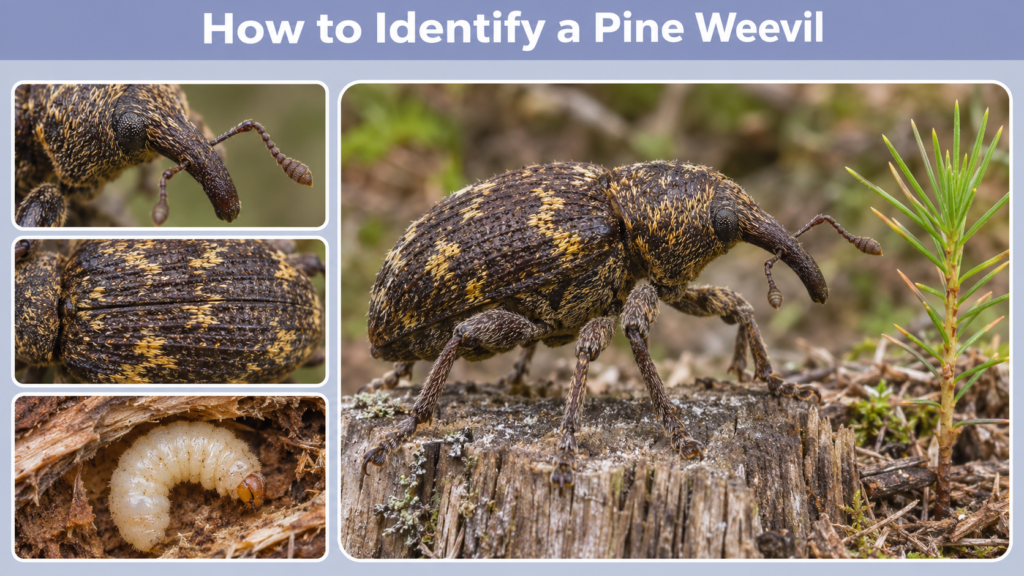
Start by looking at the beetle’s snout and the markings on its back. Then check the lower stem of nearby seedlings for missing bark. On a site with old conifer stumps and young trees, that combination gives you a more useful identification clue than color alone.
Adult Large Pine Weevil
- Size — Adults are roughly a centimeter long, with some reaching about 12 mm.
- Body — Broad and oval, usually dark brown to nearly black.
- Snout — A prominent, elongated snout projects from the head.
- Antennae — Elbowed antennae attach to the snout.
- Wing covers — Patches of yellowish hairs form irregular markings across the dark back. These markings can be less obvious on worn beetles.
- Location — Adults may be found around young stems, near conifer stumps, or under debris on recently felled sites.
Pine Weevil Larvae
The larvae are soft, cream-colored grubs with hardened brown heads. They have no legs and usually curl into a C shape when exposed. Fully grown larvae can reach about 14–16 mm. Their appearance is similar to that of other weevil grubs, so the material they’re found in helps narrow down the identification.
Large pine weevil larvae usually develop beneath the bark of dead conifer roots and stumps. If you find a grub tunneling inside the top shoot of a living spruce or pine, especially in North America, white pine weevil is a more plausible candidate. The location of the grub tells you more than its color or shape.
Where Do Pine Weevils Live?
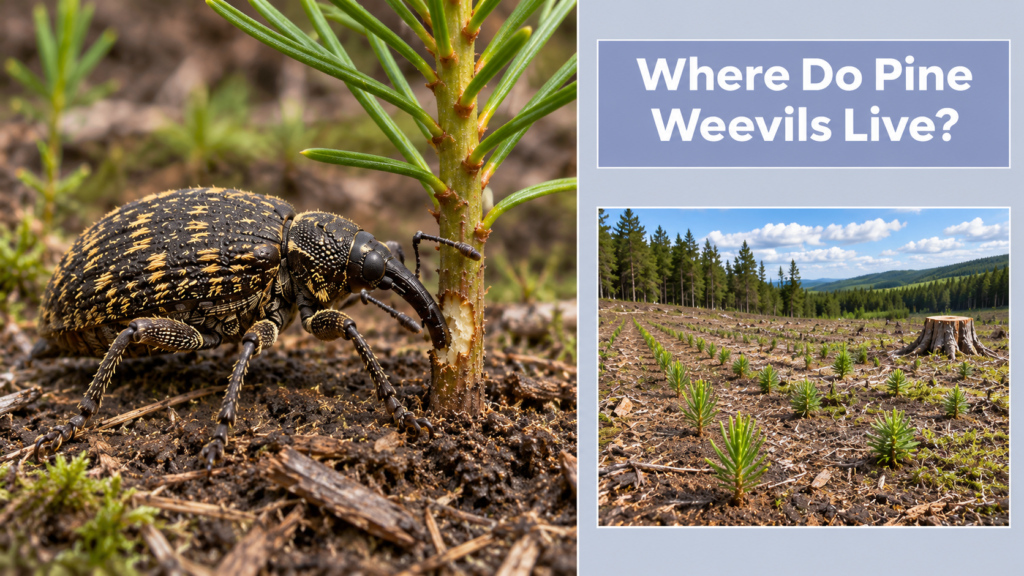
Large pine weevils are especially common on recently harvested conifer sites. Fresh stumps and roots release odors that attract adult beetles looking for places to lay eggs. Below ground, the bark of those stumps and roots provides food and shelter for developing larvae. Above ground, newly planted trees and naturally regenerating seedlings give adults a nearby source of bark. That combination explains why damage can appear soon after restocking a harvested site. Pines are among the trees affected, and young spruce and other conifers can also be damaged. On a site with several tree species, check all young plantings in an area where seedlings are failing.
What Do Pine Weevils Eat?
Adult large pine weevils chew bark on living plants. The thin bark on a young conifer’s lower stem is particularly vulnerable, and nearby seedlings may develop several feeding scars in a short period. Adults can also feed on twigs or other woody plants, so their diet extends beyond pine. Larvae feed in the inner bark and cambial region of dead conifer roots and stumps. The cambium is the thin layer between bark and wood that produces new growth. When you see bark missing from the stem of a living seedling, the exposed feeding scars are the work of adults.
What Does Pine Weevil Damage Look Like?
The clearest sign is a patch of bark chewed away from a young stem, often near ground level. Fresh scars can expose pale tissue, while older scars may darken or develop resin around the edges. One small wound may leave enough intact bark for the seedling to survive. Several scars can join together and girdle the stem, meaning the damage wraps around its entire circumference. This disrupts the movement of sugars between the foliage and roots, and deeper injury can impair water transport. A badly injured seedling may wilt, develop brown needles, or die. If several seedlings are browning, inspect their stem bases. Browning alone can also result from drought, planting stress, or root damage.
Pine Weevil Life Cycle
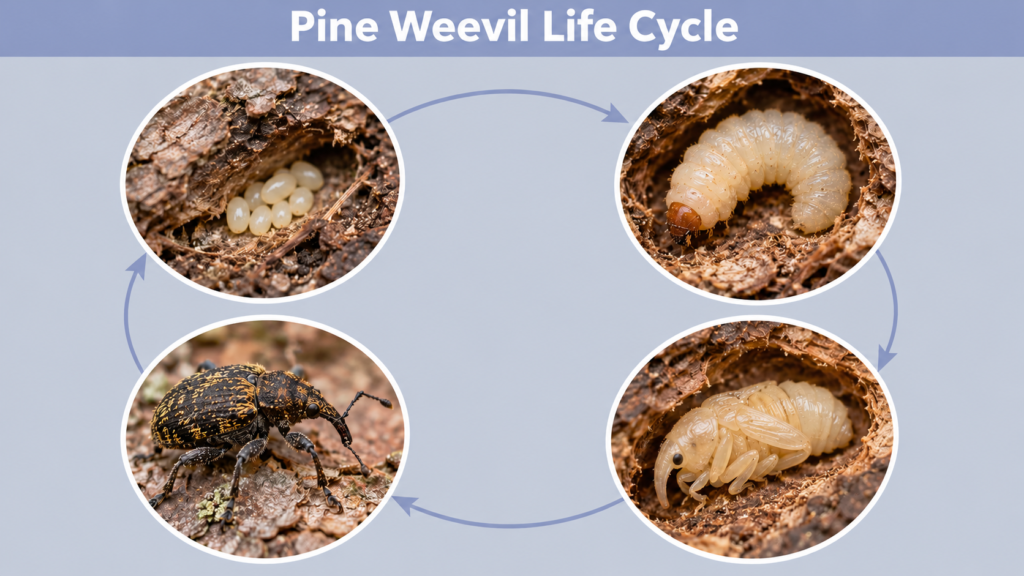
The large pine weevil develops through four stages: egg, larva, pupa, and adult. The first three stages are closely tied to dead conifer material. Seedling damage occurs during the adult stage, and the timing and severity can vary with local climate and the age of the stumps.
Eggs, Larvae, and Pupae
Females lay eggs in or near the bark of dead or recently felled conifer stumps and roots. Once the eggs hatch, the grubs feed beneath the bark and molt as they grow. Eventually, a mature larva forms a protected chamber in the breeding material and pupates there.
Temperature and site conditions affect how quickly development proceeds. On favorable lowland pine sites, development can be completed in about a year. It can take several years under cooler upland conditions. This helps explain why a site may continue to produce weevils well after the trees were felled.
When Are Adult Pine Weevils Active?
In the UK, feeding damage is most noticeable from spring into early autumn, with activity varying by local weather. Feeding often increases in spring as adults become active and again in late summer when newly emerged beetles add to the population.
On a newly replanted site, inspect seedlings more than once during the growing season. Checking the same groups of trees over time helps you see whether old wounds are healing or new feeding scars are appearing. Fresh damage on several neighboring plants is a reason to inspect the surrounding planting area.
Large Pine Weevil vs. White Pine Weevil

The easiest way to distinguish these pests is to check which part of the tree is damaged. The large pine weevil typically strips bark from the lower stem of a seedling. The white pine weevil (Pissodes strobi) damages the upright top shoot, also called the terminal leader. As that shoot wilts, its tip can bend over into a shape often called a shepherd’s crook.
| Feature | Large pine weevil | White pine weevil |
|---|---|---|
| Scientific name | Hylobius abietis | Pissodes strobi |
| Typical setting | Recently harvested or replanted conifer sites in Europe | Pine and spruce plantings in North America |
| Main damage location | Lower stem of a young tree | Top shoot of a living tree |
| Stage responsible for characteristic damage | Adults chew exposed bark | Larvae tunnel beneath the leader’s bark |
| What to look for | Missing bark, resin around wounds, or girdling | Wilted, curled, or dead top shoot |
How to Prevent and Manage Pine Weevil Damage

Start by checking the site’s harvest history and inspecting young trees for fresh scars. Where large pine weevil pressure is expected to be high, combining planting decisions, physical protection, and regular checks gives you more ways to reduce losses.
- Plan planting around site risk. Where forestry objectives and local guidance allow, delaying replanting can reduce exposure to high weevil populations. The suitable interval depends on the site and how long its stumps remain suitable for breeding.
- Choose robust planting stock. A thicker-stemmed seedling can often withstand more feeding before the stem is girdled. Stock still needs to suit the site’s soil and growing conditions.
- Consider physical protection. Forestry-grade stem barriers or protective coatings can reduce access to vulnerable bark. Inspect barriers after planting to check that they remain properly positioned.
- Monitor for fresh scars. Check the lower stems of seedlings throughout the growing season. Record where fresh damage is concentrated so you can focus inspections and protection on the most affected areas.
Frequently Asked Questions
Does the Large Pine Weevil Attack Only Pine Trees?
Adults also feed on young spruce and other conifers. In some settings, they feed on broadleaved seedlings and other woody plants. Recently felled conifer stumps and roots are particularly important for breeding.
Can a Seedling Recover From Pine Weevil Damage?
A healthy seedling can sometimes recover from a small feeding scar if enough bark remains intact. Extensive damage around the stem is more serious. Check for additional fresh wounds and watch whether the tree continues to put on healthy growth.
Why Are Pine Weevils Common After Trees Are Cut Down?
Felling leaves fresh stumps and roots that attract egg-laying adults. These provide food and shelter for larvae. If the site is replanted while beetle numbers are high, emerging adults have young stems nearby to feed on.
Do Pine Weevil Larvae Kill Living Seedlings?
Large pine weevil larvae develop in dead conifer material. Adult feeding is responsible for the lower-stem damage that can kill living seedlings. White pine weevil larvae, by comparison, can kill the top shoot of a living conifer.
What Is the First Sign of Pine Weevil Damage?
Look for small, irregular patches of missing bark near the base of a young tree. Fresh scars can appear before the needles wilt or turn brown, making a close look at the stem more useful than checking the foliage alone.