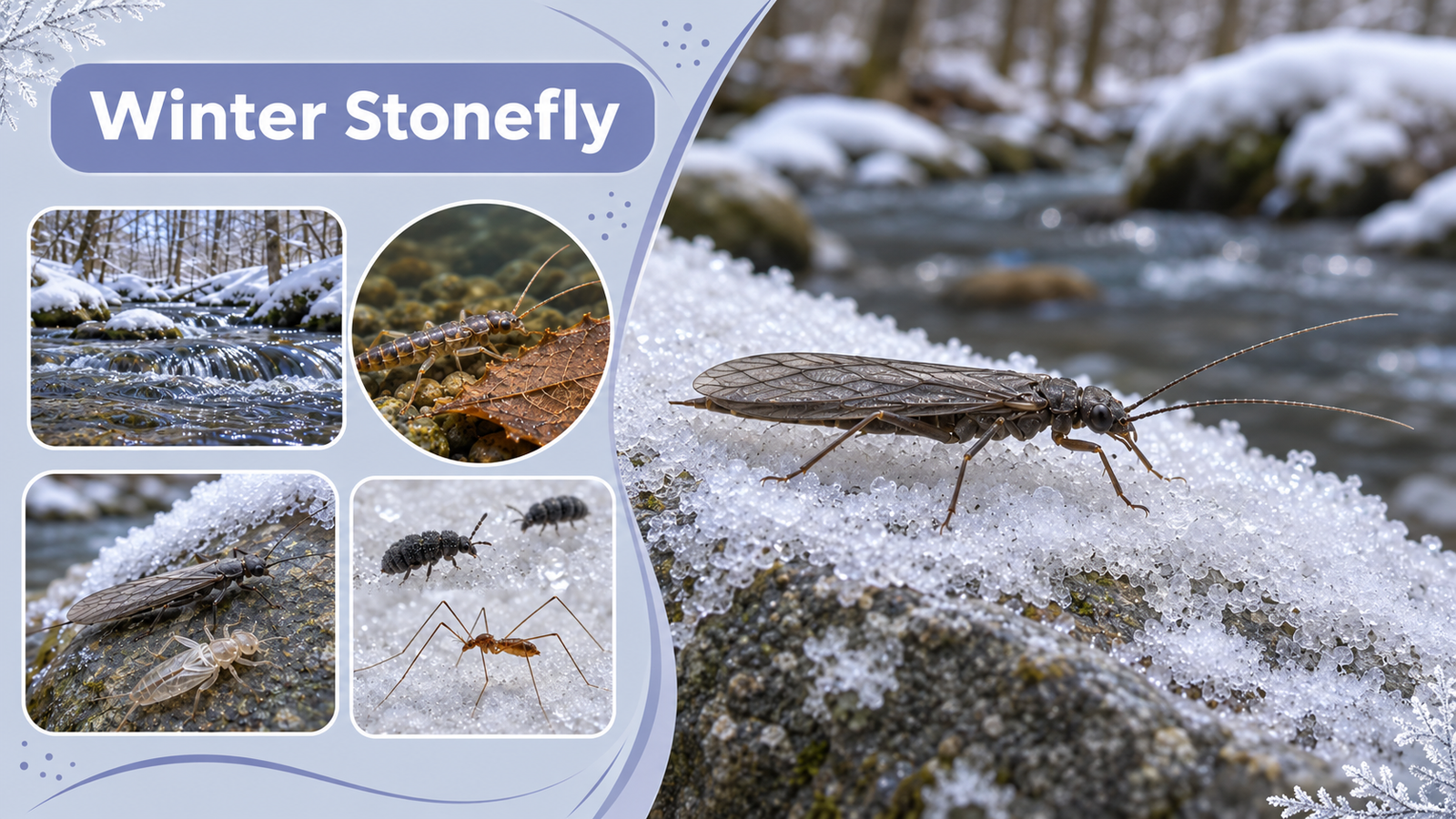
A tiny dark insect walking across snow beside a creek could be a winter stonefly. These insects spend their immature stage underwater and emerge as adults during the colder months, when many other insects are difficult to spot. Their dark bodies stand out against snow, and adults often turn up on streamside rocks, bridge railings, or the banks of flowing water. Below the surface, their nymphs may be tucked among gravel or submerged leaves. You can narrow down an identification by checking the insect’s wings, antennae, and movement, then looking at how close it is to a stream.
What Is a Winter Stonefly?
Winter stoneflies belong to Plecoptera, the insect order that includes all stoneflies. The common name refers to several kinds that emerge as adults in colder weather. In North America, small winter stoneflies generally belong to the family Capniidae, while winter stoneflies can also refer to members of Taeniopterygidae. Adult emergence varies by species and region, with some appearing in late fall and others becoming noticeable in late winter or early spring. The name “snowfly” sometimes refers to small winter stoneflies and is also used for unrelated insects. When identifying one, pay attention to its body shape and where you found it.
How to Identify a Winter Stonefly
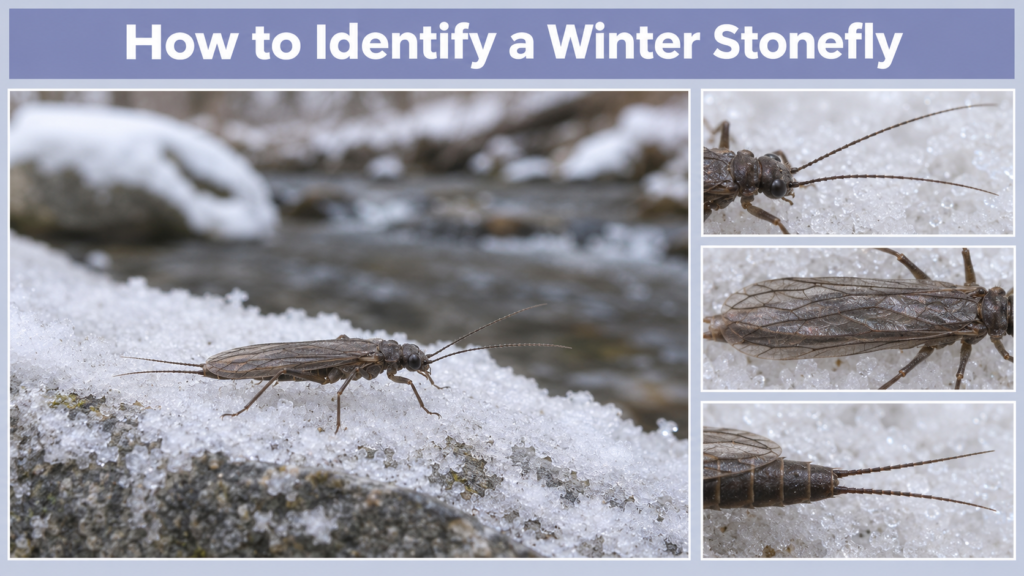
Start with where you found it and whether it walks or jumps. A slender, dark insect walking across snow near flowing water is a good candidate. A close look at the antennae, wings, legs, and rear of the abdomen can help you tell an adult stonefly from a springtail or another insect active in cold weather.
Adult Winter Stonefly
- Body — Slender and elongated, often dark brown, gray, or nearly black.
- Size — Around 7 mm is typical for many small winter stoneflies, although size varies by species.
- Antennae — Long, thin, and clearly visible in a close photograph.
- Wings — Fully developed wings lie flat along the back at rest. Some adults have reduced wings.
- Tail appendages — Some adults have two conspicuous segmented appendages called cerci. Their length varies across groups.
- Movement — Adults are frequently seen walking on snow, rocks, or structures beside streams.
Winter Stonefly Nymph
A winter stonefly nymph usually has a slender brown body, six legs, long antennae, and two thin tails. Older nymphs have wing pads on the thorax, where the legs attach. Those pads become easier to see as the insect approaches adulthood. Many small winter stonefly nymphs blend in with fine gravel, leaves, and other debris on the streambed.
Gills are another clue, though their appearance depends on the family. Capniid nymphs lack the conspicuous thoracic or abdominal gills found in some other stoneflies. A clear overhead photo can help you recognize a stonefly nymph. Identifying its family or species may require a magnified view of features such as the wing pads and the sides of the abdomen.
Where Do Winter Stoneflies Live?
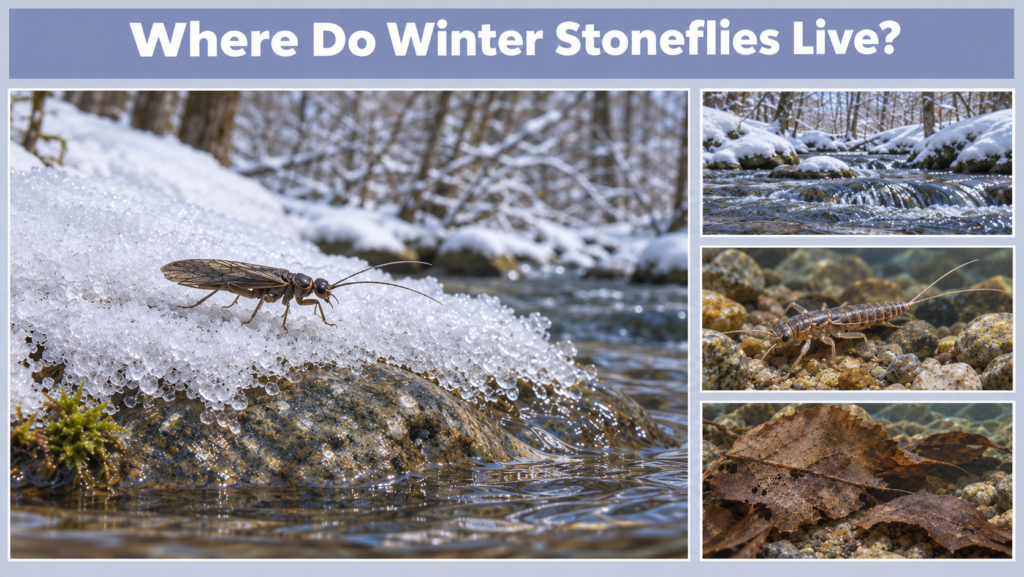
Winter stonefly nymphs live in flowing water. Depending on the species, they can inhabit small creeks, perennial streams, and larger rivers. Look for suitable habitat where gravel and cobbles create small spaces in the streambed and where leaves collect underwater. Some capniid nymphs occupy spaces beneath the surface layer of gravel, where stream water moves between the stones. Adults are easier to spot above water. Look at exposed rocks, bridge supports, railings, and nearby vegetation. Fresh snow along a stream bank can make the small, dark adults especially easy to see, even when they would blend into leaves or bare soil.
Why Do Winter Stoneflies Walk on Snow?
Winter stoneflies come out of streams during a season when the surrounding banks may be covered in snow. Mature nymphs crawl out of the water, shed their outer skin, and emerge as adults. As adults move along the banks, they may cross patches of snow or ice. Their dark color makes them much easier to notice on these pale surfaces. If you see several insects walking across the same snowy bank, check the nearest exposed rocks and bridge structures for others.
What Do Winter Stoneflies Eat?
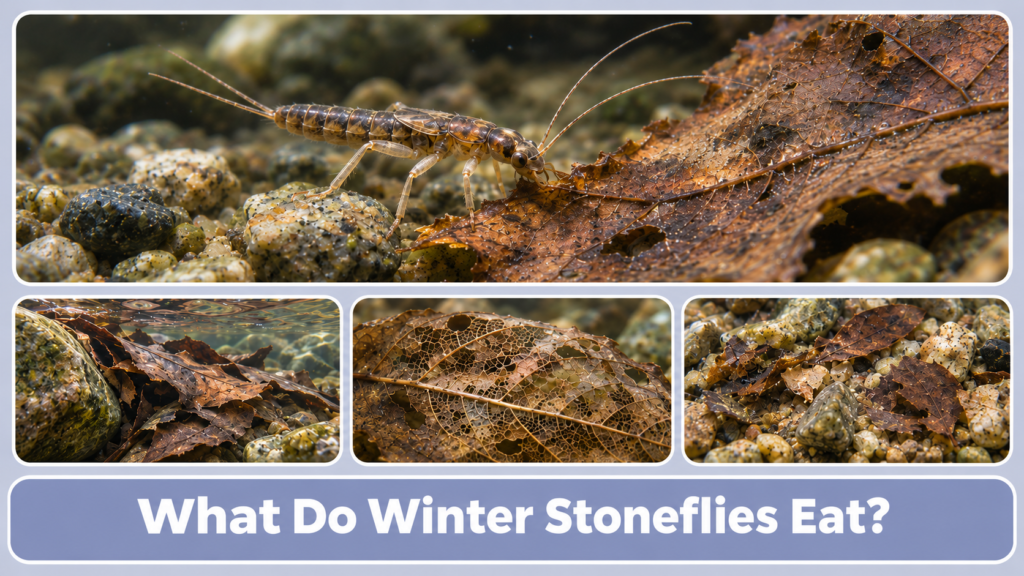
Many small winter stonefly nymphs feed on decaying plant material. Leaves that fall into a stream can collect behind rocks or branches, forming submerged leaf packs. As the leaves break down, they provide both food and shelter for small aquatic insects. Some capniid nymphs are commonly found in these leaf packs during fall and winter. Their feeding helps break plant material into smaller pieces, and the nymphs themselves provide food for fish and other stream animals. Feeding habits vary across stonefly species.
Winter Stonefly Life Cycle and Hatch Timing
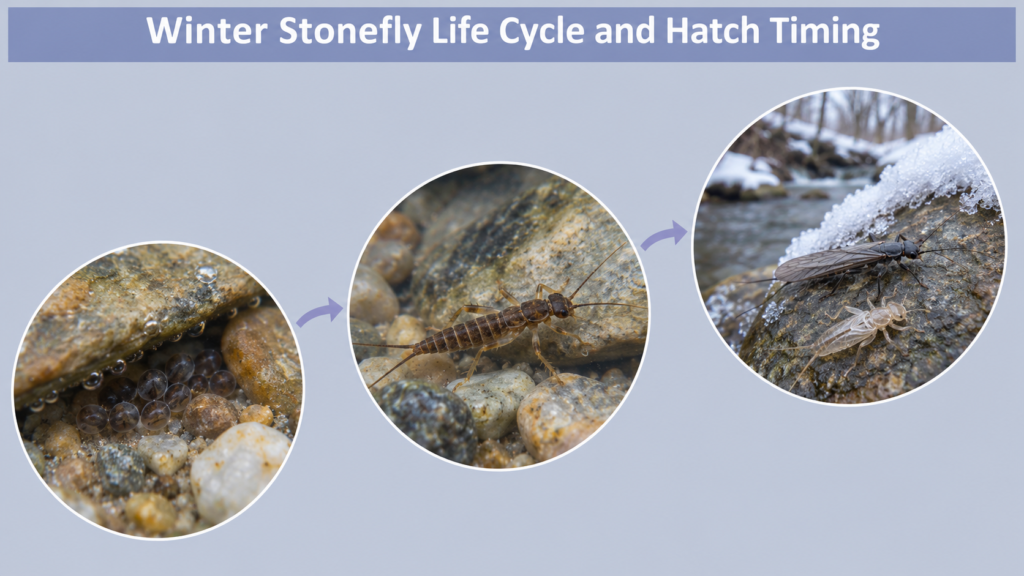
Winter stoneflies develop through three stages: egg, nymph, and adult. They spend most of their lives underwater. Adults leave the stream to mate, and females return to the water to deposit their eggs. In fly-fishing terminology, a winter stonefly “hatch” means the seasonal emergence of adults.
From Egg to Adult
After hatching, young nymphs grow underwater and shed their outer skin several times. Many small winter stoneflies are thought to complete one generation a year, though the details are better known for some species than others. Depending on the species, warmer months may be spent in a period of slow growth or suspended development.
When a nymph is ready to emerge, it crawls onto an exposed surface beside the stream. The adult pulls free through a split in the old skin. That hollow shell, called an exuvia, can remain attached to the rock or other surface after the adult moves away. Finding one close to the waterline can help you locate a stretch where stoneflies have been emerging.
When Do Winter Stoneflies Hatch?
Depending on the species and location, adults can emerge from late fall through early spring. Some small winter stoneflies are active during the coldest part of winter, while others are most noticeable toward the end of the season. Elevation and local conditions help explain why nearby streams can have different emergence windows.
To see whether adults are active on a particular stream, check the bank, streamside structures, and exposed rocks during a mild spell. Adults walking on the snow and fresh shed skins near the waterline give you clues about what is happening on that stretch.
Winter Stonefly vs. Snow Flea and Snow Fly
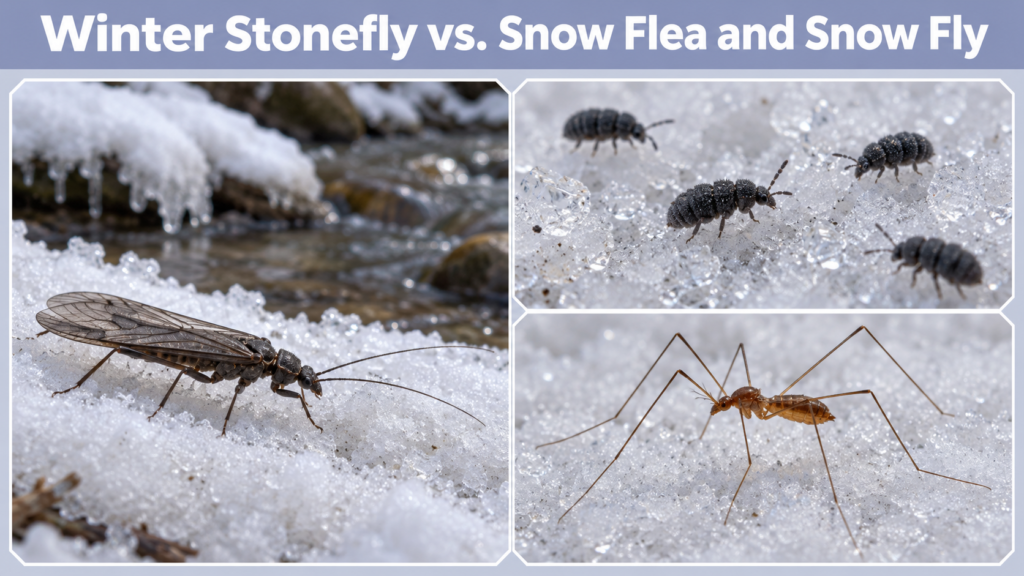
The name “snowfly” can refer to some winter stoneflies or to wingless winter crane flies. Snow fleas are springtails, a separate group known for jumping. Start with movement, then look at body shape and wing position if you can get close. A photo that shows the insect’s entire body can help you compare these features.
| Feature | Winter stonefly | Snow flea | Wingless winter crane fly |
|---|---|---|---|
| General appearance | Slender, often dark, with long antennae | Tiny dark speck, often seen in groups | Slender body with long, conspicuous legs |
| Wings | Often visible and folded flat, though some adults have reduced wings | Wingless | Wingless |
| Movement on snow | Usually seen walking | Often jumps suddenly | Usually seen walking |
| Where to look | Banks, rocks, and bridges near streams | Snow above leaf litter or other moist ground | Snow in cool, sheltered areas |
Why Winter Stoneflies Matter to Fly Anglers
Winter stoneflies give trout a potential food source when fewer familiar hatches are visible. The nymphs live below the surface, while adults can occasionally end up on the water. If trout are feeding subsurface near a rocky run or where slower water meets the main current, a slim, dark nymph pattern can imitate the underwater stage. If you see adults on the water and fish rising nearby, try a small, low-profile dry fly with a dark body and wings that sit close to its back. Match the body length of insects you see at the stream, since “winter stonefly” covers several species of different sizes.
Frequently Asked Questions
Are Winter Stoneflies Harmful to People?
Winter stoneflies are harmless to people. They lack a stinger, and you can observe adults on snow or bridge railings without handling them.
Do Winter Stoneflies Live in Snow?
Their nymphs live underwater in streams. Adults sometimes walk across snow after emerging, especially near the water. Snow makes the adults easier to see because their dark bodies stand out against it.
Can Winter Stoneflies Fly?
Many adults have functional wings and can fly. Some have reduced wings, and even fully winged adults are frequently seen walking along stream banks or across snow.
How Long Do Winter Stoneflies Live?
Many small winter stoneflies are thought to complete one generation in about a year. Most of that time passes before adult emergence. The exact duration varies by species, and the life cycle is still poorly documented for some members of the group.
Where Is the Best Place to Look for Winter Stoneflies?
Start along the bank of a flowing creek or river. Check snow near the waterline, exposed rocks, bridge railings, and supports. Small dark insects with long antennae walking in these spots are worth a closer look.