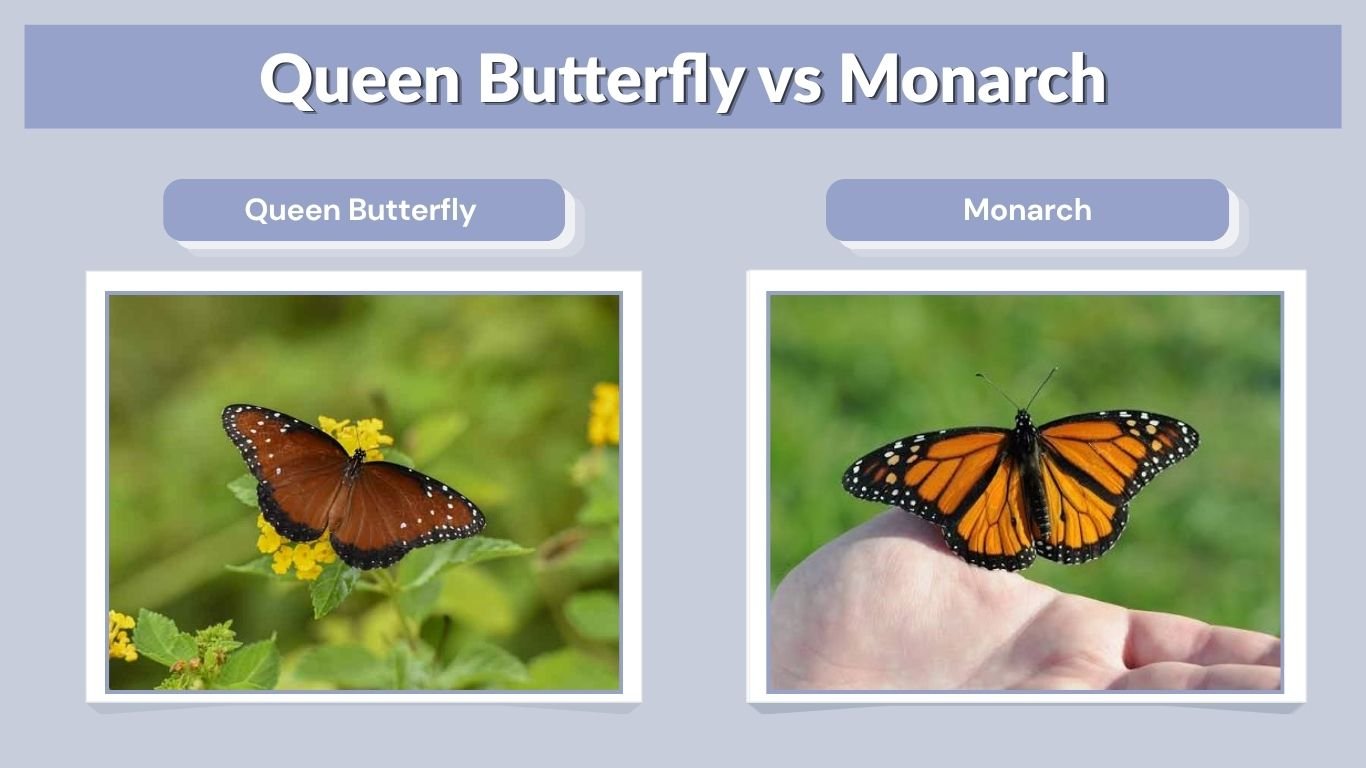
The queen butterfly and monarch butterfly look remarkably similar, making them difficult to identify at first glance. Both have orange-brown wings, black borders, and white spots. However, they are two different species with noticeable differences in wing patterns, size, caterpillars, and migration behavior. The queen monarch butterfly is also a commonly searched name, although it does not refer to a separate species. Understanding these butterflies’ unique characteristics can help you identify them correctly in gardens, fields, and natural habitats.
Are Queen Butterflies and Monarch Butterflies the Same?
Queen butterflies and monarch butterflies are closely related but belong to different species. Both are members of the genus Danaus within the brush-footed butterfly family, Nymphalidae.
Their similarities result from shared ancestry and adaptations involving milkweed plants. However, their appearances, geographic distributions, and behaviors are not identical.
Scientific Names and Classification
The queen butterfly is scientifically known as Danaus gilippus, while the monarch butterfly is Danaus plexippus.
Both belong to the subfamily Danainae, commonly called milkweed butterflies. Their caterpillars feed on milkweed and related plants, which provide chemical defenses against certain predators.
Despite these similarities, queens and monarchs are distinct species, and the term “queen monarch butterfly” should not be used as a scientific species name.
7 Key Differences Between Queen and Monarch Butterflies
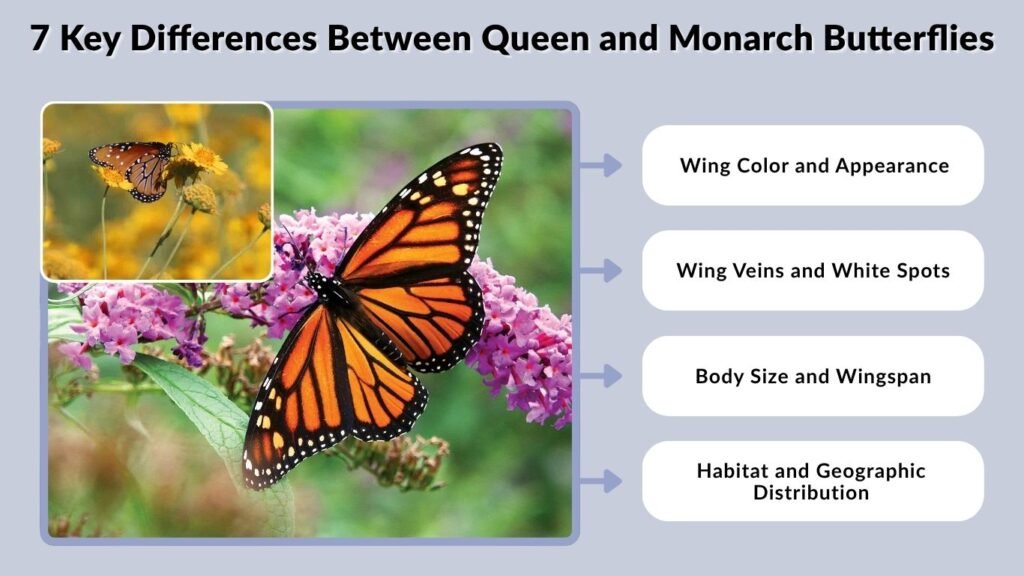
Identifying a queen butterfly versus a monarch becomes easier when you examine several characteristics together. Their wing colors, markings, body sizes, caterpillars, and geographic distributions provide useful identification clues. Some differences are immediately visible, while others require closer observation.
1. Wing Color and Appearance
The queen butterfly has dark orange-brown or mahogany-colored wings. Its overall appearance is often richer and more reddish-brown than the monarch.
Monarch butterflies generally have brighter orange wings with bold black patterns. Their wings create a distinctive stained-glass appearance.
Queens have a more uniform color across their wings, especially when viewed from above. Lighting and individual variation can affect appearance, so color alone is not always reliable.
2. Wing Veins and White Spots
Wing markings are among the most dependable differences between these butterflies.
Monarch butterflies have prominent black veins crossing their orange wings. Their white spots are mainly contained within the black wing borders.
Queen butterflies have much less noticeable black veining on the upper surfaces of their wings. They also have small white spots extending into the orange areas of their forewings.
Identification tip: A butterfly with dark orange-brown wings and scattered white spots inside the orange forewing areas is more likely to be a queen.
3. Body Size and Wingspan
Monarch butterflies are generally larger than queen butterflies, although their size ranges overlap.
Adult monarchs typically have wingspans of approximately 3.5–4 inches, with some individuals reaching around 4.5 inches.
Queen butterflies usually have wingspans around 2.5–3.75 inches, although some can approach 4 inches.
Because these measurements overlap, size should be considered alongside wing patterns rather than used as the only identification method.
4. Queen Butterfly Caterpillar vs Monarch
Caterpillar identification is often easier than identifying adult butterflies because the larvae have a distinctive anatomical difference.
Queen caterpillars possess three pairs of long, flexible filaments: one near the head, another around the middle, and a third near the rear.
Monarch caterpillars have only two pairs of filaments, positioned near the front and rear of their bodies.
Both caterpillars have black, yellow, and white markings. Queen caterpillars often display yellow spots within darker bands, while monarch caterpillars usually have more continuous stripes.
5. Queen Butterfly Chrysalis vs Monarch
Both butterflies produce green chrysalises decorated with metallic-looking gold markings.
Queen chrysalises are generally more rounded or barrel-shaped, sometimes displaying a prominent abdominal seam. Monarch chrysalises often appear smoother and more elongated.
However, differences in shape and markings can be subtle, and both species show natural variation.
The most reliable identification method is to observe the caterpillar before it pupates or the adult butterfly after emergence.
Their eggs are also very similar, making identification based on eggs alone difficult.
6. Habitat and Geographic Distribution
Monarch butterflies occur across much of North America and are particularly familiar in the United States, Canada, and Mexico. Other monarch populations occur in additional regions.
Queen butterflies prefer warmer environments and are common in parts of the southern United States, Mexico, Central America, and South America.
Within the United States, queens are especially associated with states such as Texas, Arizona, and Florida.
Both species inhabit open areas containing milkweed and nectar-producing flowers, including grasslands, gardens, roadsides, and meadows.
7. Migration and Seasonal Behavior
Monarch butterflies are famous for their long-distance migration. Many eastern North American monarchs travel thousands of miles to overwintering forests in central Mexico.
Western migratory populations generally overwinter along coastal California.
Queen butterflies do not undertake the same famous continent-spanning migration. However, they can disperse seasonally and make shorter regional movements when weather and plant availability change.
In warm regions, queen butterflies may remain active throughout much of the year.
Queen Butterfly vs Monarch: Quick Comparison Chart
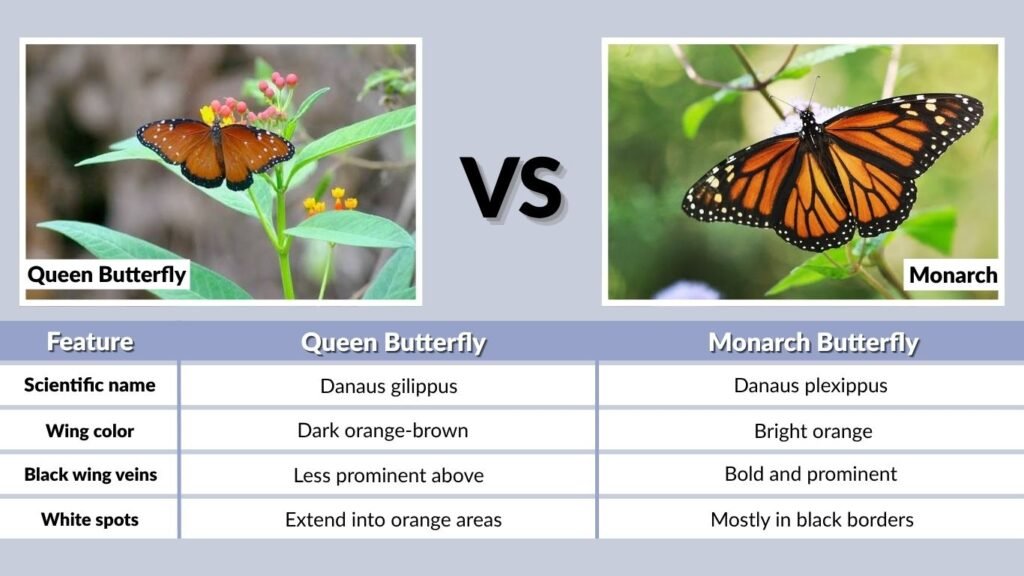
The most important distinguishing features can be summarized in a simple comparison. While queens and monarchs share many biological characteristics, several physical traits provide practical clues for identification.
| Feature | Queen Butterfly | Monarch Butterfly |
| Scientific name | Danaus gilippus | Danaus plexippus |
| Wing color | Dark orange-brown | Bright orange |
| Black wing veins | Less prominent above | Bold and prominent |
| White spots | Extend into orange areas | Mostly in black borders |
| Typical wingspan | About 2.5–3.75 inches | About 3.5–4 inches |
| Caterpillar filaments | Three pairs | Two pairs |
| Chrysalis | Rounded, green with gold markings | Smooth, green with gold markings |
| Migration | Mainly regional movements | Some populations migrate long distances |
Why Do Queen and Monarch Butterflies Look Alike?
The resemblance between queen and monarch butterflies involves their shared evolutionary history and defensive coloration. Both species feed on milkweed-related plants during their caterpillar stage and possess chemical defenses that can discourage predators.
Milkweed and Chemical Protection
Milkweed plants contain defensive chemicals called cardenolides. Caterpillars of both butterfly species can store some of these compounds in their bodies.
These chemicals may make butterflies unpleasant or harmful for certain predators to eat.
Their orange, black, and white colors act as warning signals, helping predators recognize potentially unsuitable prey.
The strength of these chemical defenses varies depending on the plants consumed and other biological factors.
Müllerian Mimicry
The similarities between queen and monarch butterflies are associated with Müllerian mimicry.
This occurs when two or more defended species share similar warning patterns. Predators that learn to avoid one species may also avoid another with a comparable appearance.
This shared warning system can improve the survival chances of both butterflies.
Queen vs Monarch vs Viceroy Butterfly
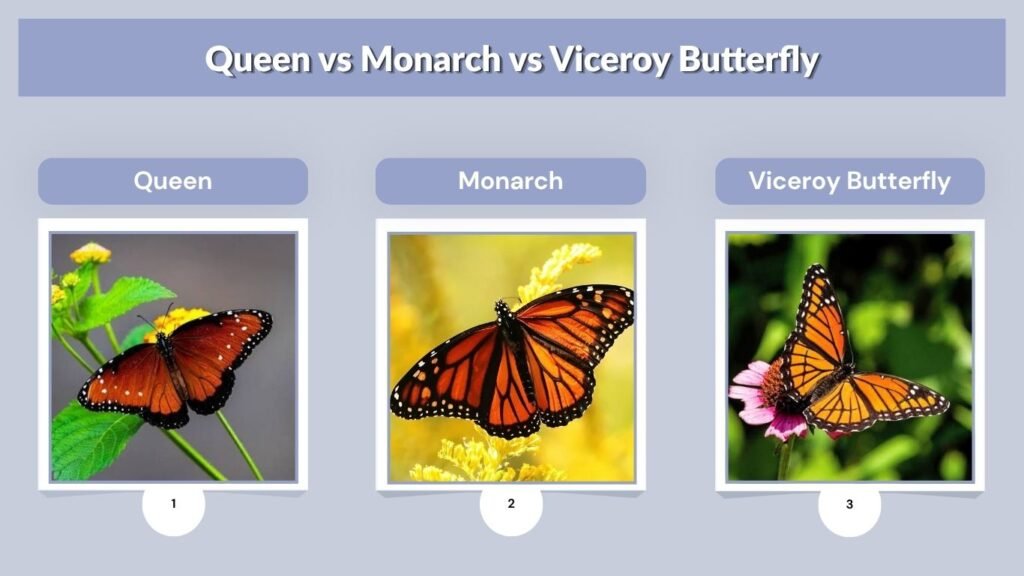
The viceroy butterfly is another orange-and-black species commonly confused with queens and monarchs. Although all three look similar, the viceroy belongs to a different genus, Limenitis.
How to Identify a Viceroy Butterfly
The easiest way to distinguish a viceroy is to examine its hindwings.
A viceroy usually has a noticeable curved black line crossing each hindwing, a marking absent from typical queen and monarch wing patterns.
Viceroys also use different caterpillar host plants, including willows and poplars, rather than milkweed.
Like monarchs and queens, viceroys can possess chemical defenses, contributing to their shared warning coloration.
FAQs
Is a Queen Butterfly a Type of Monarch?
No. The queen butterfly (Danaus gilippus) and monarch butterfly (Danaus plexippus) are different species. They belong to the same genus and share several physical characteristics, but they have distinct wing markings, caterpillar anatomy, and migration patterns.
How Can You Tell a Queen Butterfly From a Monarch?
Examine the upper wings. Queen butterflies have darker orange-brown coloring, weaker black veining, and white spots within the orange forewing areas. Monarchs have brighter orange wings, bold black veins, and white spots mainly along their black borders.
What Is the Difference Between Queen and Monarch Caterpillars?
Queen caterpillars have three pairs of flexible filaments, while monarch caterpillars have only two. Both species display black, yellow, and white coloration and depend on milkweed-related host plants during their larval development.
Do Queen and Monarch Butterflies Eat the Same Food?
Both adult butterflies primarily consume flower nectar. Their caterpillars also feed on milkweed and related host plants. However, their exact plant preferences can differ depending on species, geographic location, and the availability of suitable vegetation.
Can Queen and Monarch Butterflies Live in the Same Garden?
Yes. Both species may visit the same gardens in regions where their ranges overlap. Providing locally native milkweed species and a variety of nectar-rich flowers can help support both butterflies throughout their life cycles.