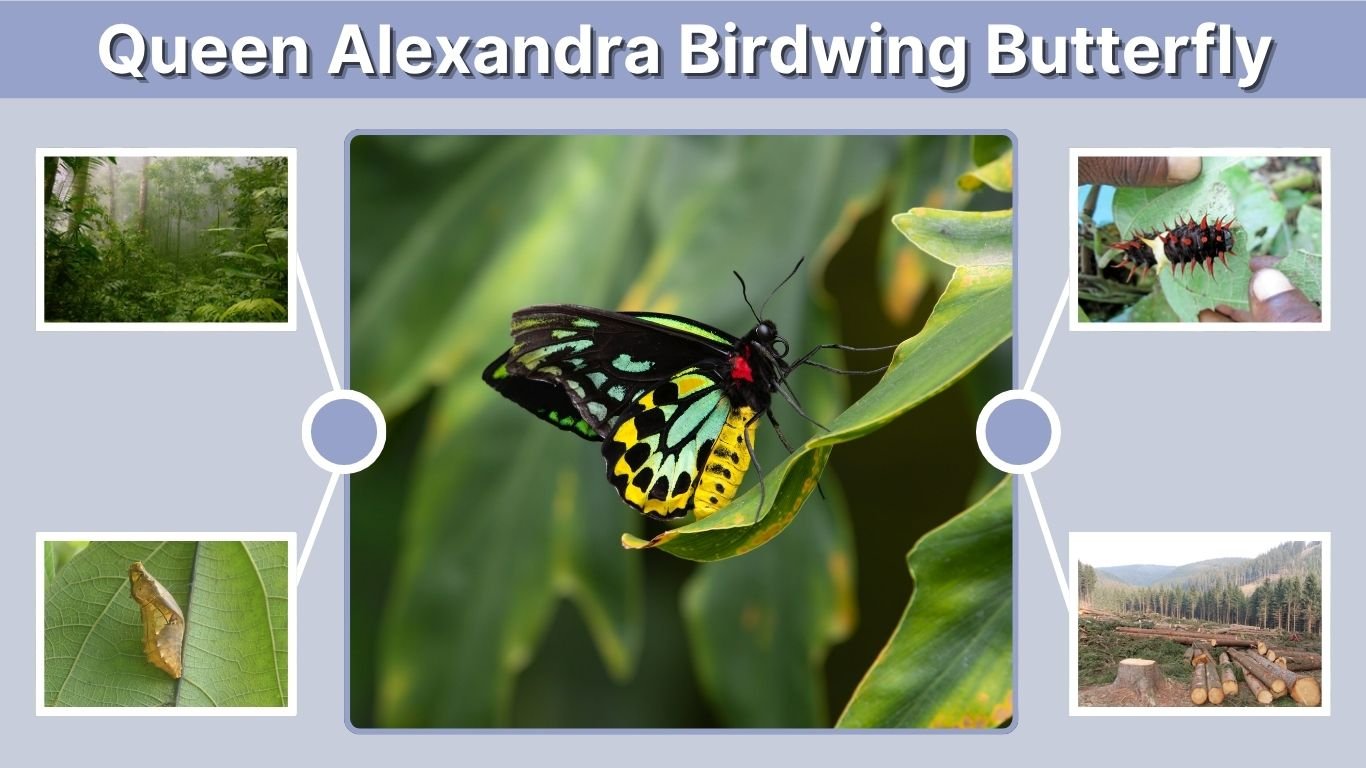
The Queen Alexandra birdwing butterfly is the largest butterfly species in the world, famous for its enormous wingspan and beautiful wing patterns. Found only in Papua New Guinea, this rare butterfly belongs to the swallowtail family and is one of the most remarkable insects on Earth. Females can reach a wingspan of approximately 30 centimeters, making them significantly larger than most butterfly species. However, habitat destruction and illegal collection have threatened their survival. Understanding their appearance, habitat, diet, life cycle, and conservation status reveals why this extraordinary butterfly deserves protection.
What Is the Queen Alexandra Birdwing Butterfly?
The Queen Alexandra’s birdwing butterfly (Ornithoptera alexandrae) is a large tropical butterfly belonging to the family Papilionidae. Its impressive size, distinctive colors, and restricted geographic distribution make it particularly interesting to scientists and butterfly enthusiasts.
Scientific Classification
The Queen Alexandra birdwing belongs to the following scientific groups:
- Common name: Queen Alexandra’s birdwing
- Scientific name: Ornithoptera alexandrae
- Family: Papilionidae
- Genus: Ornithoptera
- Order: Lepidoptera
- Native region: Papua New Guinea
- Conservation status: Endangered
Like other birdwing butterflies, this species has powerful wings that allow it to fly above tropical forest vegetation. Its large body and graceful flight sometimes make it appear similar to a small bird.
Discovery and History
Naturalist Albert Stewart Meek collected the first scientific specimens in Papua New Guinea in 1906. In 1907, Walter Rothschild formally described the species and named it after Queen Alexandra, the wife of King Edward VII.
The discovery attracted considerable attention because of the butterfly’s unusual size. Today, it remains an important species in butterfly research and tropical rainforest conservation.
Queen Alexandra Birdwing Butterfly Size and Appearance
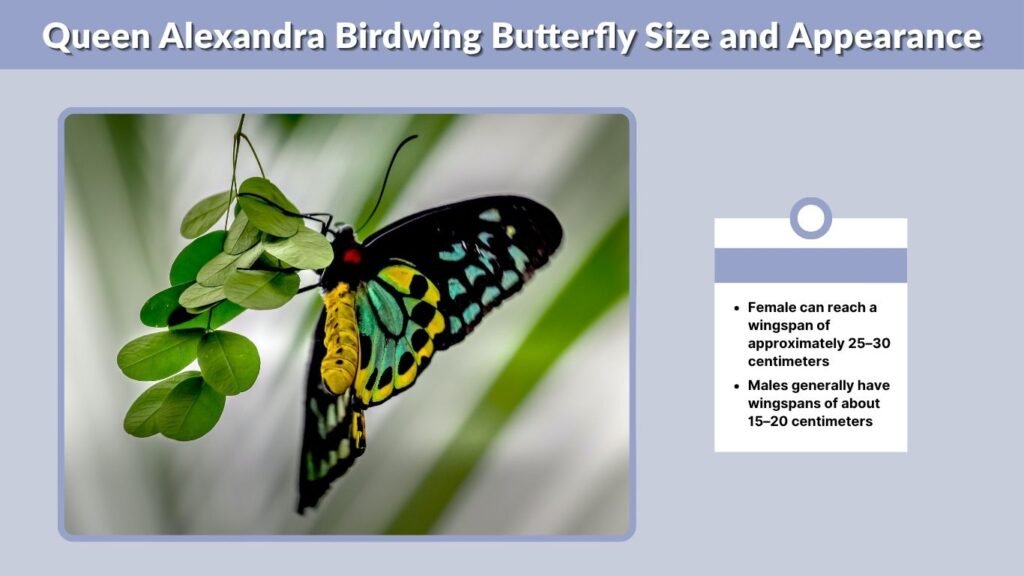
The Queen Alexandra butterfly is best known for its remarkable wingspan and distinctive differences between males and females. Both sexes have large wings, but their coloration, size, and wing patterns differ considerably.
How Big Is the Queen Alexandra Birdwing Butterfly?
Female Queen Alexandra birdwings can reach a wingspan of approximately 25–30 centimeters (10–12 inches), although many individuals are smaller. Males generally have wingspans of about 15–20 centimeters (6–8 inches).
This makes the female the largest butterfly in the world by wingspan. Its body can grow to approximately 8 centimeters long.
Despite its enormous size, the butterfly can move gracefully through tropical forests, using its powerful wings to travel between flowering trees and suitable breeding areas.
Male Queen Alexandra Birdwing Butterfly
Male Queen Alexandra birdwings have striking iridescent blue-green wings decorated with black markings. Their wings are relatively narrow, creating an elegant appearance during flight.
The male also has a bright yellow abdomen that contrasts with its dark body. Its shimmering wing colors make it one of the most visually impressive tropical butterflies.
Female Queen Alexandra Birdwing Butterfly
Females are considerably larger than males but have less colorful wings. Their wings are primarily dark brown, with pale cream, white, and yellowish markings.
The forewings contain lighter spots, while the hindwings display broader pale patches. This difference between males and females is known as sexual dimorphism and is particularly noticeable in this species.
Where Does the Queen Alexandra Birdwing Butterfly Live?
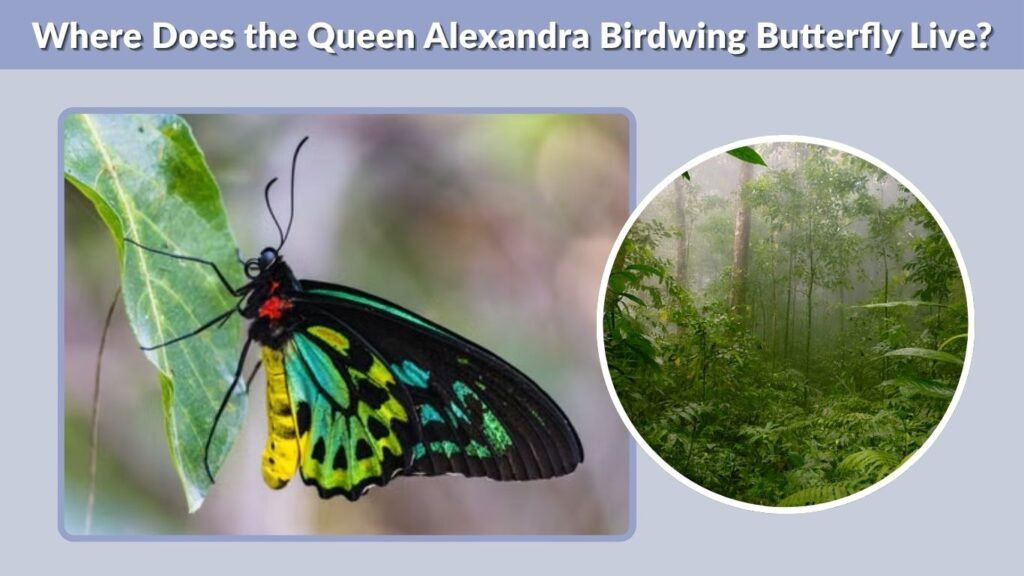
Queen Alexandra’s birdwing butterfly is endemic to Papua New Guinea, meaning it naturally occurs nowhere else in the world. Its distribution is extremely limited, making habitat protection essential for its survival.
Geographic Distribution
The butterfly primarily inhabits parts of Oro Province in eastern Papua New Guinea, especially forests near the Popondetta Plain and the Managalas Plateau.
Its populations are scattered across suitable forest habitats rather than distributed continuously throughout the region.
Although Papua New Guinea contains extensive tropical forests, this butterfly occupies only a small portion of them. Researchers believe that vegetation, climate, breeding conditions, and suitable host plants all influence its distribution.
Natural Habitat
Queen Alexandra birdwings inhabit humid tropical rainforests, including suitable secondary forests and forested hillsides.
Their preferred environment generally provides warm temperatures, sufficient humidity, flowering plants, and appropriate vines for caterpillars.
Adult butterflies often fly high among forest trees, making them difficult to observe. The species depends on suitable forest habitat for feeding, reproduction, and completing its life cycle.
Queen Alexandra Birdwing Butterfly Diet and Life Cycle
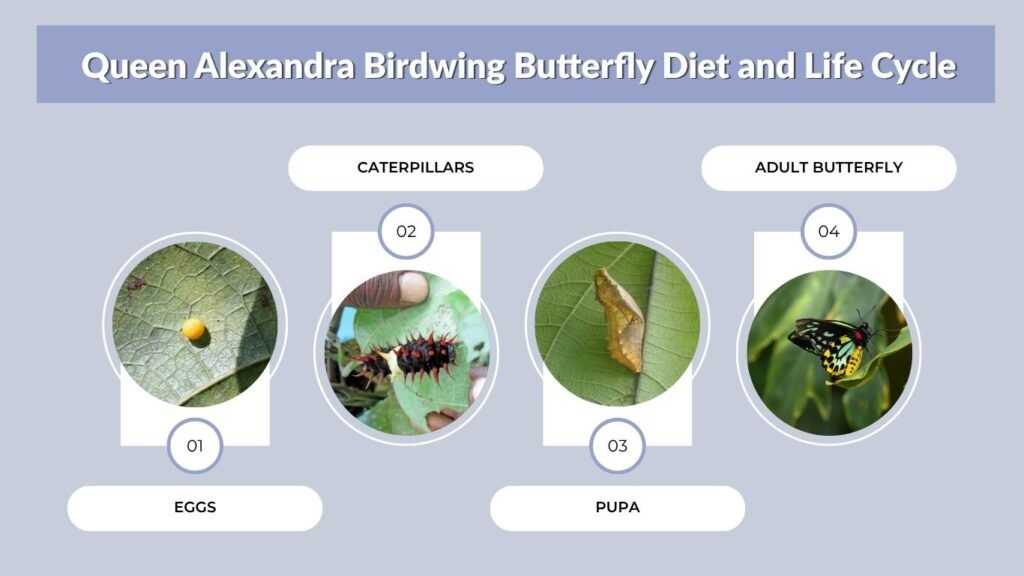
The Queen Alexandra butterfly undergoes complete metamorphosis, developing through four distinct life stages. Its feeding requirements change as it grows from a caterpillar into an adult butterfly.
What Does the Queen Alexandra Birdwing Butterfly Eat?
Adult Queen Alexandra birdwings mainly feed on nectar from flowering trees, vines, and other tropical plants. They use their long, flexible proboscis to drink nectar.
Caterpillars have a completely different diet. They feed on the leaves of particular pipevine plants in the genus Aristolochia, especially plants historically identified as Aristolochia dielsiana.
These vines are essential because female butterflies select suitable plants on which to lay their eggs. Without adequate host plants, the next generation cannot develop successfully.
Queen Alexandra Birdwing Butterfly Life Cycle
The butterfly develops through four stages:
- Egg: Females deposit eggs on suitable host plants. The developing caterpillars depend on these plants for food after hatching.
- Caterpillar: Newly hatched larvae begin feeding on plant material and grow through several molts. Mature caterpillars are dark with reddish projections and a pale band around the body.
- Pupa: After completing its feeding stage, the caterpillar forms a chrysalis. Inside, its body undergoes metamorphosis into an adult butterfly.
- Adult butterfly: The fully developed butterfly emerges, expands its wings, and eventually begins flying, feeding, and reproducing.
The period from egg to adult emergence can take approximately five to seven months, depending on environmental conditions.
How Long Does Queen Alexandra’s Birdwing Live?
The lifespan varies between individuals and sexes. According to conservation research summarized by the Swallowtail and Birdwing Butterfly Trust, adult males may survive for up to three months in the wild, while females may live for up to six months.
Actual survival depends on habitat conditions, food availability, predators, and other environmental factors.
Why Is the Queen Alexandra Birdwing Butterfly Endangered?
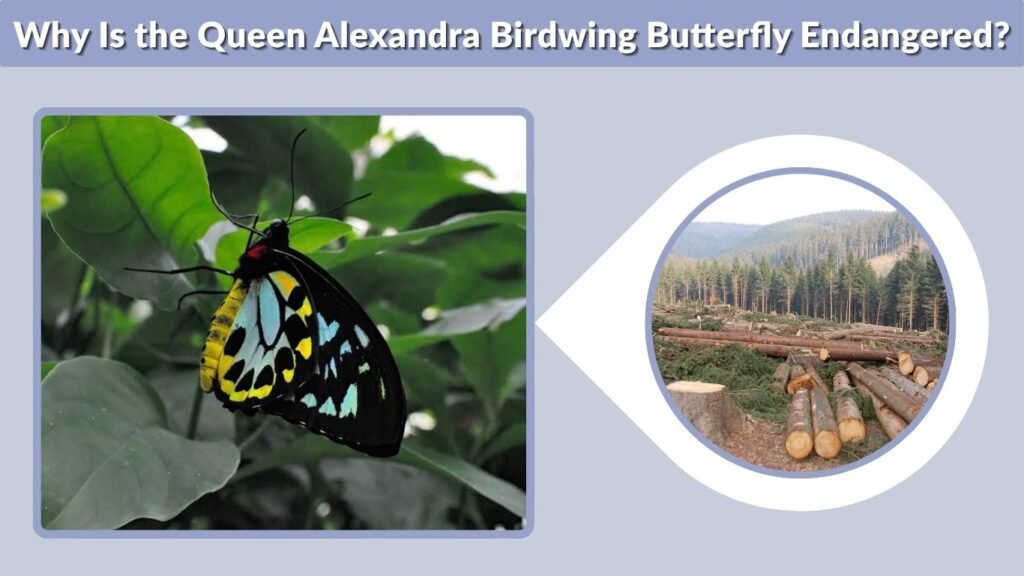
The Queen Alexandra birdwing butterfly is classified as Endangered on the IUCN Red List. Its limited distribution makes the species particularly vulnerable to environmental changes and human activities.
Major Threats to Survival
Several threats affect the remaining populations:
- Deforestation: Logging destroys important feeding and breeding habitats.
- Agricultural expansion: Oil palm plantations and other agricultural developments replace suitable forest environments.
- Habitat fragmentation: Isolated forest patches can make population recovery more difficult.
- Illegal collection: Rare specimens are sometimes targeted by collectors despite legal restrictions.
- Natural disasters: The 1951 eruption of Mount Lamington destroyed substantial areas of suitable habitat.
Habitat destruction remains one of the greatest threats to the long-term survival of this butterfly.
Conservation and Protection Efforts
Queen Alexandra’s birdwing has been legally protected in Papua New Guinea for decades. It is also listed under Appendix I of CITES, which generally prohibits international commercial trade in wild specimens.
Conservation organizations are working to protect rainforest habitats, restore host plants, and develop managed breeding programs.
The Swallowtail and Birdwing Butterfly Trust has supported breeding and conservation initiatives in Papua New Guinea. These efforts aim to improve understanding of the species and potentially support the recovery of populations in suitable habitats.
Protecting forests and working with local communities are essential parts of successful conservation.
FAQs
Is Queen Alexandra’s Birdwing the Biggest Butterfly in the World?
Yes. Queen Alexandra’s birdwing is considered the world’s largest living butterfly species by wingspan. Large females can reach approximately 30 centimeters across their wings, making them substantially larger than most other butterflies.
How Many Queen Alexandra Birdwing Butterflies Are Left?
Scientists do not have a reliable total population estimate. The species lives in fragmented forest habitats and often flies high in the canopy, making accurate surveys difficult. Researchers continue monitoring its distribution and conservation needs.
Is the Queen Alexandra Birdwing Butterfly Poisonous?
Its caterpillars feed on pipevine plants containing toxic compounds. Researchers believe these butterflies may retain defensive chemicals that discourage predators. However, they do not have venomous stingers and are not considered dangerous to humans.
Can You Buy a Queen Alexandra Birdwing Butterfly?
Queen Alexandra’s birdwing is strictly protected, and international commercial trade in wild specimens is generally prohibited under CITES Appendix I. Anyone encountering specimens advertised for sale should verify their legal origin and avoid supporting illegal wildlife collection.
Is Queen Alexandra’s Birdwing in Animal Crossing?
Yes. Queen Alexandra’s birdwing appears in Animal Crossing: New Horizons. Players can find it flying near flowers during certain months. It sells for 4,000 Bells at Nook’s Cranny, although its in-game appearance is separate from real-world conservation issues.