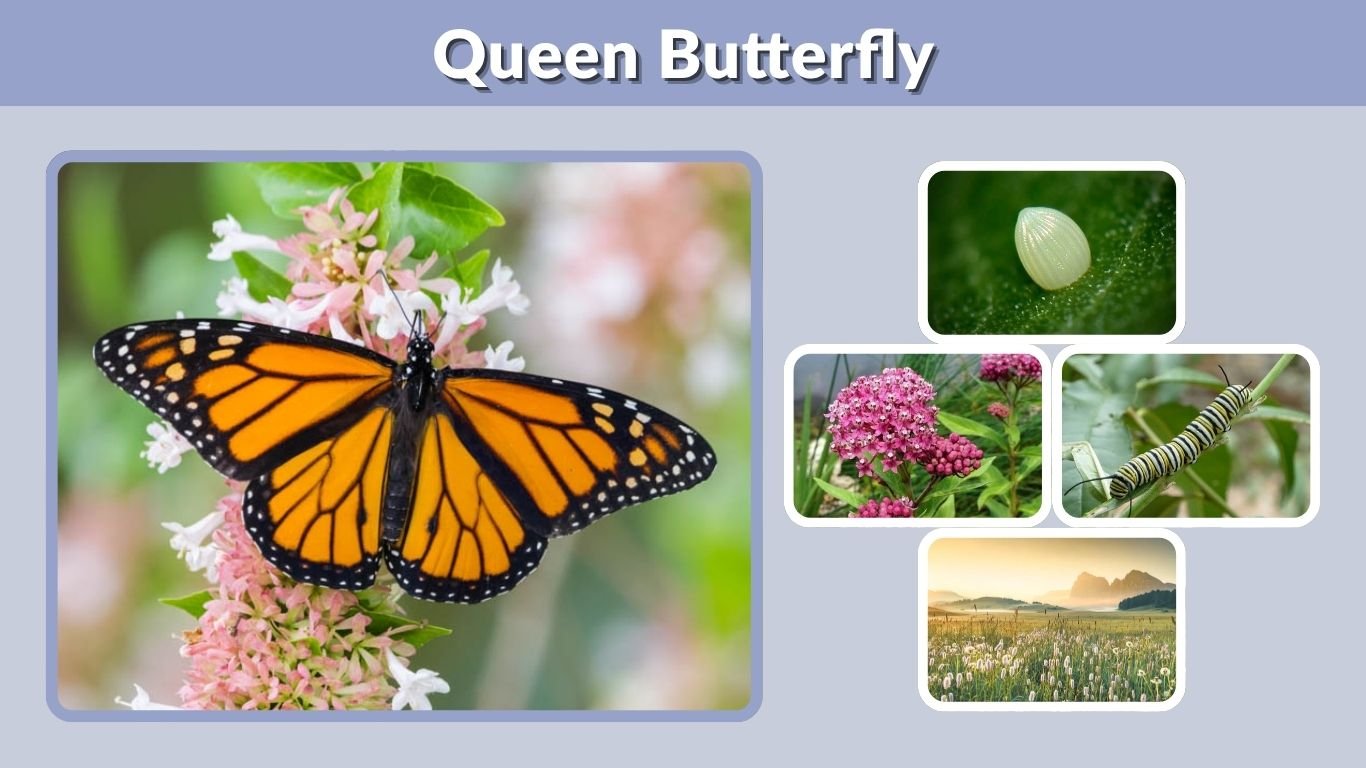
The queen butterfly (Danaus gilippus) is a beautiful North American butterfly recognized by its reddish-brown wings, black borders, and distinctive white spots. Closely related to the monarch butterfly, this species inhabits gardens, meadows, grasslands, and open fields throughout warmer regions of the Americas. Queen butterfly caterpillars feed primarily on milkweed plants, while adults visit flowers for nectar. Understanding the queen butterfly’s appearance, habitat, host plants, life cycle, and feeding behavior can help butterfly enthusiasts identify this fascinating species and distinguish it from similar butterflies in nature.
What Is a Queen Butterfly?
The queen butterfly is a medium-sized butterfly belonging to the family Nymphalidae and genus Danaus. Its scientific name is Danaus gilippus, and it is closely related to the monarch and soldier butterflies.
Adult queen butterflies typically have a wingspan of approximately 2.5–4 inches. Their rich mahogany-colored wings feature dark borders decorated with small white spots.
Queens are particularly common in warm regions of the southern United States, Mexico, Central America, and parts of South America. They frequently visit flowering plants and depend on milkweed relatives for reproduction.
Queen Butterfly Identification
Identifying a queen butterfly is relatively easy when examining its wing colors, markings, and body characteristics. Although it resembles a monarch butterfly, several distinctive features help separate these two closely related species.
Wing Color and Patterns
Queen butterflies have deep orange-brown or reddish-brown wings surrounded by black borders. Small white spots appear along the wing edges and near the forewing tips.
Unlike monarch butterflies, queens lack prominent black veins across the upper surfaces of their wings. Their overall appearance is also darker and more uniform.
Key Identification Features
- Wingspan: Approximately 2.5–4 inches.
- Upper wings: Rich reddish-brown or mahogany.
- Wing borders: Black with rows of white spots.
- Forewing markings: Small white spots extend into the brown areas.
- Body: Dark with contrasting white markings.
These features are especially useful when observing queen butterflies resting on flowers with their wings open.
Queen Butterfly vs Monarch Butterfly
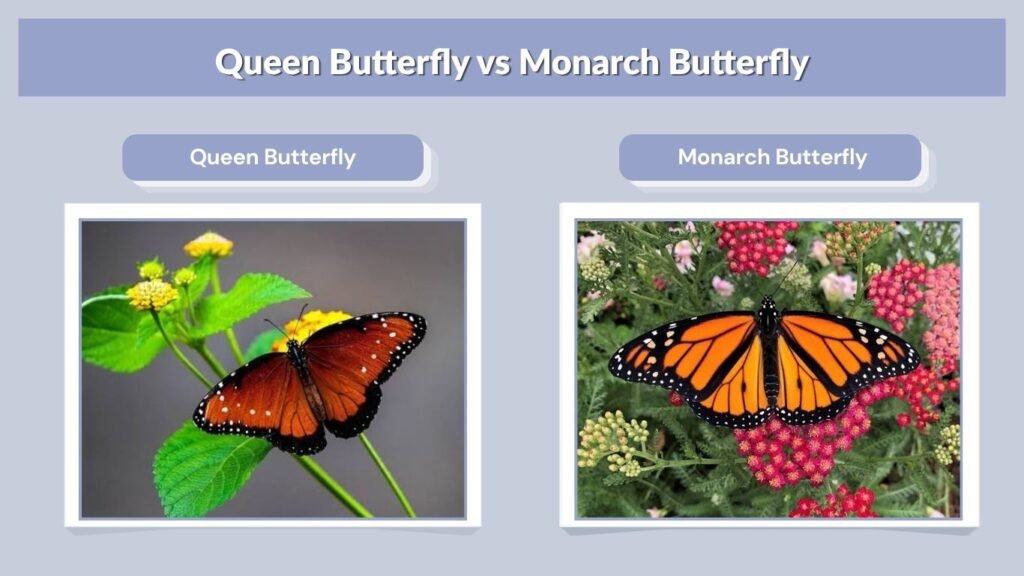
Queen and monarch butterflies are often confused because both belong to the same genus and share similar orange-brown wing colors. However, differences in wing markings, size, and caterpillar appearance make identification possible.
Physical Differences
| Feature | Queen Butterfly | Monarch Butterfly |
| Scientific name | Danaus gilippus | Danaus plexippus |
| Wing color | Dark reddish-brown | Bright orange |
| Upper wing veins | No bold black pattern | Prominent black veins |
| Wingspan | About 2.5–4 inches | About 3.5–4 inches |
| Caterpillar filaments | Three pairs | Two pairs |
| Host plants | Milkweeds and relatives | Primarily milkweeds |
The easiest way to distinguish adults is by examining the upper wing surfaces. Monarchs have noticeable black veins, while queens display more uniform reddish-brown coloring.
Queen Butterfly Caterpillar Identification
Queen butterfly caterpillars have striking black, yellow, and white patterns that closely resemble monarch caterpillars. However, their additional pair of fleshy filaments provides an important identification feature.
What Does a Queen Caterpillar Look Like?
Mature queen caterpillars have cylindrical bodies with alternating black, white, and yellow bands. Their bright coloration warns predators that they may be unpleasant to eat.
They possess three pairs of long, flexible black filaments extending from different body regions. These structures resemble antennae but are not true antennae.
Queen Caterpillar vs Monarch Caterpillar
Queen caterpillars have three pairs of black filaments, while monarch caterpillars have only two pairs.
Both species feed on milkweed and display similar warning colors. Counting these projections is generally the most dependable way to distinguish the caterpillars.
Queen Butterfly Host Plants
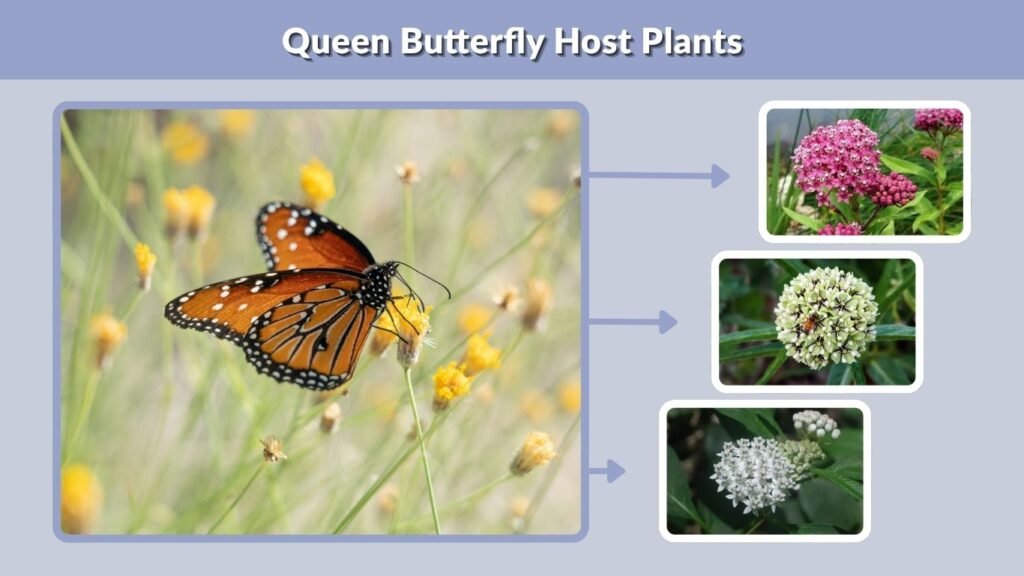
Host plants play an essential role in queen butterfly reproduction because females deposit their eggs on vegetation suitable for caterpillar feeding.
Queen caterpillars primarily consume milkweeds and related plants in the dogbane family, Apocynaceae. These plants contain defensive chemicals that caterpillars can retain in their bodies.
Common Queen Butterfly Host Plants
- Swamp milkweed: Provides leaves suitable for caterpillar development.
- Antelope horns milkweed: An important host in parts of the southern United States.
- White swamp milkweed: Supports queen larvae in suitable wet habitats.
- Tropical milkweed: A host plant in warm regions, although native milkweeds are generally preferable for gardening.
- Other native milkweeds: Additional species may support queen butterfly reproduction depending on location.
Choosing regionally native host plants helps provide appropriate breeding habitat and supports local butterfly populations.
Queen Butterfly Life Cycle
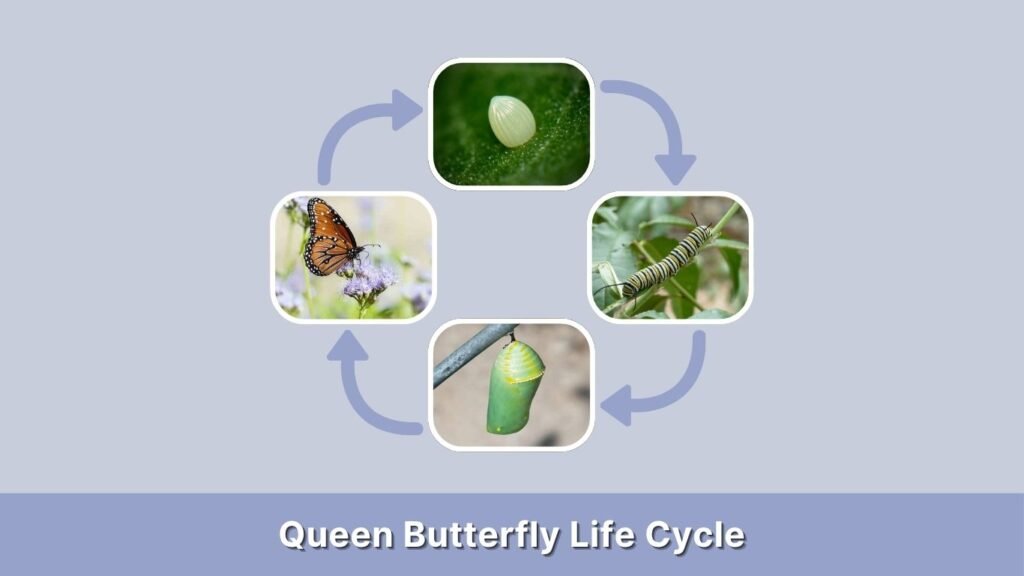
The queen butterfly undergoes complete metamorphosis, progressing through four developmental stages. Like other butterflies, its development depends on temperature, host plant quality, and environmental conditions.
1. Egg Stage
Female queen butterflies lay small, cream-colored eggs individually on suitable host plants.
The eggs have a rounded, slightly elongated shape with fine surface ridges. Tiny caterpillars emerge after several days under favorable conditions.
2. Caterpillar Stage
Newly hatched caterpillars begin feeding on milkweed leaves. They grow through successive molts while developing their characteristic striped bodies.
As they mature, their three pairs of black filaments become increasingly noticeable.
3. Chrysalis Stage
The mature caterpillar attaches itself to a suitable surface and transforms into a chrysalis.
Queen butterfly chrysalises are typically green with gold-colored markings, although color variations occur. The developing butterfly undergoes major physical changes inside.
4. Adult Butterfly Stage
The adult emerges with soft, folded wings. After expanding and drying them, it becomes capable of flight.
Adult queens feed on nectar, locate mates, and reproduce, beginning another generation.
Queen Butterfly Habitat and Distribution
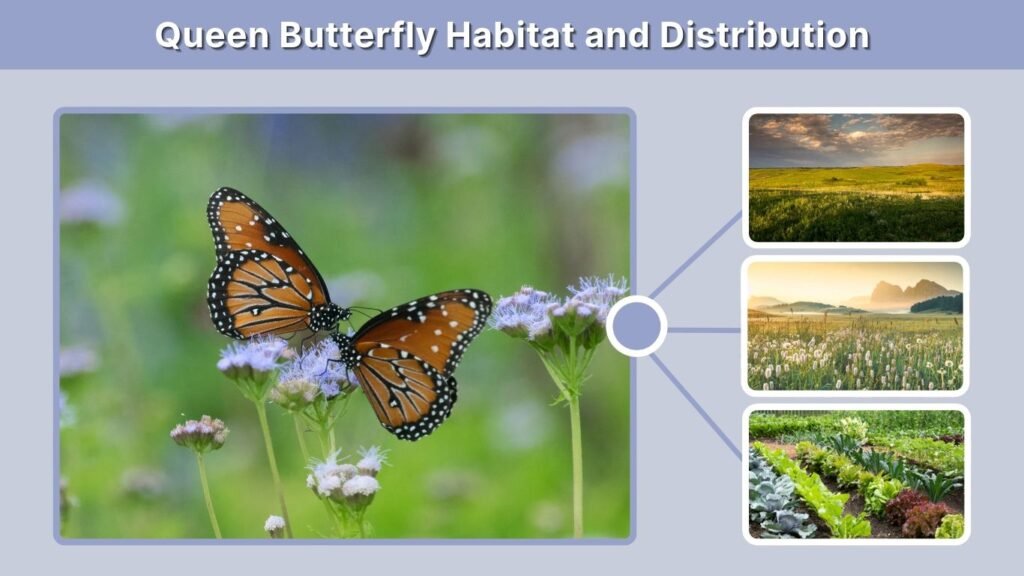
Queen butterflies inhabit open, sunny environments throughout warmer regions of the Americas. Their distribution extends across parts of the southern United States, Mexico, Central America, the Caribbean, and South America.
They are commonly found in grasslands, meadows, gardens, roadsides, coastal areas, and open woodlands.
In the United States, queens are particularly associated with Florida, Texas, Arizona, and other southern or southwestern regions.
Their presence depends heavily on warm temperatures, flowering plants, and suitable larval host plants. Populations may expand into additional areas during favorable seasonal conditions.
What Do Queen Butterflies Eat?
Adult queen butterflies primarily consume flower nectar, which supplies energy for flight, reproduction, and everyday activity.
Their long proboscis allows them to collect nectar from a variety of flowering plants. Caterpillars have a different diet and depend on suitable milkweed relatives.
Common Nectar Sources
- Milkweed flowers: Provide nectar for visiting adults.
- Lantana: Produces colorful clusters of nectar-rich flowers.
- Goldenrod: Offers important seasonal nectar.
- Asters: Attract butterflies during late summer and autumn.
- Native wildflowers: Support adult feeding throughout the growing season.
Adult males may also seek certain plant chemicals used in producing courtship pheromones.
Queen Butterfly Male vs Female
Male and female queen butterflies have similar wing colors, body shapes, and overall appearances. However, subtle physical differences help identify their sex.
Male queen butterflies possess specialized dark scent patches on their hindwings. These structures release chemical signals associated with courtship behavior.
Female queens lack these male scent patches and spend time searching for suitable host plants for egg-laying.
Both sexes visit nectar-producing flowers, although males may also seek plants containing chemical compounds useful for reproduction.
Do Queen Butterflies Migrate?
Queen butterflies exhibit seasonal movements, particularly in regions where winter temperatures limit survival.
In warm southern habitats, populations may reproduce throughout much of the year. Farther north, their abundance generally changes with seasonal conditions.
Unlike monarch butterflies, queens are not known for a comparable continent-wide migration to concentrated wintering sites.
Their movements are usually less extensive and depend on weather, flowering resources, and suitable breeding habitats.
How to Attract Queen Butterflies
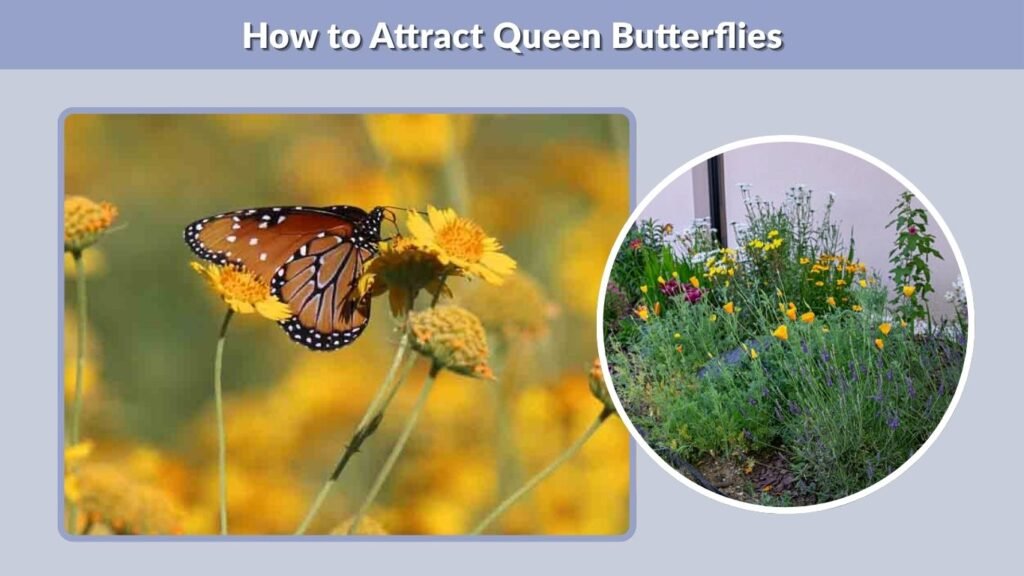
Creating a butterfly-friendly garden can encourage queen butterflies to visit and reproduce. Gardens offering nectar flowers, native milkweed, and sheltered areas are particularly beneficial.
Queen Butterfly Gardening Tips
- Plant native milkweed: Provide suitable food for developing caterpillars.
- Grow nectar flowers: Include native asters, goldenrod, and other flowering plants.
- Choose sunny areas: Butterflies depend on warmth for flight activity.
- Avoid pesticides: Reduce chemical exposure to caterpillars and adults.
- Maintain natural vegetation: Preserve suitable breeding and resting areas.
These gardening practices can support queen butterflies alongside monarchs and other native pollinators.
FAQs
1. What is the scientific name of the queen butterfly?
The scientific name of the queen butterfly is Danaus gilippus. It belongs to the Nymphalidae family and is closely related to monarch butterflies. Queens are commonly found in warm regions of North, Central, and South America.
2. How can you tell a queen butterfly from a monarch?
Queen butterflies have darker reddish-brown wings without the prominent black veins seen on monarchs. Queens also have small white spots extending into the brown wing areas, while monarchs typically display brighter orange coloring and bold black veins.
3. What do queen butterfly caterpillars eat?
Queen butterfly caterpillars primarily feed on milkweed plants and related species. They consume leaves containing defensive chemicals that help protect them from certain predators. Suitable host plants are essential for their growth, development, and survival.
4. Are queen butterflies poisonous?
Queen butterflies can be toxic or distasteful to certain predators because their caterpillars obtain defensive compounds from milkweed plants. However, queen butterflies are not venomous and are generally harmless to humans when observed or encountered in gardens.
5. Where do queen butterflies live?
Queen butterflies inhabit meadows, grasslands, gardens, roadsides, and other sunny environments. They are especially common in the southern United States, Mexico, Central America, and parts of South America where warm conditions and suitable host plants are available.