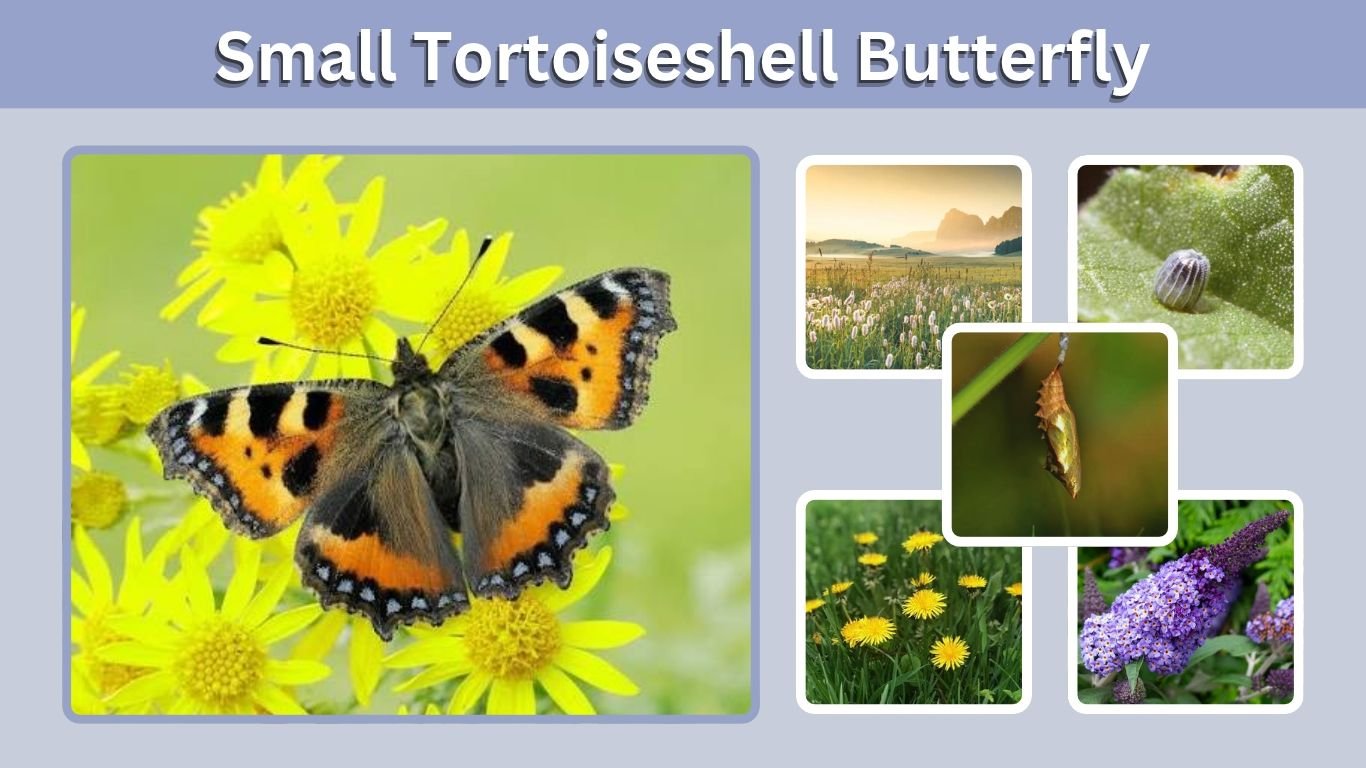
The small tortoiseshell butterfly (Aglais urticae) is a colorful butterfly recognized for its orange-red wings, black markings, and beautiful blue spots along the edges. Commonly found across the United Kingdom, Europe, and parts of Asia, this butterfly visits gardens, meadows, and grasslands throughout the warmer months. Its caterpillars feed mainly on nettles, while adults enjoy nectar from flowering plants. Understanding the small tortoiseshell butterfly’s appearance, habitat, diet, lifespan, hibernation, and life cycle helps nature enthusiasts identify this attractive species and appreciate its role in local ecosystems.
What Is a Small Tortoiseshell Butterfly?
The small tortoiseshell butterfly is a medium-sized butterfly belonging to the Nymphalidae family. Its scientific name is Aglais urticae, and it is one of the most recognizable garden butterflies in Britain and Europe.
Adults have a wingspan of approximately 4.5–6.2 centimeters. Their bright orange wings feature contrasting black and yellow markings, while the outer edges display small blue crescents.
Small tortoiseshells are active during sunny weather and frequently visit flowers. Unlike many butterflies, they survive winter as adults, allowing them to appear on unusually warm days even during colder months.
Small Tortoiseshell Butterfly Identification
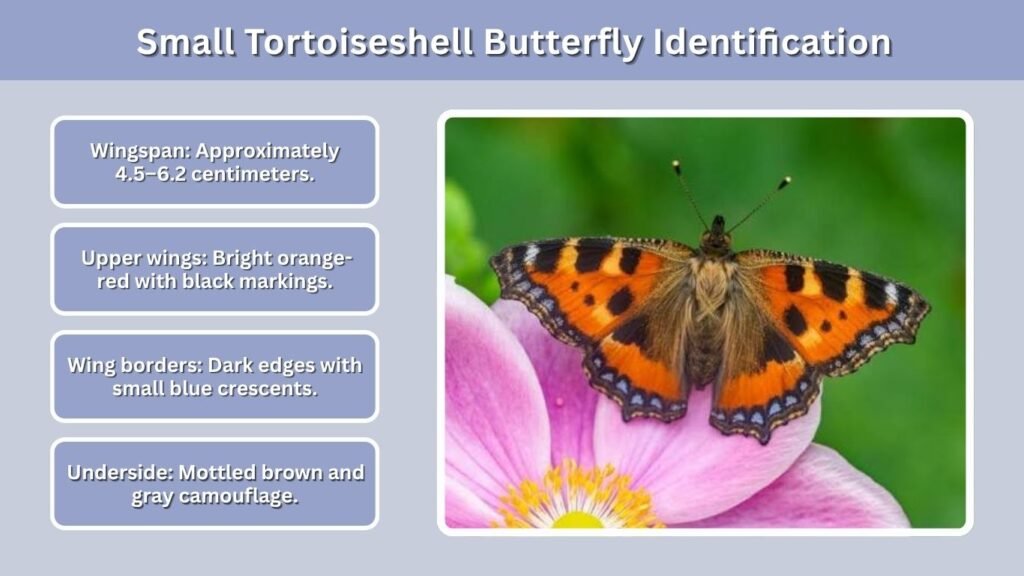
Identifying a small tortoiseshell butterfly is relatively easy because of its distinctive wing patterns and vibrant coloration. Both males and females have similar appearances, making them recognizable throughout their geographic range.
Wing Color and Appearance
The upper wings are primarily orange-red with bold black patches and pale yellow sections. The outer edges have dark borders decorated with bright blue spots.
When the butterfly closes its wings, the underside appears mostly dark brown and gray. This coloring provides camouflage against tree bark and other natural surfaces.
Key Identification Features
- Wingspan: Approximately 4.5–6.2 centimeters.
- Upper wings: Bright orange-red with black markings.
- Wing borders: Dark edges with small blue crescents.
- Underside: Mottled brown and gray camouflage.
- Body: Dark, hairy, and relatively slender.
These characteristics distinguish the small tortoiseshell from many other orange-colored butterflies.
Small Tortoiseshell Butterfly Caterpillar
Small tortoiseshell caterpillars are commonly found feeding on nettle plants during spring and summer. Unlike solitary caterpillars, young larvae often live together in groups and create protective silk webs around their food plants.
What Does the Caterpillar Look Like?
Small tortoiseshell caterpillars have dark bodies decorated with yellow stripes and numerous branched spines. Mature larvae may reach approximately 3–4 centimeters in length.
Their appearance becomes more distinctive as they develop through successive molts. The spines provide some protection from predators, although they are not venomous.
Caterpillar Identification Features
- Body color: Mainly black or dark brown.
- Markings: Yellow stripes along the body.
- Spines: Numerous dark, branched projections.
- Feeding behavior: Young caterpillars feed in groups.
- Host plants: Primarily common and small nettles.
As caterpillars mature, they often disperse from their original feeding groups before transforming into pupae.
Small Tortoiseshell Butterfly Life Cycle
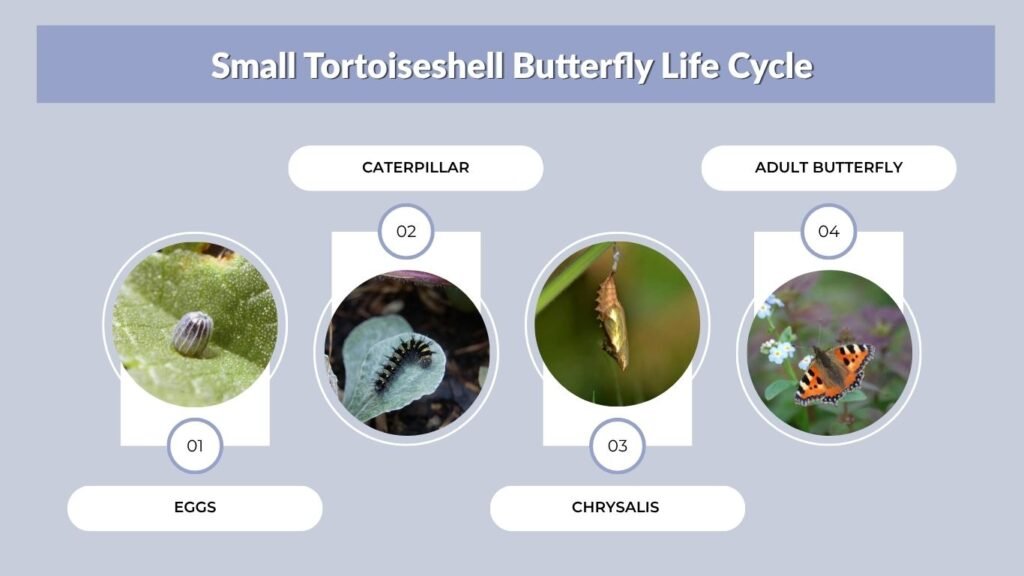
The small tortoiseshell butterfly undergoes complete metamorphosis, progressing through four developmental stages. Its life cycle depends on temperature, food availability, and seasonal conditions.
1. Egg Stage
Female butterflies lay clusters of small, greenish eggs on the undersides of nettle leaves. Each cluster may contain dozens of eggs.
The eggs usually hatch after several days, depending on environmental temperature.
2. Caterpillar Stage
Newly hatched caterpillars begin feeding together on nettle leaves. They produce silk webs that help protect their colonies.
During development, caterpillars molt several times before reaching their final size. Mature larvae eventually separate to find suitable pupation sites.
3. Chrysalis Stage
The mature caterpillar transforms into a chrysalis, usually suspended beneath a leaf, stem, or another sheltered surface.
The chrysalis may appear brownish or grayish, sometimes with metallic-looking markings. Adult structures develop inside before emergence.
4. Adult Butterfly Stage
The adult butterfly emerges from the chrysalis with soft, folded wings. After expanding and drying them, it becomes capable of flight.
Adults feed on nectar, reproduce, and may enter winter dormancy when seasonal temperatures decline.
Small Tortoiseshell Butterfly Habitat and Distribution
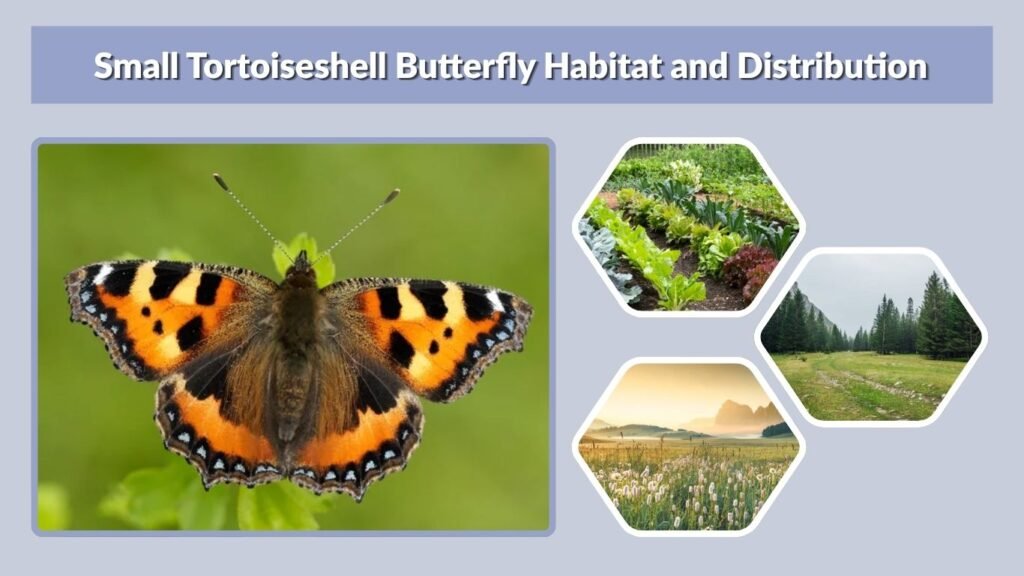
Small tortoiseshell butterflies inhabit a wide variety of environments, including gardens, meadows, farmland, woodland edges, grasslands, and coastal areas.
They are widely distributed across Europe and temperate Asia. In the United Kingdom, they occur throughout England, Scotland, Wales, and Northern Ireland.
Their preferred habitats contain abundant nettles for caterpillar development and flowering plants for adult feeding.
Although the species can survive in developed landscapes, suitable breeding areas remain important. Sunny nettle patches provide particularly valuable environments for egg-laying and larval growth.
What Do Small Tortoiseshell Butterflies Eat?
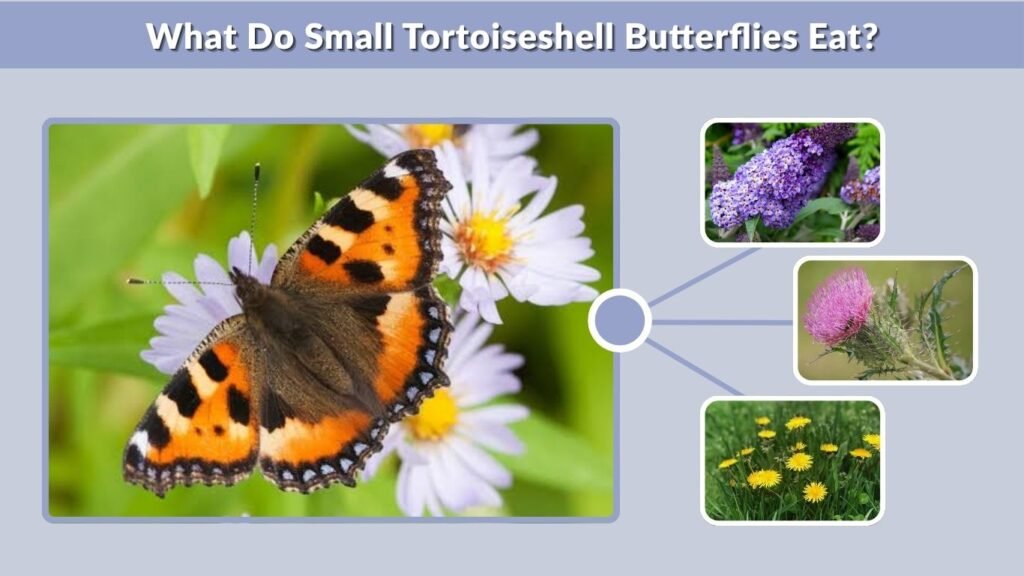
Adult small tortoiseshell butterflies primarily consume flower nectar. They use their long proboscis to reach nectar inside blossoms, obtaining energy for flight, reproduction, and seasonal activity.
Common Nectar Sources
- Buddleia: A popular nectar source in gardens.
- Thistles: Provide valuable nectar during summer.
- Dandelions: Offer food during early spring.
- Hemp agrimony: Attracts butterflies with clusters of flowers.
- Heather: Provides nectar in suitable habitats.
Small tortoiseshell caterpillars have a different diet. They primarily eat common nettle (Urtica dioica) and may also use small nettle (Urtica urens).
These nettle species are essential breeding resources because females select them for egg-laying.
Small Tortoiseshell Butterfly Lifespan
The lifespan of a small tortoiseshell butterfly varies depending on whether it survives winter dormancy.
Adults emerging during summer may remain active for weeks or months. Butterflies that successfully hibernate can survive considerably longer, sometimes living through winter and into the following spring.
This extended adult lifespan distinguishes small tortoiseshells from species that survive winter only as eggs, caterpillars, or pupae.
Environmental conditions, predators, disease, and food availability all influence survival. The exact lifespan therefore differs considerably among individuals.
Do Small Tortoiseshell Butterflies Hibernate?
Small tortoiseshell butterflies hibernate as adults, sheltering in protected locations throughout winter.
They commonly enter sheds, garages, barns, roof spaces, and occasionally houses. Natural shelters such as hollow trees and dense vegetation can also provide protection.
During dormancy, their metabolism slows and they remain largely inactive.
Warm indoor temperatures may accidentally awaken hibernating butterflies, causing them to expend valuable energy reserves.
If a dormant butterfly is discovered indoors, it is generally best to leave it undisturbed in a suitable cool, sheltered location where it can remain protected from freezing and predators.
Large Tortoiseshell vs Small Tortoiseshell Butterfly
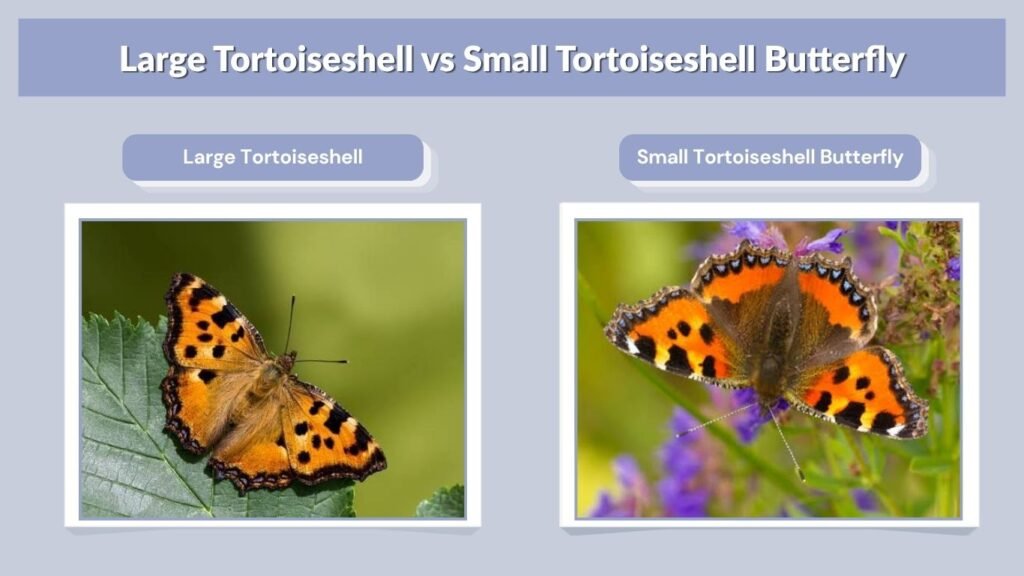
The large tortoiseshell (Nymphalis polychloros) and small tortoiseshell are separate butterfly species with somewhat similar orange and black wing patterns.
Despite their common names, size alone is not always sufficient for identification.
The small tortoiseshell has distinctive blue crescents around its wing edges and a brighter orange-red appearance.
The large tortoiseshell is generally bigger, with more muted orange-brown coloring and a different arrangement of black wing markings.
Their caterpillar food plants also differ. Small tortoiseshells primarily use nettles, while large tortoiseshells use trees such as elm, willow, and cherry.
Male vs Female Small Tortoiseshell Butterfly
Male and female small tortoiseshell butterflies look extremely similar, making visual identification difficult.
Females may be slightly larger on average, but body size and wing patterns are not dependable methods of distinguishing sexes.
Behavior provides additional clues. Males are territorial and frequently chase other butterflies away from favored areas.
During courtship, males may follow females and gently tap their hindwings with their antennae.
Females eventually select suitable nettle plants for depositing eggs, beginning another reproductive cycle.
Small Tortoiseshell Butterfly Conservation
Although small tortoiseshells remain widespread, their populations have experienced substantial long-term declines in the United Kingdom.
Possible contributing factors include habitat changes, parasitic flies, pesticide exposure, and changing climatic conditions.
The availability of nettle-rich breeding areas and flowering plants is important for supporting healthy populations.
Maintaining diverse gardens, protecting suitable habitats, and reducing unnecessary pesticide use can help conserve this familiar butterfly.
How to Attract Small Tortoiseshell Butterflies
Creating a butterfly-friendly garden is an effective way to attract small tortoiseshells and support their reproduction.
The most important requirements are suitable nettle plants, abundant nectar sources, and sheltered locations.
Butterfly Gardening Tips
- Grow nettles: Leave a sunny patch of nettles for egg-laying and caterpillars.
- Plant nectar flowers: Include buddleia, thistles, and other nectar-rich plants.
- Avoid pesticides: Protect developing caterpillars and visiting adults.
- Provide shelter: Maintain shrubs and undisturbed vegetation.
- Encourage seasonal flowers: Offer nectar from early spring through autumn.
These practices create a welcoming environment for small tortoiseshells and numerous other beneficial insects.
FAQs
1. What is the scientific name of the small tortoiseshell butterfly?
The scientific name of the small tortoiseshell butterfly is Aglais urticae. It belongs to the Nymphalidae family and is widely distributed across Europe and temperate Asia. Its caterpillars primarily feed on nettle plants.
2. How long do small tortoiseshell butterflies live?
Small tortoiseshell butterflies may live for several months, particularly when they survive winter through hibernation. Adults that emerge during summer can remain dormant throughout colder months and become active again during the following spring.
3. What do small tortoiseshell caterpillars eat?
Small tortoiseshell caterpillars primarily feed on common nettle and small nettle plants. Young caterpillars often live together in groups, creating protective silk webs around nettle leaves while feeding and developing through successive growth stages.
4. Are small tortoiseshell butterflies endangered?
Small tortoiseshell butterflies are not globally classified as endangered, but their populations have declined considerably in parts of the United Kingdom. Habitat changes, parasitism, climate-related pressures, and environmental conditions may contribute to these population reductions.
5. Do small tortoiseshell butterflies hibernate in houses?
Yes, small tortoiseshell butterflies sometimes hibernate inside houses, sheds, garages, and other sheltered buildings. They prefer cool, undisturbed environments where they can remain dormant throughout winter before becoming active again when temperatures rise in spring.