
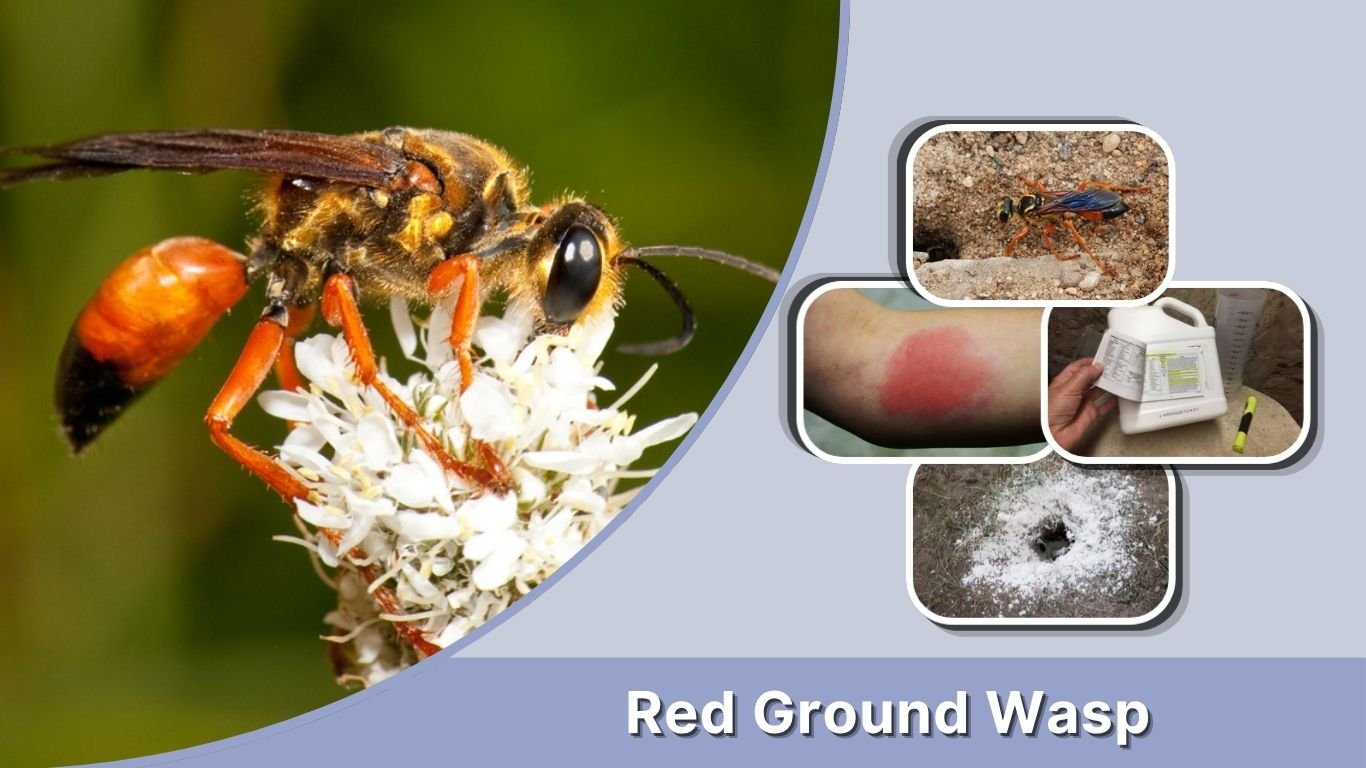
A red ground wasp is not one specific species. The name may describe a reddish-orange digger wasp, a red-and-black thread-waisted wasp, a cicada killer, or even a wingless velvet ant walking across the soil. Red paper wasps may also fly near the ground, but they usually build exposed paper nests rather than underground burrows. Identifying the insect’s body, wings, nest entrance, and behavior is essential before deciding whether it is dangerous or requires removal.
What Is a Red Ground Wasp?
Several unrelated wasps have red, orange, brown, and black markings. Some excavate underground nests, while others merely hunt or search for host nests at ground level.
Great Golden Digger Wasp
The great golden digger wasp is one of the most likely insects to be described as a red and black ground wasp. It measures slightly more than one inch long and has a dark head and thorax, reddish-orange legs, dark wings, and a reddish-orange-and-black abdomen.
Females dig nests in the soil and stock underground chambers with paralyzed katydids for their larvae. Several females may establish separate burrows in the same favorable area, creating the appearance of a large colony.
Red or Orange Thread-Waisted Wasp
Thread-waisted wasps have a long, narrow connection between the thorax and abdomen. Many species are black with red or orange markings and range from approximately ⅝ inch to one inch long.
These solitary wasps construct temporary underground nests, seal the entrances while hunting, and supply their larvae with caterpillars or sawfly larvae. They generally nest alone rather than forming a shared social colony.
Cicada Killer Wasp
A cicada killer is a very large ground-nesting wasp with a reddish-brown thorax, reddish legs, amber wings, and a black abdomen marked with yellow bands. Adults may reach 1 to 1½ inches long.
Females dig burrows in sunny, sandy lawns, gardens, and fields and carry paralyzed cicadas underground. Males frequently patrol the nesting area and fly toward people, but male cicada killers lack stingers.
Red Velvet Ant
The red velvet ant is actually a wingless female wasp. It has a fuzzy red-and-black body and is commonly seen running over lawns, bare soil, and other sunny areas.
Unlike a digger wasp, it does not usually excavate and provision its own burrow. The female searches for nests belonging to cicada killers and other ground-nesting wasps, where its offspring develop as parasites.
Red Ground Wasp Identification
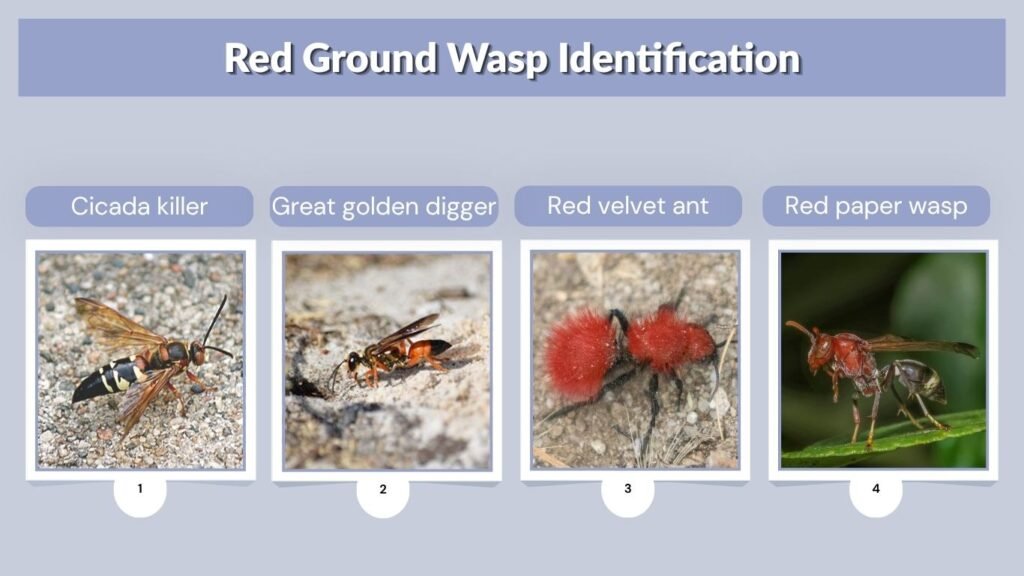
Color alone is not enough to identify a ground wasp. Look at its body covering, wing structure, size, and relationship with the hole.
| Possible identification | Appearance | Ground activity | Typical behavior |
| Great golden digger wasp | Orange legs and abdomen with black areas | Digs and provisions burrows | Solitary and generally calm |
| Thread-waisted wasp | Slender black body with red or orange markings | Builds an individual soil nest | Avoids people |
| Cicada killer | Huge, reddish-brown, black and yellow | Digs large burrows and hunts cicadas | Intimidating but usually tolerant |
| Red velvet ant | Fuzzy, red and black, wingless female | Searches across soil for host nests | Nonaggressive but capable of a painful sting |
| Red paper wasp | Dark-red body, black wings and narrow waist | Usually nests above ground | Defensive around its paper comb |
What Does the Nest Look Like?
A red ground-digger wasp nest usually appears as a round hole with loose soil piled beside the entrance. The mound may be small and fan-shaped or noticeably large, depending on the species and depth of the tunnel.
One wasp repeatedly entering one hole usually suggests a solitary species. Numerous separate holes may represent multiple females nesting near one another, not a single colony. Great golden digger wasps and cicada killers can both form these loose nesting groups.
Is It a Red Paper Wasp Nest?
Red paper wasps, including Polistes metricus and Polistes annularis, have dark-red bodies and black wings. However, they typically attach open paper-comb nests beneath eaves or in similarly protected places.
A red wasp repeatedly disappearing beneath grass does not always mean it has an underground nest. Its paper comb could be attached to low vegetation, equipment, or another sheltered surface close to the ground.
Do Red Wasps Live in the Ground?
Some red or reddish wasps truly nest underground. Great golden digger wasps, thread-waisted wasps, and cicada killers all construct soil nests. However, red paper wasps normally use protected above-ground locations.
A red velvet ant may also appear to live in the ground because it searches for underground wasp and bee nests. It is usually looking for a host burrow rather than maintaining a conventional hunting nest of its own.
Are Red Ground Wasps Dangerous?
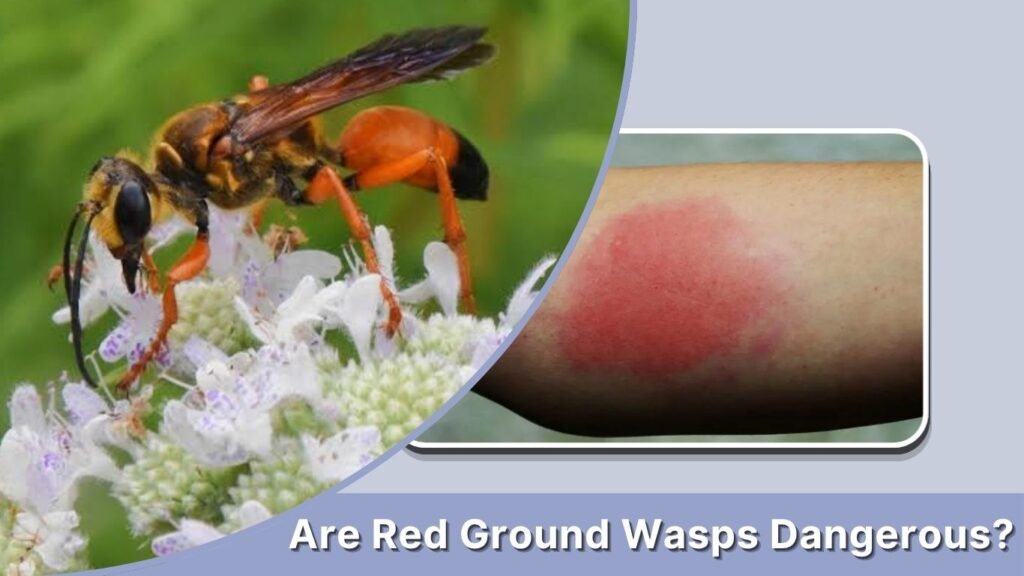
Most solitary ground-nesting wasps are not aggressive. They do not have a large queen-and-worker colony to protect and normally avoid human contact. Females can sting when stepped on, trapped in clothing, grabbed, or physically handled.
Red Ground Digger Wasp Sting
A sting may produce immediate pain, redness, itching, and swelling. A normal reaction generally remains around the sting site and can be managed by washing the area and applying a cold pack.
Velvet ants deserve particular caution. Female eastern velvet ants have long stingers and can deliver an exceptionally painful sting, although they are not naturally aggressive and usually sting only when stepped on or handled.
Signs of a Serious Reaction
Call emergency services for breathing difficulty, throat or tongue swelling, chest tightness, widespread hives, dizziness, fainting, severe vomiting, or symptoms appearing away from the sting site. Anaphylaxis can develop rapidly and requires immediate epinephrine when prescribed, followed by emergency medical attention.
Should You Remove a Red Ground Wasp Nest?
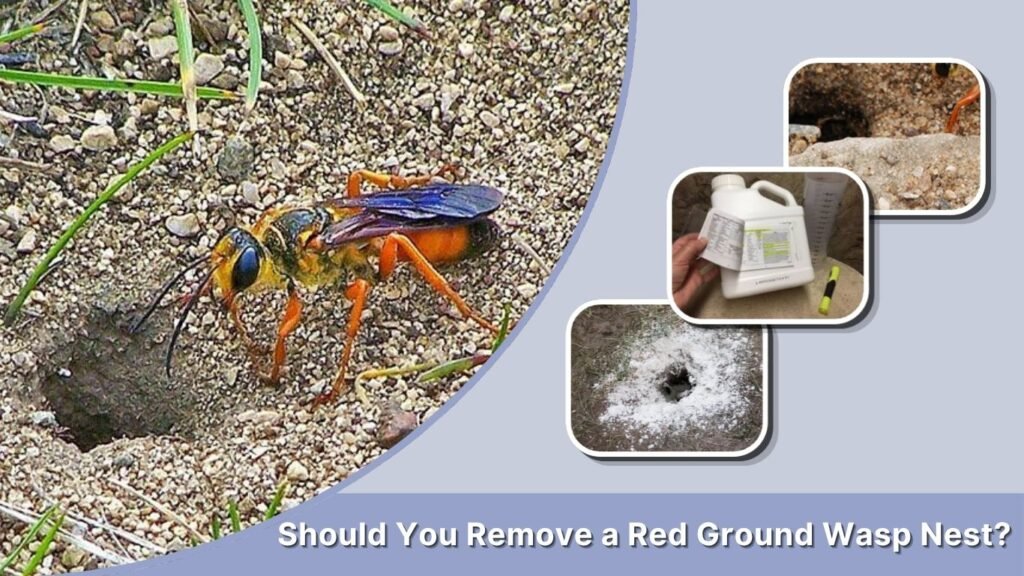
A solitary nest in an unused part of the yard can usually be left alone. These wasps help control insects, remain active for only a limited part of the season, and normally do not reuse the same nests year after year.
Removal may be appropriate when burrows are beside a doorway, playground, busy path, pet area, or another place where accidental contact is unavoidable.
Safe Control Options
First confirm that the insects are solitary digger wasps rather than social yellowjackets. If treatment is necessary, use only an insecticide specifically labeled for ground-nesting wasps and the intended site. Extension guidance notes that treating each individual burrow with an appropriately labeled insecticidal dust is generally more effective than spraying the entire ground surface with liquid.
Do not use gasoline, kerosene, bleach, ammonia, fire, or homemade chemical mixtures. A pest-control professional is the safer choice when many wasps use one entrance, the species cannot be identified, or someone nearby has a serious sting allergy.
FAQs
Do red paper wasps make nests in the ground?
Red paper wasps normally attach open paper nests beneath eaves and in other protected above-ground locations. A red wasp seen near a soil hole is more likely to be a digger species, although a paper-wasp nest may occasionally be hidden in low vegetation nearby.
What is the large red and black wasp digging in my lawn?
It may be a great golden digger wasp, thread-waisted wasp, or cicada killer. Great golden digger wasps have orange legs and a red-and-black abdomen, while cicada killers are larger and have yellow bands across a dark abdomen.
Is a red velvet ground wasp dangerous?
A red velvet ant is a wingless female wasp capable of delivering a very painful sting. It is not aggressive and usually stings only when stepped on, squeezed, or picked up. Never handle one with bare hands.
Do red ground wasps live in colonies?
Most reddish digger wasps are solitary. Several females may construct independent burrows close together, but they do not share a queen-and-worker colony. Paper wasps are social, although their paper combs are normally built in protected locations above the soil.
How can I keep red digger wasps out of my lawn?
Maintain dense grass, reduce bare sandy patches, and limit undisturbed loose soil around high-traffic areas. When nests are already active, avoid mowing directly over them. Solitary wasps often disappear naturally after several weeks, making tolerance preferable when the location is safe.
