

The tarantula hawk wasp is one of nature’s most intimidating predators. Known for its dazzling metallic-blue body and fiery orange wings, this wasp possesses a sting ranked among the most painful on Earth. Despite its fearsome appearance, the tarantula hawk wasp plays an essential ecological role, preying on tarantulas to sustain its offspring while feeding peacefully on nectar as an adult.
What Is a Tarantula Hawk Wasp?
The tarantula hawk wasp belongs to the family Pompilidae and the genus Pepsis, which includes several species found in warm climates across the globe. The best-known species is Pepsis grossa, famous for its enormous size and paralyzing sting. Its striking black-blue exoskeleton and orange wings make it easily recognizable, often mistaken for other large wasps like the great black wasp.
Although it looks fierce, the tarantula hawk is not an aggressive insect. It only stings when provoked, preferring to roam fields and deserts in search of nectar or prey. The name “tarantula hawk” refers to its unique hunting behavior—females specifically target tarantulas as hosts for their larvae.
Physical Description and Size
How Big Is a Tarantula Hawk Wasp?
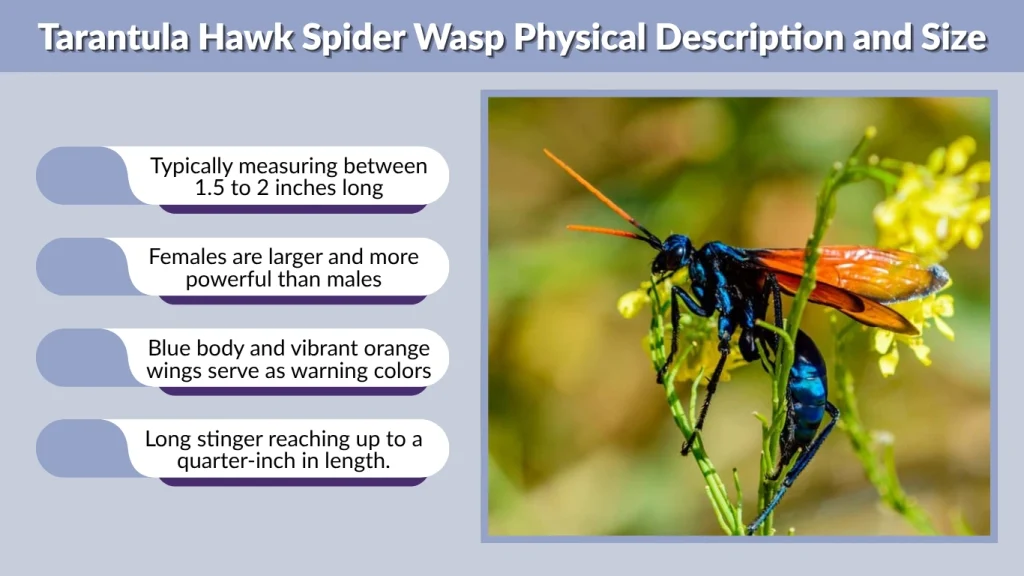
The tarantula hawk wasp is one of the largest wasp species in the world, typically measuring between 1.5 to 2 inches long. Females are larger and more powerful than males, equipped with a long stinger reaching up to a quarter-inch in length. Their large wingspan allows them to glide smoothly while searching for prey or nectar.
The wasp’s metallic blue body and vibrant orange wings serve as warning colors, signaling potential danger to predators. This coloration, known as aposematism, helps deter birds and lizards from attacking. In terms of sheer size and presence, it often rivals the Asian giant hornet but is less aggressive toward humans.
Tarantula Hawk Queen and Variants
The female tarantula hawk is often called the “queen” due to her dominant hunting role. Several variants exist across regions, including the blue tarantula hawk, black tarantula hawk, and Thisbe’s tarantula hawk. Each displays slight color and size differences based on habitat and climate.
In Australia, similar species have evolved independently, while in New Mexico and Arizona, the tarantula hawk is particularly abundant and strikingly large.
Habitat and Range
Where Does the Tarantula Hawk Wasp Live?
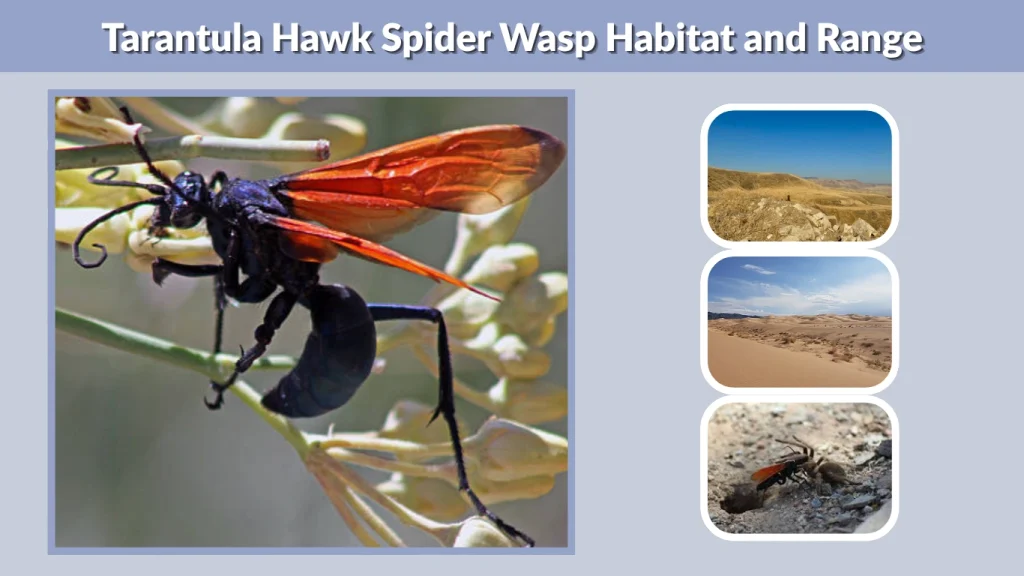
These wasps inhabit desert and semi-arid regions where tarantulas are plentiful. They are most common in the Southwestern United States, Mexico, and Central and South America. In the U.S., they thrive in Arizona, New Mexico, California, Texas, and Utah.
They are also spotted occasionally in Florida and Colorado, though such sightings are rare. The open, sun-drenched landscapes of the desert provide the perfect hunting ground for females searching for burrows to find tarantulas.
Regional Presence
| Region | Presence | Notes |
| Arizona | Very Common | Official state insect of New Mexico |
| Texas | Frequent | Seen during warm summer months |
| California | Common | Found near desert and scrub habitats |
| Florida | Rare | Sometimes mistaken for mud daubers |
| Australia | Similar species | Not native but comparable appearance |
Behavior and Diet
The tarantula hawk wasp is solitary, meaning it does not build colonies like hornets or bees. Females are the hunters, while males typically feed and patrol territories. Their diet varies between life stages—adults feed on flower nectar, especially milkweed and mesquite, while larvae consume paralyzed tarantulas.
When a female locates a tarantula, she engages in a deadly duel, using her precise sting to paralyze the spider without killing it. The wasp then drags the immobilized tarantula into a burrow, lays an egg on it, and seals the chamber. Once hatched, the larva feeds on the still-living spider, consuming it slowly to keep it fresh.
This gruesome process highlights nature’s brutal efficiency and the wasp’s essential role in controlling spider populations.
Tarantula Hawk Wasp Sting

How Painful Is the Sting?
The sting of a tarantula hawk wasp is ranked second most painful in the world, just behind the bullet ant. Entomologist Justin O. Schmidt, who created the Pain Index, described it as “blinding, fierce, and electric,” though the pain subsides after a few minutes.
Popular explorer Coyote Peterson famously documented his encounter with the wasp’s sting, describing it as an instant, searing wave of agony that quickly fades. While extremely painful, it causes no lasting harm to most people.
Are Tarantula Hawk Wasps Dangerous?
Despite their alarming name and massive size, tarantula hawk wasps are not truly dangerous to humans. They are surprisingly calm and will avoid confrontation whenever possible. The only real threat comes from their sting, which, though excruciating, is not lethal. Most victims experience brief pain, followed by minor redness or swelling that fades within an hour.
Only female wasps possess stingers, using them primarily for hunting, not defense. Male tarantula hawks are stingless and harmless, spending their days feeding on nectar and guarding small territories. Unless handled or trapped, a tarantula hawk has no reason to sting a person, making it more of a gentle giant in the insect world.
Tarantula Hawk Wasp vs. Tarantula

The duel between the tarantula hawk wasp and the tarantula is one of nature’s most dramatic predator-prey battles. When a female wasp locates a tarantula, she provokes it from its burrow, dodges its defensive strikes, and delivers a single, paralyzing sting. The venom doesn’t kill the spider but immobilizes it completely.
After the attack, the wasp drags the paralyzed tarantula to a pre-dug burrow, lays a single egg on its abdomen, and seals the chamber. When the larva hatches, it consumes the spider gradually, keeping vital organs intact until the final stages. This ensures a fresh food source throughout its development—a chilling but fascinating adaptation.
| Aspect | Tarantula Hawk Wasp | Tarantula |
| Predator/Prey | Predator | Prey |
| Weapon | Sting (venom paralysis) | Fangs (venom defense) |
| Behavior | Solitary hunter | Ambush predator |
| Outcome | Reproductive success | Death after paralysis |
Interesting Facts
- The tarantula hawk wasp is the state insect of New Mexico, symbolizing strength and resilience.
- Its vivid orange wings warn predators of its painful sting—a defense strategy known as aposematism.
- Only females sting; males rely on bluffing displays for protection.
- They are daytime fliers, most active during the heat of the afternoon when few predators are around.
- Adults live on nectar from desert plants, helping with pollination despite their fearsome reputation.
FAQs
Are tarantula hawk wasps aggressive toward humans?
Tarantula hawk wasps are not naturally aggressive. They prefer to avoid conflict and will sting only when trapped or handled. Their bright colors are a warning to stay away, not an invitation to fight, making them more peaceful than their appearance suggests.
Can a tarantula hawk wasp kill you?
No, a tarantula hawk wasp cannot kill a human. The sting is intensely painful but medically harmless in most cases. Unless a person has a severe allergy to wasp venom, symptoms typically disappear within an hour with no lasting damage.
Where are tarantula hawk wasps commonly found?
These wasps are mostly found in the Southwestern United States, especially in Arizona, New Mexico, Texas, California, and Utah. They also range through Mexico, Central America, and South America, favoring warm, dry habitats where tarantulas are abundant.
What happens when a tarantula hawk wasp stings a tarantula?
The wasp paralyzes the tarantula with a precise sting that targets its nervous system. It then drags the spider into a burrow and lays an egg on it. When the larva hatches, it slowly feeds on the paralyzed tarantula, ensuring a fresh meal during its growth.
How do tarantula hawk wasps reproduce?
Reproduction begins when a female finds and paralyzes a tarantula. After laying an egg on the immobilized spider, she seals it underground. The larva consumes the host, pupates, and emerges as an adult. Males later mate and guard territories, while females repeat the hunting cycle.
