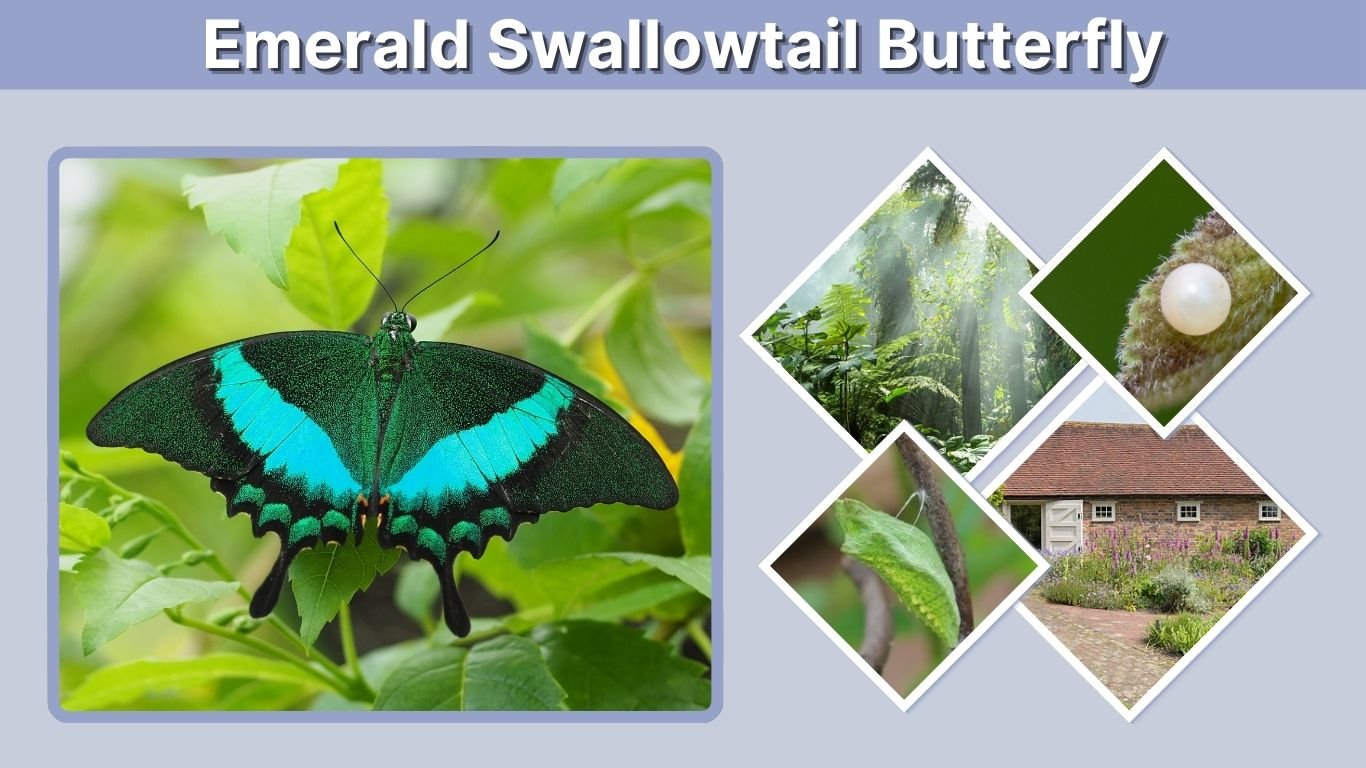
The emerald swallowtail butterfly is one of the most beautiful tropical butterflies, famous for its brilliant green wings and elegant tail-like extensions. Scientifically known as Papilio palinurus, this butterfly lives in the forests of Southeast Asia. Its shimmering emerald-green bands make it easy to recognize among other swallowtail species. Beyond its appearance, the emerald swallowtail has a fascinating life cycle, unusual wing coloration, and specialized feeding habits. Understanding its habitat, caterpillar, food sources, and behavior reveals what makes this colorful butterfly so remarkable.
What Is an Emerald Swallowtail Butterfly?
The emerald swallowtail is a tropical butterfly belonging to the Papilionidae family. It is also called the emerald peacock or green-banded peacock. This species is particularly admired for the metallic green bands extending across its dark wings. Unlike many butterflies that rely primarily on pigments for their colors, the emerald swallowtail displays remarkable structural coloration.
Scientific Name and Classification
The scientific name of the emerald swallowtail is Papilio palinurus. It was originally described by Johan Christian Fabricius in 1787.
Its classification includes:
- Scientific name: Papilio palinurus
- Family: Papilionidae
- Genus: Papilio
- Order: Lepidoptera
- Class: Insecta
- Common names: Emerald swallowtail, emerald peacock, and green-banded peacock
- Wingspan: Approximately 8–10 cm (3.1–4 inches)
Emerald Swallowtail Identification
The emerald swallowtail has dark greenish-black wings decorated with broad metallic green bands. These bands extend across the forewings and hindwings, creating a striking pattern.
Its hindwings feature long, narrow extensions resembling a swallow’s tail. The underside looks considerably different, displaying darker grayish-black coloring with small blue, orange, and whitish markings.
Both males and females share the characteristic emerald-green pattern, making them difficult to distinguish by color alone.
Why Are Emerald Swallowtail Wings Green?
The butterfly’s brilliant green appearance comes primarily from structural coloration rather than ordinary green pigment.
Microscopic structures within the wing scales reflect blue and yellow light. When these reflections combine, human eyes perceive a bright emerald-green color.
The wings may appear blue-green, yellowish-green, or darker depending on the viewing angle and lighting conditions. This optical effect makes the butterfly particularly interesting to scientists studying natural coloration.
Where Do Emerald Swallowtail Butterflies Live?
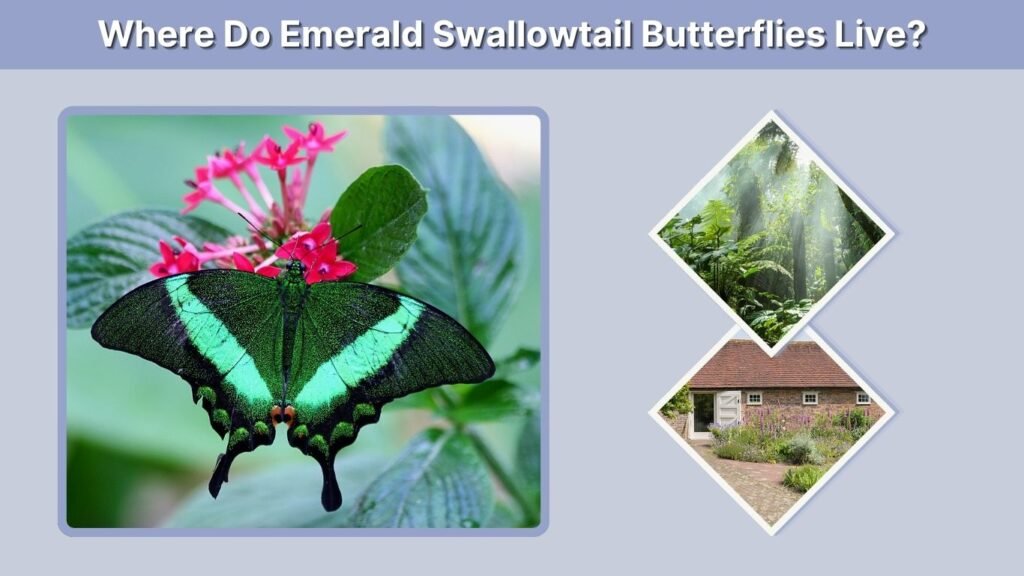
Emerald swallowtail butterflies are native to tropical regions of Southeast Asia. They prefer warm, humid environments where suitable plants provide food and shelter. These butterflies are strongly associated with forest ecosystems, although they may also visit forest edges and clearings. Their distribution includes several countries and islands with tropical vegetation.
Geographic Distribution
The emerald swallowtail occurs in several Southeast Asian locations, including:
- Myanmar: Southern tropical regions
- Thailand: Forested areas in the south
- Malaysia: Tropical forests of the Malay Peninsula
- Indonesia: Including Sumatra and Borneo
- Philippines: Several islands supporting different subspecies
Emerald Swallowtail Habitat
Primary tropical forests are an important natural habitat for emerald swallowtails. They also occur in older secondary forests and forest-edge environments.
Adults may fly through sunlit openings or visit flowering plants for nectar. Their caterpillars depend on particular host plants growing within these habitats.
Warm temperatures, vegetation, and access to suitable food plants are important for their survival and reproduction.
What Do Emerald Swallowtail Butterflies Eat?
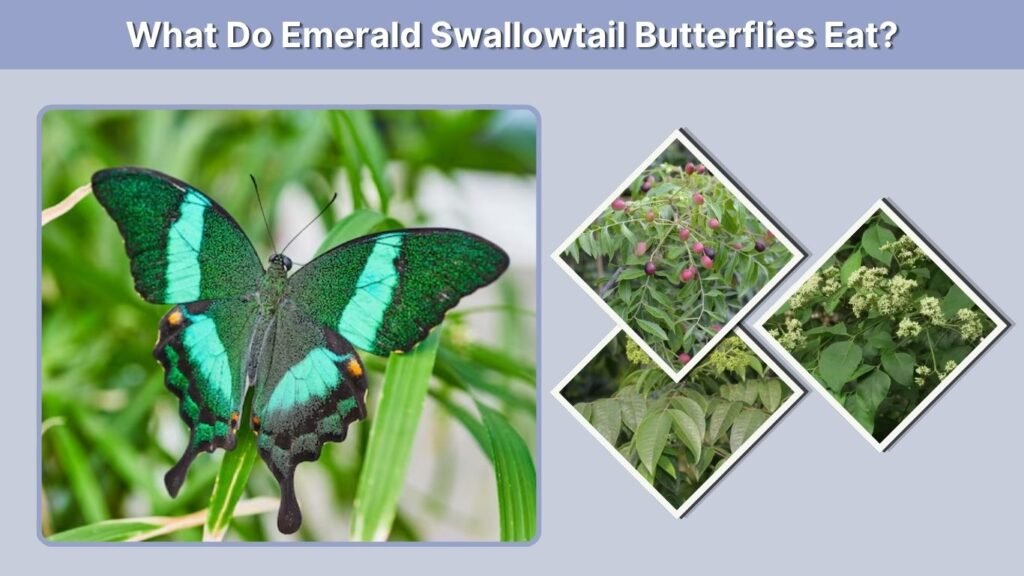
The emerald swallowtail’s diet changes during its development. Adult butterflies mainly consume liquid food, while caterpillars feed on leaves. This difference allows the two life stages to use different food resources. Understanding their feeding habits also explains why particular trees and shrubs are important for the butterfly’s continued survival.
Adult Emerald Swallowtail Food
Adult emerald swallowtails feed primarily on flower nectar. They use a long, flexible feeding tube called a proboscis to extract nectar from blossoms.
Nectar supplies sugars that support flying and other activities. While visiting flowers, adults may also transfer pollen between plants.
Access to nectar-producing flowers is therefore useful for adult butterflies living in tropical forests.
Emerald Swallowtail Caterpillar Host Plants
Emerald swallowtail caterpillars feed on plants belonging to the Rutaceae family, commonly known as the citrus or rue family.
Recorded host plants include:
- Clausena: Tropical shrubs and trees belonging to the citrus family
- Euodia: A group of plants associated with swallowtail caterpillar feeding
- Micromelum: Tropical trees and shrubs used by developing larvae
- Citrus: Citrus-family plants recorded as hosts for this species
Female butterflies select suitable host plants for egg-laying. Once the eggs hatch, young caterpillars begin feeding on nearby leaves.
Emerald Swallowtail Butterfly Life Cycle
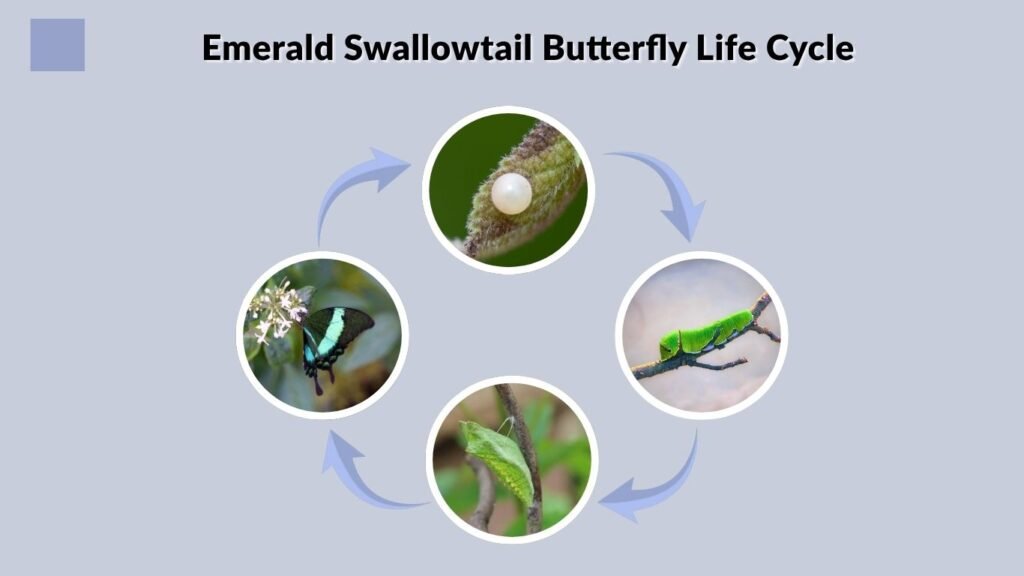
Like other butterflies, the emerald swallowtail undergoes complete metamorphosis. Its development includes four main stages: egg, caterpillar, chrysalis, and adult butterfly. Each stage has a different appearance and biological purpose. The duration of development depends on environmental conditions, including temperature, humidity, and food availability.
1. Egg Stage
The life cycle begins when a female lays eggs on suitable host plants.
These eggs contain developing embryos. After the incubation period, tiny caterpillars emerge and begin feeding on leaves.
Placing eggs on appropriate plants helps ensure the young larvae have access to food immediately after hatching.
2. Emerald Swallowtail Caterpillar
Young emerald swallowtail caterpillars resemble bird droppings. This unusual appearance provides camouflage against predators.
As they grow, they shed their skin through several developmental stages called instars.
Like other swallowtail caterpillars, they possess an osmeterium, a fork-shaped defensive organ located behind the head. When threatened, the caterpillar can extend this organ and release an unpleasant odor.
The caterpillar spends much of this stage eating leaves and storing energy for transformation.
3. Chrysalis Stage
After reaching maturity, the caterpillar stops feeding and prepares to pupate.
It attaches itself to a suitable support and transforms into a chrysalis, or pupa.
Inside this protective structure, major biological changes occur. The caterpillar’s body is reorganized into the adult butterfly.
The chrysalis stage ends when the fully developed butterfly emerges.
4. Adult Butterfly Stage
After emerging, the adult expands and dries its wings before beginning normal flight.
Its primary activities include searching for food, locating mates, and reproducing.
Female butterflies eventually lay eggs on host plants, beginning another generation.
Interesting Emerald Swallowtail Butterfly Facts
The emerald swallowtail is remarkable for more than its attractive wings. Its unusual coloration, defensive adaptations, and tropical distribution make it an interesting species to study. Although many swallowtails share similar characteristics, the emerald swallowtail’s reflective green wing bands are among its most recognizable features.
Fascinating Facts About the Emerald Swallowtail
- Structural color: Its green wing bands result from microscopic structures reflecting light.
- Changing appearance: The wings can appear different colors when viewed from different angles.
- Natural camouflage: Young caterpillars resemble bird droppings.
- Defensive organ: Caterpillars use an osmeterium to discourage predators.
- Distinctive underwings: The underside differs noticeably from the bright upper surface.
- Multiple subspecies: Different geographic populations include several recognized subspecies.
Emerald Swallowtail Butterfly Lifespan
The exact lifespan of an emerald swallowtail varies with environmental conditions and individual survival.
Like many butterflies, adults generally live for a relatively short period, often measured in weeks. However, a reliable, universal lifespan for wild Papilio palinurus adults is not well established.
Temperature, food availability, predators, and disease can influence survival. The total life cycle also includes the egg, caterpillar, and chrysalis stages.
Is the Emerald Swallowtail Endangered?
The emerald swallowtail is not currently established as globally endangered through a published IUCN Red List assessment.
However, tropical forest destruction and habitat fragmentation can threaten local butterfly populations. The removal of host plants may also reduce opportunities for reproduction.
Protecting natural forest habitats, preserving native host plants, and supporting responsible butterfly conservation practices are important ways to maintain healthy populations.
FAQs
1. Is the emerald swallowtail butterfly rare?
The emerald swallowtail is native to Southeast Asia and is not naturally found worldwide. Its abundance can vary across different forests and islands. Although it may seem rare outside its native range, this does not necessarily mean the species is globally endangered. Habitat conditions influence local populations.
2. What is the scientific name of the emerald swallowtail?
The scientific name is Papilio palinurus. It belongs to the Papilionidae family, which includes many large and colorful swallowtail butterflies. This species is also known as the emerald peacock or green-banded peacock because of its bright, reflective green wing bands.
3. What does an emerald swallowtail caterpillar look like?
Young emerald swallowtail caterpillars resemble bird droppings, helping them blend into their surroundings. As they develop, their appearance changes. Like other swallowtail caterpillars, they possess a defensive organ called an osmeterium, which can release an unpleasant smell when the caterpillar feels threatened.
4. What does the emerald swallowtail butterfly symbolize?
The emerald swallowtail is sometimes associated with beauty, transformation, renewal, and personal growth. These interpretations come from general butterfly symbolism and the insect’s vivid green appearance. However, there is no single universally accepted cultural or spiritual meaning specifically associated with the emerald swallowtail.
5. Can emerald swallowtail butterflies be kept in captivity?
Emerald swallowtail butterflies are displayed in some specialized butterfly conservatories. Successful breeding requires appropriate tropical conditions, suitable caterpillar host plants, and nectar sources for adults. They are not suitable for ordinary household keeping, and any collection, breeding, or transport should follow applicable wildlife regulations.