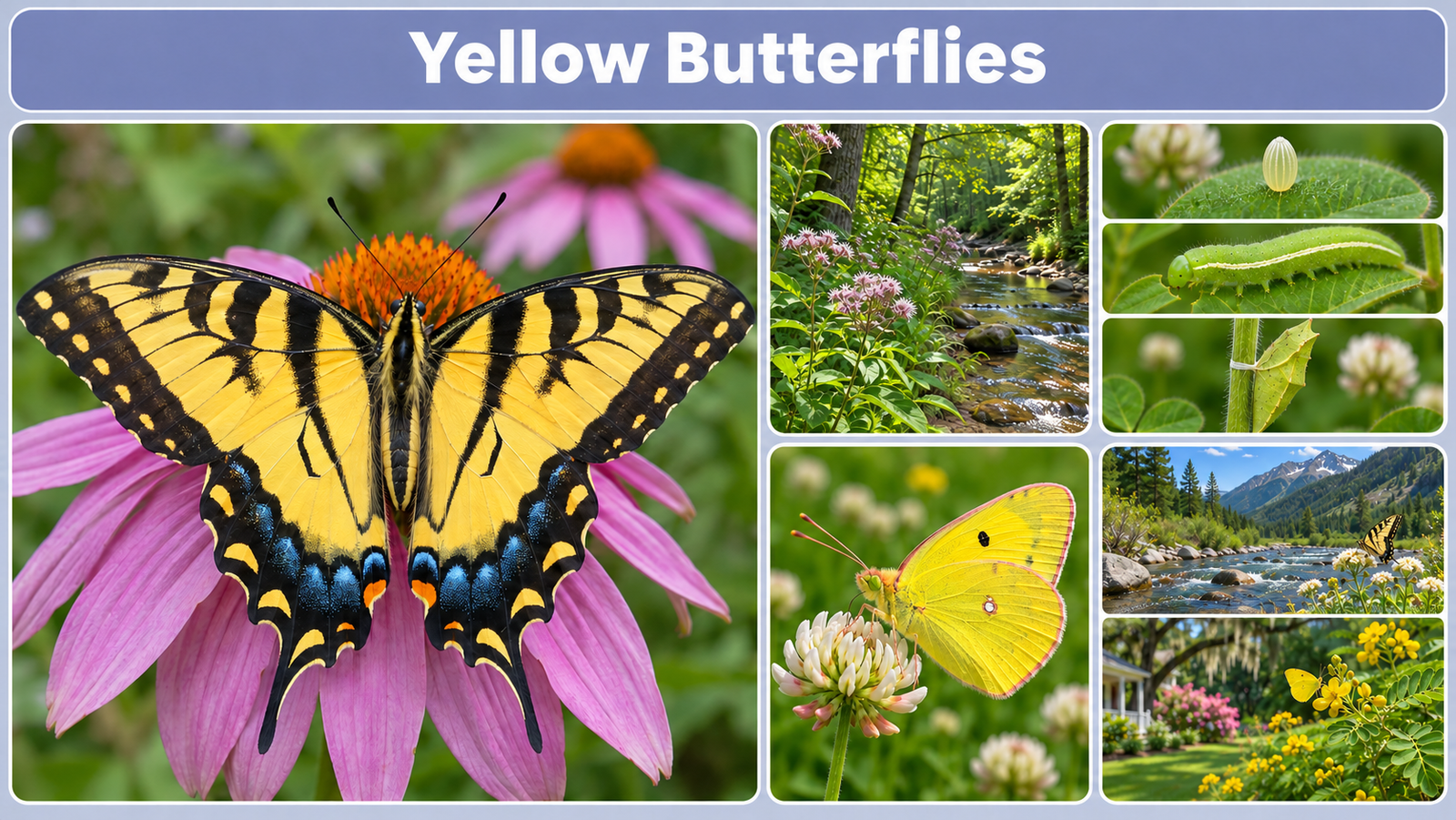
Yellow butterflies are easy to spot in a sunny garden, but telling them apart takes a closer look. A large butterfly with black stripes and long tails may be a tiger swallowtail, while a small lemon-yellow butterfly flying over clover may be a sulphur. Some species even change appearance as they fly, showing yellow underneath and orange or white above. This guide focuses on yellow butterflies found in North America and explains how to identify them, where they live, what their caterpillars eat, and how they develop from egg to adult.
What Are Yellow Butterflies?
Yellow butterflies include several groups of butterflies that show yellow on their wings. Sulphurs belong to the family Pieridae, which also includes whites. Tiger swallowtails belong to the family Papilionidae. The color can cover most of the wing, form bands across a dark surface, or appear mainly underneath. This explains why two butterflies that look equally yellow in flight can have very different markings once they land.
Common Types of Yellow Butterflies
| Butterfly | Main identification feature |
|---|---|
| Eastern tiger swallowtail | Yellow wings with black tiger stripes and long hindwing tails |
| Western tiger swallowtail | Similar striped wings and tails in western North America |
| Giant swallowtail | Yellow bands across dark upper wings and a mostly yellow underside |
| Clouded sulphur | Lemon-yellow upper wings and a pale spot under the hindwing |
| Orange sulphur | Orange shading above and a yellowish underside |
| Cloudless sulphur | Large, bright yellow wings with angled tips and no tails |
| Sleepy orange | Orange upper wings with dark borders and a variable underside |
| Little yellow | Small yellow wings with dark markings near the forewing tips |
| Dainty sulphur | Very small butterfly with relatively narrow forewings |
| Cabbage white | White upper wings and hindwings that can look pale yellow underneath |
Yellow Butterfly Identification
Wing shape is a good starting point. Long hindwing tails and bold dark markings often indicate a swallowtail. Smaller butterflies with rounded or angled wings may be sulphurs. Once the butterfly lands, check which wing surface you can see. Several yellow butterflies close their wings at rest, hiding the markings on top.
Physical Appearance and Characteristics
- Wing size ranges from the tiny dainty sulphur to the much larger tiger and giant swallowtails.
- Black stripes across broad yellow wings are characteristic of tiger swallowtails.
- Yellow bands across dark upper wings help identify a giant swallowtail.
- Dark outer borders are visible on the upper wings of many sulphurs, especially in flight.
- Silvery hindwing spots can appear underneath both clouded and orange sulphurs. Check the upper wing color to help tell them apart.
- Hindwing tails are conspicuous on tiger swallowtails. Sulphurs have no comparable tails.
Male vs. Female Yellow Butterflies
The differences depend on the species. Male clouded sulphurs usually have solid dark borders on the upper wings. Females often have pale spots within those borders, and some females have white wings. Yellow female eastern tiger swallowtails often show more blue along the hindwing edges than males. Some females have a dark form, with faint tiger stripes sometimes visible in good light.
Yellow Butterfly Habitat

Yellow butterflies occur in open fields, along streams, and around woodland edges. Adults need places to feed, and females need suitable plants on which to lay eggs. A butterfly may cross an open lawn for nectar even when its caterpillars depend on a tree growing nearby.
Preferred Natural Habitats
- Sunny fields and pastures attract clouded and orange sulphurs, particularly where clover or alfalfa grows.
- Roadsides and open lots with short plants are good places to look for little yellows and dainty sulphurs.
- Woodland edges and clearings provide feeding areas for eastern tiger swallowtails.
- Streamsides and wooded valleys are familiar habitats for western tiger swallowtails.
- Sunny gardens in warmer areas often attract cloudless sulphurs and sleepy oranges.
Can Yellow Butterflies Live in Gardens?
Yes. A garden with flowering plants can draw adults, and suitable host plants can support their caterpillars. Where cloudless sulphurs occur, native senna can provide a place for females to lay eggs. A vegetable garden may also attract cabbage whites, which use cabbage, kale, broccoli, and other mustard-family plants as caterpillar hosts.
Yellow Butterfly Life Cycle
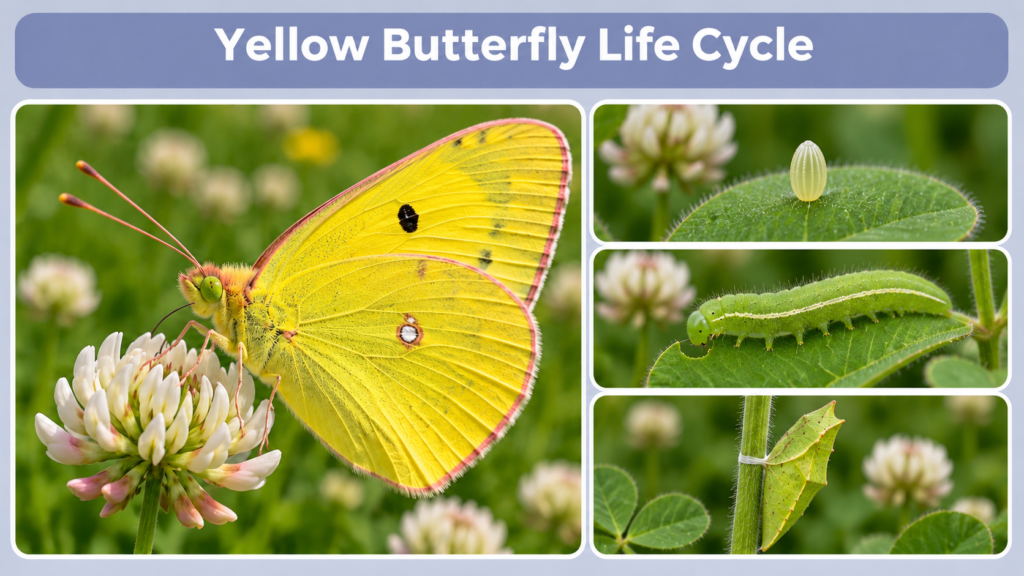
Yellow butterflies develop through four stages of complete metamorphosis. Each begins as an egg, hatches into a caterpillar, forms a chrysalis, and emerges as an adult. Temperature, season, and species affect how long each stage lasts. Some butterflies go through several generations in a warm year, while others spend winter in a dormant stage.
Egg Stage
Female butterflies usually lay eggs on or near plants their caterpillars can eat. A cloudless sulphur may choose a senna, while a giant swallowtail may select citrus or prickly ash. Eggs are small and easily overlooked, especially among new leaves.
Caterpillar Stage
A caterpillar spends much of this stage feeding and sheds its outer skin several times as it grows. Many blend in with the plants they eat. Young giant swallowtail caterpillars have a mottled pattern that resembles bird droppings, which can make them easy to miss on a citrus leaf.
Pupa Stage
After it finishes growing, the caterpillar forms a chrysalis. The adult body and wings develop inside. Tiger swallowtails can spend winter in the chrysalis stage and emerge when warmer conditions return.
Adult Butterfly Stage
A newly emerged butterfly expands its soft, folded wings and lets them firm up before flying. Adults then feed, look for mates, and move through suitable habitat. Females search for host plants to begin the next generation.
What Do Yellow Butterflies Eat?
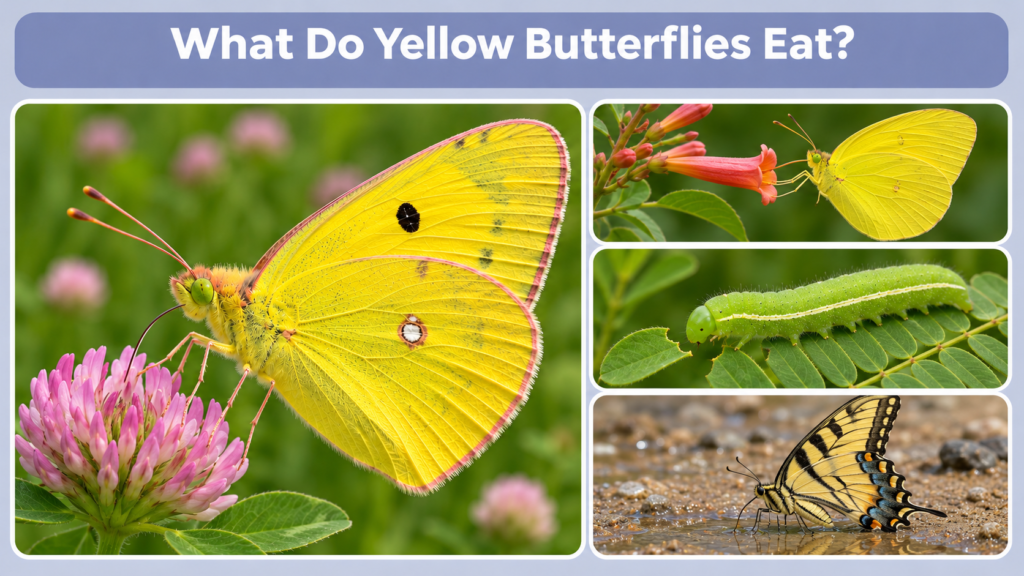
Adult yellow butterflies mainly drink flower nectar, while caterpillars chew parts of their host plants. A single flower patch may feed several species of adult butterfly. Each species uses a narrower range of plants during the caterpillar stage.
Adult Butterfly Diet
Adults draw up nectar through a flexible feeding tube called a proboscis. Depending on the species and season, you might see yellow butterflies visiting clovers, asters, coneflowers, or other blooms. Some, including tiger swallowtails, also gather on damp sand or mud to take up moisture and dissolved minerals. This behavior is known as puddling.
Yellow Butterfly Caterpillar Food Plants
| Butterfly | Examples of caterpillar host plants |
|---|---|
| Eastern tiger swallowtail | Tulip tree, wild cherry, and sweetbay magnolia |
| Western tiger swallowtail | Willows, cottonwoods, and aspens |
| Giant swallowtail | Citrus and prickly ash |
| Clouded and orange sulphurs | Clover, alfalfa, and other legumes |
| Cloudless sulphur and sleepy orange | Sennas and related plants |
| Little yellow | Partridge pea and other suitable legumes |
| Cabbage white | Cabbage, kale, broccoli, and wild mustards |
Yellow Butterfly Distribution

Yellow butterflies occur across North America, with different species appearing according to region, climate, and host plant availability. Location is especially helpful when two species have similar markings. A striped yellow swallowtail in a western river valley, for instance, is more likely to be a western tiger swallowtail than an eastern tiger swallowtail.
Yellow Butterflies in Eastern and Western North America
Eastern tiger swallowtails are familiar in eastern woodlands and gardens. Western tiger swallowtails occur in western parks, valleys, and river corridors. Clouded and orange sulphurs overlap in many open habitats, while cloudless sulphurs are especially familiar in warmer parts of the United States and may appear farther north seasonally.
When Are Yellow Butterflies Active?
Many species fly from spring into fall, depending on local weather. Sunny conditions usually make adults easier to spot, especially when flowers are in bloom. In colder areas, you may see a shorter flight season than in warmer regions, where some species produce multiple generations.
Yellow Butterfly Behavior
Flight height and resting posture can help you identify a yellow butterfly before you see its markings clearly. A large swallowtail may move between flowers with strong wingbeats, while a tiny sulphur can disappear among low-growing plants.
Flight and Resting Habits
Little yellows and dainty sulphurs often fly close to the ground. Sulphurs commonly perch with their wings closed, so watch as they take off to see the upper wing color. This is particularly helpful when comparing a clouded sulphur with an orange sulphur.
Feeding and Puddling
Butterflies often pause long enough on a flower to reveal their wing shape. Damp ground is another good place to observe them. Tiger swallowtails sometimes gather there, letting you compare their stripes and tails while they take up moisture.
Interesting Facts About Yellow Butterflies
- A giant swallowtail can look predominantly dark from above and mostly yellow from below.
- Some female clouded sulphurs are white.
- A cabbage white can look pale yellow while resting and white when it takes flight.
- Yellow tiger swallowtails and yellow sulphurs belong to different butterfly families.
- The plants that feed adults and the plants that support their caterpillars can be quite different.
How to Attract and Protect Yellow Butterflies
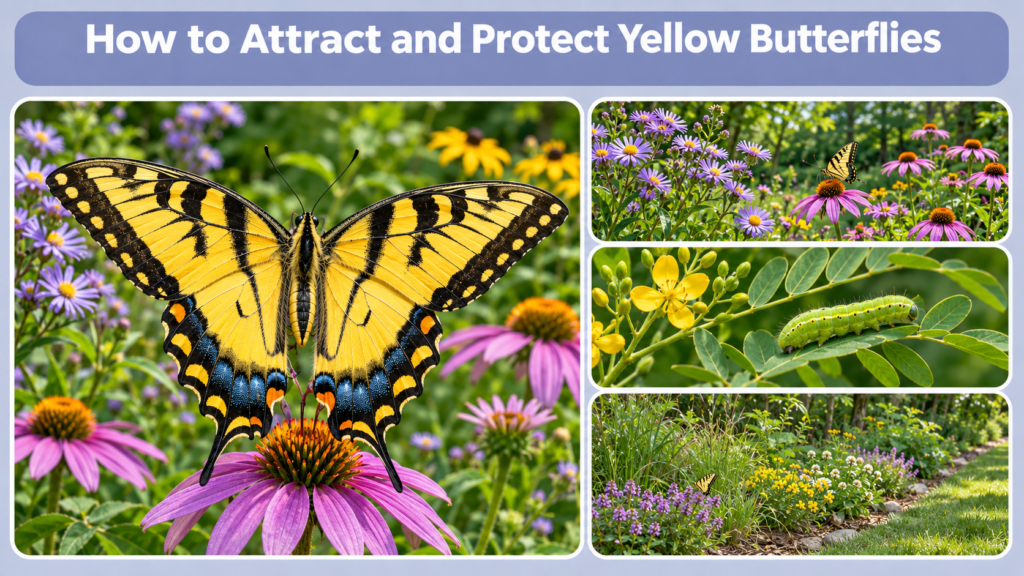
Provide flowers that bloom at different times and include host plants suited to butterflies in your area. A sunny patch of native nectar flowers can feed adults, while nearby senna, partridge pea, or native willows can support particular caterpillars where those butterflies occur. Avoid spraying insecticides on butterfly host plants. Leaving a small patch of low vegetation can also give tiny sulphurs a place to feed and rest.
FAQs
1. What is the large yellow butterfly with black stripes?
A large yellow butterfly with bold black stripes and long hindwing tails is likely a tiger swallowtail. Eastern and western tiger swallowtails look similar, so where you saw it is an important clue.
2. What are the tiny yellow butterflies flying over grass?
Little yellows and dainty sulphurs often fly low over short plants. Clouded sulphurs may also visit lawns, especially where clover grows. Check wing shape and size after the butterfly lands.
3. Why does a yellow butterfly look orange when it flies?
The upper and lower surfaces can have different colors. An orange sulphur can appear yellowish with its wings closed and show orange when it opens them or takes flight.
4. How long do yellow butterflies live?
Adult lifespan varies by species and conditions. The full life cycle can last considerably longer than the adult stage, especially if the butterfly spends winter as a chrysalis.
5. Are yellow butterflies harmful to plants?
Adults mainly feed on nectar. Caterpillars eat their host plants, and some can damage garden crops. Cabbage white caterpillars, for example, chew holes in cabbage, kale, and broccoli leaves.