

The desert recluse spider (Loxosceles deserta) is one of the most misunderstood arachnids in North America. Commonly found in the arid regions of the Southwestern United States, this spider is often mistaken for its infamous cousin, the brown recluse. Despite sharing similar traits, the desert recluse is a distinct species with unique characteristics, habitat preferences, and behavior. Understanding how to identify, avoid, and respond to a desert recluse encounter can help reduce fear and prevent potential health risks.
What Is the Desert Recluse Spider?

The desert recluse belongs to the genus Loxosceles, which includes several venomous spiders known for their violin-shaped markings and necrotic bites. Adult desert recluses measure about 1/3 inch in body length, with legs extending up to 1 inch across. Their coloration ranges from light tan to sandy brown, helping them blend into dry desert environments.
Unlike other common spiders, the desert recluse has six eyes arranged in three pairs, forming a semicircle—a key feature that differentiates it from most spiders, which have eight eyes. Its violin-shaped marking on the cephalothorax is usually fainter and less defined than the brown recluse’s.
These spiders are nocturnal hunters, feeding on small insects and other arthropods. They build irregular webs in secluded areas, not for trapping prey but as a retreat during the day. Their name, “recluse,” reflects their shy, solitary nature.
Desert Recluse Habitat and Range

The desert recluse thrives in arid and semi-arid regions, particularly across California, Arizona, Nevada, and Utah. In California, it is most common in the Mojave Desert, Coachella Valley, and parts of Southern California, including San Diego and Palm Desert. Arizona populations are widespread in Phoenix, Tucson, and Yuma areas, while Nevada sightings occur around Las Vegas and nearby deserts.
These spiders prefer undisturbed environments such as:
- Under rocks, logs, or desert debris
- Inside sheds, garages, and storage boxes
- Beneath outdoor furniture or equipment
- Occasionally inside homes in rural or desert-edge communities
Their adaptations to desert life are impressive. They can survive extreme temperatures and long periods without water by seeking shaded shelters during the day. Unlike the brown recluse, which prefers humid indoor spaces, the desert recluse thrives in dry, open landscapes.
Desert Recluse vs Brown Recluse

The desert recluse and brown recluse (Loxosceles reclusa) share a family but differ in several key ways:
| Feature | Desert Recluse (L. deserta) | Brown Recluse (L. reclusa) |
| Color | Light tan or sandy brown | Medium to dark brown |
| Marking | Faint violin shape | Dark, distinct violin shape |
| Habitat | Arid deserts (CA, AZ, NV, UT) | Humid areas (Midwest, South) |
| Web use | Shelter only | Shelter only |
| Behavior | Avoids humans, desert-adapted | Common indoors near humans |
While both spiders have necrotic venom, brown recluse bites are reported more frequently due to their closer proximity to populated areas. The desert recluse rarely bites unless directly provoked or trapped against the skin, such as in clothing or bedding left on the ground.
Are Desert Recluse Spiders Dangerous or Poisonous?
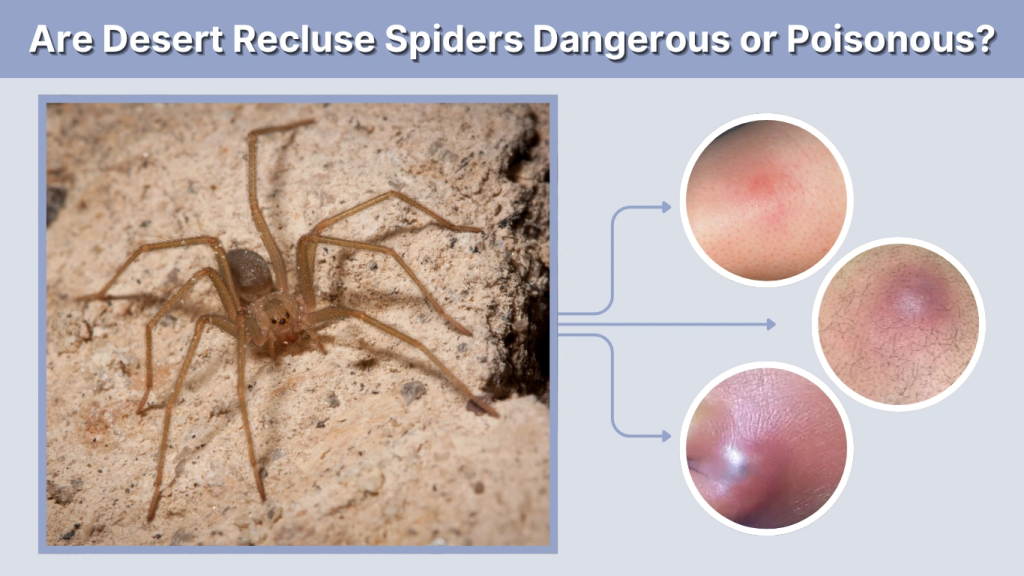
A frequent question is whether the desert recluse is poisonous. The correct term is “venomous”—it injects venom through its bite rather than releasing poison through touch or ingestion.
The venom of the desert recluse contains sphingomyelinase D, an enzyme capable of destroying red blood cells and tissue. However, most bites cause only mild to moderate reactions. Severe necrosis (tissue death) is rare but can occur in sensitive individuals or untreated wounds.
Common reactions include:
- Redness and mild pain at the bite site
- Itching or burning sensations
- Development of a small blister within 24 hours
Severe symptoms—such as tissue breakdown, ulcer formation, fever, or nausea—are uncommon and usually develop only if the bite is left untreated or if the person has a weakened immune system.
While fatalities are extremely rare, medical attention should always be sought if a bite worsens or shows signs of infection. Compared to the brown recluse, the desert recluse’s venom potency is slightly lower, and confirmed cases are much less frequent.
Early Symptoms and Bite Identification
A desert recluse bite often goes unnoticed at first because the spider’s fangs are small and the bite painless. Within a few hours, mild irritation or swelling may develop. After 24 hours, a small red or pale blister may appear, sometimes surrounded by a blue-gray area.
Unlike many spider bites, the desert recluse’s wound may progress slowly, with necrotic damage taking days to appear. However, in most cases, the bite heals naturally within two to three weeks. Early recognition and gentle care greatly reduce complications.
Desert Recluse Bite Treatment

Prompt and gentle care is vital when dealing with a possible desert recluse spider bite. Even though most bites heal without complications, incorrect home remedies can worsen tissue damage. Here’s how to treat a bite properly:
- Clean the area using mild soap and water to remove bacteria.
- Apply a cold compress or ice pack to reduce pain and swelling.
- Keep the limb elevated to slow venom spread.
- Avoid scratching or applying heat, which can aggravate tissue injury.
- Monitor symptoms for the next 24–48 hours.
If the bite becomes increasingly painful, forms a deep ulcer, or you develop fever or fatigue, seek medical help immediately.
Doctors may recommend:
- Antibiotics to prevent infection
- Wound care and debridement for necrotic tissue
- Pain management medications
- Tetanus booster if necessary
There is currently no specific antivenom for Loxosceles bites in the U.S., but early medical evaluation ensures faster healing and reduces scarring. Recovery typically takes 2–6 weeks, depending on severity and personal health.
Desert Recluse Behavior and Adaptations

The desert recluse is aptly named for its secretive lifestyle. These spiders are nocturnal, emerging after dark to hunt small insects. They rely on stealth rather than webs to capture prey, often ambushing from beneath rocks or debris.
Their adaptations to desert environments are remarkable:
- Color camouflage helps them blend with sand and soil.
- Water conservation abilities allow survival in extremely arid areas.
- They hide during the day to avoid dehydration and predators.
Despite their venomous reputation, desert recluses are shy and non-aggressive. They only bite when threatened, such as when accidentally pressed against human skin. Most encounters end harmlessly if the spider is left alone.
Desert Recluse in California and Arizona

California Desert Recluse
In California, the desert recluse is most abundant in Southern and Southeastern regions—especially the Mojave Desert, Palm Springs, Coachella Valley, and San Bernardino County. They are sometimes spotted in San Diego and even the Fresno outskirts. Although indoor infestations are rare, spiders may enter garages or sheds during hot, dry summers.
Arizona Desert Recluse
The Arizona desert recluse thrives in Sonoran Desert regions around Phoenix, Tucson, and Yuma. It favors dry woodpiles, outdoor storage, and desert vegetation. Arizona homeowners are more likely to see these spiders outdoors rather than inside living spaces.
Their close relative, the Arizona brown recluse, often causes confusion, but the true brown recluse (L. reclusa) is uncommon in the state. Desert species dominate most sightings.
Nevada and Utah Range
In Nevada, sightings cluster around Las Vegas and Henderson, while Utah’s desert recluse population resides mainly in southern parts of the state. Each regional population adapts to local desert microclimates but remains behaviorally consistent—reclusive and non-aggressive.
Prevention and Control
Preventing recluse encounters requires maintaining a clean, well-sealed environment. Here are practical tips for homeowners in desert regions:
- Reduce clutter in garages, basements, and storage areas.
- Shake out shoes, clothing, and bedding stored on floors or in boxes.
- Seal gaps and cracks around windows, vents, and doors.
- Store firewood and debris away from the house foundation.
- Use sticky traps near suspected entry points.
- Keep outdoor lighting moderate, as bright lights attract insects, which attract spiders.
If you suspect an infestation, it’s best to contact a licensed pest control specialist familiar with recluse behavior. They can safely inspect, identify, and apply targeted treatments.
When to Call a Professional
You should seek help when:
- Multiple spiders or webs appear inside your home.
- You find egg sacs (white, fuzzy spheres attached to corners).
- You’ve been bitten and symptoms worsen.
- Pets show signs of unexplained skin irritation.
Professionals use non-toxic residual sprays, vacuum removal, and entry sealing to eliminate infestations safely. Never attempt to spray or crush recluses directly—they may respond defensively.
FAQs
1. What does a desert recluse spider look like?
The desert recluse is light tan or sandy brown with long legs and a fine body hair texture. It has six eyes in three pairs and a faint violin marking on its back, often less visible than in the brown recluse.
2. Are desert recluse spiders poisonous?
They are venomous, not poisonous. Their venom can cause localized tissue damage, but severe reactions are uncommon. Most bites heal within a few weeks with proper care.
3. Where are desert recluse spiders found?
They inhabit deserts and dry areas across California, Arizona, Nevada, and Utah, especially in the Mojave and Sonoran Deserts. They prefer hiding in quiet outdoor spaces or structures near desert landscapes.
4. What should I do if I’m bitten by a desert recluse?
Clean the wound, apply ice, elevate the limb, and seek medical attention if redness, blistering, or pain worsen. Avoid applying heat or alcohol-based ointments.
5. How can I tell the difference between a desert recluse and a brown recluse?
The brown recluse has a darker color and more distinct violin mark, and it’s found mainly in the central and southern U.S. The desert recluse, on the other hand, is lighter in tone and found only in western desert regions.