

Spider mites are tiny but destructive pests that attack a wide range of plants, from fruits and vegetables to ornamentals and trees. This guide covers 35 known spider mite species, including their identification features, common host plants, damage symptoms, and habitat behavior. Whether you’re managing houseplants or crops, understanding these mites is key to spotting early signs and preventing infestations.
Two-Spotted Spider Mite (Tetranychus urticae)

The Two-Spotted Spider Mite is one of the most common and destructive spider mites found on a wide range of indoor and outdoor plants. It thrives in hot, dry conditions and can reproduce quickly, making it a serious pest for gardeners and greenhouse growers.
Identification
- Oval-shaped body, about 0.4 mm in length
- Yellow-green to reddish-orange coloration depending on the season
- Two distinct dark spots on either side of the body
- Fine silk webbing found on the underside of leaves
- Movement is slow but visible under a magnifying glass
Common Host Plants
Two-Spotted Spider Mites feed on hundreds of plant species including vegetables, fruits, ornamentals, and houseplants. Tomatoes, beans, cucumbers, strawberries, roses, and ivy are especially susceptible.
Damage Signs
Infected plants often display stippling (tiny yellow or white dots), curling or discolored leaves, fine webbing, and premature leaf drop. In severe cases, the entire plant may appear bronze or bleached.
Habitat and Behavior
These mites prefer dry, warm environments and often live on the underside of leaves where they feed on plant sap. They are especially common in greenhouses and indoor plant settings. Populations can explode within days if not controlled promptly.
2. Red Spider Mite (Tetranychus cinnabarinus)

The Red Spider Mite is a close relative of the Two-Spotted Spider Mite and is known for its reddish color. It commonly affects both ornamental and agricultural plants, particularly in warm climates. Infestations can cause serious damage if not addressed early.
Identification
- Bright red or reddish-orange oval-shaped body
- Slightly larger than some other spider mites (around 0.5 mm)
- No visible spots, unlike T. urticae
- Often found in clusters
- Produces fine silk webbing on leaves and stems
Common Host Plants
This species targets a variety of plants including cotton, beans, eggplants, peppers, roses, and several types of houseplants.
Damage Signs
Symptoms include yellow stippling, leaf bronzing, dry or brittle leaves, and visible webbing. Heavy infestations can cause full defoliation or even plant death in severe cases.
Habitat and Behavior
Red Spider Mites thrive in warm and humid environments. They are more prevalent in tropical and subtropical regions and can be a significant problem in greenhouses. Like other spider mites, they feed by piercing plant cells and sucking out the contents.
3. Clover Mite (Bryobia praetiosa)

Clover Mites are tiny red pests often seen crawling on windowsills and walls in early spring. Unlike most spider mites, they prefer cooler temperatures and are more of a nuisance indoors than a serious plant threat.
Identification
- Very small (about 0.75 mm), bright reddish color
- Long front legs that resemble antennae
- Oval body with feathered scales
- No webbing
- Leaves a red stain when crushed
Common Host Plants
Primarily feeds on grasses, clover, dandelions, and other turf plants. Occasionally found on ornamental flowers and shrubs near buildings.
Damage Signs
While damage is typically minimal, heavily infested lawns may show silvery or speckled patches. Indoors, they don’t feed on plants but may become a nuisance when they invade in large numbers.
Habitat and Behavior
Clover Mites prefer cool weather and are most active in spring and fall. They often enter buildings through cracks in walls or foundations. They reproduce without mating (parthenogenesis), which can lead to rapid population spikes.
4. Southern Red Mite (Oligonychus ilicis)

The Southern Red Mite is a cool-season mite known for infesting broadleaf evergreens. It’s more damaging during the cooler months and is often mistaken for other red mites due to its similar appearance.
Identification
- Reddish to dark red oval body
- Very small (about 0.3–0.4 mm)
- No prominent spots on the body
- Fine silk webbing present on the undersides of leaves
- Often found in dense colonies
Common Host Plants
Commonly affects azaleas, camellias, hollies, magnolias, and rhododendrons. Occasionally seen on other ornamental shrubs.
Damage Signs
Infested leaves may appear bronze, gray, or scorched. Mites suck out plant juices, causing stippling and leaf drop. Webbing may be seen under the leaves, especially with larger populations.
Habitat and Behavior
These mites thrive in cool, shady environments and are most active in spring and fall. They usually feed on the lower surface of leaves and cause noticeable damage even before populations become large.
5. Spruce Spider Mite (Oligonychus ununguis)

The Spruce Spider Mite is a cold-weather mite that targets coniferous trees and is most active in spring and fall. It’s often considered one of the most destructive pests to evergreens.
Identification
- Oval-shaped body, reddish-brown to dark green
- Tiny (about 0.4 mm)
- No visible body spots
- Produces fine silk webbing
- May appear as brown specks when present in clusters
Common Host Plants
Feeds primarily on spruce, arborvitae, juniper, hemlock, and pine.
Damage Signs
Infested needles show tiny yellow or brown speckles, eventually turning bronze and dropping. Fine webbing may be seen in dense infestations.
Habitat and Behavior
These mites prefer cooler temperatures and are most active in spring and fall. They feed on older needles and are usually found on the undersides of conifer foliage. They become dormant during summer heat.
6. European Red Mite (Panonychus ulmi)

The European Red Mite is a major pest of fruit trees and ornamental plants, especially in temperate regions. It’s known for its ability to resist common miticides and cause significant leaf damage.
Identification
- Bright red, round body with white bristles
- Slightly larger than many spider mites (about 0.4 mm)
- No dark spots, but bristly appearance
- Leaves a rusty or reddish tint on infested areas
- Webbing is minimal compared to other species
Common Host Plants
Commonly affects apples, pears, cherries, plums, peaches, roses, and various ornamental plants.
Damage Signs
Leaf stippling, curling, and premature drop are typical signs. Severe infestations may cause reduced fruit yield and poor plant health.
Habitat and Behavior
These mites are active during the warm months and often overwinter as eggs on bark or twigs. They prefer dry environments and quickly develop resistance to chemical controls, making them a persistent challenge for orchard management.
7. Tomato Russet Mite (Aculops lycopersici)

The Tomato Russet Mite is a microscopic pest that primarily affects solanaceous crops. Unlike typical spider mites, it is part of the Eriophyidae family and is nearly invisible to the naked eye. Infestations often go unnoticed until significant damage has occurred.
Identification
- Extremely small (about 0.15 mm), wedge-shaped body
- Light yellow to translucent in color
- Cannot be seen without a microscope
- No webbing is produced
- Smooth, slender body different from spider-like appearance
Common Host Plants
Mostly found on tomatoes, but also infests potatoes, eggplants, peppers, and tobacco plants.
Damage Signs
Symptoms include bronzing and curling of leaves, a greasy appearance, and death of growing tips. Fruit may remain small and deformed. Mite damage can resemble nutrient deficiency or disease.
Habitat and Behavior
Prefers hot, dry climates and is active during warm growing seasons. These mites feed on epidermal cells, destroying plant tissues quickly. Infestations usually begin in the lower canopy and move upward.
8. Tomato Red Spider Mite (Tetranychus evansi)

The Tomato Red Spider Mite is a destructive species in tropical and subtropical climates, especially for solanaceous crops. It spreads rapidly and can overwhelm a plant in a short time.
Identification
- Reddish-orange oval body, about 0.3–0.4 mm
- Similar to T. cinnabarinus in color
- Produces dense silk webbing that covers foliage
- Often found on the underside of leaves in large colonies
- Requires magnification for accurate ID
Common Host Plants
Mainly attacks tomatoes, but also affects eggplants, peppers, potatoes, and some weeds in the Solanaceae family.
Damage Signs
Causes severe yellowing, leaf drying, and premature drop. Webbing covers leaves and stems. Infestations reduce yield and can kill young plants quickly.
Habitat and Behavior
Thrives in warm, dry environments. Often begins in greenhouses or fields with limited natural predators. Known to suppress plant defenses, worsening the damage.
9. Desert Spider Mite (Tetranychus ludeni)
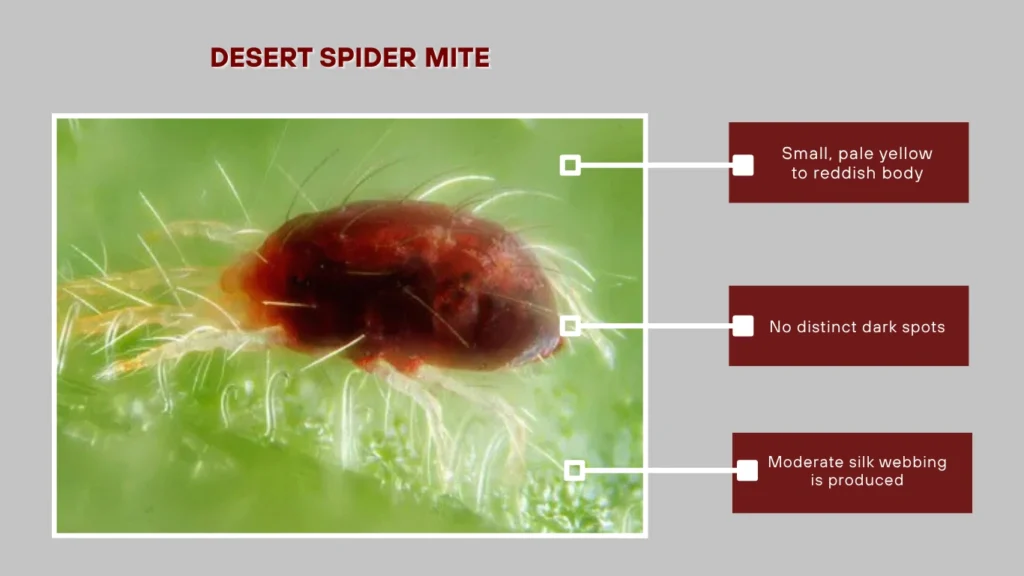
The Desert Spider Mite is a heat-tolerant species that targets many crops, especially in arid and semi-arid regions. Though less studied than some relatives, it’s recognized as a pest in many agricultural zones.
Identification
- Small, pale yellow to reddish body
- No distinct dark spots
- Moderate silk webbing is produced
- Appears similar to T. urticae under magnification
- Often seen on dry, dusty plants
Common Host Plants
Commonly found on beans, tomatoes, cucurbits, peppers, and ornamentals. Also occurs on weeds and non-crop vegetation.
Damage Signs
Feeding causes stippling, chlorosis, and bronzing of leaves. Leaves may curl and fall early. Webbing may be visible on infested areas.
Habitat and Behavior
This mite favors dry, hot conditions and is especially problematic in desert and greenhouse environments. It breeds rapidly, often completing multiple generations in a season.
10. Six-Spotted Spider Mite (Eotetranychus sexmaculatus)

The Six-Spotted Spider Mite is a significant pest in citrus-growing regions and some ornamental landscapes. It’s known for causing leaf drop and yellowing, especially on citrus and avocado trees.
Identification
- Oval, yellow-green body, about 0.3–0.4 mm
- Six distinct dark spots on the upper side of the body
- Lighter-colored legs
- Fine silk webbing may be present
- Easier to spot under magnification
Common Host Plants
Favored hosts include citrus, avocado, ornamental fig, banana, hibiscus, and other subtropical plants.
Damage Signs
Early signs include stippling and yellow patches on leaves. Severe infestations lead to leaf curling, defoliation, and general canopy thinning. Fruits may also be affected by sunburn due to leaf loss.
Habitat and Behavior
Prefers warm, dry conditions and reproduces rapidly during the hot season. Mites cluster on the underside of leaves and feed by piercing plant cells.
11. Citrus Red Mite (Panonychus citri)

The Citrus Red Mite is a common pest of citrus trees worldwide. It’s larger and more robust than many other spider mites and often causes visible damage before webbing appears.
Identification
- Bright red, rounded body (about 0.5 mm)
- Prominent white bristles on the back
- No spots; fully red appearance
- Webbing is minimal or absent
- Visible to the naked eye on leaves
Common Host Plants
Primarily citrus trees (orange, lemon, lime), but also found on other fruit trees and ornamental shrubs.
Damage Signs
Leads to silvering or bronzing of leaves, with a dry or scorched look. Heavy infestations reduce photosynthesis and fruit quality. Leaves may drop prematurely.
Habitat and Behavior
More active in cooler seasons than typical spider mites. Populations tend to build in late winter or early spring. Mites feed mostly on upper leaf surfaces, unlike many others that prefer the underside.
12. Avocado Brown Mite (Oligonychus yothersi)

The Avocado Brown Mite is a common pest of avocado trees in warm regions. While not as aggressive as other spider mites, its feeding causes noticeable damage to mature leaves.
Identification
- Small, brownish-red oval body (about 0.3 mm)
- No distinct markings or spots
- Sparse webbing may be seen
- Typically found on the upper leaf surface
- Not easy to spot without magnification
Common Host Plants
Primarily targets avocado trees, but may also feed on persimmons and citrus under certain conditions.
Damage Signs
Causes leaf speckling and bronzing, especially on mature leaves. Severe infestations may result in early leaf drop, reducing tree vigor and yield.
Habitat and Behavior
These mites prefer dry and sunny conditions. Unlike many other spider mites, they feed on the upper surface of leaves. Populations are usually controlled by natural predators unless disrupted.
13. Tea Red Spider Mite (Oligonychus coffeae)

The Tea Red Spider Mite is a major pest in tea plantations across Asia and Africa. It affects both yield and quality by damaging leaves and reducing photosynthesis efficiency.
Identification
- Reddish-brown, oval body (around 0.3 mm)
- Lacks distinct spots
- Sparse or no webbing
- Moves slowly; visible under magnification
- Often found in groups on the underside of leaves
Common Host Plants
Primarily infests tea plants but is also found on coffee, cotton, cassava, guava, and various tropical crops.
Damage Signs
Leaves develop reddish-brown discoloration, with edges curling and drying. Stippling appears first, progressing to necrosis in heavy infestations. Severe damage may lead to defoliation and reduced crop quality.
Habitat and Behavior
Thrives in warm and humid climates. Populations peak during dry spells following rainfall. It usually stays on mature leaves and is highly destructive when unchecked.
14. Pacific Spider Mite (Tetranychus pacificus)

The Pacific Spider Mite is a heat-adapted species commonly found in vineyards and orchards. It causes significant damage during hot, dry summers.
Identification
- Yellow to reddish body, about 0.3–0.4 mm
- May have faint dark spots like T. urticae
- Fine webbing on leaves and fruit clusters
- Found in dense colonies on the underside of leaves
- Difficult to distinguish without magnification
Common Host Plants
Frequently infests grapes, almonds, pistachios, stone fruits, and several ornamental trees.
Damage Signs
Stippling, bronzing, and drying of leaves, especially during drought. Infestations can reduce fruit yield and quality. Grape clusters may become sunburned due to defoliation.
Habitat and Behavior
Common in hot, arid regions. Populations build rapidly in midsummer. It prefers dusty, water-stressed plants and often becomes dominant when natural predators are suppressed.
15. Turkestan Spider Mite (Tetranychus turkestani)

The Turkestan Spider Mite is an agricultural pest known for its wide host range and ability to thrive in warm, dry environments. It closely resembles the Two-Spotted Spider Mite.
Identification
- Pale yellow to green body, about 0.4 mm
- Often shows two faint dark spots
- Produces fine silk webbing
- Eggs are spherical and translucent
- Found primarily on the undersides of leaves
Common Host Plants
Common on cotton, eggplants, tomatoes, cucurbits, beans, and ornamental plants. Also found on many weeds.
Damage Signs
Typical symptoms include yellow speckling, leaf curling, and bronzing. Webbing may cover leaves and stems. Prolonged infestations stunt plant growth and lower yields.
Habitat and Behavior
Flourishes in dry and warm climates. It is especially troublesome in irrigated agriculture and greenhouses. Like T. urticae, it reproduces quickly and can develop pesticide resistance.
16. Goosefoot Spider Mite (Tetranychus merganser)

The Goosefoot Spider Mite is less commonly known but can infest a variety of crops, especially in arid regions. It belongs to the same genus as several agricultural spider mite pests and shows similar feeding behavior.
Identification
- Small, oval-shaped body (approx. 0.3–0.4 mm)
- Pale yellow to reddish coloration
- May show faint dark spots on the body
- Produces fine webbing on infested leaves
- Requires magnification for accurate ID
Common Host Plants
Commonly found on goosefoot family plants such as beets and spinach. Also affects beans, cucurbits, and some weedy species.
Damage Signs
Typical symptoms include stippled leaves, yellowing, and premature leaf drop. In heavy infestations, the plant may appear dusty or bronzed due to mite feeding and webbing.
Habitat and Behavior
Favors hot, dry climates and reproduces quickly in stressed environments. Most commonly seen in field crops, especially in regions with limited rainfall or irrigation.
17. Kanzawa Spider Mite (Tetranychus kanzawai)

The Kanzawa Spider Mite is a significant pest in East and Southeast Asia, particularly affecting ornamental and fruit-bearing plants. It’s visually striking due to its bright red color.
Identification
- Bright red oval body (about 0.3 mm)
- May have faint dark spots on the back
- Produces fine silk webbing
- Eggs are red and spherical
- Highly visible on green foliage
Common Host Plants
Feeds on tea plants, azaleas, citrus, strawberries, grapes, and ornamental shrubs.
Damage Signs
Leaf bronzing, chlorosis, curling, and early leaf drop. Webbing becomes prominent in high infestations. Red eggs may be visible on the underside of leaves.
Habitat and Behavior
Prefers warm, humid environments and can be found both outdoors and in greenhouses. Often builds up in spring and autumn. Rapid life cycle leads to frequent outbreaks in poorly managed areas.
18. Garden Spider Mite (Tetranychus telarius)

Also known in some classifications as a synonym of Tetranychus urticae, the Garden Spider Mite is a widespread pest that affects a variety of home garden plants.
Identification
- Small oval body, yellow to greenish with dark lateral spots
- Around 0.4 mm in size
- Produces visible silk webbing
- Similar in appearance to Two-Spotted Spider Mite
- Needs magnification for exact differentiation
Common Host Plants
Affects garden vegetables like beans, tomatoes, eggplants, and ornamentals such as roses and marigolds.
Damage Signs
Leads to stippling, yellowing, and curling of leaves. Webbing is often seen between leaves and stems. Heavily infested plants may become stunted or die.
Habitat and Behavior
Active during warm, dry periods. Typically found on the underside of leaves. Reproduces quickly, especially when natural predators are absent or when pesticide use kills off beneficial insects.
19. Tropical Spider Mite (Tetranychus neocaledonicus)

The Tropical Spider Mite is a warm-climate pest often found on a wide variety of tropical and subtropical crops. Its adaptability and rapid reproduction make it a serious threat in greenhouses and outdoor fields.
Identification
- Small oval body, about 0.3–0.4 mm
- Pale yellow to greenish or orange body with dark spots
- Produces noticeable webbing
- Often found in colonies on the underside of leaves
- Difficult to distinguish without a microscope
Common Host Plants
Includes beans, okra, cotton, eggplant, cucurbits, and many tropical ornamentals and vegetables.
Damage Signs
Symptoms include stippling, yellowing, and wilting of leaves. Webbing may cover affected areas. Severe infestations result in defoliation and reduced plant vigor.
Habitat and Behavior
Flourishes in hot, humid environments. Common in tropical climates, greenhouses, and shaded fields. Its populations can explode under high temperatures and dry weather.
20. Glover’s Spider Mite (Tetranychus gloveri)

Glover’s Spider Mite is found mainly in the southern United States and parts of Central America. Though less well-known, it affects several economically important crops.
Identification
- Small reddish or yellowish body (around 0.4 mm)
- May have indistinct dark spots
- Moderate webbing production
- Most active on the underside of leaves
- Microscopic examination needed for confirmation
Common Host Plants
Includes citrus, cotton, beans, and various weeds. Also reported on okra and other vegetables in warm climates.
Damage Signs
Leads to typical stippling and yellowing of leaves. Affected areas may show leaf curling and early drop. Webbing is usually present in heavy infestations.
Habitat and Behavior
Prefers warm and arid to semi-humid environments. Active mainly during summer months and often coexists with other spider mite species, making management more difficult.
21. Oriental Spider Mite (Eutetranychus orientalis)
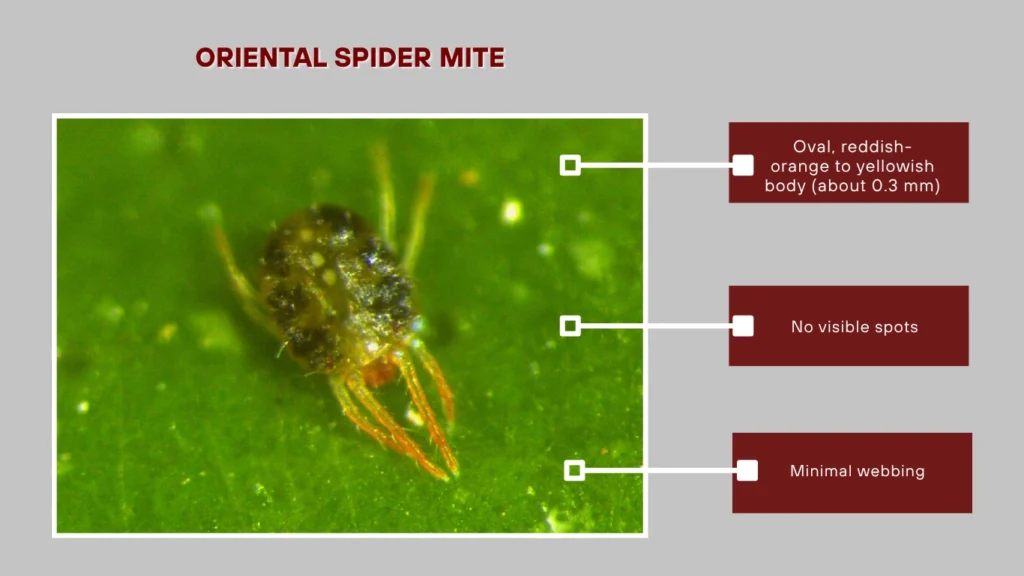
The Oriental Spider Mite is a widespread pest throughout the Middle East, Africa, and Asia, especially known for attacking citrus and other tree crops.
Identification
- Oval, reddish-orange to yellowish body (about 0.3 mm)
- No visible spots
- Minimal webbing
- Often found on upper and lower leaf surfaces
- Readily visible in clusters under magnification
Common Host Plants
Mainly citrus, but also mango, fig, guava, castor, papaya, and ornamental shrubs.
Damage Signs
Leaves show signs of bronzing, curling, and eventual drying. In severe cases, defoliation occurs. Mites feed on both leaf surfaces, leading to quicker damage.
Habitat and Behavior
Thrives in hot, dry regions. Populations rise in late spring through summer. The species is less reliant on webbing, making infestations harder to notice until damage is severe.
22. Sugarcane Spider Mite (Schizotetranychus hindustanicus)

The Sugarcane Spider Mite is a specialized pest found predominantly in South Asia. As the name suggests, it primarily targets sugarcane crops and can significantly reduce yield in unmanaged infestations.
Identification
- Small, oval body, yellowish to reddish-brown
- No prominent spots
- Produces moderate silk webbing
- Found in colonies on the underside of leaves
- Visible under a hand lens or microscope
Common Host Plants
Mainly infests sugarcane, but may occasionally appear on related grass species and certain weeds in surrounding fields.
Damage Signs
Initial signs include yellow speckling or streaking on leaves, progressing to reddish discoloration and drying. Leaves may become brittle and curl at the tips.
Habitat and Behavior
Thrives in hot, humid climates with dense crop cover. Populations peak during dry periods when plants are stressed. Reproduces rapidly and often builds up unnoticed in lower leaves.
23. Brown Wheat Mite (Petrobia latens)

The Brown Wheat Mite is a cool-season mite that targets cereal crops, especially wheat and barley. It is active during dry, windy conditions and often appears suddenly in large numbers.
Identification
- Shiny, dark brown to black oval body (approx. 0.5 mm)
- Pale, yellowish legs
- Moves quickly across leaf surfaces
- No webbing produced
- Easily spotted due to shiny appearance and fast movement
Common Host Plants
Mainly wheat, barley, oats, and rye. Occasionally found on alfalfa and grass pastures.
Damage Signs
Leaves become speckled, silvered, or bronzed. Leaf tips curl and dry. In heavy infestations, fields may appear drought-stressed despite adequate soil moisture.
Habitat and Behavior
Prefers cool, dry environments and is most active in late winter and early spring. Mites feed during the day and hide near the soil line during night. Populations collapse once temperatures rise or moisture increases.
24. Winter Grain Mite (Petrobia harti)

Winter Grain Mites are common pests of small grain crops, especially in areas with mild winters. Unlike many mites, they are most active in cold weather and can go unnoticed until damage is widespread.
Identification
- Oval, dark bluish-black body (about 0.5 mm)
- Bright red legs—very distinctive
- No webbing
- Moves quickly on plant surfaces
- Most active during cool, overcast days
Common Host Plants
Affects wheat, barley, ryegrass, and other winter cereals. Occasionally found on legumes and wild grasses.
Damage Signs
Stippling and silvering of leaves, tip burn, and slowed plant growth. Plants may appear stunted or discolored, especially in cooler zones of the field.
Habitat and Behavior
Prefers moist, cool conditions and is active during fall and winter. Feeds at night and hides in the soil during daylight. Populations diminish with the arrival of warmer spring temperatures.
25. Bamboo Spider Mite (Oligonychus perditus)

The Bamboo Spider Mite is a specialized pest that primarily affects ornamental bamboo plants. It is commonly found in landscape gardens and nurseries, particularly in East Asia and the United States.
Identification
- Small, reddish-brown oval body (around 0.3 mm)
- No prominent body markings
- Moderate silk webbing along bamboo leaves and stems
- Often found in clusters
- Requires magnification for proper identification
Common Host Plants
Primarily affects bamboo species, especially ornamental varieties grown in nurseries, gardens, and parks.
Damage Signs
Infestation causes leaf stippling, yellowing, and premature leaf drop. Fine webbing may be seen, and the foliage may take on a faded or scorched appearance over time.
Habitat and Behavior
Prefers warm, dry environments with dense foliage. It thrives in greenhouses, potted bamboo, and outdoor bamboo groves with limited airflow. Populations increase rapidly in late spring through summer.
26. Clover Spider Mite (Tetranychus lambi)

The Clover Spider Mite is a lesser-known species associated with clover and other leguminous plants. It is occasionally seen in lawns, meadows, and agricultural fields.
Identification
- Small, pale yellow to light green oval body (approx. 0.3–0.4 mm)
- May have faint dark markings
- Produces fine webbing in severe infestations
- Moves slowly on foliage
- Detected best with magnification
Common Host Plants
Primarily clover and other legumes like alfalfa. May also be found on weedy species and some ornamental groundcovers.
Damage Signs
Typical mite symptoms: stippling, discoloration, and curling of leaves. Heavily infested plants may wilt or appear drought-stressed.
Habitat and Behavior
Found mostly in temperate climates and active during the warmer months. Populations tend to develop in groundcovers and low-growing vegetation, often unnoticed until visible damage appears.
27. Rice Spider Mite (Tetranychus ogmophallos)

The Rice Spider Mite is an emerging pest in rice cultivation, especially in parts of Asia. It can cause significant yield loss if infestations are not managed early.
Identification
- Very small, reddish-orange body (about 0.3 mm)
- Smooth oval shape without distinct spots
- Moderate silk webbing on rice leaves
- Often clusters along leaf blades
- Identification requires magnification
Common Host Plants
Primarily rice but can also infest other grasses and sedges found in and around paddy fields.
Damage Signs
Infestation leads to whitish or yellowish spots on leaves, bronzing, and eventually drying of the leaf tips. Affected plants have reduced tillering and weaker grain development.
Habitat and Behavior
Prefers warm, humid rice field environments. Most active during the tillering and booting stages of rice. Reproduces rapidly under stagnant, waterlogged conditions.
28. Mango Red Spider Mite (Tetranychus truncatus)

The Mango Red Spider Mite is a significant pest of mango orchards in tropical and subtropical regions. It can lead to serious yield reductions if left uncontrolled, especially during dry seasons.
Identification
- Small, reddish-orange oval body (approx. 0.3–0.4 mm)
- May have faint lateral dark markings
- Produces fine webbing on infested foliage
- Typically found on the underside of mango leaves
- Needs magnification for accurate detection
Common Host Plants
Primarily mango trees, but also reported on castor, cotton, okra, and other warm-climate crops.
Damage Signs
Symptoms include speckling, bronzing, and yellowing of leaves. Leaf tips may curl and dry out. Severe infestations reduce flowering and fruit formation.
Habitat and Behavior
Prefers dry, warm conditions typical of mango-growing seasons. Mites multiply rapidly under drought stress, and their damage is often aggravated by dust and lack of rainfall.
29. Legume Spider Mite (Tetranychus macfarlanei)

The Legume Spider Mite is a species that primarily targets leguminous crops, especially in tropical and subtropical regions. Though less notorious than others, it poses a threat to field productivity.
Identification
- Pale yellow to greenish body with oval shape (about 0.3 mm)
- May have faint dark side markings
- Produces sparse webbing
- Found in clusters on lower leaf surfaces
- Requires magnification to confirm identity
Common Host Plants
Targets legumes such as soybean, mung bean, cowpea, pigeon pea, and lentils.
Damage Signs
Early symptoms include stippling and fading of leaves. Continued feeding causes curling, bronzing, and potential leaf drop. Growth may be stunted in young plants.
Habitat and Behavior
Common in dry, low-rainfall zones during cropping seasons. Populations thrive in field margins and can spread rapidly without natural predator pressure.
30. Caglei Spider Mite (Panonychus caglei)

The Caglei Spider Mite is an occasional pest in citrus and ornamental plant systems. It shares similarities with other red mites and is mostly reported in warmer regions.
Identification
- Reddish to dark red, rounded body (approx. 0.4–0.5 mm)
- Covered in short spines or bristles
- No distinct spots
- Minimal webbing compared to Tetranychus species
- Visible with a hand lens
Common Host Plants
Primarily citrus trees, but also seen on some ornamental shrubs and subtropical fruit plants.
Damage Signs
Feeding causes leaf bronzing, curling, and premature drop. In some cases, older leaves appear scorched or rusted, affecting overall plant health and fruit production.
Habitat and Behavior
Active in warm climates, particularly during spring and early summer. Found on both upper and lower leaf surfaces and known to resist some conventional miticides over time.
31. Mulberry Spider Mite (Panonychus mori)

The Mulberry Spider Mite is a specialized pest of mulberry trees, particularly problematic in sericulture (silk farming) regions where mulberry leaves are vital for silkworm rearing.
Identification
- Small, round, reddish body (about 0.3–0.4 mm)
- Covered with short spines
- No visible spots
- Minimal or no webbing
- May appear in clusters on leaf surfaces
Common Host Plants
Primarily mulberry (Morus species), occasionally other ornamental shrubs nearby.
Damage Signs
Infested leaves show stippling, yellowing, and curling. Feeding reduces leaf quality, which is critical in silk farming. Severe damage results in leaf drop.
Habitat and Behavior
Thrives in warm, dry environments. Common in regions where mulberry is cultivated for silkworm feeding. Reproduces quickly in leaf-dense environments.
32. Papaya Spider Mite (Panonychus caricae)

The Papaya Spider Mite targets papaya plants and is a notable pest in tropical fruit farming. It weakens plant health and reduces fruit yield and quality.
Identification
- Reddish-orange, rounded body (around 0.4 mm)
- Bristled back, no visible spots
- Limited webbing
- Often found in large numbers on the upper surface of leaves
- Visible to the naked eye under close inspection
Common Host Plants
Primarily papaya, but also found on guava, cotton, and ornamental plants.
Damage Signs
Symptoms include yellowing, stippling, and curling of leaves. Heavy feeding leads to leaf drying and premature fruit drop.
Habitat and Behavior
Flourishes in hot, dry climates. Populations rise rapidly in the absence of natural predators. Common in papaya farms and home gardens in tropical zones.
33. African Spider Mite (Eutetranychus africanus)

The African Spider Mite is a pest commonly found in arid and semi-arid regions of Africa and the Middle East, attacking citrus and tropical plants.
Identification
- Small, oval-shaped yellowish to reddish body (approx. 0.3 mm)
- No visible spots
- Sparse webbing
- Found on both surfaces of leaves
- Needs magnification for confirmation
Common Host Plants
Citrus, mango, guava, fig, and various shrubs and ornamental trees.
Damage Signs
Leads to leaf yellowing, bronzing, and scorching. Premature leaf fall can occur in severe infestations, affecting fruit production and overall tree health.
Habitat and Behavior
Prefers hot, dry climates. Builds up quickly in poorly irrigated orchards. Can survive in low humidity and is difficult to detect until damage becomes visible.
34. Mango Spider Mite (Eutetranychus banksi)

The Mango Spider Mite is a mango-specific pest often found in tropical and subtropical regions. It causes surface damage to leaves and reduces overall tree vigor.
Identification
- Pale yellow or green oval body (approx. 0.3–0.4 mm)
- No dark markings
- Sparse webbing on leaves
- Eggs are round and laid in groups
- Best seen under a magnifying lens
Common Host Plants
Primarily mango trees, though occasionally found on citrus or related tropical fruits.
Damage Signs
Leaves become yellow, curled, and dry, especially at the edges. Affected trees may produce fewer and smaller fruits. Webbing is not always visible.
Habitat and Behavior
Common in dry mango orchards with poor airflow. Active during warm, dry months and hides on the underside of leaves. Often overlooked until damage progresses.
35. Birch Spider Mite (Tetranychus collyerae)

The Birch Spider Mite is a deciduous tree pest mostly found in temperate climates. It targets birch trees and occasionally other hardwoods in parks and landscapes.
Identification
- Yellowish-green oval body with possible faint spots
- Size about 0.3 mm
- Produces moderate webbing
- Often found in colonies along leaf veins
- Visible under magnification
Common Host Plants
Primarily birch trees (Betula species), sometimes maple, elm, and other hardwood ornamentals.
Damage Signs
Leaves exhibit stippling, fading, and browning. Severely infested trees may drop leaves early, affecting aesthetics and tree health.
Habitat and Behavior
Active in spring through early fall. Populations spike during dry spells. Common in urban landscapes and residential areas where birch trees are used ornamentally.