




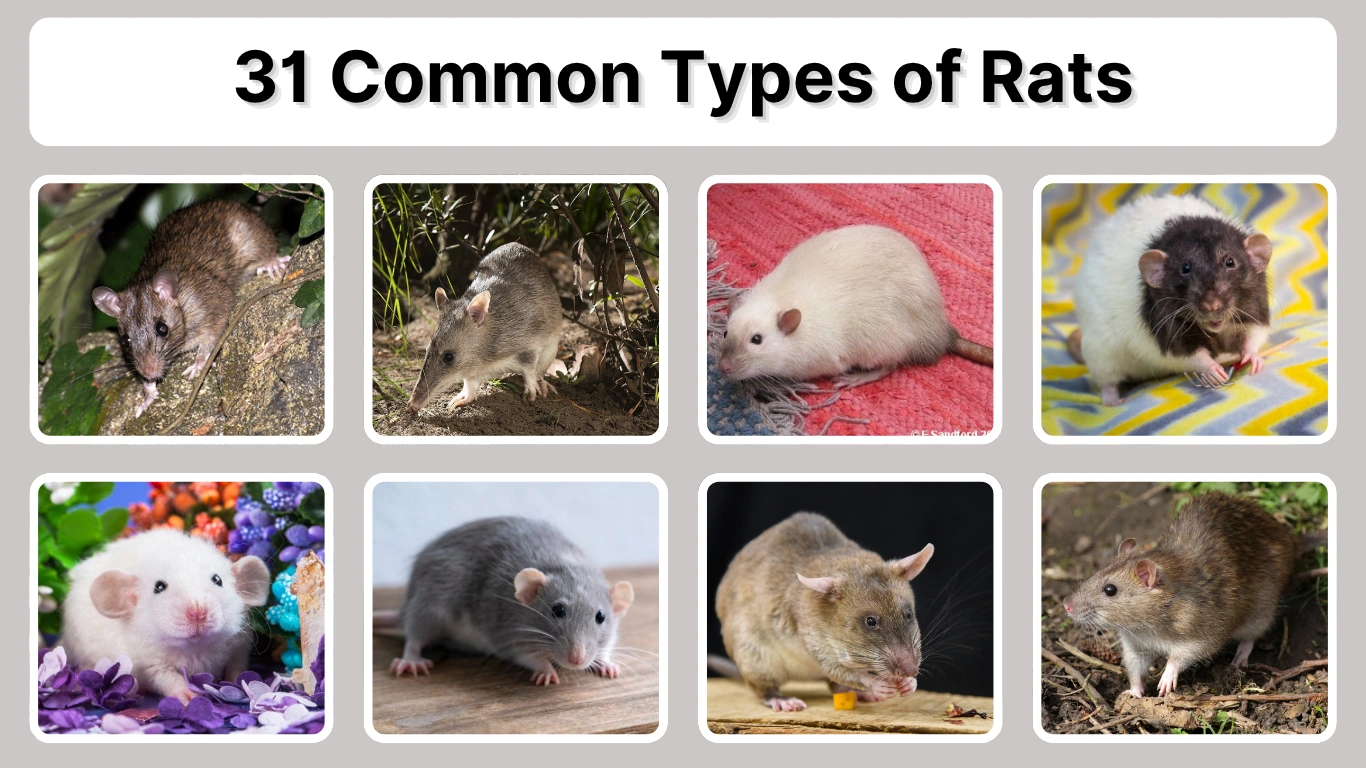
Rats are incredibly diverse and adaptable creatures found all over the world, from dense forests and mountain slopes to urban rooftops and rice fields. While many people are familiar with the common brown or black rats, there are actually dozens of distinct species, each with its own characteristics, behaviors, and ecological roles. In this guide, we’ll explore 31 types of rats—some well-known, others lesser-known—detailing how to identify them, where they live, and how they behave in their natural environments. Whether you’re curious about wild rats or want to distinguish them from urban pests, this list offers a deeper look into the world of rats.
1. Brown Rat (Norway Rat)

The brown rat, also known as the Norway rat (Rattus norvegicus), is one of the most widespread and adaptable rodent species on the planet. It thrives in both urban and rural environments and has a reputation for being intelligent, resourceful, and highly reproductive.
Identification
- Color: Brown or grayish-brown fur with a lighter gray or whitish belly
- Size: Body length 7–10 inches (18–25 cm); tail 6–8 inches (15–20 cm)
- Weight: 200–500 grams
- Tail: Scaly, shorter than the body length
- Ears: Small and close to the head
- Nose: Blunt with thick whiskers
- Eyes: Small and beady
Habitat and Distribution
Brown rats are found worldwide, especially in cities, farmlands, and sewers. They build burrows in the ground, live in basements, garbage areas, fields, and near water sources. Originally native to northern China, they now inhabit every continent except Antarctica.
Behavior and Diet
Brown rats are omnivorous and opportunistic eaters. They consume grains, meat, garbage, and even small animals. They are nocturnal and highly social, often living in large colonies. Known for their swimming ability, brown rats are often found near water and can even climb pipes and walls. Their strong survival skills make them one of the most successful mammals globally.
2. Black Rat (Roof Rat)
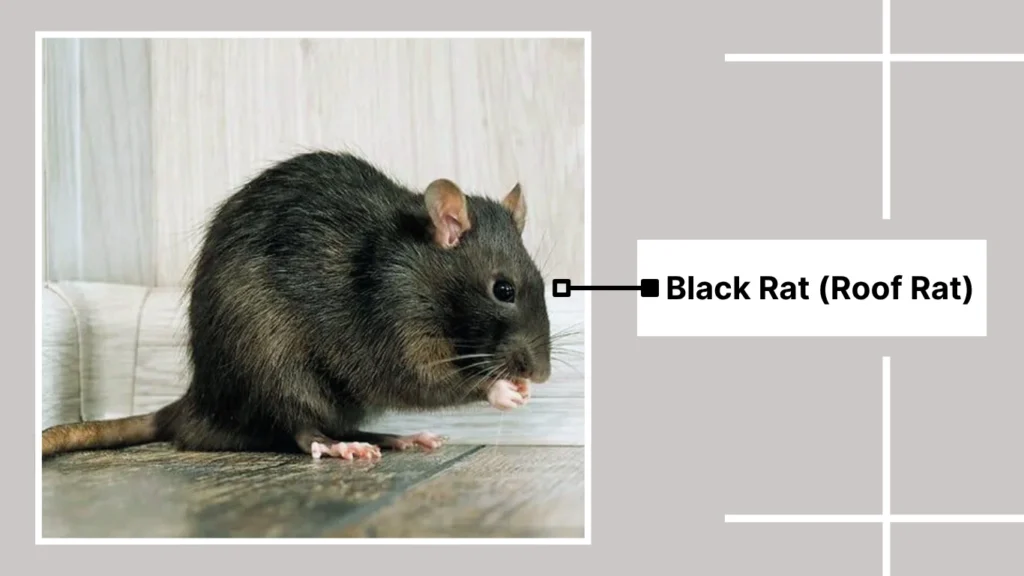
The black rat, also known as the roof rat (Rattus rattus), is a smaller and sleeker relative of the brown rat. It prefers warmer climates and elevated nesting sites, often inhabiting attics, roofs, trees, and ceilings—hence the name “roof rat.”
Identification
- Color: Black to dark brown fur with a lighter underbelly
- Size: Body length 6–8 inches (15–20 cm); tail longer than the body
- Weight: 150–250 grams
- Tail: Long, scaly, and thin—extends past the head
- Ears: Large and prominent
- Nose: Pointed
- Body: Slender and agile
Habitat and Distribution
Roof rats are found in tropical and subtropical regions, including parts of the U.S., Southeast Asia, and Australia. They commonly infest buildings, warehouses, palm trees, and dense foliage near human settlements.
Behavior and Diet
Primarily nocturnal and excellent climbers, roof rats feed on fruits, grains, nuts, and seeds. They are wary and secretive, preferring higher ground to burrow-based rats. Unlike brown rats, roof rats rarely swim and tend to nest off the ground.
3. Polynesian Rat
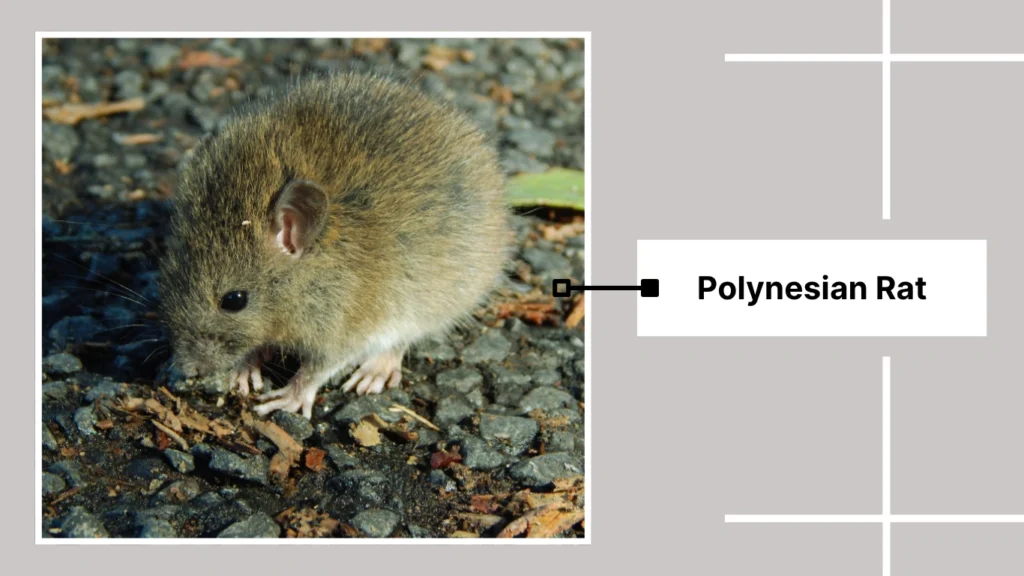
The Polynesian rat (Rattus exulans) is one of the smallest rat species and was spread by ancient seafaring peoples throughout the Pacific Islands. It plays a significant role in the history and ecology of the Pacific region.
Identification
- Color: Reddish-brown or grayish-brown fur with a white or light underside
- Size: Body length 4–6 inches (10–15 cm); tail about the same or slightly longer
- Weight: 40–80 grams
- Tail: Long and thin
- Snout: Pointed
- Ears: Medium-sized and rounded
Habitat and Distribution
Native to Southeast Asia, the Polynesian rat was introduced to many Pacific Islands by early Polynesian voyagers. It now inhabits islands in Hawaii, New Zealand, Micronesia, and Melanesia, often in forest edges, grasslands, and coastal habitats.
Behavior and Diet
These rats are mainly nocturnal and feed on seeds, fruits, insects, and small animals. On islands, they have contributed to the extinction of many native birds and plants. They nest in ground burrows, rock crevices, or under vegetation.
4. Marsh Rice Rat

The marsh rice rat (Oryzomys palustris) is a semi-aquatic rodent native to the southeastern United States. It lives in wetland habitats and is an excellent swimmer, often confused with small muskrats or voles.
Identification
- Color: Grayish-brown back with a whitish to gray belly
- Size: Body length 5–7 inches (12–18 cm); tail 4–6 inches (10–15 cm)
- Weight: 40–80 grams
- Tail: Bicolored and sparsely furred
- Snout: Narrow and pointed
- Feet: Adapted for swimming with partially webbed toes
Habitat and Distribution
Common in freshwater and saltwater marshes, wet meadows, and swamps across the southeastern U.S., from Texas to Florida and up to New Jersey.
Behavior and Diet
Marsh rice rats are omnivorous, eating seeds, grasses, aquatic plants, insects, snails, and small crustaceans. They are nocturnal, solitary, and build nests above the waterline in dense vegetation or logs.
5. Eastern Woodrat

The eastern woodrat (Neotoma floridana) is a native North American rat known for its “pack rat” behavior—collecting shiny or interesting objects to store in their nests, or “middens.”
Identification
- Color: Brownish-gray upperparts with a white or cream-colored belly
- Size: Body length 6–9 inches (15–23 cm); tail 5–8 inches (13–20 cm)
- Weight: 180–300 grams
- Tail: Furred and shorter than the body
- Ears: Large and rounded
- Eyes: Prominent and dark
Habitat and Distribution
Found in deciduous forests, rocky outcrops, swamps, and brushy areas across the southeastern and midwestern U.S. Populations are declining in some northern areas due to habitat loss and competition from other rats.
Behavior and Diet
Omnivorous—eating fruits, seeds, leaves, bark, and occasionally insects. Eastern woodrats build large stick nests in sheltered places and are territorial. They’re mostly nocturnal and active year-round, with a shy and secretive nature.
6. Allegheny Woodrat
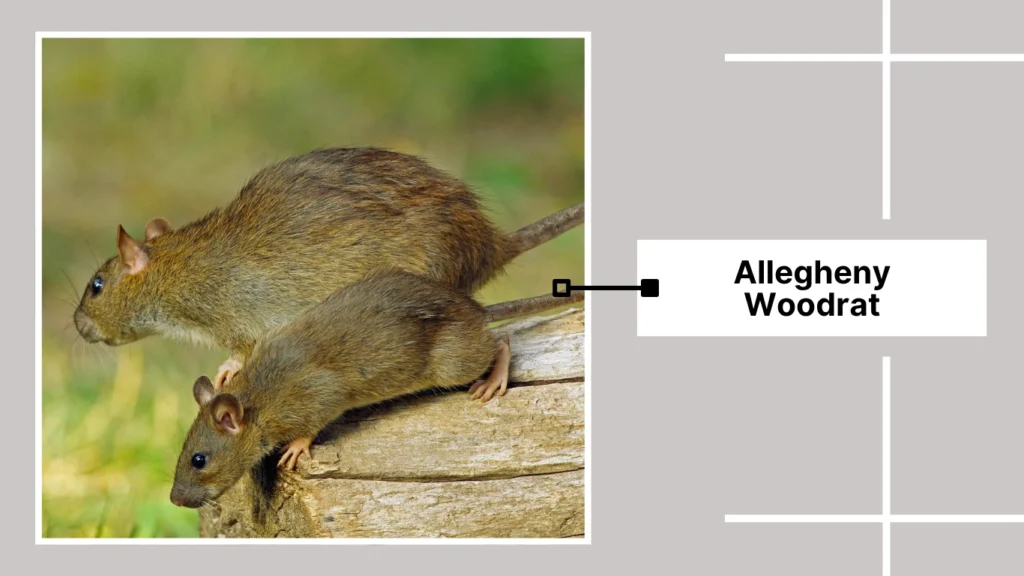
The Allegheny woodrat (Neotoma magister) is a rare and declining species of pack rat native to the Appalachian Mountains. It is closely related to the eastern woodrat but prefers rocky, forested terrain.
Identification
- Color: Brownish-gray fur with a white belly and throat
- Size: Body length 7–8 inches (18–20 cm); tail 6–7 inches (15–18 cm)
- Weight: 200–250 grams
- Tail: Furry and bicolored
- Ears: Large and lightly furred
- Eyes: Large and dark
Habitat and Distribution
Found in the Appalachian and Allegheny mountain ranges, particularly in rocky cliffs, caves, boulder fields, and talus slopes. Its range includes parts of Pennsylvania, West Virginia, Virginia, Tennessee, and Kentucky.
Behavior and Diet
Allegheny woodrats are herbivorous and feed on seeds, fruits, fungi, leaves, and nuts. Like other woodrats, they build extensive nests or “middens” made of sticks, leaves, and other collected items. They are solitary, nocturnal, and sensitive to environmental changes and human disturbance.
7. Cotton Rat

The cotton rat (Sigmodon hispidus) is a stout-bodied rodent commonly found in the southeastern U.S. and parts of Central America. It is named for its habit of nesting in cotton fields and similar grassy environments.
Identification
- Color: Coarse, dark brown to gray fur with a lighter belly
- Size: Body length 5–7 inches (13–18 cm); tail 3–5 inches (8–13 cm)
- Weight: 100–225 grams
- Build: Heavier and chunkier than typical rats
- Tail: Scaly and shorter than the body
Habitat and Distribution
Native to the southeastern U.S., Mexico, and parts of Central America. It thrives in overgrown fields, pastures, brushy roadsides, and agricultural areas—especially near crops like corn and cotton.
Behavior and Diet
Cotton rats are primarily herbivores, feeding on grasses, seeds, stems, and agricultural crops. They are active day and night, build nests in dense vegetation, and are known for their high reproductive rates. Cotton rats are prey for many predators, including hawks, snakes, and foxes.
8. Bush Rat

The bush rat (Rattus fuscipes) is a native rodent species found in Australia. Unlike invasive rat species, bush rats are an important part of the local ecosystem and are generally shy and nocturnal.
Identification
- Color: Brown to grayish-brown fur with a creamy or gray belly
- Size: Body length 5–7 inches (13–18 cm); tail about the same length or slightly shorter
- Weight: 100–225 grams
- Tail: Furred and darker on top, lighter underneath
- Ears: Small and rounded
- Build: Compact and soft-furred
Habitat and Distribution
Commonly found along the eastern and southeastern coasts of Australia, particularly in forests, heathlands, and woodland areas with dense ground cover.
Behavior and Diet
Bush rats are omnivorous, feeding on seeds, insects, fungi, and fruit. They nest in burrows or under logs and leaf litter. Unlike invasive rats, they rarely interact with human settlements. They are shy, ground-dwelling, and an essential prey species for native predators.
9. Australian Swamp Rat

The Australian swamp rat (Rattus lutreolus) is a small, thick-furred rodent native to eastern and southeastern Australia. It prefers wet, swampy habitats and thick grasslands, where it can hide from predators.
Identification
- Color: Dark brown to black fur with yellowish underfur
- Size: Body length 4.5–6 inches (11–15 cm); tail shorter than body
- Weight: 60–150 grams
- Tail: Short, thick, and scaly
- Nose: Blunt with short whiskers
- Legs: Short and powerful
Habitat and Distribution
Found in coastal wetlands, swamps, reed beds, heathlands, and moist grasslands across southeastern Australia and Tasmania.
Behavior and Diet
They feed on grasses, reeds, seeds, roots, and occasionally insects. Swamp rats are active mostly at night and spend much of their time in dense vegetation. They create tunnels and runways through thick grasses and are strong swimmers when needed.
10. Bandicoot Rat
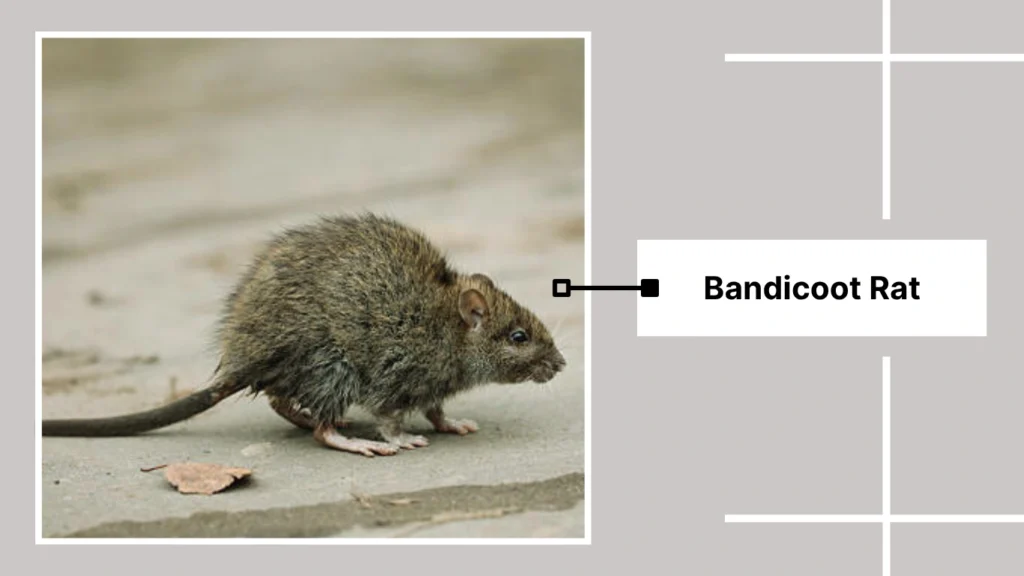
The bandicoot rat refers to several species in the Bandicota genus, notably the greater bandicoot rat and lesser bandicoot rat. These large, aggressive rodents are common in South and Southeast Asia and are considered serious urban and agricultural pests.
Identification
- Color: Coarse, dark brown to blackish fur
- Size: Body length 10–14 inches (25–35 cm); tail nearly as long
- Weight: 300–900 grams (can exceed 1 kg in some cases)
- Tail: Scaly and thick
- Head: Large with strong jaws and prominent teeth
- Build: Stocky, muscular, and powerful
Habitat and Distribution
Found in India, Bangladesh, Sri Lanka, Myanmar, and parts of Southeast Asia. Commonly inhabit rice paddies, drains, garbage heaps, and sewers—especially in urban slums and rural fields.
Behavior and Diet
Omnivorous, feeding on grains, vegetables, meat scraps, and insects. Bandicoot rats are nocturnal and known for their aggressive behavior and destructive burrowing habits. Their strong teeth can damage concrete, and they often pose health risks due to disease transmission.
11. Himalayan Field Rat
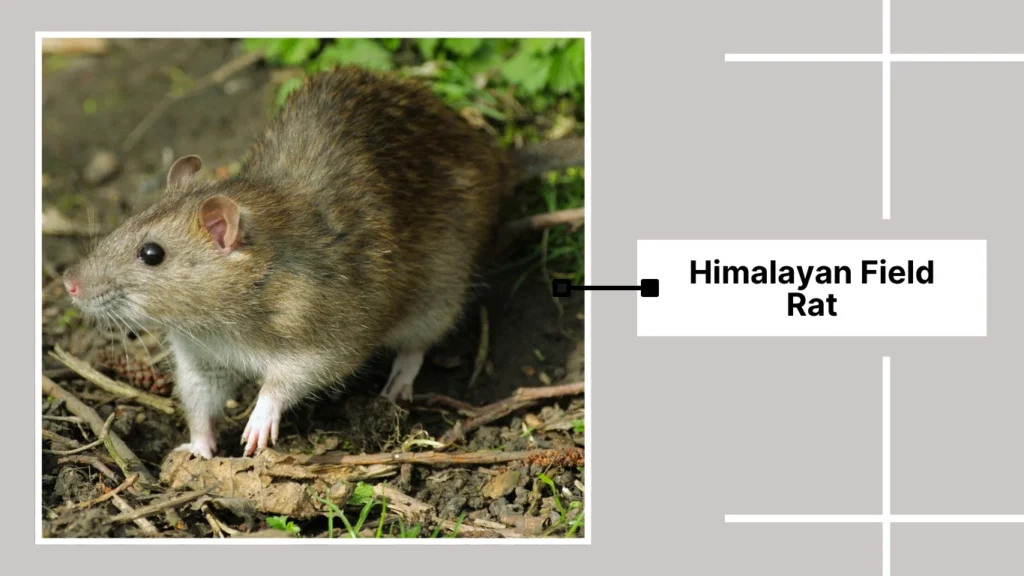
The Himalayan field rat (Rattus nitidus) is a mid-sized rodent species found in mountainous and forested regions of South and Southeast Asia. It is primarily a field and forest dweller and not commonly associated with human settlements.
Identification
- Color: Glossy dark brown back with a paler, grayish underside
- Size: Body length 6–8 inches (15–20 cm); tail slightly shorter
- Weight: Around 150–250 grams
- Tail: Scaly and bicolored
- Ears: Medium-sized and rounded
- Snout: Pointed
Habitat and Distribution
Occurs in the Himalayan foothills, northeastern India, Nepal, Bhutan, and parts of Myanmar and southern China. Prefers grassy fields, forest edges, and cultivated lands at higher elevations.
Behavior and Diet
Omnivorous—feeds on grains, fruits, roots, and insects. It is mostly nocturnal, shy, and builds nests in underground burrows or under dense vegetation. Though not a major pest, it can damage crops in rural areas.
12. Asian House Rat

The Asian house rat (Rattus tanezumi) is a common rodent species in Asia, often mistaken for the black rat due to its similar appearance. It is highly adaptable and thrives in both urban and rural environments.
Identification
- Color: Brownish or blackish-gray upper fur with a lighter belly
- Size: Body length 6–8 inches (15–20 cm); tail longer than the body
- Weight: 120–200 grams
- Tail: Long, scaly, and thin
- Ears: Prominent and rounded
- Build: Slender and agile
Habitat and Distribution
Widespread throughout South and Southeast Asia, including India, Thailand, Indonesia, and China. Found in homes, warehouses, agricultural areas, and forests.
Behavior and Diet
Omnivorous, eating cereals, grains, fruits, insects, and garbage. These rats are excellent climbers and often nest in attics, roofs, or trees. They are nocturnal, social, and reproduce rapidly, contributing to their status as pests in many regions.
13. Lesser Bandicoot Rat
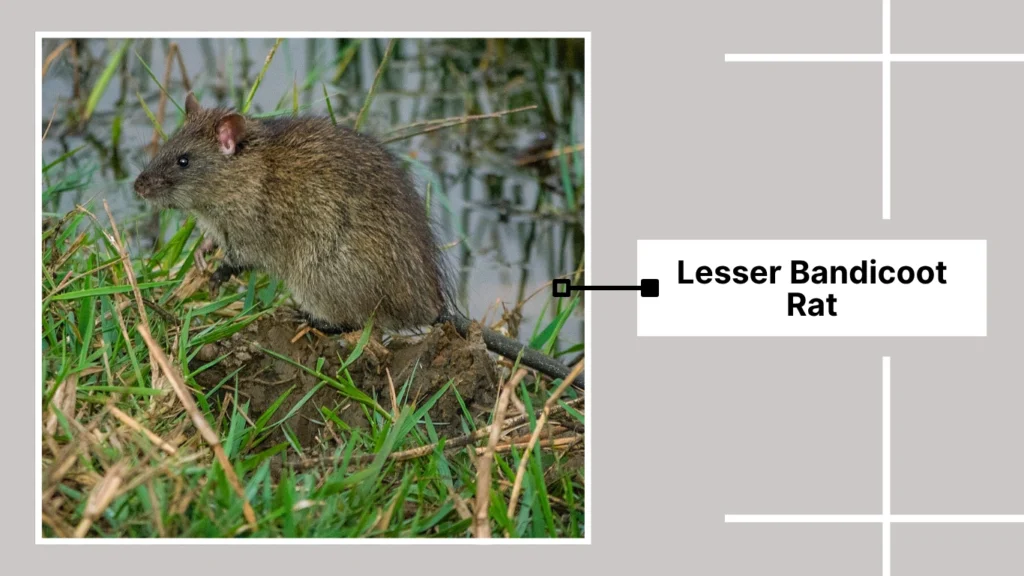
The lesser bandicoot rat (Bandicota bengalensis) is a notorious pest in South Asia, particularly in India and Bangladesh. It is smaller than the greater bandicoot rat but equally destructive in agriculture and urban areas.
Identification
- Color: Dark grayish-brown fur with a whitish belly
- Size: Body length 8–10 inches (20–25 cm); tail shorter than body
- Weight: 250–500 grams
- Tail: Thick, scaly, and sparsely furred
- Head: Broad with strong incisors
- Build: Sturdy and muscular
Habitat and Distribution
Native to India, Bangladesh, Nepal, and parts of Southeast Asia. Found in fields, gardens, garbage dumps, and beneath buildings—especially in areas with poor sanitation.
Behavior and Diet
Primarily nocturnal and omnivorous. Feeds on rice, grains, fruits, vegetables, meat scraps, and insects. It digs deep, complex burrow systems and is known for being aggressive when cornered. It poses a significant threat to crops and stored food supplies.
14. Greater Bandicoot Rat

The greater bandicoot rat (Bandicota indica) is one of the largest rat species found in Asia. Known for its aggressive nature and destructive feeding habits, it is a major urban pest, especially in Southeast Asia.
Identification
- Color: Dark brown to blackish with coarse fur and a lighter belly
- Size: Body length 10–14 inches (25–35 cm); tail nearly equal in length
- Weight: 500–900 grams, sometimes exceeding 1 kg
- Tail: Thick, scaly, and almost hairless
- Head: Large with powerful jaws and sharp incisors
- Build: Heavy-bodied and muscular
Habitat and Distribution
Widespread across India, Bangladesh, Sri Lanka, and Southeast Asia. Commonly found in cities, villages, garbage sites, sewers, and agricultural lands.
Behavior and Diet
Omnivorous—feeds on grains, household scraps, fruits, and insects. It digs deep tunnels and burrows, often causing damage to foundations, irrigation systems, and crops. It is aggressive when threatened and capable of spreading diseases like leptospirosis.
15. Pacific Rat

The Pacific rat (Rattus exulans), also known as the kiore in New Zealand, is a small rat species that spread across the Pacific with Polynesian explorers. It plays a major role in the ecology and history of island ecosystems.
Identification
- Color: Brownish upper fur with a gray or cream-colored belly
- Size: Body length 4–6 inches (10–15 cm); tail roughly the same length
- Weight: 40–80 grams
- Tail: Slender, scaly, and sparsely haired
- Ears: Moderately large and rounded
- Build: Small and lightweight
Habitat and Distribution
Once widespread across Pacific islands including New Zealand, Hawaii, and parts of Micronesia and Melanesia. Commonly inhabits forests, coastal areas, and near human dwellings.
Behavior and Diet
Omnivorous—eats seeds, fruits, insects, and small animals. It often contributes to the decline of native bird species by preying on eggs and chicks. The Pacific rat nests in burrows, under vegetation, or in thatched roofs, and is primarily nocturnal.
16. African Giant Pouched Rat

The African giant pouched rat (Cricetomys ansorgei and Cricetomys gambianus) is a large, intelligent rodent known for its excellent sense of smell. These rats are even trained to detect landmines and tuberculosis.
Identification
- Color: Gray to brownish-gray back with a lighter underside
- Size: Body length 12–17 inches (30–43 cm); tail 14–18 inches (35–46 cm)
- Weight: 1.0–1.5 kg (2.2–3.3 lbs)
- Tail: Long, scaly, and white-tipped
- Cheek Pouches: Large, used to carry food
- Build: Slender but large, with long limbs
Habitat and Distribution
Found across sub-Saharan Africa in savannas, forests, and near farmlands. Adaptable to both wild and semi-urban settings.
Behavior and Diet
Omnivorous—feeds on fruits, seeds, insects, and small animals. Known for storing food in underground caches. They are nocturnal, solitary, and curious. These rats are famously used in humanitarian work by organizations like APOPO.
17. Gambian Pouched Rat

The Gambian pouched rat (Cricetomys gambianus), often considered part of the African giant pouched rat group, is one of the largest rodents in the world. It is known for its cheek pouches and ability to adapt to captivity.
Identification
- Color: Brownish-gray with a white belly
- Size: Body length 12–16 inches (30–40 cm); tail equally long
- Weight: 1.2–1.5 kg (2.6–3.3 lbs)
- Tail: Long, thick, and white-tipped
- Ears: Large and prominent
- Cheek Pouches: Deep and expandable
Habitat and Distribution
Native to central and western Africa. It inhabits forests, woodlands, agricultural lands, and sometimes urban areas.
Behavior and Diet
Gambian pouched rats are omnivores, eating fruits, vegetables, insects, and small animals. They are nocturnal, intelligent, and often kept in research settings or trained for detection tasks. Due to their size and reproductive ability, they are considered invasive when introduced outside their native range.
18. Nile Rat

The Nile rat (Arvicanthis niloticus), also known as the African grass rat, is a diurnal rodent commonly found across parts of Africa. It is often studied for its link to diabetes when kept on a high-sugar diet in captivity.
Identification
- Color: Grizzled brown or grayish fur with lighter underparts
- Size: Body length 5–7 inches (13–18 cm); tail shorter than the body
- Weight: 100–200 grams
- Tail: Furred at base, becoming scaly toward the tip
- Head: Rounded with a short snout
- Eyes: Large and dark
Habitat and Distribution
Found throughout northeastern and sub-Saharan Africa, especially near water sources, grasslands, agricultural fields, and savanna environments.
Behavior and Diet
Diurnal and herbivorous—feeds on seeds, leaves, and crops such as sugarcane and maize. Active during the day and often forms small family groups. Known for its destructive potential in farmlands, especially near irrigation channels.
19. Turkestan Rat

The Turkestan rat (Rattus turkestanicus) is a lesser-known species found mainly in Central Asia. It’s closely related to other Rattus species but has distinct ecological preferences and regional importance.
Identification
- Color: Grayish-brown back with a pale or gray-white belly
- Size: Body length 6–8 inches (15–20 cm); tail roughly equal to or slightly longer than the body
- Weight: 150–250 grams
- Tail: Long, scaly, and thin
- Snout: Pointed with small whiskers
- Ears: Rounded and moderately sized
Habitat and Distribution
Occurs in arid and semi-arid zones across Kazakhstan, Uzbekistan, Turkmenistan, and adjacent areas. Found in rural farmlands, foothills, and dry steppe regions.
Behavior and Diet
Omnivorous—feeds on seeds, roots, crops, and insects. It is nocturnal and tends to avoid human habitations compared to the brown or black rat. Less aggressive and more elusive, this species survives well in harsher environments with limited food sources.
20. Forest Rat

The forest rat refers to multiple rodent species that inhabit wooded areas, but most notably includes Rattus rattus frugivorus, a subspecies of the black rat adapted to life in tropical forests.
Identification
- Color: Dark brown or black with a grayish belly
- Size: Body length 6–8 inches (15–20 cm); tail longer than body
- Weight: Around 150–200 grams
- Tail: Long, thin, and scaly
- Build: Slender and agile
- Ears: Large and prominent
Habitat and Distribution
Found primarily in forested regions of Southeast Asia, parts of Africa, and South America. Prefers canopies, tree hollows, and dense undergrowth.
Behavior and Diet
Arboreal and nocturnal, the forest rat feeds on fruits, seeds, insects, and bird eggs. It is excellent at climbing and often avoids ground-level predators by nesting in trees or shrubs. These rats are shy and solitary.
21. Philippine Forest Rat

The Philippine forest rat (Rattus everetti) is an endemic species to the Philippines and plays an important ecological role in seed dispersion and forest health.
Identification
- Color: Reddish-brown or chestnut fur with a pale belly
- Size: Body length 6–9 inches (15–23 cm); tail length similar or slightly shorter
- Weight: 120–250 grams
- Tail: Dark, thin, and covered in short hairs
- Snout: Pointed with long whiskers
Habitat and Distribution
Restricted to the Philippines, this rat lives in lowland and montane forests, including undisturbed and secondary growth areas.
Behavior and Diet
Primarily frugivorous but also consumes seeds and insects. Nocturnal and often ground-dwelling, it builds nests in leaf litter, root systems, or fallen logs. Unlike invasive rats, the Philippine forest rat contributes positively to forest ecosystems and is not considered a pest.
22. Mountain Rat
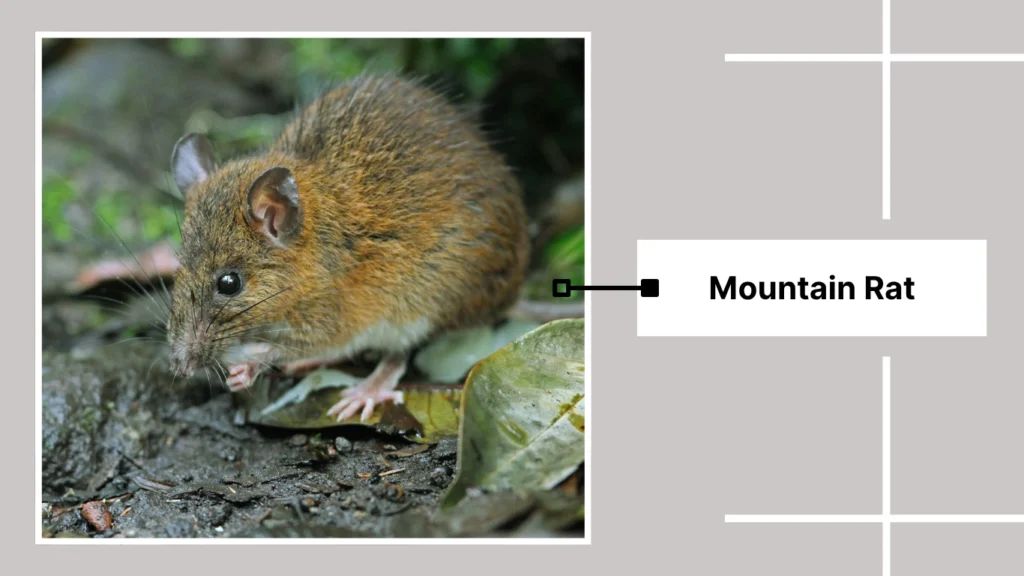
The mountain rat typically refers to various high-altitude species, including Rattus montanus, which inhabits the mountainous regions of Southeast Asia. These rats are adapted to cooler temperatures and rugged terrain.
Identification
- Color: Grayish-brown to dark brown with a lighter underbelly
- Size: Body length 5–7 inches (13–18 cm); tail slightly shorter
- Weight: 120–180 grams
- Tail: Scaly and sparsely furred
- Fur: Dense and thick to withstand cooler climates
- Head: Small with a narrow snout
Habitat and Distribution
Found in forested highlands and mountainous areas in countries like Indonesia, Malaysia, and the Philippines. They live under rocks, in tree roots, or forest floors.
Behavior and Diet
Omnivorous—feeding on berries, seeds, small invertebrates, and roots. Mountain rats are shy, nocturnal, and play a role in forest seed dispersal. Their limited distribution makes them less likely to interact with human habitats.
23. Climbing Rat

Climbing rats belong to several genera, including Tylomys and Rhipidomys, and are native to Central and South America. They are arboreal rodents with excellent climbing skills.
Identification
- Color: Varies by species—typically brown or gray with a white or buff belly
- Size: Body length 6–9 inches (15–23 cm); tail equal to or longer than the body
- Weight: 120–250 grams
- Tail: Long, often furred, and used for balance
- Limbs: Strong with curved claws for gripping
Habitat and Distribution
Inhabit tropical forests, woodlands, and highlands across Mexico, Central America, and parts of South America. They are usually found in tree canopies or forest undergrowth.
Behavior and Diet
Omnivorous—eat fruits, seeds, insects, and sometimes bird eggs. These rats are nocturnal and arboreal, often nesting in hollow trees or dense foliage. Their behaviors help control insect populations and disperse seeds, making them ecologically valuable.
24. Upland Rice Rat

The upland rice rat (Oryzomys couesi) is a rodent species found near freshwater sources in Central America and parts of Mexico. As its name suggests, it is commonly associated with rice fields and wetlands.
Identification
- Color: Brown to reddish-brown upperparts with a grayish or whitish underside
- Size: Body length 5–7 inches (13–18 cm); tail about the same length or slightly longer
- Weight: 100–180 grams
- Tail: Bicolored and sparsely furred
- Head: Slender with a pointed snout
- Ears: Small and rounded
Habitat and Distribution
Native to Mexico, Guatemala, Honduras, Nicaragua, and other parts of Central America. Found in marshes, swamps, wetlands, and agricultural fields, especially rice paddies.
Behavior and Diet
Semi-aquatic and nocturnal, this rat feeds on seeds, stems, grains, small insects, and aquatic vegetation. It is an excellent swimmer and builds nests in dense vegetation. Though it can occasionally damage crops, it’s less invasive than urban rats.
25. Indian Bush Rat

The Indian bush rat (Golunda ellioti) is a small rodent native to the Indian subcontinent. It is not as widespread or well-known as urban rat species but plays a role in local ecosystems and agriculture.
Identification
- Color: Yellowish-brown fur with black speckling and a lighter underbelly
- Size: Body length 4–6 inches (10–15 cm); tail slightly shorter than body
- Weight: 60–100 grams
- Tail: Hairy, not scaly, and relatively short
- Build: Compact with short limbs and a rounded head
Habitat and Distribution
Found throughout India, Pakistan, Nepal, and Sri Lanka. Inhabits grasslands, scrub forests, farmlands, and sometimes human dwellings in rural areas.
Behavior and Diet
Mainly herbivorous—feeds on seeds, grains, roots, and some insects. This rat is nocturnal, often burrows underground, and can become a minor crop pest. It tends to avoid cities and large human settlements, favoring wild or semi-rural zones.
26. Rice-field Rat

The rice-field rat (Rattus argentiventer) is a highly adaptable rodent found throughout Southeast Asia. It is one of the most common rat species in rice-producing regions and can become a serious agricultural pest.
Identification
- Color: Brownish-gray back with a silvery-gray underside
- Size: Body length 6–8 inches (15–20 cm); tail slightly shorter than the body
- Weight: 120–250 grams
- Tail: Scaly, bicolored, and sparsely furred
- Ears: Medium-sized and rounded
- Snout: Narrow and pointed
Habitat and Distribution
Widespread in Indonesia, Vietnam, Thailand, Cambodia, and other parts of Southeast Asia. Prefers rice fields, farmlands, grassy plains, and wetlands.
Behavior and Diet
Primarily herbivorous—feeds on rice, grains, vegetables, and fruits. It nests in burrows or grassy mounds and is active mostly at night. Due to its population booms during harvest, it can cause massive crop damage.
27. Himalayan Rat

The Himalayan rat (Rattus pyctoris) is a rodent species that thrives in mountainous and subalpine environments. It is well-adapted to cold conditions and rugged terrain.
Identification
- Color: Grayish-brown upperparts with a pale or whitish underside
- Size: Body length 6–7 inches (15–18 cm); tail slightly shorter
- Weight: Around 120–180 grams
- Tail: Scaly and moderately thick
- Fur: Dense and soft to withstand colder climates
- Build: Compact with short legs and large eyes
Habitat and Distribution
Native to the Himalayas and nearby highlands in Nepal, northern India, Bhutan, and parts of western China. Lives in rocky outcrops, forests, and shrubby alpine slopes.
Behavior and Diet
Omnivorous—feeds on roots, seeds, grasses, and insects. Mostly nocturnal and ground-dwelling, it nests in burrows or among rocks. The Himalayan rat is elusive and rarely comes into contact with human settlements.
28. Long-Tailed Giant Rat
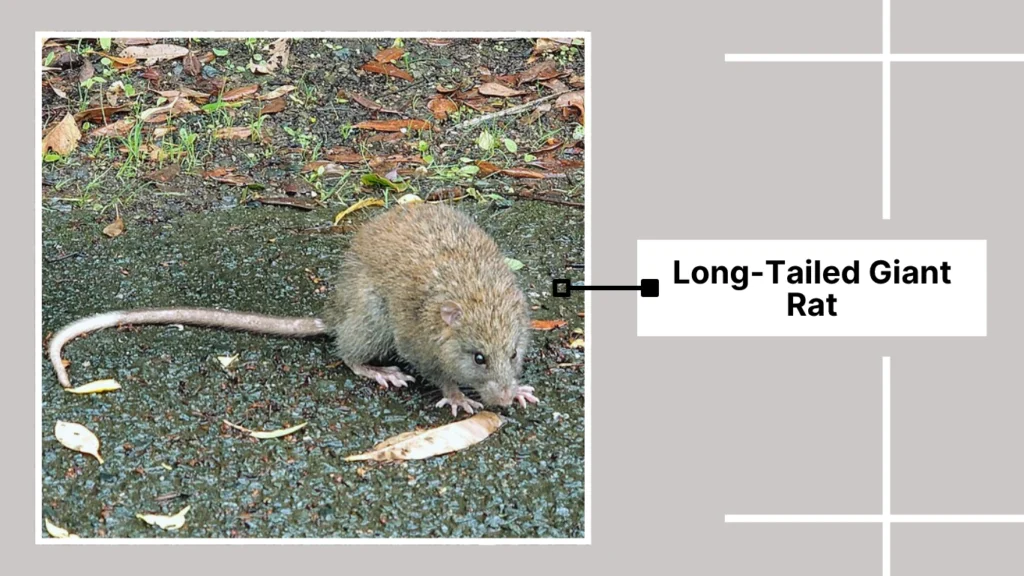
The long-tailed giant rat (Leopoldamys sabanus) is a large and arboreal rodent native to Southeast Asia. It is known for its exceptional climbing skills and long, slender tail used for balance in forest canopies.
Identification
- Color: Reddish-brown to dark brown back with a grayish-white belly
- Size: Body length 8–12 inches (20–30 cm); tail up to 14 inches (35 cm)
- Weight: 200–400 grams
- Tail: Very long, nearly hairless, and dark in color
- Head: Narrow with long whiskers
- Ears: Prominent and rounded
Habitat and Distribution
Found in Malaysia, Indonesia, Thailand, and other parts of Southeast Asia. Inhabits tropical rainforests, especially in undisturbed or mature forest regions.
Behavior and Diet
Nocturnal and omnivorous—feeds on fruits, seeds, insects, and occasionally small vertebrates. It nests in tree hollows or dense vegetation and rarely descends to the ground. This rat plays an important ecological role in seed dispersal.
29. Sikkim Rat

The Sikkim rat (Rattus andamanensis) is a lesser-known species found in the eastern Himalayan region. It is closely related to other Rattus species but has a more limited distribution.
Identification
- Color: Brownish or yellow-brown fur with a lighter belly
- Size: Body length 6–8 inches (15–20 cm); tail slightly shorter or equal to body length
- Weight: Around 150–200 grams
- Tail: Dark, thin, and sparsely haired
- Snout: Pointed
- Fur: Soft and fine
Habitat and Distribution
Native to northeastern India, Bhutan, parts of Nepal, and southern China. Prefers subtropical and temperate forests, especially near streams or undergrowth.
Behavior and Diet
Primarily nocturnal and omnivorous, feeding on seeds, fruits, roots, and insects. Builds nests in ground burrows, under logs, or in rock crevices. It is rarely found near human habitation and plays a quiet but important role in forest ecosystems.
30. Lesser Rice-Field Rat

The lesser rice-field rat (Rattus losea) is a medium-sized rodent species commonly found in Southeast Asia. It is often seen in agricultural landscapes, especially rice fields, and can become a local crop pest.
Identification
- Color: Brownish-gray back with a whitish or light gray underside
- Size: Body length 5–7 inches (13–18 cm); tail slightly shorter
- Weight: 100–180 grams
- Tail: Scaly, bicolored, and slightly hairy
- Snout: Blunt with short whiskers
- Ears: Rounded and short
Habitat and Distribution
Native to Vietnam, Taiwan, southern China, Laos, and Cambodia. Typically found in rice paddies, grassy fields, dikes, and sometimes near human dwellings in rural areas.
Behavior and Diet
Omnivorous—feeds on rice grains, seeds, stems, and small invertebrates. Nocturnal and burrowing, it creates shallow tunnels in rice fields and nests in grass or field margins. Reproduces quickly and may cause seasonal crop damage.
31. Tanezumi Rat (Asian Roof Rat)

The Tanezumi rat (Rattus tanezumi) is a close relative of the black rat and is often called the Asian roof rat. It thrives in urban and semi-urban environments and is highly adaptable.
Identification
- Color: Dark brown to blackish upperparts with a gray or pale belly
- Size: Body length 6–9 inches (15–23 cm); tail longer than the body
- Weight: 120–250 grams
- Tail: Long, thin, and scaly
- Build: Slender and light-footed
- Ears: Large and prominent
Habitat and Distribution
Widespread in Southeast Asia, India, China, and parts of Oceania. Commonly found in houses, roofs, warehouses, markets, and urban parks.
Behavior and Diet
Omnivorous and nocturnal—feeds on rice, grains, fruits, insects, and leftovers. It’s a skilled climber and nests in ceilings, attics, and tree canopies. Known to carry diseases and considered a serious urban pest.