

The black and yellow garden spider (Argiope aurantia) is one of the most recognizable orb-weaving spiders found in gardens across North America. Its striking coloration and large web often make people curious—or nervous—about its size. Understanding how big this spider actually gets helps with identification and reduces unnecessary fear. In this guide, we’ll explore the true size of the black and yellow garden spider, including differences between males and females and how their size changes over time.
What Is a Black and Yellow Garden Spider?
The black and yellow garden spider belongs to the orb-weaver family, known for building large, circular webs. Its scientific name is Argiope aurantia, and it’s commonly referred to as the writing spider, corn spider, or zipper spider—names inspired by the zigzag pattern in its web.
These spiders are commonly found in gardens, fields, and areas with tall vegetation. They play an important role in controlling insect populations, making them beneficial despite their intimidating appearance.
Black and Yellow Garden Spider Size
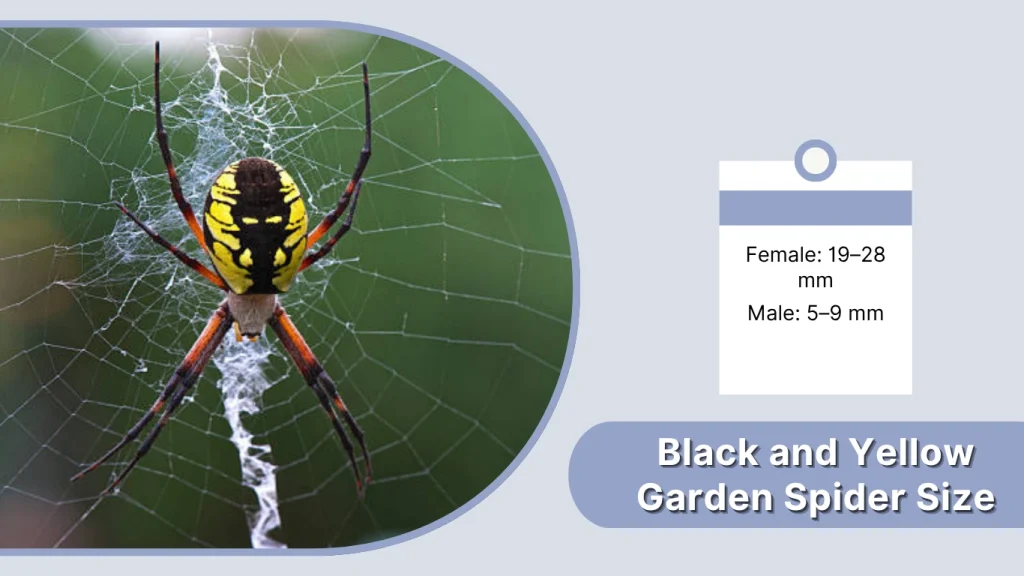
Average Size of Females
Female black and yellow garden spiders are significantly larger and more noticeable than males. Their body length typically ranges between 19 to 28 millimeters (about 0.75 to 1.1 inches). However, when you include their long legs, their total leg span can reach up to 2.5 to 3 inches.
Because of their size and bright coloration, females are often the spiders people spot hanging in the center of large webs. A fully grown female can appear about the size of a human thumb or even larger when legs are spread out.
Average Size of Males
Male black and yellow garden spiders are much smaller and often go unnoticed. Their body length usually measures only 5 to 9 millimeters, making them less than half—or even a third—the size of females.
Their smaller size also means a shorter leg span, and they tend to stay near the edges of the female’s web rather than in the center. This dramatic size difference between males and females is a classic example of sexual dimorphism in spiders.
Size Comparison Overview
| Type | Body Length | Leg Span | Visibility |
| Female | 19–28 mm | Up to ~3 inches | Very noticeable |
| Male | 5–9 mm | Much smaller | Often overlooked |
Why Are Females Larger Than Males?
The large size difference between male and female black and yellow garden spiders is not random—it serves a biological purpose.
Sexual Dimorphism Explained
Female spiders need larger bodies to produce and carry eggs. A bigger size allows them to store more nutrients and support reproduction. In contrast, males prioritize mobility over size. Being smaller helps them move quickly and avoid predators while searching for females.
Behavioral Differences
Females are responsible for building and maintaining webs, which requires strength and energy. Their larger size helps them capture bigger prey and sustain themselves. Males, on the other hand, rarely build webs and focus mainly on mating, so they don’t need the same physical size.
Growth Stages and Size Changes
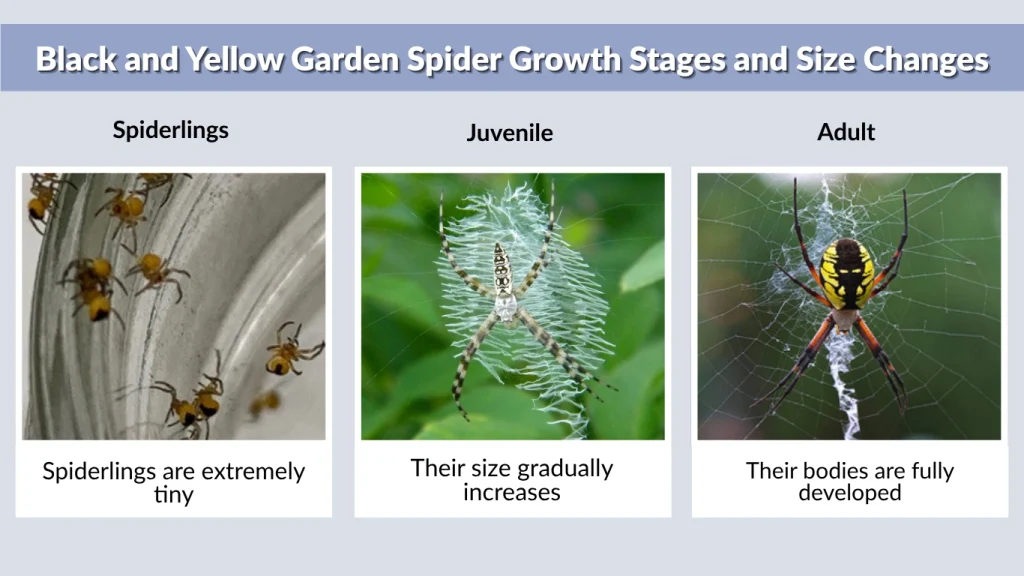
The size of a black and yellow garden spider changes significantly throughout its life cycle.
Spiderlings (Baby Spiders)
When they first hatch, spiderlings are extremely tiny—often barely visible to the naked eye. They disperse by releasing silk threads into the air, a process known as “ballooning.”
Juvenile Stage
As they grow, these spiders go through multiple molts, shedding their exoskeleton to increase in size. During this stage, their size gradually increases, but they still remain relatively small compared to adults.
Adult Size Development
By late summer, black and yellow garden spiders reach their full size. This is when females become most visible, often sitting in large webs. Their bodies are fully developed, and their size peaks during this period.
How Big Do Their Webs Get?
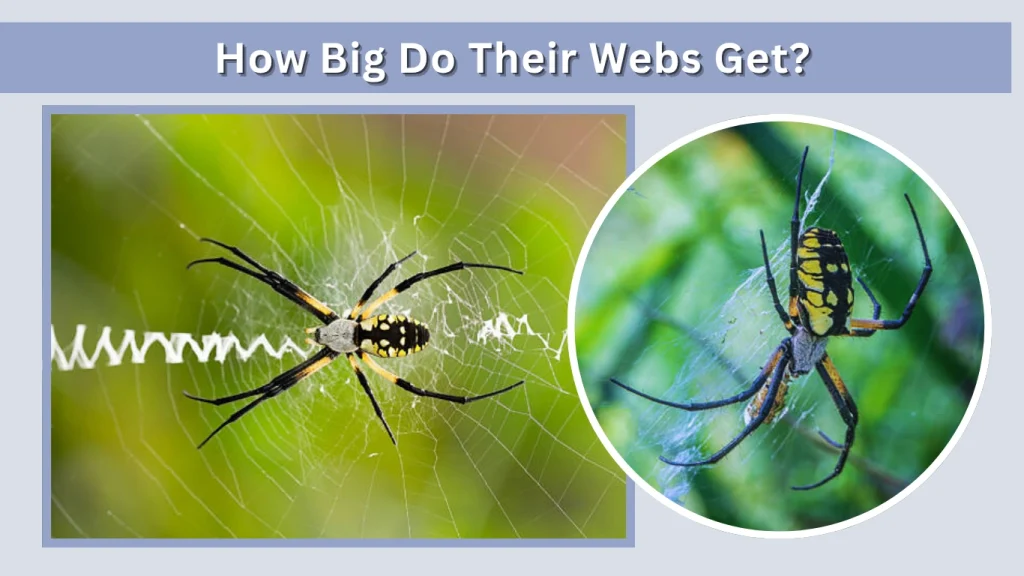
The size of the spider is closely related to the size of its web.
Web Diameter
A typical black and yellow garden spider web can measure 1 to 2 feet in diameter, making it one of the largest webs commonly found in gardens.
Size and Web Relationship
Larger female spiders tend to build bigger and stronger webs. These webs are designed to catch flying insects such as flies, grasshoppers, and beetles. The spider’s size allows it to handle larger prey and maintain a more extensive web structure.
Comparison With Other Garden Spiders
Understanding how the black and yellow garden spider compares in size to other common spiders can provide useful context.
Compared to Orb-Weavers
While many orb-weavers build similar webs, Argiope aurantia is often larger and more visually striking than most species.
Compared to Wolf Spiders
Wolf spiders may have bulkier bodies, but they typically have shorter leg spans and do not build webs, making them appear less expansive.
Compared to Jumping Spiders
Jumping spiders are much smaller overall, usually only a fraction of the size of a female black and yellow garden spider.
Does Their Size Make Them Dangerous?
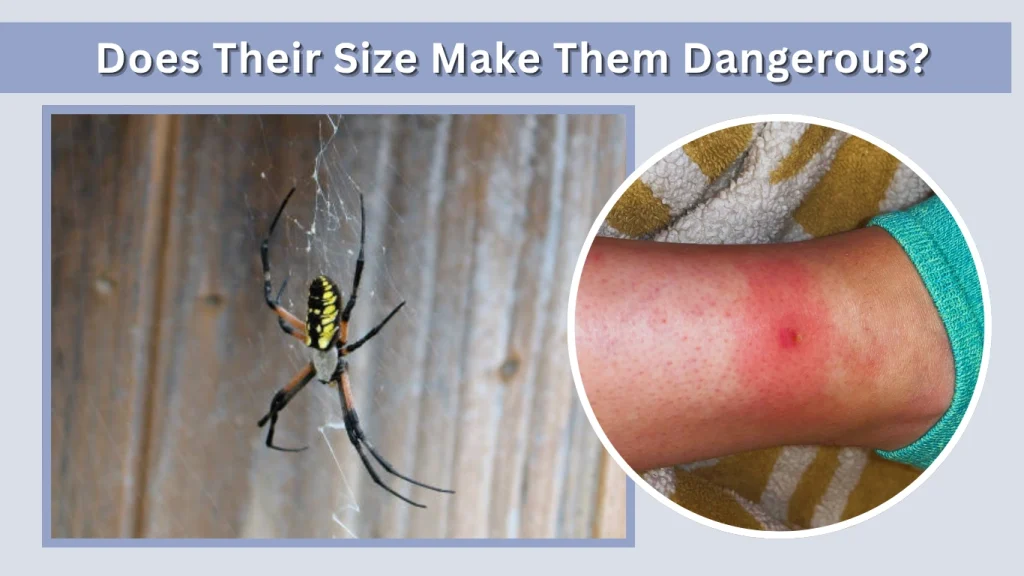
Despite their large size and bold appearance, black and yellow garden spiders are not dangerous to humans.
Bite Potential
These spiders are generally non-aggressive and will only bite if directly threatened or handled. Even in rare cases where a bite occurs, it is usually mild and comparable to a bee sting.
Venom Strength
Their venom is designed to immobilize insects, not harm humans. For most people, it causes little to no reaction beyond minor redness or swelling.
Common Misconceptions
Many people assume that a larger spider is more dangerous, but this is not true. The size of the black and yellow garden spider helps with capturing prey—not with posing a threat to humans.
Factors That Affect Their Size
Not all black and yellow garden spiders grow to the same size. Several factors influence how large they can become.
Diet and Food Availability
Spiders that have access to abundant food sources—such as flies, grasshoppers, and beetles—tend to grow larger. A well-fed spider can reach the upper end of the typical size range.
Environment and Climate
Warmer climates often support faster growth and larger sizes. In regions with longer summers, spiders have more time to develop and reach full maturity.
Genetics
Like most animals, genetics also play a role. Some individuals are naturally predisposed to grow larger or smaller than average.
Seasonal Size Changes
The size of black and yellow garden spiders varies depending on the time of year.
Spring vs Summer
In spring, these spiders are still small and developing. They may be difficult to notice at this stage.
Peak Size in Late Summer and Fall
By late summer, they reach their full adult size. This is when they are most visible, often sitting in large webs during the day. Early fall is typically when females are at their largest.
Visual Identification Tips Based on Size
Size is one of the easiest ways to identify a black and yellow garden spider in the wild.
- Large spider in the center of a web → likely a female
- Small spider near the edge of the web → likely a male
- Wide, circular web (1–2 feet) → strong indicator of this species
Females are much easier to spot due to their size and bright black-and-yellow markings, while males can be easily overlooked.
FAQs
How big is a black and yellow garden spider compared to a human hand?
A fully grown female can have a leg span of up to 3 inches, making it roughly the size of a human palm when its legs are extended.
Are females always bigger than males?
Yes, females are consistently much larger than males. This size difference is a natural biological trait in many spider species.
What is the largest recorded size?
While most females stay within the typical range, some may appear slightly larger depending on diet and environment, with leg spans reaching or slightly exceeding 3 inches.
Do they grow bigger every year?
No. Black and yellow garden spiders have a one-year life cycle. They hatch, grow, reproduce, and die within a single season.
Key Takeaways
- Female black and yellow garden spiders are much larger than males
- Their body length can reach up to about 1 inch, with a leg span of around 3 inches
- Size differences are due to reproduction and survival roles
- Larger size does not mean greater danger to humans
Conclusion
The black and yellow garden spider may look intimidating due to its size, but it is a harmless and beneficial creature in your garden. Females can grow impressively large, especially when compared to males, making them one of the more noticeable spiders in outdoor spaces. Understanding their true size—and what it means—can help replace fear with appreciation for their role in controlling pests and maintaining ecological balance.